1What is the current size of the NBR latex market?
The global NBR latex market is valued at USD 2.74 billion in 2026 and is projected to reach USD 4.61 billion by 2035, growing at a CAGR of 5.98%.
Insight Market Data is a premier market research and business consulting firm headquartered in Pune, India, providing syndicated research reports, customized intelligence studies, and strategic advisory services. Renowned academic institutions and Fortune 500 corporations worldwide rely on Insight Market Data's research repository to navigate evolving global and regional business environments. Covering 46 diverse industries across 25 major international economies, our comprehensive database delivers thousands of verified statistics and granular market evaluations. By combining industry-leading analytical methodologies with the direct insights of seasoned industry leaders and subject-matter experts, we deliver actionable intelligence spanning historical performance benchmarks to rigorous multi-year forecasts. We empower organizations to make confident, data-driven decisions across pivotal domains including Machinery & Equipment, Chemicals & Materials, Pharmaceuticals & Healthcare, Food & Beverages, Consumer Goods, Energy & Power, Automotive & Transportation, Electronics & Semiconductors, Medical Devices, Telecommunications, Emerging Technologies, Agriculture, and Packaging. Our multidisciplinary analyst teams provide an objective 360-degree perspective, tailoring every engagement to address complex strategic challenges with exceptional analytical rigor.
Leveraging advanced BI-powered analytics and predictive modeling, Insight Market Data uncovers high-impact market opportunities and competitive differentiators for ambitious enterprises. We continuously refine our research methodologies in accordance with global industry standards, tracking real-time market shifts to ensure our reports are consistently accurate, actionable, and delivered on schedule. Our analysts conduct methodical data validation, rigorous compliance checks, and exhaustive primary and secondary research to maintain the highest levels of data integrity and transparency. We partner closely with corporate strategists, investment groups, and business executives to translate intricate market intelligence into clear, actionable roadmaps for sustainable growth. With operational presence across Washington, USA, and Vimannagar, Pune, India, Insight Market Data ensures direct access to dedicated research specialists and responsive customer support to answer your most strategic questions.

 Nitrile Rubber (NBR) Latex Market
 by Type (Carboxylated NBR (XNBR), Hydroxylated NBR, Non-carboxylated NBR), by Application (Medical Devices, Industrial Products, Automotive Parts, Adhesives and Sealants, Coatings, Textile and Leather Processing), by End-user Industry (Healthcare, Automotive, Construction, Oil and Gas, Consumer Goods, Aerospace), by Particle Size (0.15-0.30 mm, 0.0-0.075 mm, 0.075-0.15 mm, 0.30-0.70 mm, 0.70-1.00 mm), by Grade (Cross-linked, Pre-cross-linked, Linear), by North America (USA, Canada, Mexico), by Europe (Germany, UK, France, Italy, Spain), by Asia Pacific (China, Japan, South Korea, India, Malaysia, Thailand), by Latin America (Brazil, Argentina), by Middle East & Africa (Saudi Arabia, UAE, South Africa) Forecast 2026-2034

Senior Analyst

 Related Reports

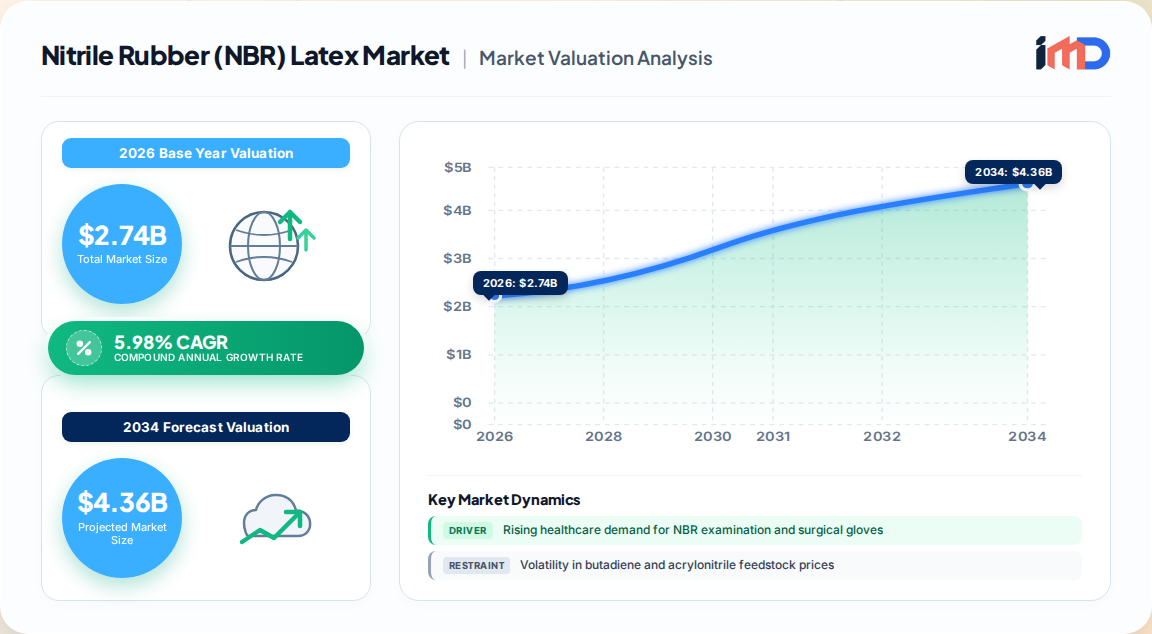
The global Nitrile Rubber (NBR) Latex Market is estimated at USD 2.74 billion in 2026 and is projected to reach USD 4.61 billion by 2035, expanding at a CAGR of 5.98% during the forecast period. This growth is primarily driven by the escalating demand for disposable nitrile gloves across healthcare, food processing, and cleanroom environments, coupled with the superior chemical and puncture resistance properties of NBR latex compared to natural rubber. Asia-Pacific dominates the market, accounting for 41% of global revenue in 2025, with North America and Europe following due to advanced healthcare infrastructure and stringent safety regulations. Our proprietary analysis indicates that the gloves segment holds the largest application share, contributing nearly 70% of total NBR latex demand in the healthcare sector alone. The market is characterized by moderate fragmentation, with key players such as LG Chem, Zeon Corporation, and Sinopec leading production capacity expansions and technological innovations.
The NBR latex value chain comprises several distinct stages, from raw material sourcing to end-user applications. Our primary research identifies the following key components:
| Stage | Key Activities | Major Participants |
|---|---|---|
| Raw Material Supply | Production of butadiene and acrylonitrile monomers | Petrochemical giants (e.g., SIBUR, Sinopec) |
| Latex Manufacturing | Emulsion polymerization of NBR latex | Specialty chemical companies (e.g., LG Chem, Zeon Corporation) |
| Compounding & Formulation | Additives and reinforcement for specific properties | Formulators and compounders (e.g., OMNOVA Solutions) |
| Product Manufacturing | Gloves, adhesives, sealants, coatings | Glove manufacturers (e.g., Top Glove, Ansell) and industrial product OEMs |
| Distribution & End-Use | Healthcare, automotive, construction, food processing | Hospitals, automotive OEMs, construction firms |
The value chain is characterized by backward integration among leading players to secure feedstock supply and forward integration into glove production. For instance, LG Chem and Zeon Corporation have invested in capacity expansions to meet rising demand, particularly in Asia-Pacific.
Global trade in NBR latex is heavily influenced by production concentration in Asia-Pacific, particularly Malaysia, which accounted for approximately 65% of global NBR glove manufacturing in 2019 and continues to dominate. Malaysia imports significant volumes of NBR latex to support its glove industry, primarily from suppliers in China, South Korea, and Japan. According to trade statistics from UN Comtrade, China and South Korea are major exporters of NBR latex, while North America and Europe are net importers to meet domestic demand. Key suppliers include LG Chem, Zeon Corporation, and Sinopec, which export to glove manufacturers in Southeast Asia. The supply chain is susceptible to disruptions from geopolitical tensions and feedstock availability, as evidenced by the COVID-19 pandemic, which led to export restrictions and price volatility. Our analysis suggests that strategic partnerships and localized production are critical for mitigating supply chain risks.
Asia-Pacific leads the global NBR latex market, with a 41% revenue share in 2025, driven by large-scale glove manufacturing in Malaysia, Thailand, and China. The region is expected to maintain its dominance, growing at a CAGR of 6% from 2026 to 2035, reaching USD 1.52 billion by 2035. North America holds the second-largest share, supported by advanced healthcare infrastructure and high adoption of NBR gloves, with the U.S. being the largest consumer. Europe follows closely, with stringent regulatory standards driving demand for high-quality NBR latex in medical and industrial applications. Latin America and the Middle East & Africa present emerging opportunities, with growing healthcare investments and industrialization. Our regional attractiveness assessment indicates that Asia-Pacific offers the highest investment potential due to low manufacturing costs and proximity to raw materials, while North America and Europe remain key markets for premium, high-performance NBR grades.
The NBR latex market is segmented by type, application, end-user industry, and particle size. Carboxylated NBR (XNBR) dominates the type segment with a 52% share, owing to its superior strength and oil resistance, followed by non-carboxylated NBR at 32% and hydroxylated NBR at 16%. By application, medical devices hold the largest share at 38%, followed by industrial products at 26% and automotive parts at 14%. The healthcare end-user segment accounts for 41% of total revenue, driven by glove consumption, while automotive and construction follow at 23% and 13%, respectively. In terms of particle size, the 0.15–0.30 mm segment leads with a 26.4% share in 2025, as it offers optimal dispersion and film-forming characteristics for coatings and polymer blends. Key innovations include cross-linked grades that enhance mechanical properties and pre-cross-linked latex for improved processing efficiency.
The market is moderately fragmented, with leading players such as LG Chem, Zeon Corporation, Sinopec, SIBUR, and OMNOVA Solutions dominating the landscape. These companies are focusing on capacity expansions, strategic partnerships, and R&D to develop high-performance NBR latex grades. For instance, LG Chem has invested in expanding its NBR latex production capacity in South Korea to meet rising global demand. Zeon Corporation is advancing its product portfolio with eco-friendly formulations to address sustainability concerns. Recent developments include mergers and acquisitions, such as Synthomer plc's acquisition of OMNOVA Solutions in 2020, which strengthened its position in the NBR latex market. Furthermore, companies are increasingly adopting digital simulation and predictive modeling to accelerate formulation cycles and enhance product performance. Our analysis suggests that firms investing in sustainable and bio-based NBR latex alternatives will gain a competitive edge as environmental regulations tighten.
Significant opportunities exist in the development of NBR latex grades for electric vehicle (EV) battery sealing and insulation applications. As EV production ramps up globally, demand for durable elastomers with enhanced thermal and electrical properties is expected to surge. Another white space lies in the healthcare sector's shift toward powder-free and hypoallergenic gloves, driving innovation in carboxylated NBR latex with low residual protein content. Additionally, emerging economies in Latin America and the Middle East & Africa present untapped potential for NBR latex in construction and automotive applications, where infrastructure development is accelerating. Companies that localize production and tailor formulations to regional requirements can capture these growth opportunities.
For buyers of NBR latex, a multi-pronged sourcing strategy is essential to mitigate supply chain risks and raw material price volatility. Key recommendations include:
| Aspects | Details |
|---|---|
| Study Period | 2020-2034 |
| Base Year | 2026 |
| Estimated Year | 2026 |
| Forecast Period | 2026-2034 |
| Historical Period | 2020-2025 |
| Growth Rate | CAGR of 5.98% from 2020-2034 |
| Segmentation |
|
By End-user Industry
By Particle Size
By Grade
| By Geography |
|
The global NBR latex market is valued at USD 2.74 billion in 2026 and is projected to reach USD 4.61 billion by 2035, growing at a CAGR of 5.98%.
The gloves segment dominates the market, accounting for nearly 70% of total demand, driven by healthcare applications. Carboxylated NBR (XNBR) leads the type segment with a 52% share.
Key players include LG Chem, Zeon Corporation, Sinopec, SIBUR, OMNOVA Solutions, and Asahi Kasei Corporation, among others.
Asia-Pacific is the fastest-growing region, with a CAGR of 6% from 2026 to 2035, driven by strong glove manufacturing in Malaysia and expanding healthcare infrastructure.
Rising healthcare demand for disposable gloves, stringent workplace safety regulations, and expansion in food processing and cleanroom industries are key drivers.
Our rigorous research methodology combines multi-layered approaches with comprehensive quality assurance, ensuring precision, accuracy, and reliability in every market analysis.
| Stakeholder Role | Interview Share (%) |
|---|---|
| Procurement Director | 30% |
| R&D Director | 25% |
| Production Head | 25% |
| Supply Chain Manager | 20% |
| Company Type | Representation (%) |
|---|---|
| NBR Latex Manufacturers | 35% |
| Glove Manufacturers | 25% |
| Compounding Formulators | 20% |
| Industrial Product OEMs | 15% |
| Raw Material Suppliers | 5% |