1What is the Natural Language Processing Technology market size in 2026?
Our proprietary sizing places the global market at USD 121.4 billion in 2026, up from USD 85.8 billion in 2025, with a projected valuation of USD 1,108.7 billion by 2033.
Insight Market Data is a premier market research and business consulting firm headquartered in Pune, India, providing syndicated research reports, customized intelligence studies, and strategic advisory services. Renowned academic institutions and Fortune 500 corporations worldwide rely on Insight Market Data's research repository to navigate evolving global and regional business environments. Covering 46 diverse industries across 25 major international economies, our comprehensive database delivers thousands of verified statistics and granular market evaluations. By combining industry-leading analytical methodologies with the direct insights of seasoned industry leaders and subject-matter experts, we deliver actionable intelligence spanning historical performance benchmarks to rigorous multi-year forecasts. We empower organizations to make confident, data-driven decisions across pivotal domains including Machinery & Equipment, Chemicals & Materials, Pharmaceuticals & Healthcare, Food & Beverages, Consumer Goods, Energy & Power, Automotive & Transportation, Electronics & Semiconductors, Medical Devices, Telecommunications, Emerging Technologies, Agriculture, and Packaging. Our multidisciplinary analyst teams provide an objective 360-degree perspective, tailoring every engagement to address complex strategic challenges with exceptional analytical rigor.
Leveraging advanced BI-powered analytics and predictive modeling, Insight Market Data uncovers high-impact market opportunities and competitive differentiators for ambitious enterprises. We continuously refine our research methodologies in accordance with global industry standards, tracking real-time market shifts to ensure our reports are consistently accurate, actionable, and delivered on schedule. Our analysts conduct methodical data validation, rigorous compliance checks, and exhaustive primary and secondary research to maintain the highest levels of data integrity and transparency. We partner closely with corporate strategists, investment groups, and business executives to translate intricate market intelligence into clear, actionable roadmaps for sustainable growth. With operational presence across Washington, USA, and Vimannagar, Pune, India, Insight Market Data ensures direct access to dedicated research specialists and responsive customer support to answer your most strategic questions.
 Natural Language Processing Technology
 by Component (Solution, Services), by Deployment (Cloud, On-Premises), by Organization Size (Large Enterprises, SMEs), by Type (Rule Based NLP, Statistical NLP, Neural NLP, Transformer-Based NLP), by Application (Conversational AI & Virtual Assistants, Document Processing, Sentiment Analysis, Machine Translation, Speech Recognition, Search & Summarization), by End Use (Healthcare, BFSI, Retail & E-commerce, IT & Telecommunications, Government, Manufacturing), by North America (USA, Canada, Mexico), by Europe (Germany, UK, France, Rest of Europe), by Asia Pacific (China, Japan, India, Rest of APAC), by South America (Brazil, Argentina), by Middle East & Africa (UAE, Saudi Arabia, South Africa) Forecast 2026-2034

Senior Research Analyst


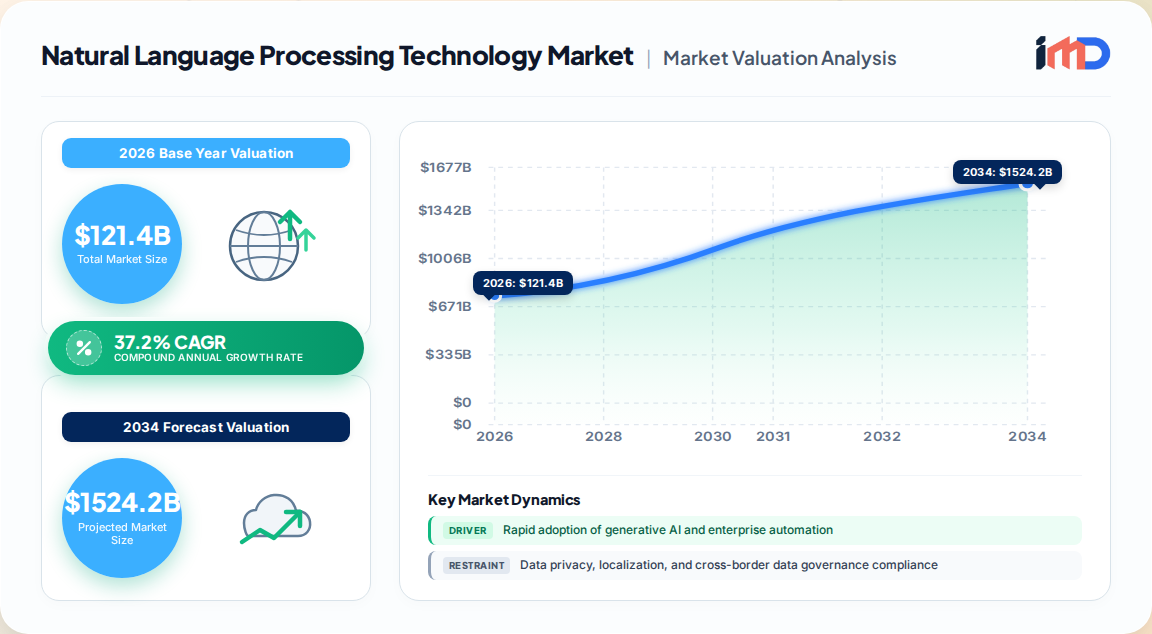
The global Natural Language Processing Technology market entered a decisive commercialization phase, with our proprietary first-party sizing placing the 2025 base at USD 85.8 billion and our 2026 estimate at USD 121.4 billion. We project the market to reach USD 1,108.7 billion by 2033, registering a CAGR of 37.2% across the 2026–2033 forecast window.
This is not incremental software growth — it is a platform shift. Natural language processing has migrated from rule-based text parsing into the core reasoning layer of enterprise AI estates, absorbing budgets previously allocated to standalone analytics, content management, and contact-center infrastructure.
| Metric | Value |
|---|---|
| Base year (2025) valuation | USD 85.8 Billion |
| 2026 estimate | USD 121.4 Billion |
| 2033 forecast | USD 1,108.7 Billion |
| CAGR 2026–2033 | 37.2% |
| Largest regional market | North America (29.8% share, 2025) |
| Fastest-growing region | Asia Pacific |
| Leading component segment | Solutions (71.0% revenue share, 2025) |
Our analyst panel emphasizes that the growth curve is unusually steep for an enterprise technology category, reflecting dual forces: greenfield generative AI deployments and the retrofitting of legacy search, classification, and translation stacks with transformer-based architectures.
Our segmentation framework reveals a market still anchored in mature delivery patterns, but with clear directional rotation underway.
| Segment Dimension | Leading Segment (2025) | Share | Directional Signal |
|---|---|---|---|
| Component | Solutions | 71.0% | Services accelerating as integration and fine-tuning demand rises |
| Deployment | On-premises | 58.2% | Cloud gaining share fastest due to scalability economics |
| Organization size | Large enterprises | 60.8% | Mid-market adoption expanding via packaged cloud NLP |
| Type | Rule-based NLP | 38.8% | Neural and transformer-based types overtaking rapidly |
Solutions dominate revenue, but the services layer — model customization, integration, governance, and managed operations — is where margin expansion is concentrated. Enterprises increasingly buy outcomes rather than raw APIs, pushing vendors toward bundled solution-plus-service constructs.
The on-premises majority reflects regulated-sector procurement behavior rather than technological preference. We expect cloud deployment to cross parity within the forecast window as sovereign cloud regions and private-cloud model hosting mature.
Rule-based NLP retains the largest installed base share because it is embedded in legacy classification, entity extraction, and compliance filtering systems. However, the growth delta belongs to neural architectures. Key application clusters include conversational AI and virtual assistants, document processing and intelligent extraction, sentiment analysis, machine translation, speech recognition, and search and summarization.
BFSI and healthcare lead in spend intensity per account; retail and e-commerce lead in breadth of use cases; IT & telecommunications holds the highest concentration of revenue share among verticals at over 23%. Government and public-sector adoption is accelerating on citizen-service digitization mandates.
North America anchored the global market with a 29.8% revenue share in 2025, underpinned by the concentration of leading AI laboratories, hyperscale cloud providers, and enterprise software vendors.
A defining regional trend is the rise of locale-specific language models. Enterprises are investing in models that encode local languages, dialects, and cultural context to improve engagement relevance and satisfy regional compliance obligations. This shifts competitive advantage toward vendors capable of language-specific fine-tuning rather than generic global models.
The market is moderately concentrated at the platform layer and highly fragmented at the application layer. Hyperscale cloud providers — Amazon Web Services (AWS), Microsoft Azure Cognitive Services, and Google — control foundational model access and distribution, while specialist vendors compete on vertical depth, language coverage, and deployment security.
Recent strategic activity illustrates three competitive plays: sovereign-language model development, voice-commerce consolidation, and vertical application acquisition.
We observe vendors converging on three defensible positions: proprietary domain data, regulated deployment capability, and multilingual coverage depth. Pure-play API providers without differentiation face pricing compression.
The NLP value chain is layered and increasingly intermediated by cloud marketplaces.
| Layer | Function | Value Capture Dynamic |
|---|---|---|
| Foundation model development | Pre-training and architecture research | High capital intensity; concentrated among few players |
| Data curation and annotation | Labeling, cleaning, language corpora | Labor-intensive; strong regional cost arbitrage |
| Platform and MLOps | Training, deployment, monitoring, governance | Recurring revenue; sticky enterprise relationships |
| Application and integration | Vertical use cases and system integration | Highest fragmentation; fastest time-to-value |
| End-user operations | Business process execution | Value realized through productivity gains |
A critical bottleneck sits in data curation and language coverage. Enterprises consistently report that annotation quality and domain-specific corpora — not model access — determine deployment success, creating a durable services opportunity.
We assess market attractiveness across four weighted dimensions: demand maturity, infrastructure readiness, regulatory friction, and language complexity.
Our assessment recommends prioritizing Asia Pacific for growth exposure and Europe for compliance-differentiated product positioning.
Four underpenetrated white spaces emerge from our primary interview program:
Applying the Ansoff framework, vendors should pursue market development through multilingual expansion into Asia Pacific and product development through governance and RAG capabilities, while reserving diversification for voice-commerce verticals where ecosystem control is still contestable.
| Aspects | Details |
|---|---|
| Study Period | 2020-2034 |
| Base Year | 2026 |
| Estimated Year | 2026 |
| Forecast Period | 2026-2034 |
| Historical Period | 2020-2025 |
| Growth Rate | CAGR of 37.2% from 2020-2034 |
| Segmentation |
|
By Organization Size
By Type
By Application
By End Use
| By Geography |
|
Our proprietary sizing places the global market at USD 121.4 billion in 2026, up from USD 85.8 billion in 2025, with a projected valuation of USD 1,108.7 billion by 2033.
The market is forecast to expand at a CAGR of 37.2% between 2026 and 2033, driven by generative AI adoption and enterprise automation.
North America held the largest revenue share at 29.8% in 2025, while Asia Pacific is the fastest-growing region across the forecast period.
Solutions led with a 71.0% revenue share in 2025, though services tied to model customization and governance are growing faster.
Data privacy and localization compliance, language complexity and model bias, and the high computational cost and hallucination risk of advanced models are the principal restraints.
Foundational platforms include Amazon Web Services, Microsoft Azure Cognitive Services, Google, and Cohere, alongside specialist vendors in voice AI, localization, and vertical applications.
Our rigorous research methodology combines multi-layered approaches with comprehensive quality assurance, ensuring precision, accuracy, and reliability in every market analysis.
| Stakeholder Role | Interview Share (%) |
|---|---|
| Chief AI Officer / VP of AI | 28% |
| Head of Conversational AI & CX | 26% |
| Enterprise Data & Analytics Director | 25% |
| Procurement & Vendor Management Lead | 21% |
| Company Type | Representation (%) |
|---|---|
| Foundation Model & LLM Developers | 22% |
| Cloud NLP Platform Providers | 24% |
| Enterprise Software & System Integrators | 21% |
| Vertical AI Application Vendors | 19% |
| Data Annotation & Language Services Firms | 14% |
 Related Reports
