1What is the size of the Morocco poultry market?
The Morocco poultry market is valued at **USD 4.27 billion in 2026** and is forecast to reach **USD 5.39 billion by 2031**, growing at a **4.75% CAGR**.
Insight Market Data is a premier market research and business consulting firm headquartered in Pune, India, providing syndicated research reports, customized intelligence studies, and strategic advisory services. Renowned academic institutions and Fortune 500 corporations worldwide rely on Insight Market Data's research repository to navigate evolving global and regional business environments. Covering 46 diverse industries across 25 major international economies, our comprehensive database delivers thousands of verified statistics and granular market evaluations. By combining industry-leading analytical methodologies with the direct insights of seasoned industry leaders and subject-matter experts, we deliver actionable intelligence spanning historical performance benchmarks to rigorous multi-year forecasts. We empower organizations to make confident, data-driven decisions across pivotal domains including Machinery & Equipment, Chemicals & Materials, Pharmaceuticals & Healthcare, Food & Beverages, Consumer Goods, Energy & Power, Automotive & Transportation, Electronics & Semiconductors, Medical Devices, Telecommunications, Emerging Technologies, Agriculture, and Packaging. Our multidisciplinary analyst teams provide an objective 360-degree perspective, tailoring every engagement to address complex strategic challenges with exceptional analytical rigor.
Leveraging advanced BI-powered analytics and predictive modeling, Insight Market Data uncovers high-impact market opportunities and competitive differentiators for ambitious enterprises. We continuously refine our research methodologies in accordance with global industry standards, tracking real-time market shifts to ensure our reports are consistently accurate, actionable, and delivered on schedule. Our analysts conduct methodical data validation, rigorous compliance checks, and exhaustive primary and secondary research to maintain the highest levels of data integrity and transparency. We partner closely with corporate strategists, investment groups, and business executives to translate intricate market intelligence into clear, actionable roadmaps for sustainable growth. With operational presence across Washington, USA, and Vimannagar, Pune, India, Insight Market Data ensures direct access to dedicated research specialists and responsive customer support to answer your most strategic questions.
 Morocco Poultry Market
 by Product Type (Meat, Table Eggs), by Distribution Channel (Off-Trade, On-Trade), by Form (Fresh/Chilled, Frozen, Processed, Specialty), by Application (Retail, Foodservice, Industrial), by Casablanca-Settat, by Rabat-Salé-Kénitra, by Marrakech-Safi, by Fès-Meknès, by Tanger-Tétouan-Al Hoceïma, by Other Regions Forecast 2026-2034

Research Associate


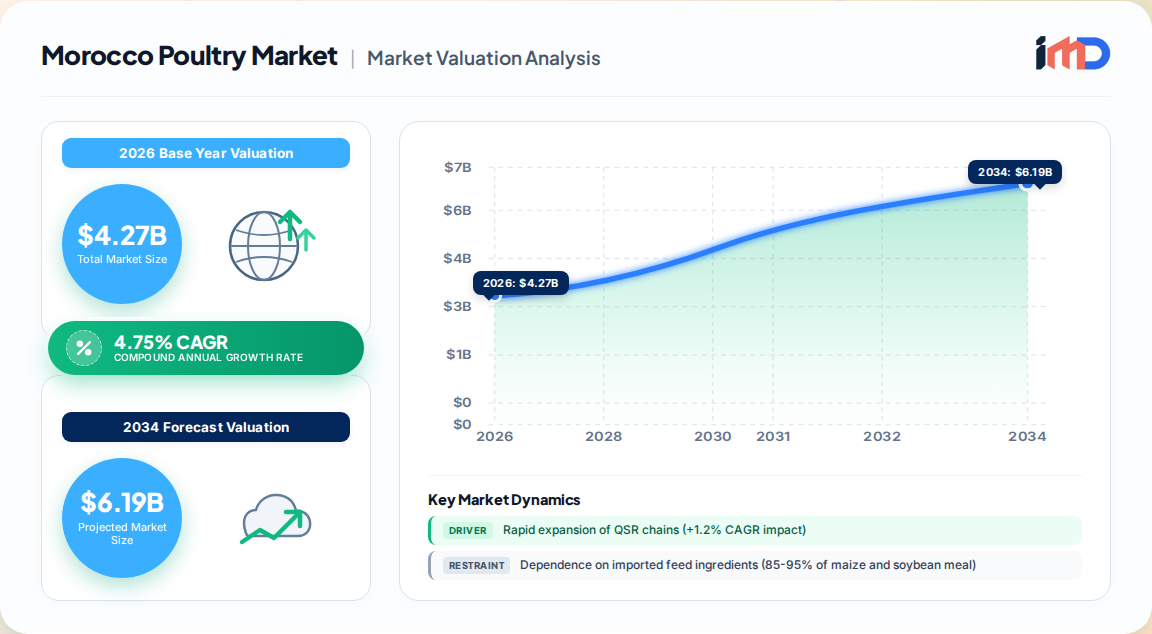
The Morocco poultry market represents the largest animal protein segment in the country by volume, anchoring a food system that increasingly relies on chicken and eggs to meet national protein demand. Our proprietary first-party research estimates the market at USD 4.27 billion in 2026, with a forecast CAGR of 4.75% driving valuation to USD 5.39 billion by 2031.
Poultry meat accounts for an estimated 55-60% of total meat consumption in Morocco, a share that has expanded steadily over the past two decades as poultry has remained more accessible than red meat. Chicken represents approximately 85-90% of poultry volume, making it the dominant protein for households across all income levels. Per-capita poultry consumption is estimated at 18-20 kg annually, well below the 25-30 kg average in higher-income Mediterranean markets, signalling substantial headroom for volume growth.
The market structure spans industrial integrated producers, semi-intensive family farms, and a long tail of backyard and traditional operations. The commercial segment supplies urban and peri-urban demand through a network of wholesalers, souks, and increasingly modern retail. Domestic production satisfies nearly all demand, with imports playing a marginal role limited to specific frozen categories and institutional buyers.
By product type, meat accounted for 72.18% of the Morocco poultry market share in 2025, while table eggs are projected to expand at a faster 7.15% CAGR through 2031. By distribution channel, off-trade captured 60.55% of the market share in 2025, with off-trade revenue forecast to rise at a 4.72% CAGR to 2031.
The Morocco poultry market is shaped by powerful structural drivers and persistent operational restraints that together define its growth trajectory.
Key Drivers:
Key Restraints:
The Morocco poultry value chain is undergoing rapid modernization, with integration and cold-chain investment reshaping competitive dynamics.
Feed Production: Feed costs dominate production economics, representing 65-75% of broiler costs. Integrated operators are responding to volatility by investing in grain storage and forward-contracting strategies. The poultry feed market is valued at approximately USD 1.2 billion in 2025, growing at a 6.2% CAGR to reach USD 1.6 billion by 2031.
Breeding and Hatcheries: Modern integrated operations now account for an estimated 60-70% of commercial broiler output, with vertical integration spanning hatcheries, feed mills, and processing plants gradually displacing traditional farm models.
Farming and Production: The sector includes industrial integrated producers, semi-intensive family farms, and a long tail of backyard operations. Adoption of smart systems for monitoring feed, water, and environmental conditions is improving efficiency and productivity.
Processing and Value Addition: Rapid investment in cold-chain logistics and processing plants is enabling producers to deliver differentiated, value-added products. Processed and value-added poultry products — including marinated cuts, breaded items, and ready-to-cook formats — are gaining shelf presence in modern retail.
Distribution: Modern retail and foodservice channels are estimated to capture 35-45% of poultry distribution, growing faster than traditional souks and independent butchers as supermarket penetration expands in urban centres. Off-trade remains dominant at 60.55% share in 2025.
| Value Chain Stage | Key Characteristics | Market Impact |
|---|---|---|
| Feed Production | 65-75% of broiler costs; 85-95% import dependence for maize/soy | High volatility exposure; forward contracting rising |
| Breeding & Hatcheries | 60-70% integrated output; automation adoption | Productivity gains; quality standardization |
| Farming | Mix of industrial, semi-intensive, backyard | Consolidation pressure; biosecurity investment |
| Processing | Cold-chain investment; value-added focus | Higher margins; export readiness |
| Distribution | Off-trade 60.55%; modern retail growing | Channel shift; brand development |
Morocco's poultry market is almost entirely supplied by domestic production, with imports playing a marginal role limited to specific frozen categories and institutional buyers. However, the country's dependence on imported feed ingredients creates significant trade exposure.
Feed Ingredient Imports: Morocco imports approximately 85-95% of its maize and soybean meal requirements, exposing producers to exchange-rate volatility, global grain price shocks, and supply-chain disruptions. This import dependence is the single largest structural risk facing the industry, transmitting directly into farm-gate and retail poultry prices.
Poultry Product Trade: The market's domestic orientation means that production economics — feed costs, chick prices, biosecurity, and farm productivity — are the primary determinants of market prices. Regulatory tightening by ONSSA is improving export readiness, with government emphasis on halal certification and compliance with international quality standards positioning Moroccan producers to capitalize on expanded export opportunities.
Supplier Landscape: The competitive landscape includes integrated operators such as Zalar Holding, Koutoubia Holding, ALF Sahel, Dar El Fellous, and Matinales. These players are investing in grain storage and forward-contracting strategies to mitigate feed price volatility. International feed companies including Cargill, Alltech, Nutreco, De Heus, and Charoen Pokphand are active in the Moroccan poultry feed market.
The Morocco poultry market is segmented by product type, distribution channel, and geography, with distinct dynamics across each dimension.
By Product Type:
By Distribution Channel:
By Product Form (Supplementary Segmentation):
The Morocco poultry market is characterized by medium market concentration, with integrated operators competing alongside a long tail of smaller producers. Key players include:
Additional companies profiled in the market include La Fonda, Maroc Dawajine, Zaime Eggs, Socavol, and Rabat Poultry Dawajine Johara. International feed companies including Cargill, Alltech, Nutreco, De Heus, and Charoen Pokphand are active in the feed segment.
The competitive landscape is shaped by consolidation pressure as smaller producers struggle to fulfill volume and consistency requirements of QSR chains. International franchise operators increasingly rely on integrated suppliers to ensure consistent product specifications across multiple locations.
The Morocco poultry market presents several high-value strategic opportunities for stakeholders across the value chain.
Recent Developments:
The Morocco poultry market exhibits distinct regional dynamics, with demand concentrated in urban and peri-urban areas.
Casablanca-Settat: The largest regional market, accounting for approximately 32% of national demand. The region hosts the highest concentration of QSR chains, modern retail, and foodservice establishments, driving demand for processed and value-added poultry products.
Rabat-Salé-Kénitra: The second-largest market with 21% share, benefiting from high urbanization and government presence. The region is a priority for supply chain modernization.
Marrakech-Safi: Represents 18% of demand, with tourism significantly supporting the QSR sector and foodservice consumption.
Fès-Meknès: Accounts for 12% share, with a mix of traditional and modern retail channels.
Tanger-Tétouan-Al Hoceïma: Represents 9% of demand, benefiting from infrastructure investment and proximity to European markets.
Other Regions: Account for the remaining 8%, with growth driven by urbanization and rising disposable incomes. With 66% of Morocco's population living in urban areas in 2024, demand is increasingly concentrated in cities, pushing producers to enhance processing capabilities and cold-chain infrastructure.
| Aspects | Details |
|---|---|
| Study Period | 2020-2034 |
| Base Year | 2026 |
| Estimated Year | 2026 |
| Forecast Period | 2026-2034 |
| Historical Period | 2020-2025 |
| Growth Rate | CAGR of 4.75% from 2020-2034 |
| Segmentation |
|
By Form
By Application
| By Geography |
|
The Morocco poultry market is valued at **USD 4.27 billion in 2026** and is forecast to reach **USD 5.39 billion by 2031**, growing at a **4.75% CAGR**.
Poultry meat dominates with **72.18% market share** in 2025, driven by chicken's position as the primary protein source for Moroccan households.
Key players include Zalar Holding, Koutoubia Holding, ALF Sahel, Dar El Fellous, and Matinales, alongside international feed companies such as Cargill and Nutreco.
Growth is driven by rapid QSR expansion (+1.2% CAGR impact), government modernization initiatives (+0.9%), technological advancements (+0.8%), and rising demand for quality and variety (+0.7%).
Key challenges include dependence on imported feed ingredients (65-75% of broiler costs), recurrent drought conditions, and disease pressure requiring biosecurity investment.
Off-trade captured **60.55% share** in 2025, with revenue forecast to grow at a **4.72% CAGR** to 2031, driven by supermarket and traditional retail expansion.
Our rigorous research methodology combines multi-layered approaches with comprehensive quality assurance, ensuring precision, accuracy, and reliability in every market analysis.
| Stakeholder Role | Interview Share (%) |
|---|---|
| Procurement Director | 30% |
| Farm Operations Manager | 25% |
| Nutritionist and Feed Formulation Specialist | 25% |
| Food Safety and Quality Assurance Manager | 20% |
| Company Type | Representation (%) |
|---|---|
| Integrated Poultry Producers | 30% |
| Feed Manufacturers and Millers | 25% |
| Commercial Broiler and Layer Farms | 20% |
| Poultry Processors and Slaughterhouses | 15% |
| Feed Distributors and Agro-Dealers | 10% |
 Related Reports
