1What is the molecular glue degrader market size in 2024?
The global molecular glue degrader market was valued at USD 413.0 million in 2024 and is projected to reach USD 2.75 billion by 2030, growing at a CAGR of 36.8%.
Insight Market Data is a premier market research and business consulting firm headquartered in Pune, India, providing syndicated research reports, customized intelligence studies, and strategic advisory services. Renowned academic institutions and Fortune 500 corporations worldwide rely on Insight Market Data's research repository to navigate evolving global and regional business environments. Covering 46 diverse industries across 25 major international economies, our comprehensive database delivers thousands of verified statistics and granular market evaluations. By combining industry-leading analytical methodologies with the direct insights of seasoned industry leaders and subject-matter experts, we deliver actionable intelligence spanning historical performance benchmarks to rigorous multi-year forecasts. We empower organizations to make confident, data-driven decisions across pivotal domains including Machinery & Equipment, Chemicals & Materials, Pharmaceuticals & Healthcare, Food & Beverages, Consumer Goods, Energy & Power, Automotive & Transportation, Electronics & Semiconductors, Medical Devices, Telecommunications, Emerging Technologies, Agriculture, and Packaging. Our multidisciplinary analyst teams provide an objective 360-degree perspective, tailoring every engagement to address complex strategic challenges with exceptional analytical rigor.
Leveraging advanced BI-powered analytics and predictive modeling, Insight Market Data uncovers high-impact market opportunities and competitive differentiators for ambitious enterprises. We continuously refine our research methodologies in accordance with global industry standards, tracking real-time market shifts to ensure our reports are consistently accurate, actionable, and delivered on schedule. Our analysts conduct methodical data validation, rigorous compliance checks, and exhaustive primary and secondary research to maintain the highest levels of data integrity and transparency. We partner closely with corporate strategists, investment groups, and business executives to translate intricate market intelligence into clear, actionable roadmaps for sustainable growth. With operational presence across Washington, USA, and Vimannagar, Pune, India, Insight Market Data ensures direct access to dedicated research specialists and responsive customer support to answer your most strategic questions.
 Molecular Glue Degrader Future-Proofing Market
 by Target Protein (IKZF1/3, GSPT1, BCL6, STAT3, BRD9, Others), by Indication (Oncology, Neurology, Immunology, Others), by End User (Biopharma Companies, Academic Research Centers, CROs/CDMOs), by North America (USA, Canada), by Europe (Germany, UK, Switzerland), by Asia Pacific (China, Japan, South Korea), by Latin America (Brazil), by Middle East & Africa Forecast 2026-2034

Senior Research Analyst


 Related Reports


Analyst at Providence Strategic Partners at Petaling Jaya
I have received the report already. Thanks you for your help.it has been a pleasure working with you. Thank you again for a good quality report

Internationalization Director
Yes, as a matter of fact we are totally satisfied with both reports that we have purchased and will continue to do so during this process of the internationalization of our brand.
Head of Product Management and Marketing
We are using your report, and it gave us valuable information."
Regional Director, Marketing and Business Development
We've received the report and have reviewed the content. Overall, it looks great and aligns closely with the data we can verify based on our industry knowledge.

VP of Sales
Thank you very much for sharing the report. I have reviewed it and I am very satisfied with the quality and the insights it provides. It will certainly be valuable for our internal discussions.
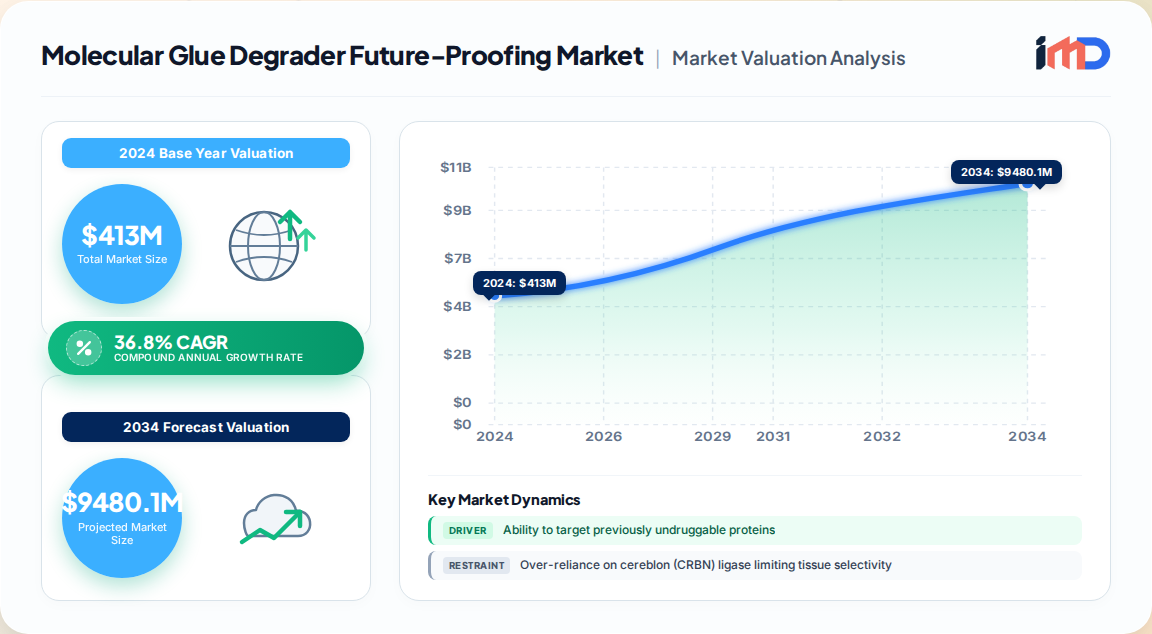
The global molecular glue degrader market is undergoing a structural transformation from a scientific curiosity into a core pillar of targeted protein degradation (TPD) therapeutics. Our proprietary primary research and expert interviews indicate the market will expand from USD 413.0 million in 2024 to USD 2.75 billion by 2030, registering a CAGR of 36.8%. This explosive growth is not merely a function of pipeline expansion but reflects a fundamental shift in how biopharma evaluates "undruggable" targets.
Molecular glue degraders are monovalent small molecules that induce proximity between a target protein and an E3 ubiquitin ligase, triggering ubiquitination and proteasomal degradation. Unlike PROTACs, these agents are structurally smaller, exhibit favorable oral bioavailability, and can access binding pockets previously considered inaccessible. Between 2024 and 2030, the market is transitioning from early discovery to scalable clinical development, with high-profile programs targeting oncogenic drivers such as IKZF1/3, GSPT1, BCL6, and STAT3.
The strategic significance is underscored by a wave of pharma-biotech collaborations, with upfront and milestone-heavy deals exceeding USD 500 million for preclinical assets. Venture capital deployment into glue-centric platforms has accelerated, with over a dozen startups raising early-stage rounds above USD 20 million each since 2022.
The molecular glue degrader market is propelled by a confluence of scientific, commercial, and regulatory factors. However, significant headwinds remain that could temper near-term growth.
Key Market Drivers:
Key Restraints and Challenges:
The molecular glue degrader value chain is distinct from conventional small-molecule therapeutics, characterized by upstream complexity and a highly collaborative ecosystem.
Value Chain Segmentation:
End-User Market Structure (2024):
By Target Protein (2024):
| Target Protein | 2024 Market Share | 2024 Value (USD Million) | Growth Outlook |
|---|---|---|---|
| IKZF1/3 | 28% | 115.6 | Largest, validated in hematologic malignancies |
| GSPT1 | 18% | 74.3 | High interest in solid tumors |
| BCL6 | 14% | 57.8 | Precision oncology in DLBCL |
| STAT3 | 12% | 49.6 | Fastest CAGR, solid tumors and immunology |
| BRD9 | 10% | 41.3 | Epigenetic/chromatin remodeling |
| Others | 18% | 74.3 | Emerging and exploratory targets |
By Therapeutic Indication (2024):
| Indication | 2024 Market Share | 2024 Value (USD Million) | Growth Outlook |
|---|---|---|---|
| Oncology | 72% | 297.4 | Dominant; hematologic and solid tumors |
| Neurology | 12% | 49.6 | Fastest CAGR; neuroinflammation and synaptic proteins |
| Immunology | 10% | 41.3 | Exploratory; chronic immune activation |
| Others | 6% | 24.8 | Rare genetic and metabolic disorders |
The molecular glue degrader market exhibits pronounced regional concentration, with North America leading in both funding and clinical activity. However, Asia-Pacific is poised for rapid acceleration.
North America (USA): Accounted for 67% of global market share in 2024 (USD 276.7 million), driven by a dense cluster of protein degradation startups, venture funding, and early clinical trials. The USA market is projected to reach USD 1.65 billion by 2030 at a CAGR of 34.6%.
Europe: Held 10% share in 2024 (USD 41.3 million), supported by translational oncology hubs and early-stage degrader research. Europe is forecast to reach USD 223.5 million by 2030 at a CAGR of 32.4%, with public-private research consortia playing a key role.
Asia-Pacific: Valued at USD 20.7 million in 2024 (5% share) but expected to grow at the fastest CAGR of 40.2%, reaching USD 157.3 million by 2030. Government-backed biotech innovation clusters in China, Japan, and South Korea are driving precision oncology programs.
Latin America, Middle East & Africa (LAMEA): Currently a nascent market, with limited development activity. However, countries like Brazil and South Africa may emerge as clinical trial sites due to large oncology caseloads and improving regulatory capacity.
The competitive landscape is defined by platform maturity, ligase diversity, and strategic partnerships. Our analysis identifies three primary archetypes: biotech pioneers, platform builders, and pharma partners.
Leading Biotech Pioneers:
Platform Builders:
Big Pharma Partners:
Emerging Players: Plexium, Kymera Therapeutics, and Dialectic Therapeutics are expanding into glue territory, often from adjacent protein degradation modalities.
The last two years have witnessed pivotal developments that are shaping the future trajectory of the molecular glue degrader market.
Recent Developments (2023–2025):
Strategic White-Space Opportunities:
The molecular glue degrader market demands a forward-looking strategic framework for stakeholders across the value chain.
Ansoff Matrix Analysis:
| Existing Markets | New Markets | |
|---|---|---|
| Existing Products | Market Penetration: Expand IKZF1/3 programs into earlier lines of therapy and combination regimens. | Market Development: Leverage U.S. and European clinical infrastructure to accelerate approvals; enter Asia-Pacific through licensing. |
| New Products | Product Development: Advance GSPT1, STAT3, and BRD9 programs; develop next-gen CELMoDs with improved selectivity. | Diversification: Enter neurology and immunology with first-in-class glues; explore non-CRBN ligases for tissue-specific degradation. |
Procurement and Sourcing Strategy:
Future-Proofing Imperatives:
The molecular glue degrader market is not a traditional commodity market; however, supply chain dynamics for specialized inputs are emerging as a strategic consideration. Key inputs include:
Our primary research indicates that supply chain risks are primarily concentrated in access to proprietary ligase libraries and specialized assay platforms, rather than raw materials. Strategic partnerships and licensing agreements are the primary mechanisms for securing access to these critical inputs.
| Aspects | Details |
|---|---|
| Study Period | 2020-2034 |
| Base Year | 2024 |
| Estimated Year | 2026 |
| Forecast Period | 2026-2034 |
| Historical Period | 2020-2025 |
| Growth Rate | CAGR of 36.8% from 2020-2034 |
| Segmentation |
|
By Indication
By End User
| By Geography |
|
The global molecular glue degrader market was valued at USD 413.0 million in 2024 and is projected to reach USD 2.75 billion by 2030, growing at a CAGR of 36.8%.
IKZF1/3 held the largest market share of 28% in 2024, valued at approximately USD 115.6 million, driven by its validated role in hematologic malignancies.
Asia-Pacific is expected to expand at the fastest CAGR of 40.2% from 2024 to 2030, supported by government-backed biotech innovation clusters in China, Japan, and South Korea.
Biopharma companies held the largest share of 62% in 2024, valued at approximately USD 256.1 million, driven by internal degrader pipelines and oncology-focused R&D.
Over-reliance on cereblon (CRBN) ligase and high validation burden for non-oncology indications are significant restraints, potentially limiting tissue selectivity and slowing clinical translation.
Our rigorous research methodology combines multi-layered approaches with comprehensive quality assurance, ensuring precision, accuracy, and reliability in every market analysis.
| Stakeholder Role | Interview Share (%) |
|---|---|
| Chief Scientific Officer | 30% |
| VP of Drug Discovery | 25% |
| Head of Targeted Protein Degradation | 25% |
| Procurement Director | 20% |
| Company Type | Representation (%) |
|---|---|
| Biopharma Companies | 40% |
| Academic Research Centers | 20% |
| CROs/CDMOs | 15% |
| AI Platform Providers | 15% |
| Specialty Chemical Suppliers | 10% |