1What is the modular flying car market size and growth rate?
The market is valued at USD 120.0 Million in 2023 and is projected to reach USD 4,930.2 Million by 2033, growing at a 45.0% CAGR during 2024–2033.
Insight Market Data is a premier market research and business consulting firm headquartered in Pune, India, providing syndicated research reports, customized intelligence studies, and strategic advisory services. Renowned academic institutions and Fortune 500 corporations worldwide rely on Insight Market Data's research repository to navigate evolving global and regional business environments. Covering 46 diverse industries across 25 major international economies, our comprehensive database delivers thousands of verified statistics and granular market evaluations. By combining industry-leading analytical methodologies with the direct insights of seasoned industry leaders and subject-matter experts, we deliver actionable intelligence spanning historical performance benchmarks to rigorous multi-year forecasts. We empower organizations to make confident, data-driven decisions across pivotal domains including Machinery & Equipment, Chemicals & Materials, Pharmaceuticals & Healthcare, Food & Beverages, Consumer Goods, Energy & Power, Automotive & Transportation, Electronics & Semiconductors, Medical Devices, Telecommunications, Emerging Technologies, Agriculture, and Packaging. Our multidisciplinary analyst teams provide an objective 360-degree perspective, tailoring every engagement to address complex strategic challenges with exceptional analytical rigor.
Leveraging advanced BI-powered analytics and predictive modeling, Insight Market Data uncovers high-impact market opportunities and competitive differentiators for ambitious enterprises. We continuously refine our research methodologies in accordance with global industry standards, tracking real-time market shifts to ensure our reports are consistently accurate, actionable, and delivered on schedule. Our analysts conduct methodical data validation, rigorous compliance checks, and exhaustive primary and secondary research to maintain the highest levels of data integrity and transparency. We partner closely with corporate strategists, investment groups, and business executives to translate intricate market intelligence into clear, actionable roadmaps for sustainable growth. With operational presence across Washington, USA, and Vimannagar, Pune, India, Insight Market Data ensures direct access to dedicated research specialists and responsive customer support to answer your most strategic questions.
 Modular Flying Car Market
 by Mode of Operation (Manned Flying Cars, Unmanned Flying Cars), by Application (Military, Commercial, Civil), by Seating Capacity (One, Two, Four, More Than Four), by Product Type (VTOL, Others), by End Use (Private, Commercial, Others), by North America (United States, Canada), by Europe (Germany, France, U.K., Italy, Russia), by Asia-Pacific (China, Japan, South Korea, India, Australia), by Latin America (Mexico, Brazil, Argentina), by Middle East & Africa (Turkey, Saudi Arabia, UAE) Forecast 2026-2034

Research Associate


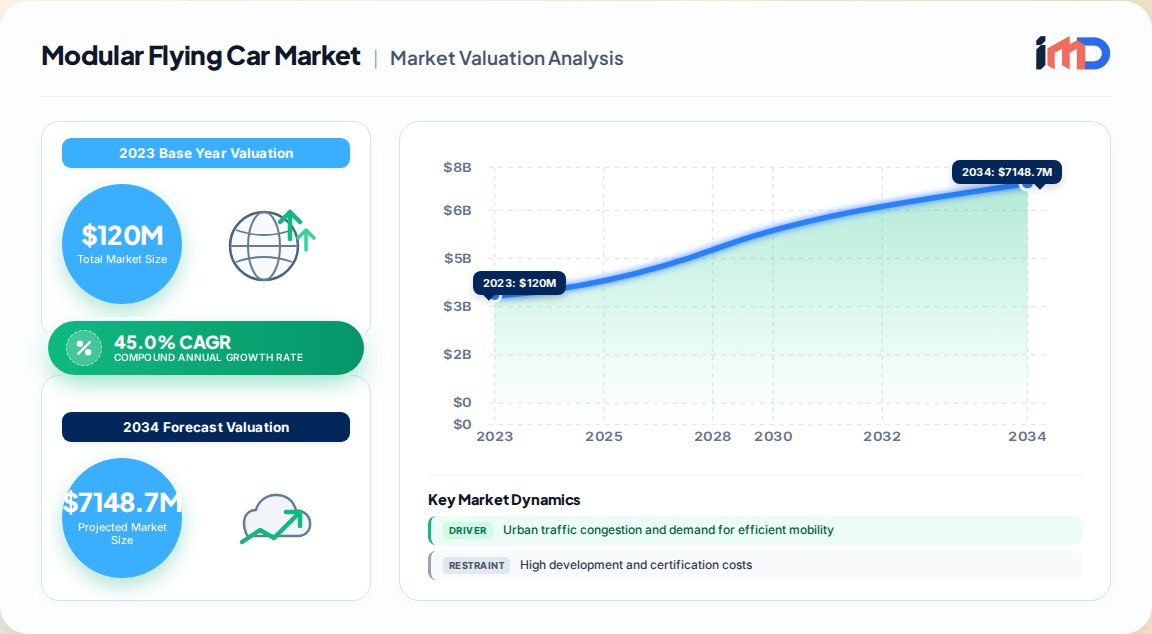
The modular flying car market represents one of the most capital-intensive and technologically ambitious frontiers in advanced air mobility. Our proprietary primary research estimates the global market at USD 120.0 Million in 2023, projected to expand to USD 4,930.2 Million by 2033, registering a remarkable CAGR of 45.0% across the 2024–2033 forecast window. This trajectory reflects a market transitioning from experimental prototypes toward certified, commercially deployable dual-mode vehicles.
Modular flying cars combine road-legal automotive chassis engineering with electric vertical takeoff and landing (eVTOL) propulsion, enabling detachable or reconfigurable air and ground modules. This modularity delivers operational flexibility, lowers maintenance complexity, and supports differentiated use cases from private mobility to military rapid deployment.
| Metric | Value |
|---|---|
| Base Year Market Size (2023) | USD 120.0 Million |
| Forecast Market Size (2033) | USD 4,930.2 Million |
| CAGR (2024–2033) | 45.0% |
| Fastest-Growing Region | Asia-Pacific |
| Largest Regional Market | North America (38.0%) |
| Dominant Mode of Operation | Unmanned (63.0%) |
| Leading Application | Military (48.0%) |
The modular flying car value chain spans five distinct tiers, each with specialized capability requirements.
| Tier | Activity | Key Requirements |
|---|---|---|
| Component Supply | Batteries, composite airframes, avionics, sensors | Aviation-grade certification, 10C–60C discharge capability |
| Subsystem Integration | Propulsion modules, flight control, detachable couplings | Redundancy engineering, weight optimization |
| Vehicle Assembly | Final airframe and road-module integration | Precision manufacturing, quality assurance |
| Certification & Testing | Airworthiness validation, flight-test programs | Regulatory liaison, safety documentation |
| Operations & Services | Air taxi fleets, maintenance, vertiport operations | Fleet management, charging infrastructure |
Modularity introduces a distinctive value-chain advantage: air and ground modules can be manufactured, certified, and serviced independently, reducing lifecycle cost and enabling parallel production lines.
By Mode of Operation, unmanned flying cars command 63.0% share, reflecting autonomous technology maturity and favorable regulatory treatment. Manned variants retain critical importance where human judgment is irreplaceable.
By Application, military dominates at 48.0%, driven by rapid deployment and vertical takeoff advantages. Commercial air taxi and cargo applications are scaling fastest, while civil private ownership builds gradually on technological familiarity.
By Seating Capacity, two-person configurations lead, balancing performance, practicality, and commuter utility. Four-seat and larger models are pivotal for air taxi economics.
| Segment | Dominant Sub-Segment | Share |
|---|---|---|
| Mode of Operation | Unmanned | 63.0% |
| Application | Military | 48.0% |
| Seating Capacity | Two-Person | Leading |
| Propulsion | Fully Electric | ~70.0% |
North America leads with 38.0% share, underpinned by aerospace depth, defense investment, and state-level regulatory experimentation. Asia-Pacific is the fastest-growing region, propelled by urbanization intensity and manufacturing scale commitments.
Leading participants—PAL-V, XPENG, Coolhigh (Beijing), Terrafugia, AeroMobil, Joby Aviation, Volocopter, Kitty Hawk, Urban Aeronautics, and Lilium—are pursuing differentiated strategies spanning gyroplane dual-mode designs, all-electric eVTOL architectures, and automation-centric platforms.
Key developments shaping competitive dynamics include large-scale assembly facility investments targeting 10,000 units annually, air taxi service launch commitments beginning 2025–2026, and expanding battery technology partnerships. Strategic priorities center on certification acceleration, vertiport partnerships, and modular design standardization.
Underexploited opportunities include:
Buyers and manufacturers should prioritize battery suppliers with demonstrated aviation-grade cycle life, dual-source composite airframe vendors to mitigate concentration risk, and engage regulatory consultants early to compress certification timelines. Modular architecture itself is a procurement hedge—independent module sourcing reduces single-vendor dependency and enables competitive tension across subsystem tiers.
| Aspects | Details |
|---|---|
| Study Period | 2020-2034 |
| Base Year | 2023 |
| Estimated Year | 2026 |
| Forecast Period | 2026-2034 |
| Historical Period | 2020-2025 |
| Growth Rate | CAGR of 45.0% from 2020-2034 |
| Segmentation |
|
By Seating Capacity
By Product Type
By End Use
| By Geography |
|
The market is valued at USD 120.0 Million in 2023 and is projected to reach USD 4,930.2 Million by 2033, growing at a 45.0% CAGR during 2024–2033.
North America leads with a 38.0% revenue share, attributed to aerospace and defense depth, while Asia-Pacific is the fastest-growing region.
Military applications dominate with 48.0% share, driven by defense investment in silent VTOL platforms and rapid deployment capabilities.
Unmanned flying cars hold 63.0% share, supported by advances in autonomous technology, sensor fusion, and supportive regulatory frameworks.
Key participants include PAL-V, XPENG, Coolhigh (Beijing), Terrafugia, AeroMobil, Joby Aviation, Volocopter, Kitty Hawk, Urban Aeronautics, and Lilium.
Two-person seating configurations lead the market, offering an optimal balance between performance, practicality, and commuter utility.
Our rigorous research methodology combines multi-layered approaches with comprehensive quality assurance, ensuring precision, accuracy, and reliability in every market analysis.
| Stakeholder Role | Interview Share (%) |
|---|---|
| Chief Technology Officer | 30% |
| Head of Certification & Airworthiness | 28% |
| Procurement Director | 24% |
| Urban Air Mobility Program Manager | 18% |
| Company Type | Representation (%) |
|---|---|
| eVTOL Airframe OEMs | 32% |
| Battery & Propulsion Suppliers | 24% |
| Composite Material Manufacturers | 18% |
| Vertiport Infrastructure Developers | 14% |
| Fleet Operators & Air Taxi Providers | 12% |
 Related Reports
