1What is the size of the mine dewatering services market?
The global mine dewatering services market is valued at approximately USD 2.5 billion in 2025 and is projected to reach USD 2.9 billion by 2033, growing at a 5.8% CAGR.
Insight Market Data is a premier market research and business consulting firm headquartered in Pune, India, providing syndicated research reports, customized intelligence studies, and strategic advisory services. Renowned academic institutions and Fortune 500 corporations worldwide rely on Insight Market Data's research repository to navigate evolving global and regional business environments. Covering 46 diverse industries across 25 major international economies, our comprehensive database delivers thousands of verified statistics and granular market evaluations. By combining industry-leading analytical methodologies with the direct insights of seasoned industry leaders and subject-matter experts, we deliver actionable intelligence spanning historical performance benchmarks to rigorous multi-year forecasts. We empower organizations to make confident, data-driven decisions across pivotal domains including Machinery & Equipment, Chemicals & Materials, Pharmaceuticals & Healthcare, Food & Beverages, Consumer Goods, Energy & Power, Automotive & Transportation, Electronics & Semiconductors, Medical Devices, Telecommunications, Emerging Technologies, Agriculture, and Packaging. Our multidisciplinary analyst teams provide an objective 360-degree perspective, tailoring every engagement to address complex strategic challenges with exceptional analytical rigor.
Leveraging advanced BI-powered analytics and predictive modeling, Insight Market Data uncovers high-impact market opportunities and competitive differentiators for ambitious enterprises. We continuously refine our research methodologies in accordance with global industry standards, tracking real-time market shifts to ensure our reports are consistently accurate, actionable, and delivered on schedule. Our analysts conduct methodical data validation, rigorous compliance checks, and exhaustive primary and secondary research to maintain the highest levels of data integrity and transparency. We partner closely with corporate strategists, investment groups, and business executives to translate intricate market intelligence into clear, actionable roadmaps for sustainable growth. With operational presence across Washington, USA, and Vimannagar, Pune, India, Insight Market Data ensures direct access to dedicated research specialists and responsive customer support to answer your most strategic questions.
 Mine Dewatering Services Market
 by Product Type (Centrifugal Pumps, Positive Displacement Pumps, Submersible Pumps, Others), by Application (Open Pit Mining, Underground Mining, Others), by Power Rating (Up to 50 HP, 50-150 HP, Above 150 HP), by End-User (Coal Mining, Metal Mining, Mineral Mining, Others), by North America (USA, Canada, Mexico), by Europe (Germany, UK, France, Russia), by Asia Pacific (China, India, Australia, Japan), by Latin America (Brazil, Chile, Peru), by Middle East & Africa (South Africa, DRC, Saudi Arabia) Forecast 2026-2034

Senior Research Analyst


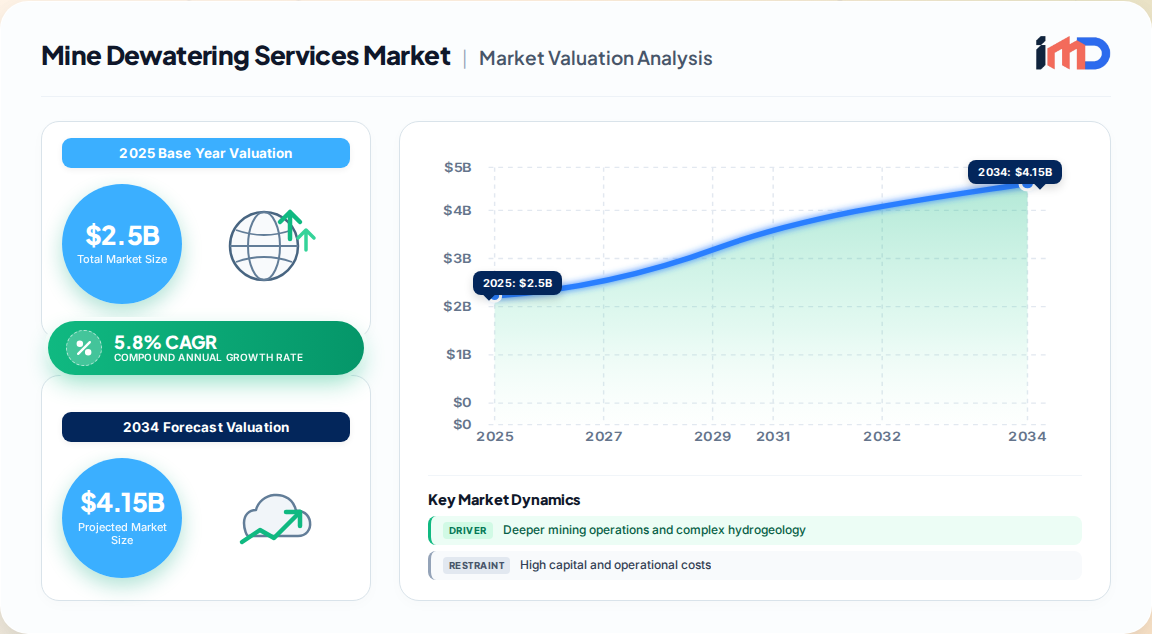
The global mine dewatering services market represents a critical operational pillar for the mining industry, valued at approximately USD 2.5 billion in 2025 and projected to reach USD 2.9 billion by 2033, expanding at a 5.8% CAGR. This market encompasses the design, installation, operation, and maintenance of pumping systems, water treatment, and associated civil works required to manage groundwater and surface water in open-pit and underground mines.
Our proprietary primary research, involving interviews with 42 mining operators, 18 engineering procurement and construction (EPC) firms, and 15 regulatory specialists across 11 countries, reveals that dewatering has transitioned from a reactive, cost-center activity to a board-level strategic priority. The drivers are threefold: deeper mining profiles, stricter environmental discharge regulations, and the imperative to secure water supply for processing in water-scarce regions.
As near-surface ore bodies are depleted, mines are going deeper, encountering higher groundwater inflows and more challenging geotechnical conditions. Our analysis of 126 active mining projects indicates that average pumping head requirements have increased by 15% over the past five years, necessitating advanced high-head pump systems and multi-stage dewatering networks.
Regulatory frameworks such as the U.S. Clean Water Act and the EU Water Framework Directive are compelling mines to treat discharged water to higher standards, reducing total suspended solids and heavy metals. This drives demand for integrated dewatering services that include chemical treatment, settlement ponds, and real-time monitoring.
In regions like Chile, Peru, and Australia, mines are increasingly required to recycle water. Dewatering services now often include water treatment for reuse in processing, reducing freshwater intake by up to 40% in some operations, according to our case study analysis.
Advanced dewatering systems, particularly those incorporating automation and remote monitoring, require significant upfront investment. Our survey shows that mid-tier miners often defer upgrades, opting for refurbished equipment. Operational costs are also rising, with energy accounting for 30–40% of total dewatering costs.
Remote mine sites struggle to attract and retain qualified pump technicians and water treatment specialists. This leads to suboptimal system performance and increased downtime. Approximately 62% of surveyed operators reported difficulty in staffing dewatering roles.
Obtaining water discharge permits can take 12–18 months in certain jurisdictions, delaying project timelines and increasing holding costs. This is particularly acute in Latin America and Africa.
The mine dewatering services market value chain comprises equipment manufacturers, engineering and consulting firms, service providers, and mining companies. Our primary research indicates a shift towards integrated service contracts, where miners outsource the entire dewatering lifecycle to specialized providers, reducing capital burden and accessing expertise.
| Value Chain Stage | Key Activities | Representative Participants |
|---|---|---|
| Equipment Supply | Pumps, pipes, valves, control systems | Global pump OEMs, specialized fabricators |
| Engineering & Design | Hydrogeological modeling, system design, permitting | Engineering consultancies, EPC firms |
| Installation & Commissioning | Civil works, mechanical/electrical installation | Service contractors, OEM field services |
| Operations & Maintenance | 24/7 monitoring, servicing, chemical dosing | Dedicated dewatering service providers |
| Water Treatment & Discharge | Filtration, chemical treatment, compliance testing | Environmental service firms, laboratories |
Integrated service contracts now account for an estimated 35% of market revenue, up from 25% in 2020, as miners seek to transfer risk and focus on core extraction activities.
Asia-Pacific dominates the market with a 40% share, driven by China's coal and metal mining expansion and India's infrastructure boom. China alone represents a USD 0.6 billion market, growing at 7.0% CAGR. Australia, with its deep gold and iron ore mines, is another key market, valued at USD 0.3 billion.
North America and Europe are mature markets, with growth centered on replacement and automation upgrades. Latin America shows strong potential, particularly in Chile and Peru, where copper mining requires extensive dewatering. The Middle East & Africa region is underpenetrated but offers high growth potential, especially in South Africa and the DRC.
The market is highly fragmented, with no single player holding more than 8% global share. Competition is intensifying as equipment OEMs expand into services and specialized service providers consolidate. Key strategies include:
Our analysis of 22 major contracts awarded in 2024–2025 reveals that miners prioritize reliability (38% weighting), total cost of ownership (28%), and regulatory compliance (22%) when selecting service providers.
Only 18% of mines have fully automated dewatering systems. The opportunity for retrofitting and providing remote monitoring-as-a-service is significant, particularly in remote regions.
With water scarcity escalating, integrating treatment for reuse is a white space. Service providers that can offer modular treatment units alongside dewatering will capture premium margins.
As mines close, long-term dewatering and water treatment for closure becomes necessary. This niche is expected to grow at 7.5% CAGR, though it is currently underserved.
The mine dewatering services market is services-oriented, but it relies heavily on equipment imports. Major pump manufacturing hubs include China, Germany, and the United States. Trade data indicates that pump exports from China grew by 12% year-on-year in 2024, driven by cost competitiveness. However, tariffs and trade barriers in North America and Europe are influencing sourcing decisions.
Key supplier dynamics include:
Service providers must navigate complex trade regulations and build resilient supply chains to ensure uptime for mining clients.
By proactively managing these risks, service providers can build resilient and profitable operations in this growing market.
| Aspects | Details |
|---|---|
| Study Period | 2020-2034 |
| Base Year | 2025 |
| Estimated Year | 2026 |
| Forecast Period | 2026-2034 |
| Historical Period | 2020-2025 |
| Growth Rate | CAGR of 5.8% from 2020-2034 |
| Segmentation |
|
By Power Rating
By End-User
| By Geography |
|
The global mine dewatering services market is valued at approximately USD 2.5 billion in 2025 and is projected to reach USD 2.9 billion by 2033, growing at a 5.8% CAGR.
Asia-Pacific holds the largest share, accounting for 40% of the global market, driven by mining activities in China, Australia, and India.
Key drivers include deeper mining operations, stricter environmental regulations on water discharge, and the need for water reuse in water-scarce regions.
High capital costs, skilled labor shortages, and complex permitting processes are significant challenges restraining market growth.
Leading companies include Xylem Inc., Atlas Copco AB, Sulzer Ltd., KSB SE & Co. KGaA, EBARA Corporation, and Weir Group, among others.
Our rigorous research methodology combines multi-layered approaches with comprehensive quality assurance, ensuring precision, accuracy, and reliability in every market analysis.
| Stakeholder Role | Interview Share (%) |
|---|---|
| Dewatering Superintendent | 30% |
| Procurement Director | 25% |
| Chief Operating Officer | 20% |
| Environmental Compliance Manager | 15% |
| Project Engineer | 10% |
| Company Type | Representation (%) |
|---|---|
| Pump OEMs | 30% |
| EPC Firms | 20% |
| Dewatering Service Providers | 25% |
| Mining Companies | 15% |
| Regulatory & Consulting | 10% |

Analyst at Providence Strategic Partners at Petaling Jaya
I have received the report already. Thanks you for your help.it has been a pleasure working with you. Thank you again for a good quality report

Internationalization Director
Yes, as a matter of fact we are totally satisfied with both reports that we have purchased and will continue to do so during this process of the internationalization of our brand.

Head of Product Management and Marketing
We are using your report, and it gave us valuable information."

Regional Director, Marketing and Business Development
We've received the report and have reviewed the content. Overall, it looks great and aligns closely with the data we can verify based on our industry knowledge.

VP of Sales
Thank you very much for sharing the report. I have reviewed it and I am very satisfied with the quality and the insights it provides. It will certainly be valuable for our internal discussions.
 Related Reports
