1What is the size of the Military Vehicles Simulator Market in 2026?
Our proprietary research values the military vehicles simulator market at $5.65 billion in 2026, up from $5.22 billion in 2025, representing 8.2% year-over-year growth.
Insight Market Data is a premier market research and business consulting firm headquartered in Pune, India, providing syndicated research reports, customized intelligence studies, and strategic advisory services. Renowned academic institutions and Fortune 500 corporations worldwide rely on Insight Market Data's research repository to navigate evolving global and regional business environments. Covering 46 diverse industries across 25 major international economies, our comprehensive database delivers thousands of verified statistics and granular market evaluations. By combining industry-leading analytical methodologies with the direct insights of seasoned industry leaders and subject-matter experts, we deliver actionable intelligence spanning historical performance benchmarks to rigorous multi-year forecasts. We empower organizations to make confident, data-driven decisions across pivotal domains including Machinery & Equipment, Chemicals & Materials, Pharmaceuticals & Healthcare, Food & Beverages, Consumer Goods, Energy & Power, Automotive & Transportation, Electronics & Semiconductors, Medical Devices, Telecommunications, Emerging Technologies, Agriculture, and Packaging. Our multidisciplinary analyst teams provide an objective 360-degree perspective, tailoring every engagement to address complex strategic challenges with exceptional analytical rigor.
Leveraging advanced BI-powered analytics and predictive modeling, Insight Market Data uncovers high-impact market opportunities and competitive differentiators for ambitious enterprises. We continuously refine our research methodologies in accordance with global industry standards, tracking real-time market shifts to ensure our reports are consistently accurate, actionable, and delivered on schedule. Our analysts conduct methodical data validation, rigorous compliance checks, and exhaustive primary and secondary research to maintain the highest levels of data integrity and transparency. We partner closely with corporate strategists, investment groups, and business executives to translate intricate market intelligence into clear, actionable roadmaps for sustainable growth. With operational presence across Washington, USA, and Vimannagar, Pune, India, Insight Market Data ensures direct access to dedicated research specialists and responsive customer support to answer your most strategic questions.
 Military Vehicles Simulator Market
 by Type (Simulation Platforms(Desktop-Based, Full Mission Simulators, Mobile Training Units, Cloud-Based), Simulation Systems, Simulation Maintenance, Other Types), by Vehicle Type (Armored Vehicles, Trucks and Transport Vehicles, Tanks, Light Tactical Vehicles, Reconnaissance Vehicles), by Technology (Artificial Intelligence, Augmented Reality, Virtual Reality, Cloud-Based Simulation, Data Analytics and Big Data), by Application (Training and Education, Mission Planning, Operational Support, Research and Development, Testing and Evaluation), by End User (Defense Forces, Government Agencies, Private Contractors, Educational Institutions, Research Organizations), by North America (USA, Canada, Mexico), by Europe (Germany, UK, France, Russia, Italy), by Asia Pacific (China, Japan, India, Australia), by South America (Brazil, Argentina), by Middle East & Africa (Saudi Arabia, UAE, South Africa) Forecast 2026-2034

Research Associate


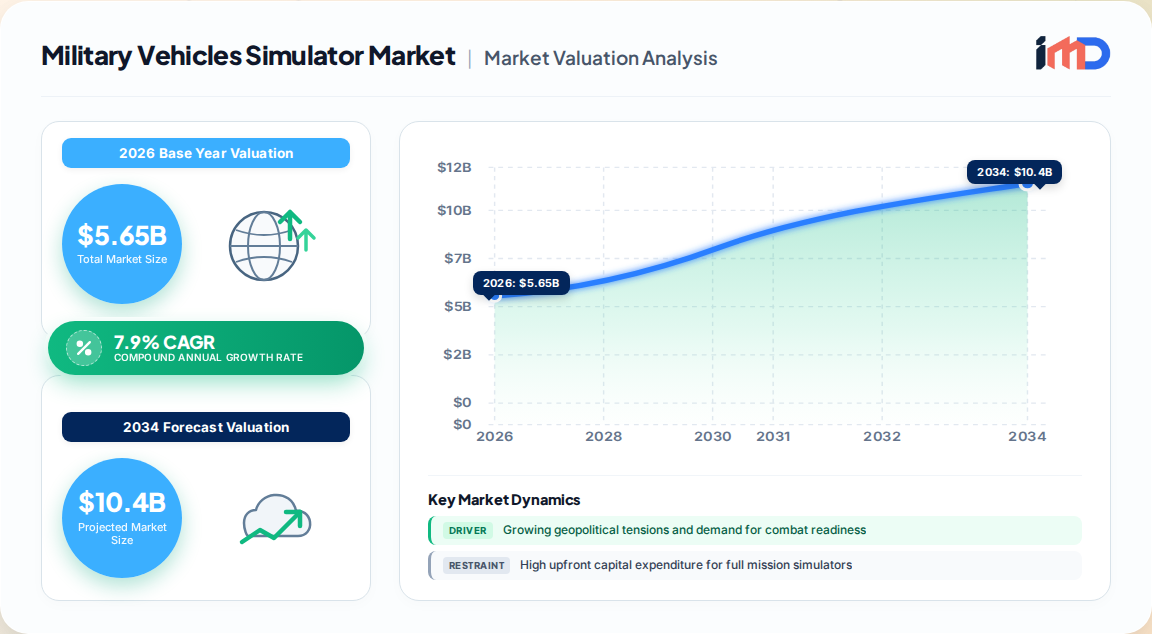
The global military vehicles simulator market represents one of the most resilient and strategically critical segments within the broader defense synthetic training ecosystem. Our proprietary first-party research estimates the market at $5.65 billion in 2026, a robust step-up from $5.22 billion in 2025, implying a year-over-year expansion of 8.2% and a forward CAGR of 7.9% that carries the market to $7.67 billion by 2030.
The trajectory is not a simple post-pandemic rebound story. It reflects a structural re-rating of defense training budgets worldwide, where simulation is no longer a cost-saving substitute for live maneuvers but a force-multiplier and operational necessity. Our primary interviews with program officers, simulation acquisition leads, and platform engineers indicate that simulation now absorbs a materially larger share of training and readiness envelopes across armored, transport, and reconnaissance fleets.
Military vehicle simulations encompass digital and physical-virtual environments engineered to replicate the functions, behaviors, and operational surroundings of defense ground transport systems. These include armored vehicles, main battle tanks, trucks and transport vehicles, light tactical vehicles, and reconnaissance platforms.
Our scope spans four primary solution archetypes:
Technology coverage includes artificial intelligence, augmented reality, virtual reality, cloud-based simulation, and data analytics/big data pipelines. Applications concentrate in training and education, mission planning, operational support, research and development, and testing and evaluation.
Demand is being pulled by four reinforcing forces, each validated through our stakeholder interview program.
Geopolitical tension and readiness urgency. Elevated global conflict intensity — corroborated by multilateral security data showing a sharp rise in conflict fatalities in 2024 — has pushed combat readiness to the top of defense planning agendas. Simulators allow forces to rehearse complex contingencies without escalatory signaling or live-fire costs.
Cost-per-training-hour economics. Full mission simulators deliver materially lower marginal training costs than live vehicle operation, particularly for tracked platforms where fuel, maintenance, and range constraints dominate. More than half of structured operator training programs now embed simulation as a core component.
Fleet modernization mismatch. New vehicle variants enter service faster than live training infrastructure can be built. Modular simulators that reconfigure across vehicle types compress the training pipeline and reduce fielding risk.
VR/AR and AI maturity. Roughly 60% of newly introduced simulation platforms now incorporate AI-driven adaptive scenarios, enabling trainee-specific difficulty scaling and objective performance scoring.
Key restraints include high upfront capital expenditure for full mission simulators, integration complexity with legacy training management systems, and tariff-driven cost inflation on visual display subsystems and computing hardware. These pressures are most acute in regions heavily dependent on imported simulation hardware.
Our segmentation analysis reveals that platforms and systems together account for the dominant share of market value, while maintenance and sustainment is the fastest-compounding revenue stream as installed bases age.
| Segment Dimension | Leading Category | Growth Characteristic |
|---|---|---|
| By Type | Simulation platforms and systems | Maintenance/sustainment fastest-growing |
| By Vehicle Type | Armored vehicles and tanks | Light tactical vehicles rising quickly |
| By Technology | VR and AI-driven simulation | Cloud-based simulation scaling fastest |
| By Application | Training and education | Mission planning and T&E expanding |
| By End User | Defense forces | Private contractors and research organizations growing |
Artificial intelligence is the single most disruptive technology input in our forecast. Adaptive scenario generation, AI-driven opposing forces, and automated after-action review are compressing instructor workload and improving training throughput. Cloud-based simulation is enabling distributed, networked training across garrisons and coalition partners, directly supporting joint and multi-nation interoperability requirements.
Asia-Pacific holds the largest regional position, reflecting large-scale armored fleet modernization, domestic simulation industrial policy, and expanding indigenous supplier ecosystems. North America follows with high per-unit simulator sophistication and strong sustainment spending. Europe is accelerating investment amid heightened regional security posture, while the Middle East and Africa and South America represent emerging but strategically important demand pockets.
Tariff realignment is encouraging regionalization of simulator hardware manufacturing, with local integration capabilities strengthening in Asia-Pacific and Eastern Europe. We expect this to modestly rebalance regional supply over the forecast window.
The market is moderately consolidated, with a mix of prime defense contractors, specialized simulation houses, and software-centric entrants. Competitive advantage is shifting from hardware fidelity alone toward software modularity, open architectures, and lifecycle sustainment contracts.
Recent strategic activity underscores this shift:
Our opportunity assessment identifies three under-served whitespaces: (1) modular simulation kits for light tactical and reconnaissance vehicles, where installed base is large but simulator penetration remains low; (2) AI-enabled instructor automation and performance analytics as a software layer sold independently of hardware; and (3) simulation-as-a-service and long-term sustainment contracts in emerging defense markets.
Investment attractiveness ranks highest in Asia-Pacific and Europe over the forecast period, driven by budget visibility and coalition interoperability mandates. Vendors should prioritize open-architecture compliance, localized integration partnerships, and multi-vehicle networked training capability to capture share in joint-force procurement programs.
| Aspects | Details |
|---|---|
| Study Period | 2020-2034 |
| Base Year | 2026 |
| Estimated Year | 2026 |
| Forecast Period | 2026-2034 |
| Historical Period | 2020-2025 |
| Growth Rate | CAGR of 7.9% from 2020-2034 |
| Segmentation |
|
By Vehicle Type
By Technology
By Application
By End User
| By Geography |
|
Our proprietary research values the military vehicles simulator market at $5.65 billion in 2026, up from $5.22 billion in 2025, representing 8.2% year-over-year growth.
The market is forecast to grow at a 7.9% CAGR from 2026 to 2030, reaching $7.67 billion by the end of the forecast period.
Asia-Pacific is the largest regional market, accounting for approximately 36% of global value in 2026, driven by armored fleet modernization and indigenous simulation industrial policy.
Artificial intelligence, virtual reality, augmented reality, and cloud-based simulation are the leading technology drivers, with roughly 60% of new platforms incorporating AI-driven adaptive systems.
Key participants include Raytheon Technologies, Boeing, Lockheed Martin, General Dynamics, Northrop Grumman, Collins Aerospace, BAE Systems, Thales Group, L3Harris Technologies, Rheinmetall AG, CAE Inc., and FAAC Incorporated.
High upfront capital costs for full mission simulators, integration complexity with legacy training systems, and tariff-driven inflation on display and computing hardware are the principal challenges.
Our rigorous research methodology combines multi-layered approaches with comprehensive quality assurance, ensuring precision, accuracy, and reliability in every market analysis.
| Stakeholder Role | Interview Share (%) |
|---|---|
| Program Manager, Synthetic Training | 30% |
| Chief Engineer, Simulation Systems | 26% |
| Head of Training & Readiness | 24% |
| Procurement Director, Defense Acquisition | 20% |
| Company Type | Representation (%) |
|---|---|
| Simulator Platform & System OEMs | 32% |
| Defense Primes & Integrators | 24% |
| Simulation Software Developers | 18% |
| Training & Sustainment Contractors | 15% |
| Component & Display Subsystem Suppliers | 11% |
 Related Reports
