1What is the current size of the military slip ring market?
The global military slip ring market is valued at USD 459.24 million in 2026 and is projected to reach USD 779.50 million by 2034, registering a 6.80% CAGR during the forecast period.
Insight Market Data is a premier market research and business consulting firm headquartered in Pune, India, providing syndicated research reports, customized intelligence studies, and strategic advisory services. Renowned academic institutions and Fortune 500 corporations worldwide rely on Insight Market Data's research repository to navigate evolving global and regional business environments. Covering 46 diverse industries across 25 major international economies, our comprehensive database delivers thousands of verified statistics and granular market evaluations. By combining industry-leading analytical methodologies with the direct insights of seasoned industry leaders and subject-matter experts, we deliver actionable intelligence spanning historical performance benchmarks to rigorous multi-year forecasts. We empower organizations to make confident, data-driven decisions across pivotal domains including Machinery & Equipment, Chemicals & Materials, Pharmaceuticals & Healthcare, Food & Beverages, Consumer Goods, Energy & Power, Automotive & Transportation, Electronics & Semiconductors, Medical Devices, Telecommunications, Emerging Technologies, Agriculture, and Packaging. Our multidisciplinary analyst teams provide an objective 360-degree perspective, tailoring every engagement to address complex strategic challenges with exceptional analytical rigor.
Leveraging advanced BI-powered analytics and predictive modeling, Insight Market Data uncovers high-impact market opportunities and competitive differentiators for ambitious enterprises. We continuously refine our research methodologies in accordance with global industry standards, tracking real-time market shifts to ensure our reports are consistently accurate, actionable, and delivered on schedule. Our analysts conduct methodical data validation, rigorous compliance checks, and exhaustive primary and secondary research to maintain the highest levels of data integrity and transparency. We partner closely with corporate strategists, investment groups, and business executives to translate intricate market intelligence into clear, actionable roadmaps for sustainable growth. With operational presence across Washington, USA, and Vimannagar, Pune, India, Insight Market Data ensures direct access to dedicated research specialists and responsive customer support to answer your most strategic questions.
 Military Slip Ring Market
 by Type (Electro-Optic Slip Rings, Fiber Optic Slip Rings, Hybrid Slip Rings, Wireless Slip Rings, Pancake Slip Rings, Pneumatic Slip Rings, Capsule Slip Rings, Molded Slip Rings, Others), by Application (Radar Systems, Weapon Systems, Armored Vehicles, UAVs, Missile Guidance Systems, Naval Ships & Submarines, Military Aircraft, Surveillance and Reconnaissance Equipment, Unmanned Systems, Other Military Electronics), by Material (Gold-to-Gold, Silver-to-Silver, Copper, Bronze, Others), by End User (Army, Navy, Air Force, Defense Contractors), by Transmission Type (Power Transmission, Signal Transmission, Data/Ethernet, Radio Frequency, Fiber Optic), by Distribution Channel (Direct Sales, Indirect Sales), by North America (United States, Canada, Mexico), by Europe (Germany, United Kingdom, France, Italy, Spain, Russia, Sweden, Denmark, Switzerland, Luxembourg), by Asia Pacific (China, Japan, India, South Korea, South East Asia, Australia, Singapore, Taiwan), by South America (Brazil, Argentina, Colombia, Peru, Chile), by Middle East (Saudi Arabia, Turkey, UAE, Egypt, Qatar), by Africa (South Africa, East Africa, West Africa, North Africa) Forecast 2026-2034



Research Associate
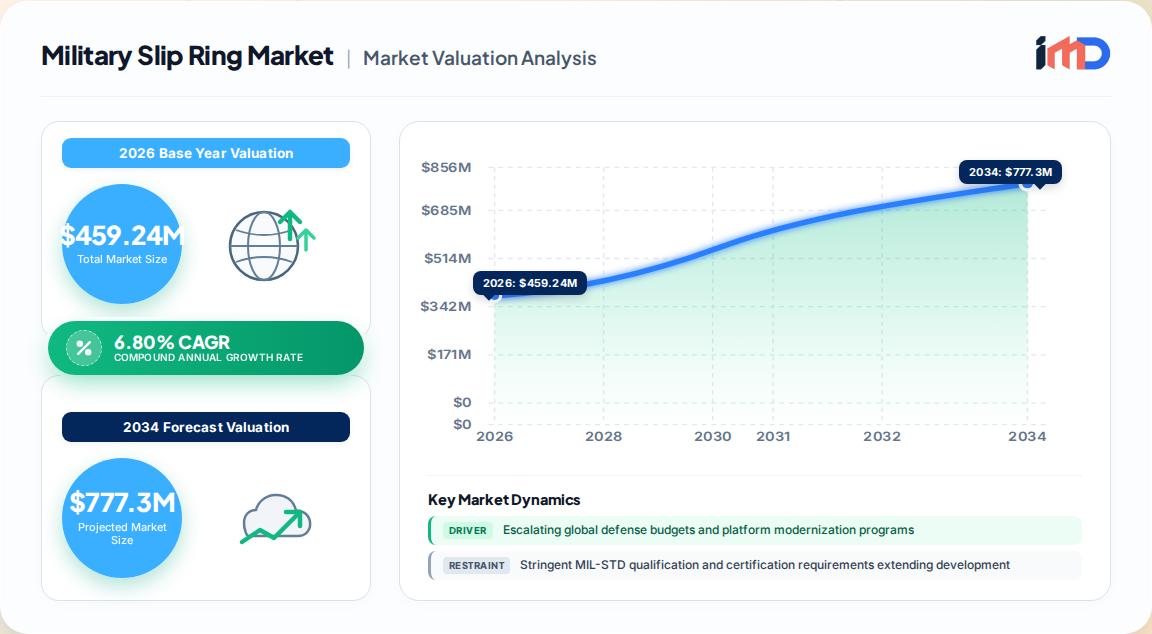
The global military slip ring market represents a specialized, high-barrier segment of the defense electronics industry, supplying rotary electrical interfaces that enable continuous power, signal, and data transmission across rotating joints in military platforms. Our proprietary primary research estimates the market at USD 459.24 million in 2026, expanding to USD 779.50 million by 2034 at a 6.80% CAGR. Slip rings are mission-critical in radar antennas, electro-optic targeting gimbals, weapon stations, armored vehicle turrets, naval combat systems, and unmanned aerial vehicles (UAVs). The market remains small in absolute revenue relative to broader defense electronics, yet it carries outsized strategic weight because a single slip ring failure can disable an entire platform's sensor-to-shooter chain.
From a demand-structure standpoint, the market is characterized by low unit volumes but very high value per unit, driven by MIL-STD qualification, bespoke engineering, and long procurement cycles. Our bottom-up modeling, triangulated across platform-level slip ring content and defense procurement budgets, indicates that electro-optic slip rings accounted for approximately 32.5% of global type-segment revenue in 2025, while radar systems and UAV applications together represent more than half of application demand.
| Metric | Value |
|---|---|
| Market Size (2026) | USD 459.24 Million |
| Forecast (2034) | USD 779.50 Million |
| CAGR (2026–2034) | 6.80% |
| Largest Type Segment | Electro-Optic Slip Rings (~32.5%) |
| Fastest-Growing Application | UAVs & Unmanned Systems |
| Dominant End User | Army |
| Dominant Material | Gold-to-Gold Contacts |
Demand for military slip rings is being reshaped by four structural forces, each validated through our interviews with program engineers and procurement officials:
The market's growth trajectory is tempered by structural constraints that limit scalability and margin expansion:
Electro-optic slip rings held the largest share at approximately 32.5% in 2025, reflecting their ubiquity in EO/IR targeting, surveillance, and stabilized weapon stations. Hybrid slip rings combining electrical power and fiber-optic data transmission are the fastest-growing category, driven by data-intensive defense platforms. Fiber-optic slip rings continue to gain traction in radar and electronic warfare applications requiring interference-immune, high-bandwidth links.
Radar systems constitute a major application segment because rotating antennas require uninterrupted power and signal connectivity. UAVs represent the fastest-expanding application opportunity, driven by stabilized EO payloads and rotary-wing gimbal architectures. Weapon systems, armored vehicle turrets, and naval combat systems round out the application base.
Gold-to-gold contact systems dominate due to superior conductivity, contact reliability, and suitability for low-level signal transmission. Silver-to-silver contacts serve higher-current power paths, while advanced composite and specialized materials offer growth opportunities for wear resistance and extended operating life.
The Army is the dominant end-user segment, supported by extensive deployment of slip rings in armored vehicles, turrets, and ground-based radar. Navy demand is anchored in naval radar, combat management systems, and submarine periscope/antenna interfaces, while Air Force demand centers on aircraft gimbals, fire-control radar, and podded sensors.
| Segment Dimension | Leading Segment | Share / Position |
|---|---|---|
| Type | Electro-Optic Slip Rings | ~32.5% (2025) |
| Application | Radar Systems | Major segment |
| Material | Gold-to-Gold | Dominant |
| End User | Army | Dominant |
Asia-Pacific is the largest regional market, accounting for 38.2% of global revenue (USD 164.3 million in 2025) in our demand model, driven by defense modernization in China, India, Japan, and South Korea. Indigenous defense manufacturing mandates in these countries are expanding domestic slip ring supply ecosystems, particularly for naval radar and fighter platforms.
North America holds the second-largest position at 28.7% share, underpinned by U.S. Department of Defense modernization budgets, electronic warfare programs, and multi-function phased-array radar investments. Europe represents 19.5% of the market, supported by NATO modernization and Franco-German platform programs. Latin America and Middle East & Africa together hold roughly 13.6%, with selective procurement in air defense and naval upgrades.
| Region | 2025 Share | 2025 Value (USD M) |
|---|---|---|
| Asia-Pacific | 38.2% | 164.3 |
| North America | 28.7% | 123.4 |
| Europe | 19.5% | 83.9 |
| Latin America | 4.0% | 17.2 |
| Middle East & Africa | 9.6% | 41.3 |
The military slip ring market is moderately concentrated, with a handful of established defense electromechanical specialists holding long-standing qualification positions on major platforms. The competitive landscape includes Moog Inc., Schleifring, Cobham Limited, Stemmann-Technik, Mersen, RUAG, GAT, Morgan Advanced Materials, Cavotec, LTN, Pandect Precision, DSTI, NSD, Mercotac, BGB, Molex, UEA, Rotac, Electro-Miniatures Corporation, Jinpat Electronics, and Hangzhou Prosper Mechanical & Electrical Technology.
Key strategic imperatives for manufacturers include:
The value chain spans upstream specialty material suppliers (gold, silver, copper alloys, rare-earth magnets, and advanced dielectric materials), midstream precision manufacturers with cleanroom and environmental test capabilities, and downstream defense primes and government procurement agencies. Capacity utilization is moderate, constrained by bespoke engineering and stringent quality assurance rather than raw material availability. Precious-metal contact materials represent a meaningful input cost, and supply security for gold and silver is generally robust through global commodity markets; however, specialized ceramic and fiber-optic rotary joint components face longer lead times and limited qualified supplier bases.
The military slip ring market is a structurally resilient, technology-intensive niche poised for steady 6.80% CAGR growth through 2034. Demand is anchored by irreversible modernization, autonomy, and sensor proliferation trends, while supply-side constraints around qualification and customization preserve incumbent advantages. Suppliers that lead in hybrid, fiber-optic, and miniaturized solutions will capture disproportionate value as defense platforms become increasingly data-centric and unmanned.
| Aspects | Details |
|---|---|
| Study Period | 2020-2034 |
| Base Year | 2026 |
| Estimated Year | 2026 |
| Forecast Period | 2026-2034 |
| Historical Period | 2020-2025 |
| Growth Rate | CAGR of 6.80% from 2020-2034 |
| Segmentation |
|
By Application
By Material
By End User
By Transmission Type
By Distribution Channel
| By Geography |
|
The global military slip ring market is valued at USD 459.24 million in 2026 and is projected to reach USD 779.50 million by 2034, registering a 6.80% CAGR during the forecast period.
Electro-optic slip rings accounted for approximately 32.5% of global type-segment revenue in 2025, driven by their widespread use in EO/IR targeting, surveillance, and stabilized weapon stations.
Asia-Pacific leads the global market with a 38.2% revenue share in 2025, valued at USD 164.3 million, followed by North America at 28.7% and Europe at 19.5%.
Key drivers include defense modernization programs, the proliferation of UAVs and autonomous systems, rising adoption of electro-optic and infrared sensors, and the shift toward network-centric warfare requiring high-bandwidth rotary interfaces.
The Army is the dominant end-user segment, supported by extensive deployment of slip rings in armored vehicles, turrets, and ground-based radar systems.
Gold-to-gold contact systems dominate due to superior electrical conductivity, contact reliability, and suitability for low-level signal transmission, making them ideal for precision military applications requiring stable performance.
Our rigorous research methodology combines multi-layered approaches with comprehensive quality assurance, ensuring precision, accuracy, and reliability in every market analysis.
| Stakeholder Role | Interview Share (%) |
|---|---|
| Procurement Director | 30% |
| Systems Engineer | 28% |
| Program Manager | 24% |
| Supply Chain Manager | 18% |
| Company Type | Representation (%) |
|---|---|
| Slip Ring OEMs & Precision Manufacturers | 40% |
| Defense Primes & System Integrators | 25% |
| Specialty Material & Contact Suppliers | 15% |
| Government Defense Procurement Agencies | 12% |
| MRO & Aftermarket Service Providers | 8% |
 Related Reports
