1What is the size of the Middle East amusement parks market?
The Middle East amusement parks market is valued at USD 3.68 billion in 2026 and is forecast to reach USD 5.84 billion by 2031, growing at a 9.72% CAGR.
Insight Market Data is a premier market research and business consulting firm headquartered in Pune, India, providing syndicated research reports, customized intelligence studies, and strategic advisory services. Renowned academic institutions and Fortune 500 corporations worldwide rely on Insight Market Data's research repository to navigate evolving global and regional business environments. Covering 46 diverse industries across 25 major international economies, our comprehensive database delivers thousands of verified statistics and granular market evaluations. By combining industry-leading analytical methodologies with the direct insights of seasoned industry leaders and subject-matter experts, we deliver actionable intelligence spanning historical performance benchmarks to rigorous multi-year forecasts. We empower organizations to make confident, data-driven decisions across pivotal domains including Machinery & Equipment, Chemicals & Materials, Pharmaceuticals & Healthcare, Food & Beverages, Consumer Goods, Energy & Power, Automotive & Transportation, Electronics & Semiconductors, Medical Devices, Telecommunications, Emerging Technologies, Agriculture, and Packaging. Our multidisciplinary analyst teams provide an objective 360-degree perspective, tailoring every engagement to address complex strategic challenges with exceptional analytical rigor.
Leveraging advanced BI-powered analytics and predictive modeling, Insight Market Data uncovers high-impact market opportunities and competitive differentiators for ambitious enterprises. We continuously refine our research methodologies in accordance with global industry standards, tracking real-time market shifts to ensure our reports are consistently accurate, actionable, and delivered on schedule. Our analysts conduct methodical data validation, rigorous compliance checks, and exhaustive primary and secondary research to maintain the highest levels of data integrity and transparency. We partner closely with corporate strategists, investment groups, and business executives to translate intricate market intelligence into clear, actionable roadmaps for sustainable growth. With operational presence across Washington, USA, and Vimannagar, Pune, India, Insight Market Data ensures direct access to dedicated research specialists and responsive customer support to answer your most strategic questions.
 Middle East Amusement Parks Market
 by Rides (Mechanical Rides, Water Rides, Other Rides), by Age (Up To 18 Years, 19-35 Years, 36-50 Years, 51-65 Years, More Than 65 Years), by Revenue Source (Tickets, Food & Beverages, Merchandise, Hotels/Resorts, Others), by GCC (UAE, Saudi Arabia, Qatar, Kuwait, Oman, Bahrain), by Turkey & Iran (Turkey, Iran), by Rest of Middle East (Jordan, Lebanon, Iraq, Yemen) Forecast 2026-2034

Research Associate


 Related Reports

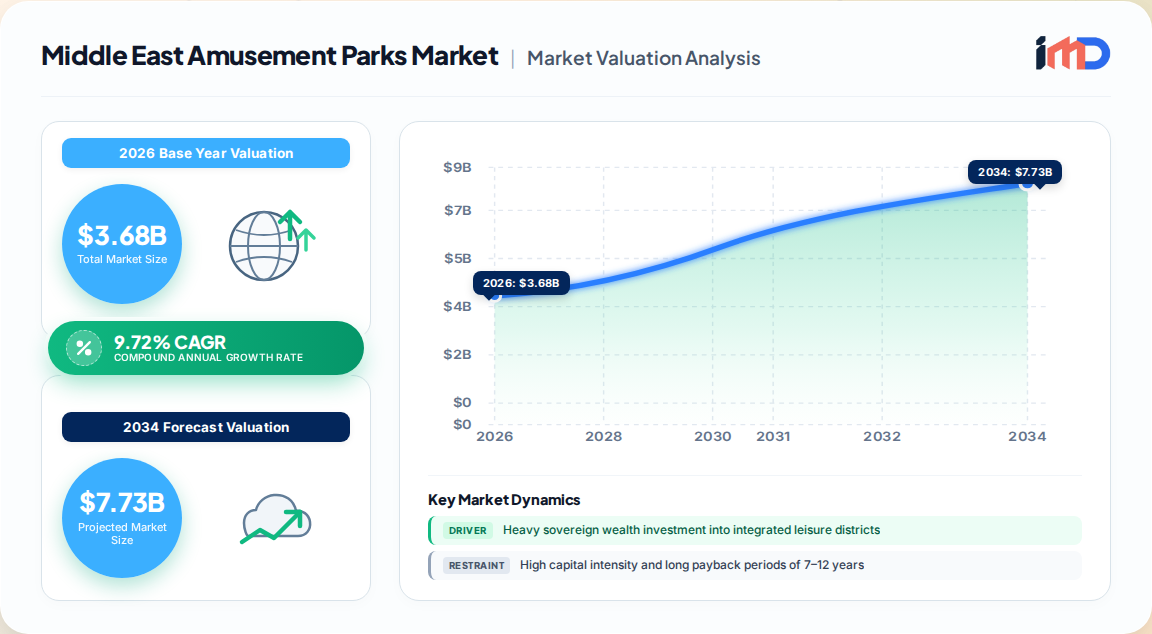
The Middle East amusement parks market is in the midst of a structural transformation. Our proprietary first-party research pegs the market at USD 3.68 billion in 2026, expanding to USD 5.84 billion by 2031 at a 9.72% CAGR — roughly double the global industry growth rate of 4.95%. This is not a cyclical spike; it is the deliberate product of sovereign capital allocation, tourism-led national visions, and a generational shift in consumer preferences toward experience-based leisure.
Three structural forces define the current cycle. First, GCC governments — particularly Saudi Arabia and the UAE — are deploying sovereign wealth into integrated leisure districts rather than standalone parks. Second, tourism arrivals have rebounded and diversified, with Dubai recording 18.7 million overnight visitors in 2024 (up 9.1% year on year) and Dubai International Airport handling 92.3 million passengers. Third, operators are adopting climate-resilient and technology-enabled formats (AI queue optimization, contactless entry, indoor micro-parks in malls) that lift throughput and extend operating seasons.
The competitive field remains moderately concentrated. Sovereign-backed and family conglomerate operators — Miral Asset Management, DXB Entertainments, IMG Worlds of Adventure, and Saudi Entertainment Ventures — control flagship assets, while international ride OEMs and IP licensors (Merlin Entertainments, Comcast/Universal, Six Flags) participate through partnerships and licensing. The market is not yet commoditized, and white space persists in secondary cities and mid-market formats.
Our expert interviews and proprietary driver impact model attribute the following percentage contributions to the 9.72% CAGR:
| Driver | Impact on CAGR | Geographic Relevance | Timeline |
|---|---|---|---|
| Heavy sovereign wealth investment into integrated leisure districts | +3.2% | Saudi Arabia, UAE, Qatar | Long term (≥4 years) |
| Rapid tourism-led footfall growth in GCC | +2.8% | GCC, spillover to Turkey | Medium term (2–4 years) |
| Regulatory push for family-centric entertainment to diversify oil economies | +2.1% | Saudi Arabia, UAE, Kuwait, Oman | Long term (≥4 years) |
| Post-COVID "revenge leisure" spending surge | +1.9% | Global, highest impact in GCC | Short term (≤2 years) |
| Indoor micro-theme-park format inside malls | +1.4% | GCC, early adoption in UAE | Medium term (2–4 years) |
| AI-driven queue & capacity optimization | +0.8% | UAE, Saudi Arabia, Qatar | Medium term (2–4 years) |
Sovereign wealth is the single largest accelerant. Saudi Arabia's Public Investment Fund alone is targeting a USD 70 billion slice of global park revenue, backing giga-projects such as Qiddiya (a 366 km² entertainment mega-city designed to attract 17 million annual visitors) and NEOM. Individual assets like Aquarabia and Land of Legends Qatar each carry about USD 3 billion in capital. This funding depth decouples project financing from oil price cycles and enables multi-day destination districts rather than isolated parks.
Tourism-led footfall is the demand multiplier. Tourism delivered AED 236 billion (USD 64.3 billion) to the UAE economy in 2024, equal to 12% of GDP. New air routes from China and Southeast Asia raised arrivals from those regions by 24.2% in 2024, diversifying visitor origin and insulating footfall from single-market shocks.
Restraints are real but manageable. High capital intensity and long payback periods (typically 7–12 years for destination parks) remain the principal barrier, with an estimated –0.6% drag on CAGR. Weather-related revenue volatility is mitigated by sophisticated cooling systems and indoor formats, but summer attendance dips of 15–20% persist for outdoor-only parks. Labor cost inflation for specialized roles (mechatronics technicians, safety engineers) remains 8–15% above pre-pandemic levels, with recruitment timelines extending to 60–90 days.
Mechanical attractions led with 49.88% share in 2025, reflecting the region's preference for high-thrill flagship hardware. Water rides, however, are the fastest-growing category at an 11.58% CAGR through 2031, driven by climate-resilient indoor water park formats and family-oriented demand. Our MEA data book indicates mechanical rides held 88.29% of the broader MEA ride segment in 2025, underscoring their dominance even as water rides gain relative share.
The 19–35 year cohort accounted for 43.11% of market size in 2025, reflecting a young regional demographic and strong demand for thrill rides and social experiences. Visitors under 18 are projected to grow at a 9.87% CAGR to 2031, as family-centric entertainment becomes a policy priority and integrated resorts cater to multi-generational groups.
Tickets supplied 61.14% of total receipts in 2025, but the strategic story is the ancillary shift. Hotels and resorts are poised to climb at a 14.95% CAGR, capturing a rising share of market size as operators adopt "stay-and-play" models. Moving 8–12% of annual visitors into one-night packages can increase total guest spend by 35–60% and lift EBITDA margin by 250–450 basis points. Resort conversion revenue potential ranges from USD 80 million to USD 250 million in incremental annual revenue for operators with 2–5 million annual visits.
| Segment | 2025 Share / Metric | 2026–2031 Outlook |
|---|---|---|
| Mechanical rides | 49.88% share | Steady, flagship capex |
| Water rides | — | 11.58% CAGR (fastest) |
| Age 19–35 | 43.11% share | Core demographic |
| Age under 18 | — | 9.87% CAGR |
| Tickets | 61.14% of receipts | Largest but decelerating |
| Hotels & resorts | — | 14.95% CAGR (fastest) |
| GCC geography | 76.84% revenue share | Saudi Arabia 12.74% CAGR |
The GCC held 76.84% revenue share in 2025, and Saudi Arabia is set to post the fastest 12.74% CAGR through 2031. This is a notable shift: the UAE has historically anchored the regional market (with assets like IMG Worlds of Adventure, Aquaventure, and Motiongate), but Saudi Arabia's Vision 2030 entertainment strategy is creating a second pole of gravity.
The amusement park value chain in the Middle East is import-dependent at the hardware layer and increasingly localized at the operating and experience layers.
A key supply chain risk is concentration in ride OEMs and specialized maintenance talent. Recruitment timelines for mechatronics technicians have extended from 30–45 days to 60–90 days, and training cohorts meet only 50–60% of replacement demand in some markets. Operators are responding with in-house training academies and long-term OEM service contracts.
The market is moderately concentrated, with sovereign-backed and family conglomerate operators controlling flagship assets. International operators participate through licensing, management contracts, and equity partnerships.
Recent developments underscore the capital cycle:
Three opportunity areas stand out for investors and operators:
Key risks to monitor include oil price-linked fiscal cycles (mitigated by sovereign funding depth), talent shortages, and geopolitical volatility in non-GCC markets. The overall risk-reward profile remains favorable for long-horizon institutional capital.
| Aspects | Details |
|---|---|
| Study Period | 2020-2034 |
| Base Year | 2026 |
| Estimated Year | 2026 |
| Forecast Period | 2026-2034 |
| Historical Period | 2020-2025 |
| Growth Rate | CAGR of 9.72% from 2020-2034 |
| Segmentation |
|
By Revenue Source
| By Geography |
|
The Middle East amusement parks market is valued at USD 3.68 billion in 2026 and is forecast to reach USD 5.84 billion by 2031, growing at a 9.72% CAGR.
Saudi Arabia is projected to post the fastest CAGR of 12.74% through 2031, driven by Vision 2030 giga-projects such as Qiddiya and NEOM.
Mechanical rides led with 49.88% market share in 2025, while water rides are the fastest-growing segment at an 11.58% CAGR through 2031.
Key operators include Miral Asset Management, DXB Entertainments, IMG Worlds of Adventure, Saudi Entertainment Ventures (SEVEN), and Qiddiya Investment Company, alongside global partners such as Merlin Entertainments and Six Flags.
Tickets accounted for 61.14% of total receipts in 2025, but hotels and resorts are the fastest-growing revenue source at a 14.95% CAGR through 2031.
The 19–35 year cohort accounted for 43.11% of market size in 2025, while visitors under 18 are growing at a 9.87% CAGR, signaling strong family-oriented demand.
Our rigorous research methodology combines multi-layered approaches with comprehensive quality assurance, ensuring precision, accuracy, and reliability in every market analysis.
| Stakeholder Role | Interview Share (%) |
|---|---|
| Chief Operating Officer | 28% |
| Director of Park Operations | 26% |
| Head of Capital Projects | 24% |
| VP of Commercial & Revenue Management | 22% |
| Company Type | Representation (%) |
|---|---|
| Sovereign-backed park developers & operators | 30% |
| Ride OEMs & attraction technology vendors | 22% |
| Hospitality & integrated resort management companies | 20% |
| IP licensors & entertainment content providers | 15% |
| Construction & themed environment contractors | 13% |