1What is the size of the Mexico retail industry market?
The Mexico retail industry market is valued at USD 435 Billion in 2026 and is projected to reach USD 526.7 Billion by 2032, growing at a 3.18% CAGR from 2027 to 2032.
Insight Market Data is a premier market research and business consulting firm headquartered in Pune, India, providing syndicated research reports, customized intelligence studies, and strategic advisory services. Renowned academic institutions and Fortune 500 corporations worldwide rely on Insight Market Data's research repository to navigate evolving global and regional business environments. Covering 46 diverse industries across 25 major international economies, our comprehensive database delivers thousands of verified statistics and granular market evaluations. By combining industry-leading analytical methodologies with the direct insights of seasoned industry leaders and subject-matter experts, we deliver actionable intelligence spanning historical performance benchmarks to rigorous multi-year forecasts. We empower organizations to make confident, data-driven decisions across pivotal domains including Machinery & Equipment, Chemicals & Materials, Pharmaceuticals & Healthcare, Food & Beverages, Consumer Goods, Energy & Power, Automotive & Transportation, Electronics & Semiconductors, Medical Devices, Telecommunications, Emerging Technologies, Agriculture, and Packaging. Our multidisciplinary analyst teams provide an objective 360-degree perspective, tailoring every engagement to address complex strategic challenges with exceptional analytical rigor.
Leveraging advanced BI-powered analytics and predictive modeling, Insight Market Data uncovers high-impact market opportunities and competitive differentiators for ambitious enterprises. We continuously refine our research methodologies in accordance with global industry standards, tracking real-time market shifts to ensure our reports are consistently accurate, actionable, and delivered on schedule. Our analysts conduct methodical data validation, rigorous compliance checks, and exhaustive primary and secondary research to maintain the highest levels of data integrity and transparency. We partner closely with corporate strategists, investment groups, and business executives to translate intricate market intelligence into clear, actionable roadmaps for sustainable growth. With operational presence across Washington, USA, and Vimannagar, Pune, India, Insight Market Data ensures direct access to dedicated research specialists and responsive customer support to answer your most strategic questions.
 Mexico Retail Industry
 by Product Type (Food, Beverage & Tobacco Products, Personal Care & Household Care, Apparel, Footwear & Accessories, Furniture, Toys & Hobby, Electronic & Household Appliances, Others), by Retail Channel (Traditional Mom & Pop Retail, Modern Trade Retail, E-commerce & Others), by Format (Convenience Stores, Supermarkets & Hypermarkets, Specialty Stores, Discount Stores, Others), by North, by Central, by South, by West Forecast 2026-2034

Research Analyst


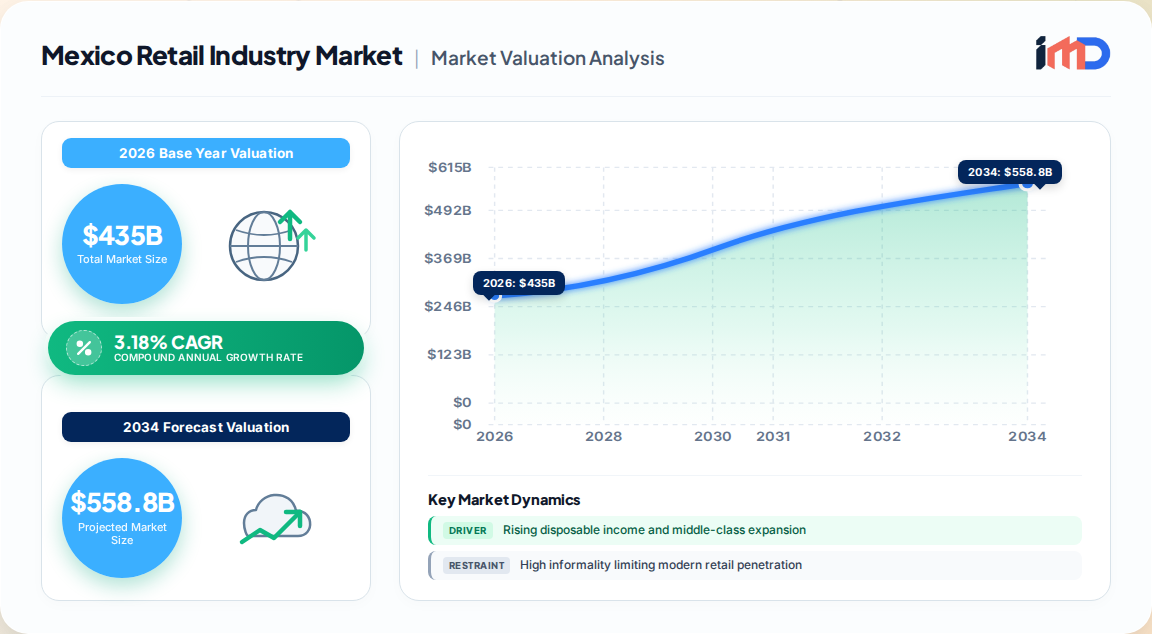
The Mexico retail industry market is a structurally large, consumption-led engine of the national economy. Based on our proprietary primary research and expert interview program, the market is valued at USD 435 Billion in 2026, rising to USD 450.3 Billion in 2027, and projected to reach USD 526.7 Billion by 2032, representing a CAGR of 3.18% over the 2027–2032 forecast window.
Growth is anchored in two durable forces: rising real labor income and the widening acceptance of digital payments among micro and small merchants. Real labor income per capita rose 8% year over year in Q2 2026, expanding household purchasing power after inflation. Simultaneously, financial-inclusion programs have enabled more than one million micro, small, and midsize enterprises to accept digital payments, pulling previously cash-only commerce into measurable retail channels.
The market remains only moderately concentrated. Modern-trade banners, convenience chains, and department stores compete alongside a vast traditional mom-and-pop base that still commands the largest single channel share. This duality defines pricing, assortment, and distribution strategy across the country.
Our driver-impact analysis quantifies how each force shifts the forecast CAGR. The weighted impacts below reflect our bottom-up demand model and trade-channel interviews.
| Driver | Impact on CAGR | Geographic Relevance | Timeline |
|---|---|---|---|
| Accelerating e-commerce & digital payment adoption | +1.7% | Nationwide | Medium term (2–4 years) |
| Rising disposable income & middle-class expansion | +1.2% | Nationwide | Short term (≤2 years) |
| Rapid roll-out of modern trade formats | +1.0% | Nationwide | Medium term (2–4 years) |
| Near-shoring boom lifting industrial & auto retail | +0.6% | General Escobedo, Nuevo León | Medium term (2–4 years) |
| Front-of-pack labeling driving healthier product mixes | +0.25% | Nationwide | Medium term (2–4 years) |
| Fintech micro-credit unlocking rural consumption | +0.2% | Veracruz, Oaxaca, Chiapas, Puebla, Guerrero | Long term (≥4 years) |
Digital commerce is the single largest marginal driver. Our estimates indicate retail e-commerce sales value grew 19.2% in nominal terms in 2025, supported by expanded merchant acceptance of card and QR payments. Grocery shops, online merchants, and restaurants are the most represented categories among newly digitized small businesses.
Store network expansion complements digital growth. One leading modern-trade operator opened more than 100 Bodega Aurrerá Express stores in 2025 and a further 21 Bodega Aurrerá outlets in Q2 2026, demonstrating that proximity formats remain a primary vehicle for capturing new demand.
Near-shoring creates a parallel industrial and automotive retail opportunity. Mexico recorded 1.14 million new light-vehicle sales from January through September 2026, up 5% year over year, while new automotive-parts capacity in Nuevo León expands the prospective industrial customer base.
| Restraint | Impact on CAGR | Geographic Relevance | Timeline |
|---|---|---|---|
| High informality limits modern retail penetration | –0.75% | Nationwide | Long term (≥4 years) |
| Logistics bottlenecks inflate distribution costs | –0.55% | Nationwide | Medium term (2–4 years) |
| Organized-crime-led retail shrinkage | –0.4% | Nationwide | Short term (≤2 years) |
| CFDI 4.0 e-invoicing compliance burden on SMEs | –0.2% | Nationwide | Short term (≤2 years) |
Informality is the most persistent structural restraint. In a survey of an 800-person online panel conducted in early 2026, 60% of respondents reported choosing pirated or replica products in informal commerce. This price sensitivity caps how much added spending reaches formal retailers in exposed categories such as apparel, footwear, and personal accessories.
Logistics friction is concentrated in peak promotional periods. Parcel shortages during Hot Sale and Buen Fin elevate fulfillment costs, while cheaper replica goods compete directly on price. Together, these forces trim the effective capture rate of incremental consumer spending by formal retail.
Food, beverage, and tobacco products dominate with 49.12% of the 2026 market, reflecting the non-discretionary nature of grocery demand. Electronic and household appliances represent the fastest-growing product segment at a forecast 9.8% CAGR (2027–2032), driven by replacement cycles, credit access, and expanded online assortment.
| Product Segment | 2026 Share / Outlook |
|---|---|
| Food, Beverage & Tobacco Products | 49.12% share (leader) |
| Personal Care & Household Care | Stable, defensive growth |
| Electronic & Household Appliances | Fastest-growing, 9.8% CAGR |
| Apparel, Footwear & Accessories | Exposed to informal competition |
| Furniture, Toys & Hobby | Discretionary, urban-demand linked |
Traditional mom-and-pop retail retains the largest channel share at 39.82% in 2026, underscoring the continued importance of neighborhood commerce. The e-commerce and other digital channels segment is forecast to grow fastest at a 15.04% CAGR (2027–2032), though from a smaller base.
| Retail Channel | 2026 Share / Outlook |
|---|---|
| Traditional Mom & Pop Retail | 39.82% share (leader) |
| Modern Trade Retail | Expanding via new store rollouts |
| E-commerce & Others | Fastest-growing, 15.04% CAGR |
Convenience stores led formats with 28.95% of retail sales in 2026, benefiting from urbanization and demand for speedy, small-basket purchases. Specialty stores are forecast to be the fastest-growing format at a 9.95% CAGR (2027–2032).
| Format | 2026 Share / Outlook |
|---|---|
| Convenience Stores | 28.95% share (leader) |
| Supermarkets & Hypermarkets | Core grocery anchor |
| Specialty Stores | Fastest-growing, 9.95% CAGR |
| Discount & Membership Stores | Value-driven expansion |
The Mexico retail industry is moderately concentrated, with a mix of domestic champions and global operators. Competitive advantage increasingly derives from omnichannel integration, proximity-format density, and supply-chain efficiency.
Key players covered in our analysis include Walmart de México y Centroamérica (Walmex), FEMSA Comercio (OXXO), Organización Soriana, Chedraui, and Liverpool. Each pursues a distinct strategic posture:
Recent developments shaping the competitive field include:
The regulatory environment is a material determinant of assortment strategy. Mexico's NOM-051 phase-three delay began in January 2026 under a revised federal agreement, deferring stricter supplemental nutrition criteria for prepackaged foods and nonalcoholic beverages. The extended adjustment window gives packaged-food suppliers more time to reformulate and re-merchandise products.
Front-of-pack labeling is estimated to contribute +0.25% to CAGR by driving healthier product mixes and reformulation investment. Separately, CFDI 4.0 e-invoicing compliance imposes a short-term administrative burden on SMEs, with an estimated –0.2% CAGR impact, though it also accelerates formalization and digital record-keeping.
Retail demand is geographically uneven, shaped by population density, income levels, and logistics infrastructure. Our directional assessment allocates market activity across four macro-regions.
| Region | Share of Market Activity | Attractiveness Rationale |
|---|---|---|
| Central | 37% | Largest population base, highest modern-trade density, Mexico City hub |
| North | 28% | Near-shoring industrial corridor, higher incomes, automotive retail strength |
| South | 18% | Growing fintech micro-credit access, underserved modern retail |
| West | 17% | Tourism and agribusiness-linked consumption, expanding convenience formats |
The Bajío and northern border states offer the strongest near-term white space for industrial and automotive retail, tied to nearshoring investment. The southern states present long-term upside as fintech micro-credit unlocks rural consumption, though informality and logistics gaps slow modern-trade penetration.
Three opportunity clusters emerge from our segmentation and channel data:
The retail value chain spans manufacturers and importers, national distributors, regional wholesalers, retail banners, and last-mile fulfillment providers. Traditional mom-and-pop outlets often rely on wholesalers and route sales, while modern-trade operators invest in centralized distribution centers and automated fulfillment.
Key structural dynamics include:
Mexico's retail market outlook is one of steady, structurally supported expansion. The 3.18% CAGR through 2032 reflects a mature but modernizing market where digital payments, proximity formats, and nearshoring investment progressively offset informality and logistics friction.
| Aspects | Details |
|---|---|
| Study Period | 2020-2034 |
| Base Year | 2026 |
| Estimated Year | 2026 |
| Forecast Period | 2026-2034 |
| Historical Period | 2020-2025 |
| Growth Rate | CAGR of 3.18% from 2020-2034 |
| Segmentation |
|
By Retail Channel
By Format
| By Geography |
|
The Mexico retail industry market is valued at USD 435 Billion in 2026 and is projected to reach USD 526.7 Billion by 2032, growing at a 3.18% CAGR from 2027 to 2032.
Food, beverage, and tobacco products led the market with a 49.12% share in 2026, while electronic and household appliances are forecast to grow fastest at a 9.8% CAGR through 2032.
Traditional mom-and-pop retail held the largest channel share at 39.82% in 2026, but e-commerce and other digital channels are forecast to grow fastest at a 15.04% CAGR from 2027 to 2032.
Leading players include Walmart de México y Centroamérica (Walmex), FEMSA Comercio (OXXO), Organización Soriana, Chedraui, and Liverpool, operating across grocery, convenience, and department-store formats.
Growth is driven by rising real labor income, which rose 8% year over year in Q2 2026, accelerating e-commerce and digital payment adoption, modern trade rollout, and near-shoring-linked industrial and automotive retail demand.
High informality limits modern retail penetration, logistics bottlenecks inflate distribution costs, organized-crime-led shrinkage erodes margins, and CFDI 4.0 e-invoicing compliance adds an administrative burden on SMEs.
Our rigorous research methodology combines multi-layered approaches with comprehensive quality assurance, ensuring precision, accuracy, and reliability in every market analysis.
| Stakeholder Role | Interview Share (%) |
|---|---|
| Chief Commercial Officer | 25% |
| Retail Operations Director | 30% |
| Category & Procurement Manager | 25% |
| Supply Chain & Logistics Head | 20% |
| Company Type | Representation (%) |
|---|---|
| Modern-trade grocery & convenience chains | 30% |
| Traditional mom-and-pop & wholesale distributors | 25% |
| E-commerce marketplaces & fulfillment providers | 20% |
| CPG manufacturers & importers | 15% |
| Fintech & payment-enablement providers | 10% |

Analyst at Providence Strategic Partners at Petaling Jaya
I have received the report already. Thanks you for your help.it has been a pleasure working with you. Thank you again for a good quality report

Internationalization Director
Yes, as a matter of fact we are totally satisfied with both reports that we have purchased and will continue to do so during this process of the internationalization of our brand.

Head of Product Management and Marketing
We are using your report, and it gave us valuable information."

Regional Director, Marketing and Business Development
We've received the report and have reviewed the content. Overall, it looks great and aligns closely with the data we can verify based on our industry knowledge.

VP of Sales
Thank you very much for sharing the report. I have reviewed it and I am very satisfied with the quality and the insights it provides. It will certainly be valuable for our internal discussions.
 Related Reports
