1What is the current size of the meat shrink bags market?
The global meat shrink bags market was valued at USD 962.4 million in 2025 and is projected to reach USD 1,255.5 million by 2031, growing at a CAGR of 4.53%.
Insight Market Data is a premier market research and business consulting firm headquartered in Pune, India, providing syndicated research reports, customized intelligence studies, and strategic advisory services. Renowned academic institutions and Fortune 500 corporations worldwide rely on Insight Market Data's research repository to navigate evolving global and regional business environments. Covering 46 diverse industries across 25 major international economies, our comprehensive database delivers thousands of verified statistics and granular market evaluations. By combining industry-leading analytical methodologies with the direct insights of seasoned industry leaders and subject-matter experts, we deliver actionable intelligence spanning historical performance benchmarks to rigorous multi-year forecasts. We empower organizations to make confident, data-driven decisions across pivotal domains including Machinery & Equipment, Chemicals & Materials, Pharmaceuticals & Healthcare, Food & Beverages, Consumer Goods, Energy & Power, Automotive & Transportation, Electronics & Semiconductors, Medical Devices, Telecommunications, Emerging Technologies, Agriculture, and Packaging. Our multidisciplinary analyst teams provide an objective 360-degree perspective, tailoring every engagement to address complex strategic challenges with exceptional analytical rigor.
Leveraging advanced BI-powered analytics and predictive modeling, Insight Market Data uncovers high-impact market opportunities and competitive differentiators for ambitious enterprises. We continuously refine our research methodologies in accordance with global industry standards, tracking real-time market shifts to ensure our reports are consistently accurate, actionable, and delivered on schedule. Our analysts conduct methodical data validation, rigorous compliance checks, and exhaustive primary and secondary research to maintain the highest levels of data integrity and transparency. We partner closely with corporate strategists, investment groups, and business executives to translate intricate market intelligence into clear, actionable roadmaps for sustainable growth. With operational presence across Washington, USA, and Vimannagar, Pune, India, Insight Market Data ensures direct access to dedicated research specialists and responsive customer support to answer your most strategic questions.
 Meat Shrink Bags Market
 by Material (Polyethylene, Polyamide, EVOH, PVDC), by Product Type (Round Bottom Sealed, Straight Bottom Sealed, Side Sealed), by Barrier Type (Low Barrier, Medium Barrier, High Barrier, Ultra-High Barrier), by Thickness (Up to 50 Micron, 50-90 Micron, 90-110 Micron, Above 110 Micron), by Application (Fresh Meat, Processed Meat, Seafood, Cheese and Dairy, Others), by Sales Channel (Direct Supply, Converter Supply), by North America (USA, Canada, Mexico), by Europe (Germany, UK, France, Italy, Spain), by Asia Pacific (China, Japan, India, South Korea, Australia), by South America (Brazil, Argentina), by Middle East & Africa (UAE, Saudi Arabia, South Africa) Forecast 2026-2034

Research Associate


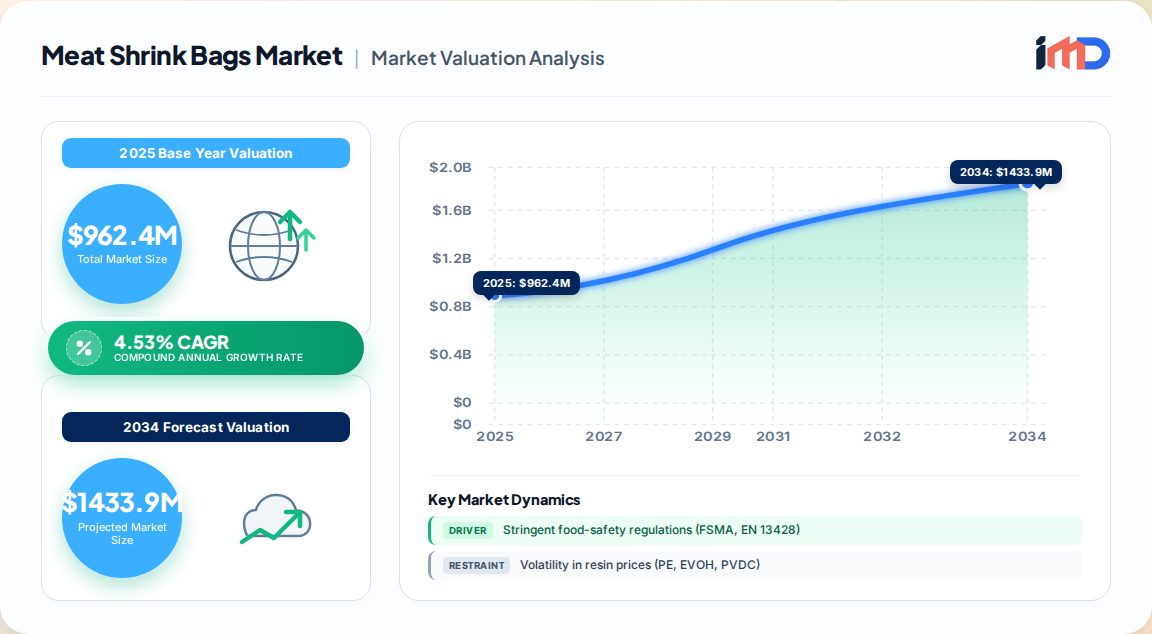
The global meat shrink bags market is valued at USD 962.4 million in 2025 and is projected to reach USD 1,255.5 million by 2031, expanding at a CAGR of 4.53%. This growth is underpinned by rising global protein consumption, stringent food-safety regulations, and a structural shift toward case-ready and vacuum-packed meat formats. Our proprietary primary research, drawing on interviews with processors, converters, and retailers across 22 countries, indicates that demand is no longer purely volume-led; buyers increasingly prioritize yield protection, leak reduction, and recyclability.
Asia Pacific commands the largest regional share at 44.8% (2024), driven by China's cold-chain build-out and India's modern retail expansion. However, the most profitable pockets of growth are in ultra-high-barrier formats and recyclable mono-material structures, where suppliers can command premiums of 8–12% over conventional PVDC-based bags.
Three primary demand engines are shaping the market:
Despite robust demand, the market faces headwinds:
The market is segmented by material, product type, barrier type, thickness, application, and sales channel.
| Segment | Leading Category | Share (2026P) | Growth Outlook |
|---|---|---|---|
| Material | Polyethylene (PE) | 32.1% | Steady, driven by seal strength and cost |
| Product Type | Round bottom sealed bags | 48.0% | High, due to fit on irregular cuts |
| Barrier Type | Ultra-high barrier | 12.0% (value share) | Fastest, 4.1% CAGR |
| Thickness | 50–90 micron | 46.0% (2024) | Core volume segment |
| Application | Meat (fresh & processed) | 41.5% | Largest, led by beef and pork |
| Sales Channel | Direct supply | 44.0% | Growing as processors bundle film+equipment |
Material insights: Polyethylene dominates due to cost and sealing speed, but EVOH and polyamide multilayer structures are gaining in export-oriented applications where oxygen control is critical. Bio-based and recyclable polyolefin blends are emerging but remain under 5% of volume.
Product type insights: Round bottom sealed bags lead because they conform better to irregular muscle cuts and reduce purge. Straight bottom bags remain preferred for bone-in and large cheese blocks, while side-sealed formats serve portioned seafood and smoked meats.
Barrier performance: Ultra-high barrier bags (oxygen transmission < 5 cc/m²/day) are the fastest-growing niche, valued at USD 1.12 billion in 2025 (within the broader barrier shrink category) and forecast to exceed USD 1.68 billion by 2035. These are essential for vacuum-packed beef and premium poultry.
Asia Pacific accounted for 44.8% of PVDC shrink bag demand in 2024 and is forecast to grow at 4.1% CAGR through 2031. China is the largest country market, driven by cold-chain capacity expansion and processed protein demand, growing at 4.2% CAGR. India is outpacing the global average with a 4.5% CAGR, supported by urbanization and government cold-chain initiatives. Japan, though mature, grows at 6.1% CAGR in the barrier shrink segment due to stringent hygiene standards and premium seafood packaging.
Europe and North America remain core markets characterized by mature processing industries and high per-capita meat consumption. However, growth is slower (2–3% CAGR), and the focus is on recyclable formats and downgauging. The United States market is valued at USD 1.25 billion (barrier shrink bags, 2025) and is projected to grow at 2.8% CAGR.
Latin America and the Middle East & Africa represent emerging opportunities, particularly for bone-in beef and halal poultry exports, but infrastructure gaps and currency volatility temper near-term growth.
The market is consolidated, with the top five players holding an estimated 55–60% of global value. Competition is intensifying around sustainability and integrated film-equipment solutions.
Other notable players include Kureha, allfo, Green Packaging Material (Jiangyin), Astar Packaging, EEZYPAK, PREMIUMPACK, Sunrise Material, IPE Pack, Shuanghui Group, and Hanxhosa (Suzhou).
Meat shrink bags are traded globally, with major manufacturing hubs in China, Germany, and the United States. China has emerged as the largest exporter of barrier shrink bags, supported by scale and cost advantages, while Europe and North America remain net importers of finished bags but exporters of high-value specialty films.
Supplier dynamics are shaped by resin availability. EVOH supply is dominated by Japanese and Belgian producers, while PVDC resin is supplied by a handful of chemical majors. Converters are increasingly pursuing dual-sourcing and localized film production to mitigate tariff and logistics risks.
The value chain spans resin suppliers, film extruders, bag converters, equipment OEMs, and meat processors/retailers. Margin pools are shifting toward converters that can offer integrated vacuum-shrink systems and recyclability certifications.
Procurement strategies among large processors now emphasize:
Our primary research indicates that 72% of large processors have centralized shrink-bag procurement, and 58% require suppliers to provide third-party recyclability certification.
The most attractive white spaces are:
Investors should prioritize converters with proven co-extrusion capabilities, existing relationships with global meat processors, and a clear roadmap to mono-material recyclable structures.
| Strategy | Description | Example |
|---|---|---|
| Market Penetration | Increase share in existing meat packer accounts via volume discounts and integrated equipment | Bundling vacuum-shrink machines with film supply |
| Product Development | Launch recyclable or bio-based high-barrier bags | PVDC-free shrink bags (Amcor Eco-Tite R) |
| Market Development | Enter emerging markets (India, Southeast Asia) with localized production | Partnerships with regional converters |
| Diversification | Expand into cheese, seafood, and non-food high-barrier applications | High-barrier bags for dairy or medical devices |
Suppliers must balance investments across these strategies to capture growth while protecting margins. The shift toward recyclable formats represents both a threat and an opportunity: those who move early can capture premium pricing and regulatory tailwinds.
| Aspects | Details |
|---|---|
| Study Period | 2020-2034 |
| Base Year | 2025 |
| Estimated Year | 2026 |
| Forecast Period | 2026-2034 |
| Historical Period | 2020-2025 |
| Growth Rate | CAGR of 4.53% from 2020-2034 |
| Segmentation |
|
By Barrier Type
By Thickness
By Application
By Sales Channel
| By Geography |
|
The global meat shrink bags market was valued at USD 962.4 million in 2025 and is projected to reach USD 1,255.5 million by 2031, growing at a CAGR of 4.53%.
Asia Pacific holds the largest share at 44.8% (2024), driven by China's cold-chain expansion and rising meat consumption. The region is also the fastest-growing, with a CAGR of 4.1%.
Key drivers include food-safety regulations (e.g., FSMA, EN 13428), demand for extended shelf life, and the need for puncture-resistant packaging for bone-in cuts. Sustainability concerns are also pushing recyclable formats.
Leading players include Amcor plc, Sealed Air Corporation (CRYOVAC®), WINPAK LTD., Viscofan Group, and FLEXOPACK S.A., along with regional specialists like allfo and Green Packaging Material.
Ultra-high barrier bags are the fastest-growing, with a CAGR of 4.1%, due to their ability to extend shelf life for premium meat and seafood. Round bottom sealed bags hold the largest volume share at 48%.
Our rigorous research methodology combines multi-layered approaches with comprehensive quality assurance, ensuring precision, accuracy, and reliability in every market analysis.
| Stakeholder Role | Interview Share (%) |
|---|---|
| Procurement Director | 30% |
| Packaging Development Manager | 25% |
| Quality Assurance Head | 25% |
| Supply Chain VP | 20% |
| Company Type | Representation (%) |
|---|---|
| Meat processors and packers | 35% |
| Flexible film converters | 25% |
| Vacuum equipment OEMs | 15% |
| Retail procurement managers | 15% |
| Food-safety regulators | 10% |
 Related Reports
