1What is the market size of oxygen analyzers for industrial gas in 2026?
The global oxygen analyzer market for industrial gas is valued at USD 2.28 billion in 2026 and is projected to reach USD 3.98 billion by 2032, growing at a 9.4% CAGR.
Insight Market Data is a premier market research and business consulting firm headquartered in Pune, India, providing syndicated research reports, customized intelligence studies, and strategic advisory services. Renowned academic institutions and Fortune 500 corporations worldwide rely on Insight Market Data's research repository to navigate evolving global and regional business environments. Covering 46 diverse industries across 25 major international economies, our comprehensive database delivers thousands of verified statistics and granular market evaluations. By combining industry-leading analytical methodologies with the direct insights of seasoned industry leaders and subject-matter experts, we deliver actionable intelligence spanning historical performance benchmarks to rigorous multi-year forecasts. We empower organizations to make confident, data-driven decisions across pivotal domains including Machinery & Equipment, Chemicals & Materials, Pharmaceuticals & Healthcare, Food & Beverages, Consumer Goods, Energy & Power, Automotive & Transportation, Electronics & Semiconductors, Medical Devices, Telecommunications, Emerging Technologies, Agriculture, and Packaging. Our multidisciplinary analyst teams provide an objective 360-degree perspective, tailoring every engagement to address complex strategic challenges with exceptional analytical rigor.
Leveraging advanced BI-powered analytics and predictive modeling, Insight Market Data uncovers high-impact market opportunities and competitive differentiators for ambitious enterprises. We continuously refine our research methodologies in accordance with global industry standards, tracking real-time market shifts to ensure our reports are consistently accurate, actionable, and delivered on schedule. Our analysts conduct methodical data validation, rigorous compliance checks, and exhaustive primary and secondary research to maintain the highest levels of data integrity and transparency. We partner closely with corporate strategists, investment groups, and business executives to translate intricate market intelligence into clear, actionable roadmaps for sustainable growth. With operational presence across Washington, USA, and Vimannagar, Pune, India, Insight Market Data ensures direct access to dedicated research specialists and responsive customer support to answer your most strategic questions.
 Markets Driving Oxygen Analyzers for Industrial Gas Market
 by Technology (Electrochemical, Paramagnetic, Zirconia, Optical/Laser), by Product (In-Line, Panel Mounted, Portable), by End User (Chemicals & Petrochemicals, Healthcare, Oil & Gas, Power Generation, Steel & Metallurgy, Electronics, Food & Beverages), by Application (Process Monitoring, Quality Control, Research & Development, Safety & Environmental), by North America (USA, Canada, Mexico), by Europe (Germany, UK, France, Italy, Spain, Rest of Europe), by Asia Pacific (China, Japan, India, South Korea, Australia, Rest of Asia Pacific), by South America (Brazil, Argentina, Rest of South America), by Middle East & Africa (Saudi Arabia, UAE, South Africa, Rest of MEA) Forecast 2026-2034

Research Analyst


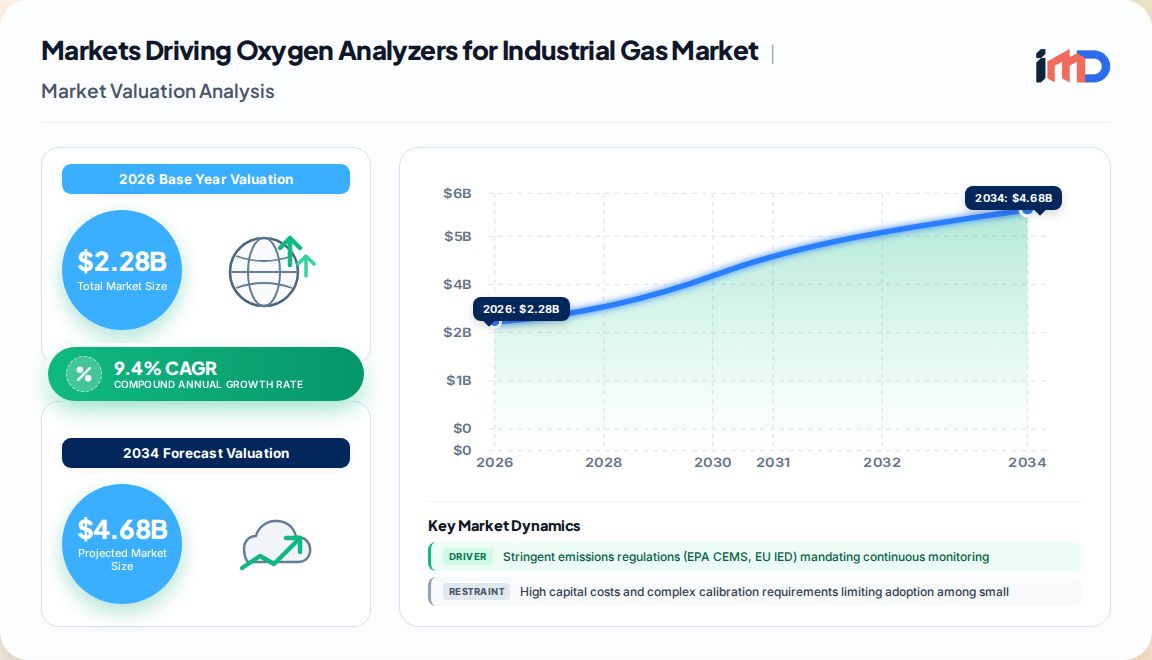
The oxygen analyzer market for industrial gas is experiencing a structural uplift, transitioning from auxiliary quality-check instrumentation to a core enabler of process integrity, safety, and regulatory compliance. Our proprietary primary research estimates the market at USD 2.28 billion in 2026, expanding to USD 3.98 billion by 2032, registering a 9.4% CAGR. This growth outpaces the broader industrial gas market (projected at a 4.4% CAGR from 2026 to 2033) and the general gas analyzer market (6.5% CAGR), reflecting a distinct premium on oxygen-specific measurement precision across high-value manufacturing and energy applications.
Oxygen analyzers are no longer confined to spot checks; they are being embedded into continuous process control loops, emissions monitoring architectures, and safety instrumented systems. The industrial gas sector—dominated by oxygen as the largest product segment with 38.5% revenue share—increasingly relies on trace and process oxygen analyzers to validate gas purity, optimize combustion, and prevent contamination in semiconductor, pharmaceutical, and metal fabrication workflows. This report dissects the demand drivers, technology shifts, and regional dynamics shaping this specialized market, providing decision-grade intelligence for OEMs, industrial gas producers, and EPC contractors.
The oxygen analyzer market for industrial gas is segmented by technology, product form factor, and end-use application. Electrochemical analyzers dominate, accounting for approximately 40% of product-type demand in 2026, favored for their practical accuracy, lower cost, and familiar calibration protocols. However, optical and laser-based technologies (TDLAS, QCL) are gaining traction in high-value segments, commanding 3x–5x pricing premiums due to superior stability, faster response, and immunity to cross-sensitivity—critical for semiconductor and pharmaceutical applications.
| Technology | Share (2026) | Key Advantages | Primary Applications |
|---|---|---|---|
| Electrochemical | ~40% | Low cost, compact, proven reliability | Process monitoring, safety, portable field checks |
| Paramagnetic | ~25% | High accuracy, stable in harsh environments | Combustion control, industrial gas purity |
| Zirconia | ~20% | High-temperature tolerance, fast response | Furnace atmospheres, emissions monitoring |
| Optical/Laser | ~15% | No drift, multi-gas capability, digital integration | Semiconductor, pharma, R&D, CEMS |
Portable analyzers are projected to account for 45% of portability-type demand in 2026, driven by the need for on-site inspections, emergency response, and multi-site validation in oil & gas, pharmaceuticals, and environmental monitoring. Benchtop and fixed analyzers remain dominant in continuous process environments, particularly in cleanrooms, power plants, and air separation units where high-volume, uninterrupted analysis is required.
Asia-Pacific is the largest and fastest-growing regional market, holding 42% of global demand in 2026. The region's growth is fueled by rapid industrialization in China, India, and South Korea, coupled with massive investments in semiconductor fabrication and stricter emissions monitoring. China's mandatory online monitoring for over 320,000 enterprises and India's NCAP (National Clean Air Programme) are direct procurement triggers. Japan, in particular, is the fastest-growing country-level market for trace oxygen analyzers, with a 7.5% CAGR through 2036.
Europe represents a mature but steady market, with stringent regulations such as the IED and the revised EU Ambient Air Quality Directive driving replacement demand and upgrades to higher-precision analyzers. The region accounted for 41.7% of the broader industrial gas market in 2025, and its emphasis on clean manufacturing and carbon reduction ensures sustained investment in oxygen measurement for combustion optimization and emissions control. North America, led by the U.S., focuses on EPA CEMS compliance and process safety in oil & gas and chemicals. The U.S. is also a major market for portable analyzers used in environmental monitoring and pharmaceutical production. South America and the Middle East & Africa are emerging markets, with growth concentrated in oil & gas, mining, and power generation, though cost sensitivity remains a barrier to widespread adoption of premium technologies.
The market is characterized by a mix of established instrumentation majors and specialized sensor providers. Key players include Emerson Electric Co., Yokogawa Electric Corporation, AMETEK, Inc., Teledyne Technologies, and Horiba, among others. Competition is intensifying around sensor reliability, digital diagnostics, and lifecycle support. Suppliers that can offer connected analyzers with predictive maintenance capabilities and seamless integration into DCS/PLC systems are gaining preference, particularly in regulated industries.
Procurement strategies have shifted post-2025, with U.S. tariffs prompting stricter vendor qualification, dual-sourcing, and platform standardization. Industrial gas operators are increasingly evaluating total cost of ownership, favoring suppliers with local service networks and remote diagnostic capabilities. The trend toward turnkey packaged analyzer systems, including sample handling and filtration, is growing, as end-users seek to minimize integration risk and downtime.
The value chain for oxygen analyzers spans raw material suppliers (sensors, electronics, specialty metals), analyzer OEMs, system integrators, and end-users (industrial gas producers, chemical plants, healthcare facilities). Critical components such as zirconia sensors and optical fibers are subject to supply chain bottlenecks, particularly given geopolitical tensions and export controls on advanced semiconductors. The 2025 U.S. tariffs have further complicated sourcing, encouraging regionalization of manufacturing and inventory buffering.
Global trade in oxygen analyzers is dominated by intra-regional flows, with Europe and North America serving as major export hubs for high-value analytical instruments. Asia-Pacific is the largest import destination, reflecting its manufacturing growth and reliance on advanced instrumentation from Western suppliers. According to UN Comtrade data, global exports of gas and smoke analyzers (HS code 9027.10) exceeded USD 8 billion in 2023, with China, Germany, and the U.S. as leading exporters. However, precise oxygen analyzer trade data is fragmented within this category. Key supplier dynamics include:
Several underpenetrated opportunities exist for stakeholders:
The oxygen analyzer market for industrial gas is poised for robust growth, underpinned by regulatory mandates, industrial digitalization, and the expanding scope of oxygen purity requirements across high-tech manufacturing. With a 9.4% CAGR and a trajectory toward USD 3.98 billion by 2032, the market offers significant opportunities for suppliers that can combine precision, connectivity, and lifecycle support. Strategic focus on Asia-Pacific, investment in digital diagnostics, and proactive supply chain resilience will be decisive for capturing value in this evolving landscape.
| Aspects | Details |
|---|---|
| Study Period | 2020-2034 |
| Base Year | 2026 |
| Estimated Year | 2026 |
| Forecast Period | 2026-2034 |
| Historical Period | 2020-2025 |
| Growth Rate | CAGR of 9.4% from 2020-2034 |
| Segmentation |
|
 Related Reports

By End User
By Application
| By Geography |
|
The global oxygen analyzer market for industrial gas is valued at USD 2.28 billion in 2026 and is projected to reach USD 3.98 billion by 2032, growing at a 9.4% CAGR.
Asia-Pacific is the largest and fastest-growing region, accounting for approximately 42% of global demand in 2026, driven by industrialization and stringent emissions monitoring in China, India, and Japan.
Key drivers include tightening emissions regulations (such as the EU IED and U.S. EPA CEMS), rising healthcare and pharmaceutical demand, and the expansion of semiconductor manufacturing requiring ultra-trace oxygen monitoring.
Electrochemical analyzers dominate with approximately 40% market share in 2026, favored for their cost-effectiveness and reliability, though optical and laser-based technologies are gaining traction in high-precision applications.
Leading companies include Emerson Electric Co., Yokogawa Electric Corporation, AMETEK, Inc., Teledyne Technologies Incorporated, and Horiba, among others.
Our rigorous research methodology combines multi-layered approaches with comprehensive quality assurance, ensuring precision, accuracy, and reliability in every market analysis.
| Stakeholder Role | Interview Share (%) |
|---|---|
| Product Managers | 35% |
| Procurement Directors | 25% |
| Process Control Engineers | 25% |
| Regulatory Compliance Officers | 15% |
| Company Type | Representation (%) |
|---|---|
| Analyzer OEMs | 30% |
| Industrial Gas Producers | 25% |
| EPC Contractors | 20% |
| System Integrators | 15% |
| Regulatory & Standards Bodies | 10% |