1What is the current size of the maritime software market?
Our primary research estimates the global maritime software market at USD 4.96 billion in 2026, growing at a CAGR of 8.95% to reach USD 7.61 billion by 2031.
Insight Market Data is a premier market research and business consulting firm headquartered in Pune, India, providing syndicated research reports, customized intelligence studies, and strategic advisory services. Renowned academic institutions and Fortune 500 corporations worldwide rely on Insight Market Data's research repository to navigate evolving global and regional business environments. Covering 46 diverse industries across 25 major international economies, our comprehensive database delivers thousands of verified statistics and granular market evaluations. By combining industry-leading analytical methodologies with the direct insights of seasoned industry leaders and subject-matter experts, we deliver actionable intelligence spanning historical performance benchmarks to rigorous multi-year forecasts. We empower organizations to make confident, data-driven decisions across pivotal domains including Machinery & Equipment, Chemicals & Materials, Pharmaceuticals & Healthcare, Food & Beverages, Consumer Goods, Energy & Power, Automotive & Transportation, Electronics & Semiconductors, Medical Devices, Telecommunications, Emerging Technologies, Agriculture, and Packaging. Our multidisciplinary analyst teams provide an objective 360-degree perspective, tailoring every engagement to address complex strategic challenges with exceptional analytical rigor.
Leveraging advanced BI-powered analytics and predictive modeling, Insight Market Data uncovers high-impact market opportunities and competitive differentiators for ambitious enterprises. We continuously refine our research methodologies in accordance with global industry standards, tracking real-time market shifts to ensure our reports are consistently accurate, actionable, and delivered on schedule. Our analysts conduct methodical data validation, rigorous compliance checks, and exhaustive primary and secondary research to maintain the highest levels of data integrity and transparency. We partner closely with corporate strategists, investment groups, and business executives to translate intricate market intelligence into clear, actionable roadmaps for sustainable growth. With operational presence across Washington, USA, and Vimannagar, Pune, India, Insight Market Data ensures direct access to dedicated research specialists and responsive customer support to answer your most strategic questions.
 Maritime Software
 by Solution Type (Vessel/Fleet Management Software, Port and Terminal Management, Commercial and Voyage Management, Crew Management, Vessel Performance, Navigation and Emissions Compliance, Compliance and Risk Reporting, Others), by Deployment Mode (Cloud/SaaS, On-Premises, Onboard Installed), by Enterprise Size (SMEs, Large Enterprises), by Location (Onboard Systems, Onshore/Shore-side Systems), by End-User (Commercial Shipping, Offshore Energy and OSVs, Ports and Terminal Operators, Navies, Coast Guards and Government, Charterers, Operators and Commodity Traders, Others), by North America (USA, Canada, Mexico), by Europe (Germany, UK, France, Norway, Greece, Denmark), by Asia Pacific (China, Japan, Singapore, Hong Kong, Republic of Korea), by Middle East & Africa (UAE, Saudi Arabia, Egypt, South Africa), by South America (Brazil, Panama, Mexico, Chile) Forecast 2026-2034

Senior Research Analyst


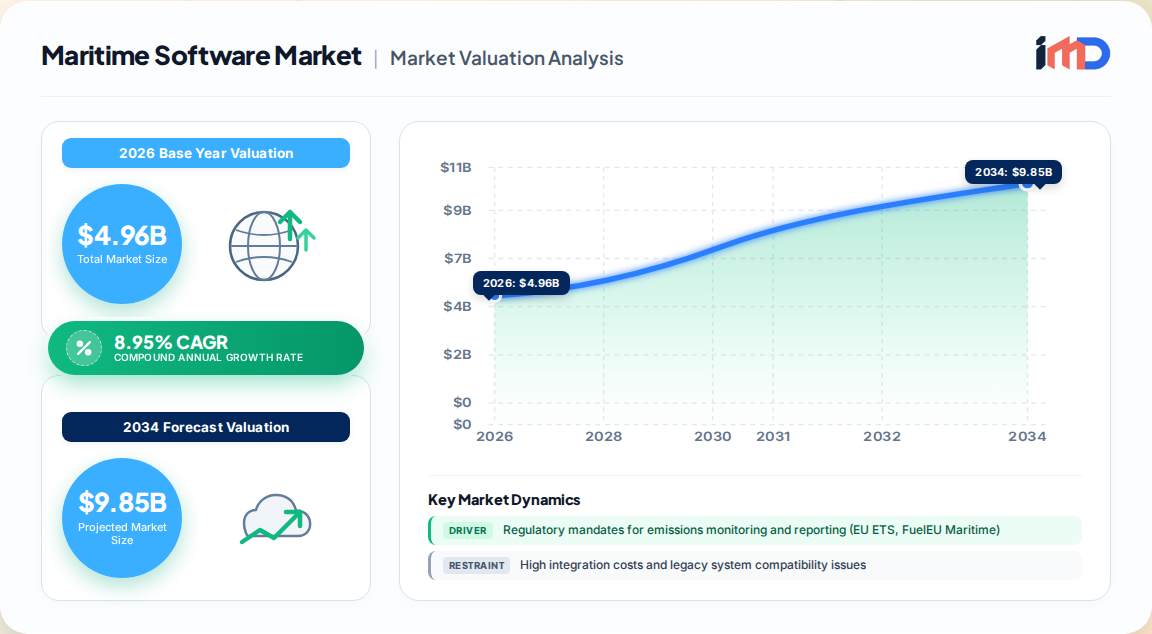
The global maritime software market is undergoing a structural transformation, driven by an unprecedented convergence of regulatory mandates, technological maturation, and operational necessity. Our proprietary primary research estimates the market at USD 4.96 billion in 2026, projected to reach USD 7.61 billion by 2031, expanding at a CAGR of 8.95%. This growth is not merely a continuation of historical trends but represents a fundamental shift in how shipowners, operators, and port authorities invest in digital infrastructure.
The market's trajectory is shaped by three powerful forces. First, the European Union's Emissions Trading System (EU ETS) and FuelEU Maritime have moved emissions reporting from a voluntary best practice to a legal obligation with direct financial consequences. Second, the rapid adoption of cloud-native platforms is democratizing access to advanced analytics for small and medium-sized enterprises (SMEs), broadening the addressable market. Third, the integration of artificial intelligence (AI) and the Internet of Things (IoT) is delivering tangible ROI through fuel savings and predictive maintenance, moving software from a cost center to a profit enabler.
Our analysis indicates that the market is transitioning from a fragmented landscape of point solutions toward integrated platforms. Vendors that can offer end-to-end compliance, voyage optimization, and fleet management capabilities are gaining share, while niche providers face pressure to specialize or partner. This report provides a comprehensive, data-driven examination of the maritime software market, including segmentation, regional dynamics, competitive strategies, and future growth opportunities.
The maritime software market is propelled by several interconnected drivers, each with a quantifiable impact on growth.
Regulatory Compliance Mandates (Impact: +2.8% CAGR): The EU ETS requires shipping companies to surrender allowances for 40% of 2024 emissions in 2025, 70% of 2025 emissions in 2026, and 100% from 2027. This necessitates precise, voyage-level fuel and emissions data, which cannot be managed via spreadsheets. Consequently, demand for compliance and risk reporting software is surging, with this segment growing at a 12.95% CAGR through 2031.
Fuel Efficiency and Cost Optimization (Impact: +1.7% CAGR): Fuel represents up to 60% of a vessel's operating costs. Predictive analytics and dynamic route optimization tools, such as those employing AI-driven weather routing, can reduce bunker consumption by as much as 8%. This directly improves margins and accelerates the payback period for software investments.
Cloud Adoption and SaaS Economics (Impact: +1.4% CAGR): Cloud-based deployments captured 54.88% of the market in 2025 and are growing at a 15.05% CAGR. The subscription model lowers upfront costs, enabling SMEs to adopt advanced tools. This is particularly significant as the SME segment is growing at 11.75% CAGR, outpacing large enterprises.
Fleet Expansion and Maritime Trade Growth (Impact: +2.1% CAGR): Despite short-term volatility, global seaborne trade continues to expand. Asia generated 42% of global seaborne exports in 2024, and the orderbook for alternatively-fuelled ships reached 49% of new orders. This creates a growing installed base of vessels requiring sophisticated management software.
However, the market faces notable restraints:
High Integration Costs and Legacy Compatibility (Impact: -1.8% CAGR): Retrofitting older vessels with modern sensors and integrating disparate legacy systems remains a significant barrier, particularly for cost-sensitive operators.
Cybersecurity Vulnerabilities (Impact: -1.2% CAGR): The convergence of operational technology (OT) and information technology (IT) exposes vessels and ports to cyber threats. The US Coast Guard cybersecurity rule, effective July 2025, mandates cyber plans for US-flag vessels, adding compliance burden but also driving security software spending.
Lack of Skilled Personnel (Impact: -0.9% CAGR): A global shortage of officers and digitally trained crew limits the effective utilization of advanced software, slowing adoption in some regions.
The maritime software market is segmented by solution type, deployment mode, enterprise size, location, and end-user. Our analysis reveals clear winners within each category.
| Segment | Dominant Sub-Segment (2025 Share) | Fastest-Growing Sub-Segment (CAGR) |
|---|---|---|
| Solution Type | Vessel & Fleet Management (41.85%) | Compliance & Risk Reporting (12.95%) |
| Deployment Mode | Cloud (54.88%) | Cloud (15.05%) |
| Enterprise Size | Large Enterprises (61.05%) | SMEs (11.75%) |
| Location | Shore-side (63.35%) | Onboard Systems (11.30%) |
| End-User | Commercial Shipping (67.21%) | Offshore Energy & OSVs (13.75%) |
Solution Type: Vessel and fleet management suites remain the revenue backbone, but compliance and risk reporting is the fastest-growing segment, driven by regulatory pressures. Integrated platforms that combine voyage optimization, maintenance scheduling, and compliance reporting are becoming the preferred choice.
Deployment Mode: Cloud platforms have already achieved majority share and are growing at nearly three times the rate of on-premises solutions. The SaaS model is particularly attractive to SMEs and operators with heterogeneous fleets.
Enterprise Size: While large operators dominate revenue, SMEs are the growth engine, fueled by cloud-based offerings that lower barriers to entry.
Location: Shore-side systems account for the bulk of spending, but onboard systems are growing faster as real-time data collection and edge analytics become more critical for compliance and performance monitoring.
End-User: Commercial shipping is the largest end-user, but offshore energy and offshore support vessels (OSVs) represent the fastest-growing vertical, driven by complex logistical requirements and harsh operating environments.
North America currently leads the market with 38.85% revenue share in 2025, supported by early adoption of advanced technologies, a strong vendor ecosystem, and stringent cybersecurity regulations. The US Coast Guard's cyber rule is a key driver, requiring cybersecurity plans for US-flag vessels and port facilities.
Europe is the second-largest market, closely tied to Asia-Pacific, and is characterized by the most stringent environmental regulations. The EU ETS and FuelEU Maritime are mandatory for ships calling at EU ports, forcing widespread adoption of emissions monitoring and compliance software. Europe is home to several leading vendors and benefits from a high concentration of shipowners in Greece, Norway, and Germany.
Asia-Pacific is the fastest-growing region, projected to expand at a 16.25% CAGR through 2031. The region accounts for 56% of world carrying capacity and 60% of container throughput. Rapid shipbuilding activity in China, Japan, and South Korea, coupled with government-backed digital port initiatives, is driving demand. Lower-priced domestic software in China keeps average spend per vessel lower, but the sheer volume of vessels ensures robust revenue growth.
South America and the Middle East & Africa are smaller but growing markets, primarily driven by port modernization projects and single-window initiatives. The IMO's requirement for Maritime Single Windows from January 2024 has catalyzed investment in port community systems across these regions.
The maritime software market is moderately concentrated, with established players competing alongside specialized niche providers. Key players include Oracle Corporation, ABB Ltd., Wärtsilä Voyage, DNV (ShipManager/CFARER), Navis (Kaleris), Kongsberg Maritime, Veson Nautical, ZeroNorth, NAPA, and Lloyd's Register. The competitive dynamic is shifting from standalone products to integrated platforms that can deliver a unified view of fleet operations, compliance, and performance.
Recent strategic developments underscore this trend. DNV spun out its ShipManager platform as CFARER in August 2025 to focus on digital solutions. Kongsberg Maritime listed on Euronext Oslo Børs in April 2026, raising capital for further innovation. Veson Nautical launched its unified Veson Platform in June 2026, integrating commercial and operational modules. Wärtsilä acquired SMarT Solutions in February 2025 to expand its crew management and voyage optimization portfolio. Inmarsat partnered with ShipNet in March 2025 to integrate satellite connectivity with crew management software.
Our primary research indicates that vendors are prioritizing:
The maritime software value chain comprises four primary levels:
The value chain is evolving as software providers increasingly offer bundled solutions that include analytics and consulting services. This trend is blurring the lines between software vendors and service providers, creating new opportunities for differentiation.
The maritime software market is not a traditional commodity market; it is a knowledge-intensive, IP-driven sector. As such, import/export dynamics are less about physical goods and more about cross-border software licensing, data flows, and service delivery. However, several supply-side factors are relevant.
Our analysis identifies several underpenetrated areas that represent significant opportunities for vendors:
| Aspects | Details |
|---|---|
| Study Period | 2020-2034 |
| Base Year | 2026 |
| Estimated Year | 2026 |
| Forecast Period | 2026-2034 |
| Historical Period | 2020-2025 |
| Growth Rate | CAGR of 8.95% from 2020-2034 |
| Segmentation |
|
By Deployment Mode
By Enterprise Size
By Location
By End-User
| By Geography |
|
Our primary research estimates the global maritime software market at USD 4.96 billion in 2026, growing at a CAGR of 8.95% to reach USD 7.61 billion by 2031.
Asia-Pacific is the fastest-growing region, projected to expand at a 16.25% CAGR through 2031, driven by shipbuilding activity, port modernization, and government digital initiatives.
Key drivers include regulatory compliance mandates (EU ETS, FuelEU Maritime), fuel efficiency and cost optimization, cloud adoption, and fleet expansion. Compliance and risk reporting software is growing at 12.95% CAGR.
Leading vendors include Oracle Corporation, ABB Ltd., Wärtsilä Voyage, DNV (CFARER), Navis (Kaleris), Kongsberg Maritime, Veson Nautical, ZeroNorth, NAPA, and Lloyd's Register.
The EU ETS requires precise emissions reporting and has made compliance software mission-critical. It is a major driver, contributing an estimated +2.8% to the market's CAGR, as shipowners must surrender allowances for 100% of emissions from 2027.
Our rigorous research methodology combines multi-layered approaches with comprehensive quality assurance, ensuring precision, accuracy, and reliability in every market analysis.
| Stakeholder Role | Interview Share (%) |
|---|---|
| Fleet Manager | 30% |
| IT Director | 25% |
| Operations Head | 25% |
| Compliance Officer | 20% |
| Company Type | Representation (%) |
|---|---|
| Ship Owners and Ship Managers | 35% |
| Port and Terminal Operators | 20% |
| Software Vendors and Technology Providers | 25% |
| Charterers and Commodity Traders | 12% |
| Maritime Regulatory Bodies | 8% |
 Related Reports
