1How big is the Make Up Artist Service market in 2025?
Our first-party modeling values the global Make Up Artist Service market at USD 6.93 Billion in 2025, with a projected expansion to USD 12 Billion by 2035 at a 5.6% CAGR.
Insight Market Data is a premier market research and business consulting firm headquartered in Pune, India, providing syndicated research reports, customized intelligence studies, and strategic advisory services. Renowned academic institutions and Fortune 500 corporations worldwide rely on Insight Market Data's research repository to navigate evolving global and regional business environments. Covering 46 diverse industries across 25 major international economies, our comprehensive database delivers thousands of verified statistics and granular market evaluations. By combining industry-leading analytical methodologies with the direct insights of seasoned industry leaders and subject-matter experts, we deliver actionable intelligence spanning historical performance benchmarks to rigorous multi-year forecasts. We empower organizations to make confident, data-driven decisions across pivotal domains including Machinery & Equipment, Chemicals & Materials, Pharmaceuticals & Healthcare, Food & Beverages, Consumer Goods, Energy & Power, Automotive & Transportation, Electronics & Semiconductors, Medical Devices, Telecommunications, Emerging Technologies, Agriculture, and Packaging. Our multidisciplinary analyst teams provide an objective 360-degree perspective, tailoring every engagement to address complex strategic challenges with exceptional analytical rigor.
Leveraging advanced BI-powered analytics and predictive modeling, Insight Market Data uncovers high-impact market opportunities and competitive differentiators for ambitious enterprises. We continuously refine our research methodologies in accordance with global industry standards, tracking real-time market shifts to ensure our reports are consistently accurate, actionable, and delivered on schedule. Our analysts conduct methodical data validation, rigorous compliance checks, and exhaustive primary and secondary research to maintain the highest levels of data integrity and transparency. We partner closely with corporate strategists, investment groups, and business executives to translate intricate market intelligence into clear, actionable roadmaps for sustainable growth. With operational presence across Washington, USA, and Vimannagar, Pune, India, Insight Market Data ensures direct access to dedicated research specialists and responsive customer support to answer your most strategic questions.
 Make Up Artist Service
 by Service Type (Bridal Makeup, Fashion Makeup, Special Effects Makeup, Corporate Makeup, Editorial Makeup, Theatrical Makeup), by Client Type (Individual Clients, Event Planners, Corporate Clients, Fashion Industry, Film and Television), by Application Area (Weddings, Photoshoots, Fashion Shows, Film Productions, Theatrical Performances, Personal Events), by Duration of Service (Short Term, Medium Term, Long Term), by Service Mode (On-site Services, Studio Services), by North America (USA, Canada, Mexico), by Europe (Germany, UK, France, Italy), by Asia Pacific (China, Japan, India, South Korea), by South America (Brazil, Argentina), by Middle East & Africa (UAE, Saudi Arabia, South Africa) Forecast 2026-2034
Senior Analyst


 Related Reports

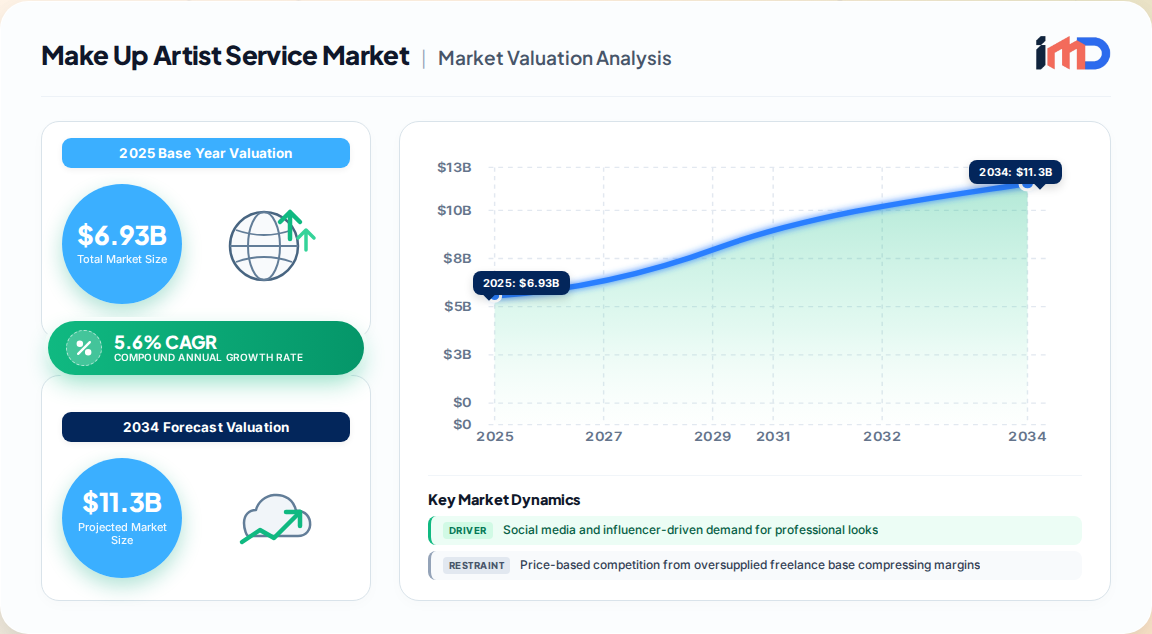
The Make Up Artist Service market represents one of the most resilient and rapidly professionalizing segments of the global beauty and personal care economy. Our proprietary bottom-up modeling places the global market at USD 6.93 Billion in 2025, on a trajectory to reach USD 12 Billion by 2035, expanding at a CAGR of 5.6% across the 2026–2035 forecast window.
This growth unfolds against a broader beauty and personal care backdrop that generated over USD 625 Billion in global revenue in 2023 and is projected to approach USD 736 Billion by 2028. Professional makeup artistry is capturing a rising share of that value pool as consumers shift spending from products alone toward applied expertise — the service layer where technique, personalization, and occasion-specific execution command premium pricing.
Key structural characteristics of the current market:
Highly fragmented supply base: No single enterprise holds more than 5% share of service revenue in major markets, with independent artists, mobile agencies, salon networks, and brand-operated studios competing across price tiers.
Occasion-led demand concentration: Bridal and personal-event services anchor volume, while film, television, editorial, and fashion-week work anchors prestige pricing and trend influence.
Digital intermediation accelerating: Booking platforms, virtual consultations, and augmented-reality try-on tools are compressing customer acquisition costs and expanding geographic reach for freelance artists.
Premiumization of the bridal and event segment: Rising wedding expenditure globally, particularly in culturally ceremonial markets, sustains high-margin, multi-session service bundles.
Bridal makeup remains the dominant service type, followed by fashion and special-effects artistry.
Personal events constitute the largest application cluster, with professional events and media/entertainment as secondary demand engines.
On-site (mobile) service delivery is gaining share over studio-based service as clients prioritize convenience and destination-event flexibility.
Demand-side momentum is being shaped by four reinforcing forces. First, social media and influencer culture have converted makeup artistry from a backstage craft into a visible, aspirational consumer service — driving replication demand for trend-led looks. Second, the global expansion of the wedding and destination-event industry creates recurring, high-ticket demand. Third, rising disposable income in emerging Asia-Pacific economies is democratizing access to professional services beyond elite clientele. Fourth, technological enablement — mobile booking, AR visualization, and virtual consultations — reduces friction across the discovery-to-purchase journey.
| Growth Driver | Primary Mechanism | Relative Impact |
|---|---|---|
| Social media & influencer culture | Trend replication, tutorial-driven demand | High |
| Wedding & event industry expansion | High-value recurring occasion spend | High |
| Rising emerging-market disposable income | Volume expansion of first-time clients | Medium-High |
| AR/virtual consultation tools | Conversion uplift, reduced trial risk | Medium |
| Sustainability & clean-beauty preference | Portfolio differentiation for ethical positioning | Medium |
Restraints temper, but do not reverse, the growth trajectory. The most persistent is price-based competition stemming from an oversupplied freelance base, which compresses margins for non-differentiated artists. Continuous skill obsolescence — the need to retrain as techniques and trends evolve — imposes recurring cost and time burdens. Economic cyclicality disproportionately affects discretionary luxury services during downturns. Seasonal concentration of wedding demand also creates capacity-utilization inefficiencies.
The service value chain differs structurally from product-based beauty markets, centering on human capital rather than manufacturing.
The growing power of the intermediation layer is a defining competitive dynamic — platforms aggregating supply are capturing discovery economics and, in some cases, standardizing pricing and quality expectations across formerly informal markets.
Market behavior diverges meaningfully by region, reflecting cultural ceremony economics, entertainment-industry depth, and digital adoption pace.
| Region | Share of Global Revenue | Demand Signature |
|---|---|---|
| North America | 32% | Entertainment/film production, high-profile events, mature digital booking |
| Europe | 24% | Sustainability-led specification, fashion-week prestige work |
| Asia-Pacific | 31% | Bridal ceremony depth, rising middle class, fastest growth trajectory |
| South America | 6% | Event-led growth, expanding professionalization |
| Middle East & Africa | 7% | Luxury wedding and ceremony spending, destination-event demand |
North America leads on revenue, underpinned by a thriving film, television, and content-production ecosystem and a concentrated base of high-profile event demand. Asia-Pacific is the highest-growth region, driven by ceremonial wedding expenditure in India and China and the rapid emergence of an aspirational middle class. Europe is differentiated by client preference for eco-friendly products and techniques, signaling specification shifts toward environmental considerations in supplier selection.
The market's competitive fabric is dual-layered. On one side sit independent artists differentiating through personal brand, portfolio, and niche specialization (bridal, special effects, editorial). On the other sit brand-affiliated service programs and on-demand agency networks that leverage scale, training standardization, and mobile dispatch.
Recent industry developments underline consolidation and ecosystem integration:
Several underpenetrated opportunity areas merit strategic attention:
While makeup artistry is a service market, its delivery depends on a concentrated global supply chain for professional cosmetics and kit inputs. France, South Korea, the United States, Japan, and Germany together control over 50% of global beauty-product exports, with France alone exporting nearly USD 11 Billion annually.
The next decade will reward players who convert artistry from a transactional occasion service into a recurring, technology-enabled, personalization-driven relationship.
| Aspects | Details |
|---|---|
| Study Period | 2020-2034 |
| Base Year | 2025 |
| Estimated Year | 2026 |
| Forecast Period | 2026-2034 |
| Historical Period | 2020-2025 |
| Growth Rate | CAGR of 5.6% from 2020-2034 |
| Segmentation |
|
By Client Type
By Application Area
By Duration of Service
By Service Mode
| By Geography |
|
Our first-party modeling values the global Make Up Artist Service market at USD 6.93 Billion in 2025, with a projected expansion to USD 12 Billion by 2035 at a 5.6% CAGR.
North America leads with roughly 32% of global service revenue, supported by its film and entertainment production ecosystem, while Asia-Pacific at about 31% is the fastest-growing region driven by ceremonial wedding spending.
Bridal makeup is the largest and most premiumized service type, with on-site mobile delivery gaining share as clients prioritize convenience for destination and multi-day events.
Social media influencer culture, rising global wedding and event expenditure, growing disposable income in emerging economies, and AR/virtual consultation tools are the primary demand drivers.
Leading participants include on-demand platforms such as Glamsquad, The Glam App, and UrbanClap as well as freelance marketplaces like Fiverr and Thumbtack, alongside brand-linked service programs.
A heavy presence of non-employer freelance artists competing on price means no single company holds more than 5% share in major markets, keeping the competitive field highly dispersed.
Our rigorous research methodology combines multi-layered approaches with comprehensive quality assurance, ensuring precision, accuracy, and reliability in every market analysis.
| Stakeholder Role | Interview Share (%) |
|---|---|
| Artistry Agency Founder/Director | 32% |
| Head Makeup Artist / Lead Artisan | 28% |
| Platform Category & Marketplace Manager | 24% |
| Beauty Brand Service Program Manager | 16% |
| Company Type | Representation (%) |
|---|---|
| Independent Freelance Makeup Artists | 38% |
| On-Demand Mobile Artistry Agencies | 22% |
| Freelance Marketplaces & Booking Platforms | 18% |
| Brand-Operated Studio/In-Store Artistry Programs | 14% |
| Makeup Academies & Certification Institutions | 8% |