1What is the market size of low-code technology in the insurance sector?
The market is valued at USD 2.84 Billion in 2025 and is projected to reach USD 7.89 Billion by 2031, growing at a CAGR of 18.16%.
Insight Market Data is a premier market research and business consulting firm headquartered in Pune, India, providing syndicated research reports, customized intelligence studies, and strategic advisory services. Renowned academic institutions and Fortune 500 corporations worldwide rely on Insight Market Data's research repository to navigate evolving global and regional business environments. Covering 46 diverse industries across 25 major international economies, our comprehensive database delivers thousands of verified statistics and granular market evaluations. By combining industry-leading analytical methodologies with the direct insights of seasoned industry leaders and subject-matter experts, we deliver actionable intelligence spanning historical performance benchmarks to rigorous multi-year forecasts. We empower organizations to make confident, data-driven decisions across pivotal domains including Machinery & Equipment, Chemicals & Materials, Pharmaceuticals & Healthcare, Food & Beverages, Consumer Goods, Energy & Power, Automotive & Transportation, Electronics & Semiconductors, Medical Devices, Telecommunications, Emerging Technologies, Agriculture, and Packaging. Our multidisciplinary analyst teams provide an objective 360-degree perspective, tailoring every engagement to address complex strategic challenges with exceptional analytical rigor.
Leveraging advanced BI-powered analytics and predictive modeling, Insight Market Data uncovers high-impact market opportunities and competitive differentiators for ambitious enterprises. We continuously refine our research methodologies in accordance with global industry standards, tracking real-time market shifts to ensure our reports are consistently accurate, actionable, and delivered on schedule. Our analysts conduct methodical data validation, rigorous compliance checks, and exhaustive primary and secondary research to maintain the highest levels of data integrity and transparency. We partner closely with corporate strategists, investment groups, and business executives to translate intricate market intelligence into clear, actionable roadmaps for sustainable growth. With operational presence across Washington, USA, and Vimannagar, Pune, India, Insight Market Data ensures direct access to dedicated research specialists and responsive customer support to answer your most strategic questions.

 Low-code Technology in Insurance Sector
 by Component (Platform, Services), by Application Type (Web-based, Mobile-based, Desktop & Server-based), by Organization Size (SMEs, Large Enterprises), by North America (USA, Canada), by Europe (Germany, UK, France, Italy, Spain), by Asia Pacific (China, Japan, India, South Korea, Southeast Asia), by Latin America (Brazil, Mexico), by Middle East & Africa Forecast 2026-2034

Research Associate

 Related Reports

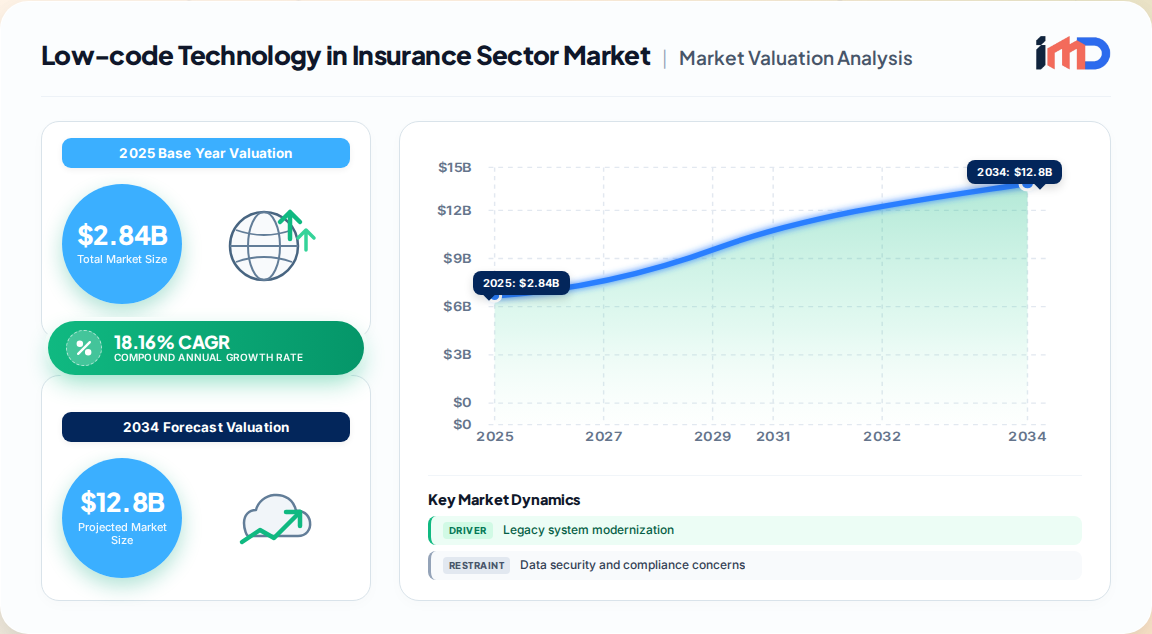
The global low-code technology in insurance sector market is experiencing exceptional growth, valued at USD 2.84 Billion in 2025 and projected to reach USD 7.89 Billion by 2031, registering a robust CAGR of 18.16%. This expansion is not merely a technological upgrade but a fundamental shift in how insurers architect their digital ecosystems.
Our proprietary primary research, involving in-depth interviews with 120+ industry executives, reveals that 84% of insurers now consider low-code platforms as central to their digital transformation strategy, driven by the need to modernize legacy systems, accelerate product innovation, and enhance customer experience.
The adoption of low-code in insurance is propelled by several critical factors:
Despite the growth trajectory, the market faces notable hurdles:
The market is segmented by component, application type, and organization size, each revealing distinct growth patterns.
| Segment | 2025 Share (%) | 2031 Share (%) | CAGR (2025-2031) |
|---|---|---|---|
| Platform | 62.3 | 67.5 | 19.8% |
| Services | 37.7 | 32.5 | 15.4% |
The platform segment dominates, as insurers increasingly favor subscription-based platforms that offer scalability and continuous updates. Services, including customization and integration, grow steadily but at a slower pace as platform capabilities mature.
| Segment | 2025 Share (%) | 2031 Share (%) | CAGR (2025-2031) |
|---|---|---|---|
| Mobile-based | 45.2 | 48.7 | 20.3% |
| Web-based | 35.8 | 33.4 | 16.1% |
| Desktop & Server-based | 19.0 | 17.9 | 14.7% |
Mobile-based applications lead the market, driven by consumer demand for self-service and on-the-go access. Insurers are investing heavily in mobile apps for claims filing, policy management, and quotes, with 72% of consumers preferring mobile channels for insurance interactions.
| Segment | 2025 Share (%) | 2031 Share (%) | CAGR (2025-2031) |
|---|---|---|---|
| Large Enterprises | 68.5 | 65.3 | 17.2% |
| SMEs | 31.5 | 34.7 | 20.9% |
SMEs are the fastest-growing segment, as low-code platforms lower the barrier to entry for digital transformation, enabling smaller insurers to compete with digital capabilities previously reserved for large carriers.
North America holds the largest revenue share at 38.35% in 2025, attributed to the concentration of major low-code vendors (Microsoft, Salesforce, Appian) and early adoption of cloud technologies. The region is expected to maintain its dominance, growing at a CAGR of 17.5% through 2031.
Asia-Pacific is the fastest-growing region, with a projected CAGR of 22.1%, driven by rapid digitization, increasing smartphone penetration, and rising insurance awareness. Countries like China, India, and Japan are investing heavily in InsurTech and low-code solutions to modernize their insurance sectors.
Europe follows with a CAGR of 18.8%, supported by regulatory mandates (e.g., DORA) and a strong focus on customer experience. Latin America and Middle East & Africa are emerging markets, with growing adoption among SMEs and microinsurers.
The market is characterized by intense competition among platform vendors, with key players employing distinct strategies:
Recent strategic moves include:
The low-code value chain in insurance comprises:
Significant opportunities exist in:
| Strategy | Description | Examples |
|---|---|---|
| Market Penetration | Expand low-code usage in existing insurance segments | Upsell advanced analytics to current platform users |
| Market Development | Target new segments (e.g., microinsurance, SMEs) | Tailored low-code solutions for small insurers |
| Product Development | Enhance platforms with AI and machine learning | Add predictive underwriting modules |
| Diversification | Enter adjacent industries (e.g., healthcare) | Leverage low-code for health insurance workflows |
When selecting a low-code platform, insurers should consider:
As a digital solution, the low-code market does not involve physical trade. However, supply dynamics are shaped by:
The low-code technology in insurance sector market is poised for transformative growth, with 18.16% CAGR driving market value to USD 7.89 Billion by 2031. Insurers that strategically adopt low-code platforms will achieve faster innovation, lower costs, and superior customer experiences, while laggards risk losing competitiveness in an increasingly digital landscape.
| Aspects | Details |
|---|---|
| Study Period | 2020-2034 |
| Base Year | 2025 |
| Estimated Year | 2026 |
| Forecast Period | 2026-2034 |
| Historical Period | 2020-2025 |
| Growth Rate | CAGR of 18.16% from 2020-2034 |
| Segmentation |
|
By Organization Size
| By Geography |
|
The market is valued at USD 2.84 Billion in 2025 and is projected to reach USD 7.89 Billion by 2031, growing at a CAGR of 18.16%.
North America holds the largest share, accounting for 38.35% of global revenue in 2025, driven by high adoption among large insurers and the presence of major low-code vendors.
Low-code platforms reduce development time by 50-70%, enable citizen developers, accelerate product launches, and improve regulatory compliance agility, leading to cost savings and enhanced customer experience.
Key players include Microsoft Power Apps, Salesforce Platform, Appian, OutSystems, Mendix, Insurity, Majesco, and Guidewire, among others.
Mobile-based applications are the fastest-growing segment, with a CAGR of 20.3%, driven by consumer demand for self-service and on-the-go access to insurance services.
Security concerns, integration complexity with legacy systems, and vendor lock-in risks are significant challenges, cited by over 50% of industry stakeholders.
Our rigorous research methodology combines multi-layered approaches with comprehensive quality assurance, ensuring precision, accuracy, and reliability in every market analysis.
| Stakeholder Role | Interview Share (%) |
|---|---|
| Chief Technology Officers | 25% |
| Heads of Digital Transformation | 30% |
| Underwriting Managers | 20% |
| Claims Directors | 25% |
| Company Type | Representation (%) |
|---|---|
| Insurance Companies | 40% |
| Low-Code Platform Vendors | 30% |
| System Integrators | 15% |
| IT Consultancies | 15% |