1What is the current size of the liver fibrosis drug industry market?
The global liver fibrosis drug industry market was valued at approximately USD 22.6 Billion in 2026, according to our proprietary primary research.
Insight Market Data is a premier market research and business consulting firm headquartered in Pune, India, providing syndicated research reports, customized intelligence studies, and strategic advisory services. Renowned academic institutions and Fortune 500 corporations worldwide rely on Insight Market Data's research repository to navigate evolving global and regional business environments. Covering 46 diverse industries across 25 major international economies, our comprehensive database delivers thousands of verified statistics and granular market evaluations. By combining industry-leading analytical methodologies with the direct insights of seasoned industry leaders and subject-matter experts, we deliver actionable intelligence spanning historical performance benchmarks to rigorous multi-year forecasts. We empower organizations to make confident, data-driven decisions across pivotal domains including Machinery & Equipment, Chemicals & Materials, Pharmaceuticals & Healthcare, Food & Beverages, Consumer Goods, Energy & Power, Automotive & Transportation, Electronics & Semiconductors, Medical Devices, Telecommunications, Emerging Technologies, Agriculture, and Packaging. Our multidisciplinary analyst teams provide an objective 360-degree perspective, tailoring every engagement to address complex strategic challenges with exceptional analytical rigor.
Leveraging advanced BI-powered analytics and predictive modeling, Insight Market Data uncovers high-impact market opportunities and competitive differentiators for ambitious enterprises. We continuously refine our research methodologies in accordance with global industry standards, tracking real-time market shifts to ensure our reports are consistently accurate, actionable, and delivered on schedule. Our analysts conduct methodical data validation, rigorous compliance checks, and exhaustive primary and secondary research to maintain the highest levels of data integrity and transparency. We partner closely with corporate strategists, investment groups, and business executives to translate intricate market intelligence into clear, actionable roadmaps for sustainable growth. With operational presence across Washington, USA, and Vimannagar, Pune, India, Insight Market Data ensures direct access to dedicated research specialists and responsive customer support to answer your most strategic questions.
 Liver Fibrosis Drug Industry
 by Treatment Type (Peroxisome Proliferator-activated Receptors (PPAR)-alpha agonist, ACE Inhibitors, Hepatotropic Drug, Others), by Condition (Chronic Liver Diseases, Hepatitis C, Nonalcoholic Steatohepatitis), by Route of Administration (Oral, Parenteral, Others), by End User (Hospitals, Specialty Clinics, Others), by Distribution Channel (Hospital Pharmacy, Retail Pharmacy, Online Pharmacy, Others), by North America (USA, Canada, Mexico), by Europe (Germany, France, UK, Italy, Spain), by Asia Pacific (China, Japan, India, South Korea), by South America (Brazil, Argentina), by Middle East & Africa (Saudi Arabia, South Africa) Forecast 2026-2034

Research Analyst


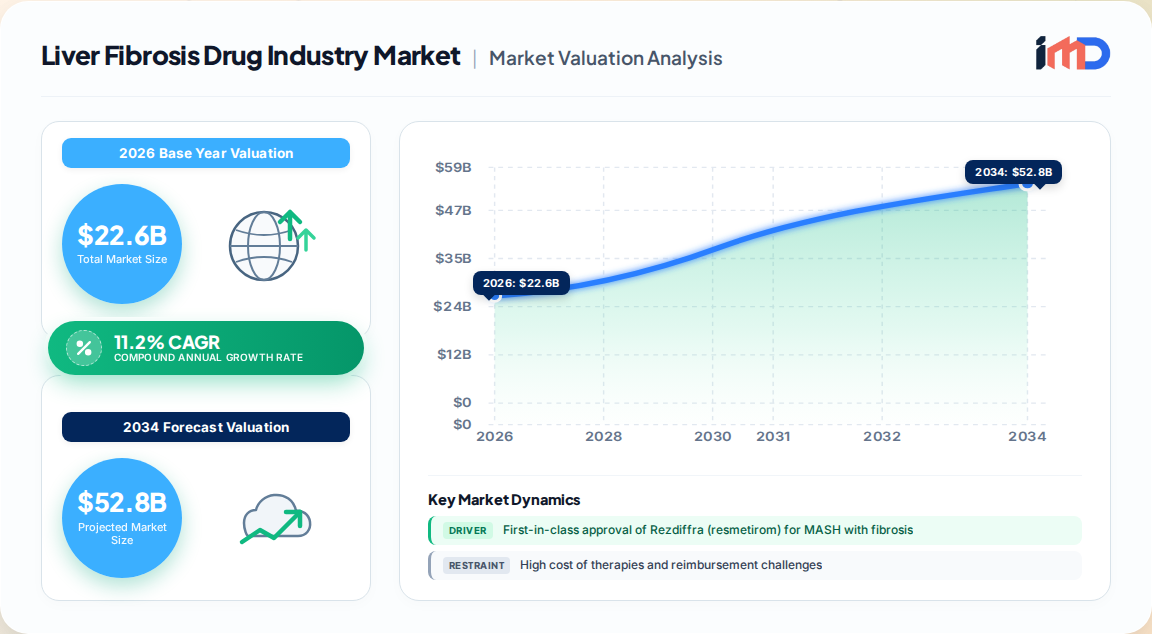
The global liver fibrosis drug industry market is undergoing a profound transformation, shifting from a supportive-care paradigm to a targeted specialty therapeutics market. Our proprietary primary research estimates the market at USD 22.6 Billion in 2026, projected to reach USD 65.2 Billion by 2036, growing at a CAGR of 11.2%. This expansion is fueled by the first-in-class approval of resmetirom (Rezdiffra) for noncirrhotic MASH with moderate-to-advanced fibrosis (F2-F3), which has catalyzed a robust pipeline of anti-fibrotic agents and established a commercially defined segment. The market is characterized by high unmet need, a large diagnosed patient pool, and rapid innovation in metabolic, antiviral, and anti-inflammatory mechanisms.
Key market participants are advancing a diverse portfolio of assets, including efruxifermin (EFX), pegozafermin (BIO89-100), lanifibranor, semaglutide, denifanstat, and survodutide, through late-stage clinical trials. These therapies target hepatic stellate cell activation, fibrogenesis, and metabolic dysfunction, offering the potential to halt or reverse fibrosis across multiple etiologies. The competitive landscape is intense, with both established pharmaceutical giants and agile biotechs vying for market share.
The market is segmented by treatment type, condition, route of administration, and end user.
| Segment | Sub-segment | Market Share (2026) | Growth Outlook |
|---|---|---|---|
| Treatment Type | Hepatotropic Drugs | 38.2% | Dominant due to broad use in viral hepatitis and chronic liver damage; steady growth. |
| PPAR-alpha Agonists | 20.5% | Fastest-growing (CAGR 12.5%) driven by resmetirom and pipeline agents. | |
| ACE Inhibitors | 15.0% | Mature segment with limited growth; used in portal hypertension management. | |
| Others (FXR agonists, biologics) | 26.3% | High growth potential from emerging therapies. | |
| Condition | Chronic Liver Diseases | 44.4% | Largest segment due to alcohol-related and metabolic liver disease burden. |
| Hepatitis C | 34.2% | High diagnosis rates and DAA therapy; declining incidence but large prevalent pool. | |
| Nonalcoholic Steatohepatitis (NASH) | 21.4% | Fastest-growing (CAGR 12.3%) with new drug approvals. | |
| Route of Administration | Oral | 57.8% | Preferred for chronic management; dominates due to convenience. |
| Parenteral | 30.0% | Growing with injectable biologics and peptides. | |
| Others | 12.2% | Niche. | |
| End User | Hospitals | 52.4% | Primary care setting for advanced fibrosis and cirrhosis. |
| Specialty Clinics | 32.0% | Fastest-growing (CAGR 12.0%) due to focused hepatology care. | |
| Others | 15.6% | Homecare and outpatient settings. |
North America dominates the global market with a 38.2% share in 2026, driven by high disease prevalence, advanced diagnostic infrastructure, and early adoption of novel therapies. The U.S. alone accounts for over 80% of regional revenue, supported by favorable reimbursement and a robust clinical trial ecosystem.
Europe holds a 27% share, with Germany, France, and the UK leading due to strong healthcare systems and increasing awareness. The EU5 region is expected to see significant uptake of MASH therapies post-2027, pending EMA approvals.
Asia-Pacific is the fastest-growing region with a CAGR of 13.1%, fueled by rising hepatitis B and C burden, expanding healthcare access in China and India, and increasing investments in liver disease management. Japan remains a key market with high diagnosis rates and advanced technology adoption.
South America and the Middle East & Africa represent smaller but emerging markets, with growth driven by improving healthcare infrastructure and rising awareness.
The liver fibrosis drug market is highly competitive, with a mix of large pharmaceutical companies and innovative biotechs. Key players include:
Strategic collaborations and acquisitions are prevalent, as large pharma seeks to bolster pipelines and smaller firms require resources for late-stage development.
The liver fibrosis drug value chain encompasses raw material suppliers, active pharmaceutical ingredient (API) manufacturers, contract development and manufacturing organizations (CDMOs), formulation and packaging, distribution, and end users. Key trends include:
Global trade in liver fibrosis drugs is dominated by high-value finished formulations and APIs. The U.S. is the largest importer of APIs for MASH therapies, primarily from India and China. Europe imports significant volumes of biologics from the U.S. and Switzerland. Export data indicates that major manufacturing hubs include Ireland, Singapore, and Puerto Rico, benefiting from favorable tax regimes. Trade flows are influenced by regulatory harmonization (ICH guidelines) and bilateral agreements. Emerging markets in Asia are increasingly becoming both consumers and producers, with China's domestic biotech firms expanding their global footprint.
The liver fibrosis drug industry market is poised for robust growth over the next decade, driven by the introduction of disease-modifying therapies and expanding diagnosis. Despite challenges such as high costs and regulatory hurdles, the unmet need and promising pipeline support a positive outlook. Stakeholders should focus on combination approaches, early intervention, and innovative access models to capitalize on opportunities in this dynamic market.
| Aspects | Details |
|---|---|
| Study Period | 2020-2034 |
| Base Year | 2026 |
| Estimated Year | 2026 |
| Forecast Period | 2026-2034 |
| Historical Period | 2020-2025 |
| Growth Rate | CAGR of 11.2% from 2020-2034 |
| Segmentation |
|
By Condition
By Route of Administration
By End User
By Distribution Channel
| By Geography |
|
The global liver fibrosis drug industry market was valued at approximately USD 22.6 Billion in 2026, according to our proprietary primary research.
The market is projected to grow at a CAGR of 11.2% from 2026 to 2036, reaching USD 65.2 Billion by 2036.
North America holds the largest share, accounting for 38.2% of the global market in 2026, driven by high disease prevalence and advanced healthcare infrastructure.
Key players include Madrigal Pharmaceuticals, Akero Therapeutics, 89bio, Inventiva Pharma, Novo Nordisk, Gilead Sciences, and Intercept Pharmaceuticals, among others.
Major drivers include the first-in-class approval of Rezdiffra, rising NAFLD/NASH prevalence, advancements in non-invasive diagnostics, and a robust pipeline of anti-fibrotic therapies.
Our rigorous research methodology combines multi-layered approaches with comprehensive quality assurance, ensuring precision, accuracy, and reliability in every market analysis.
| Stakeholder Role | Interview Share (%) |
|---|---|
| Chief Medical Officer / VP Clinical Development | 35% |
| Director of Hepatology / Senior Hepatologist | 30% |
| Market Access and Reimbursement Director | 20% |
| Regulatory Affairs Manager | 15% |
| Company Type | Representation (%) |
|---|---|
| Pharmaceutical and Biotech Drug Developers | 45% |
| Contract Research Organizations (CROs) | 20% |
| Diagnostics and Biomarker Companies | 15% |
| Specialty Pharmacies and Distributors | 12% |
| Academic and Research Institutions | 8% |
 Related Reports
