1What is the market size of the Latin America stevedoring and marine cargo handling market?
The market was valued at USD 0.85 billion in 2026 and is projected to reach USD 1.05 billion by 2031, growing at a CAGR of 4.2%.
Insight Market Data is a premier market research and business consulting firm headquartered in Pune, India, providing syndicated research reports, customized intelligence studies, and strategic advisory services. Renowned academic institutions and Fortune 500 corporations worldwide rely on Insight Market Data's research repository to navigate evolving global and regional business environments. Covering 46 diverse industries across 25 major international economies, our comprehensive database delivers thousands of verified statistics and granular market evaluations. By combining industry-leading analytical methodologies with the direct insights of seasoned industry leaders and subject-matter experts, we deliver actionable intelligence spanning historical performance benchmarks to rigorous multi-year forecasts. We empower organizations to make confident, data-driven decisions across pivotal domains including Machinery & Equipment, Chemicals & Materials, Pharmaceuticals & Healthcare, Food & Beverages, Consumer Goods, Energy & Power, Automotive & Transportation, Electronics & Semiconductors, Medical Devices, Telecommunications, Emerging Technologies, Agriculture, and Packaging. Our multidisciplinary analyst teams provide an objective 360-degree perspective, tailoring every engagement to address complex strategic challenges with exceptional analytical rigor.
Leveraging advanced BI-powered analytics and predictive modeling, Insight Market Data uncovers high-impact market opportunities and competitive differentiators for ambitious enterprises. We continuously refine our research methodologies in accordance with global industry standards, tracking real-time market shifts to ensure our reports are consistently accurate, actionable, and delivered on schedule. Our analysts conduct methodical data validation, rigorous compliance checks, and exhaustive primary and secondary research to maintain the highest levels of data integrity and transparency. We partner closely with corporate strategists, investment groups, and business executives to translate intricate market intelligence into clear, actionable roadmaps for sustainable growth. With operational presence across Washington, USA, and Vimannagar, Pune, India, Insight Market Data ensures direct access to dedicated research specialists and responsive customer support to answer your most strategic questions.

 Latin America Stevedoring and Marine Cargo Handling Market
 by Service (Stevedoring, Cargo Handling and Transportation, Other Services), by Cargo Type (Dry Bulk, Liquid Bulk, Containerized, Breakbulk/General/Project/RoRo), by End Use (Agriculture, Construction, Manufacturing, Oil and Gas, Others), by Brazil, by Argentina, by Chile, by Colombia, by Peru, by Rest of South America Forecast 2026-2034

Research Associate

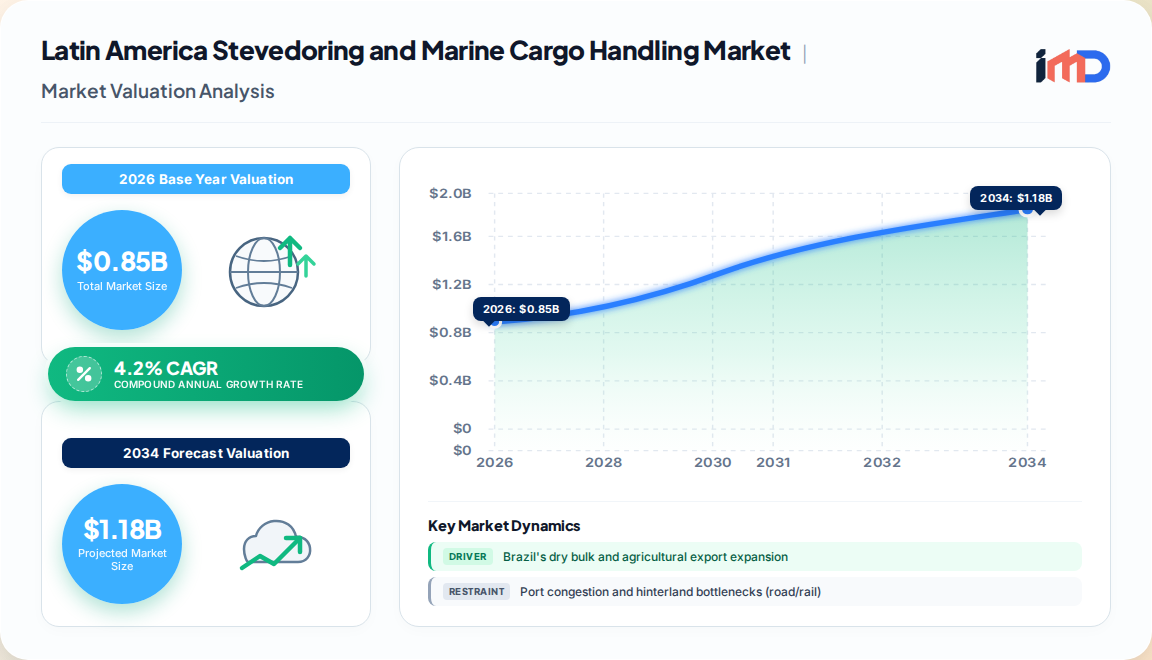
The Latin America stevedoring and marine cargo handling market is entering a phase of strategic expansion, underpinned by surging agricultural exports, deepening trade links with Asia, and a wave of private port concessions. Our proprietary primary research estimates the market at USD 0.85 billion in 2026, advancing to USD 1.05 billion by 2031 at a CAGR of 4.2%. This growth is not merely a function of volume; it reflects rising handling intensity from containerized and specialized cargo, alongside yield improvements from terminal modernization.
Brazil remains the fulcrum of the regional market, accounting for 53.18% of total revenue in 2025. However, the fastest growth is emerging in Peru (5.42% CAGR), driven by new copper and agricultural export corridors. The competitive landscape is increasingly shaped by global terminal operators and carrier-affiliated groups expanding beyond berth operations into integrated logistics, making reliability, berth productivity, and inland connectivity the new battlegrounds.
Three structural forces are propelling the Latin America stevedoring and marine cargo handling market forward:
Brazil's Dry Bulk and Agricultural Export Expansion: Brazil's ports handled 1.4 billion tonnes of waterborne cargo in 2025, with soybean volumes reaching 139.7 million tonnes (up 14% year-on-year). The Northern Arc corridor now handles over 50% of crop shipments, redistributing stevedoring demand away from traditional southeastern gateways. This shift is driving investment in equipment and berth capacity across both northern and southeastern corridors. The Port of Itaqui alone handled 16.5 million metric tonnes in H1 2026, with soybeans representing more than 51% of volume.
Containerization of Intra-Regional and Asia Trade: Container volumes are outpacing total cargo growth at several gateways. Trade with Asia is fueling demand for dedicated container services, while the cargo mix broadens to include frozen meat, reefer fruit, auto parts, and e-commerce goods. This diversification increases handling complexity and service intensity, boosting revenue per tonne.
Port Modernization and Private Concessions: Private capital is unlocking capacity upgrades that public funding could not support. Notable developments include a 25-year concession awarded to DEME in March 2026 to deepen the Paranagua access channel from 13.3 to 15.5 meters, and a USD 50 million credit facility from CAF for enabling works at Puerto Exterior in Chile, part of a USD 4.45 billion project to add two semi-automated container terminals and lift San Antonio's capacity to 6 million TEUs.
Despite robust demand, the market faces significant headwinds:
Port Congestion and Hinterland Bottlenecks: Inefficient road and rail connections, particularly in Brazil and Argentina, create costly delays. These bottlenecks erode terminal productivity and increase dwell times, constraining effective capacity. Our analysis estimates a -0.8% impact on CAGR from these factors.
High Capital Intensity: Modern cranes, automated systems, and compliance with safety and environmental regulations require substantial upfront investment. This disproportionately affects small and mid-sized operators, slowing modernization in cost-sensitive geographies.
Regulatory and Environmental Compliance: Stricter IMO regulations on emissions and ballast water treatment are pushing ports to adopt cleaner technologies, raising operating costs. While necessary, these investments compete with capacity expansion budgets.
By service, stevedoring held 46.24% of the market in 2025, reflecting its core role in ship-to-shore transfer. However, cargo handling and transportation is the fastest-growing segment at 4.54% CAGR, as operators integrate yard, rail, and trucking services to offer end-to-end solutions.
By cargo type, containerized cargo dominated with 49.36% share in 2025, driven by rising container penetration and the need for specialized handling of reefer and high-value goods. Dry bulk is forecast to grow at the fastest rate (4.63% CAGR), fueled by agricultural and mineral exports.
By end use, manufacturing accounted for 28.97% of revenue in 2025 and is projected to grow at 4.86% CAGR, as industrial supply chains increasingly rely on just-in-time maritime logistics.
| Segment | 2025 Share (%) | Projected CAGR (2026-2031) |
|---|---|---|
| Stevedoring | 46.24 | 3.8% |
| Cargo Handling & Transportation | 38.5 | 4.54% |
| Other Services | 15.26 | 3.9% |
| Containerized Cargo | 49.36 | 4.0% |
| Dry Bulk | 27.5 | 4.63% |
| Liquid Bulk | 15.0 | 3.5% |
| Manufacturing End Use | 28.97 | 4.86% |
Brazil's dominance is unchallenged, with its ports handling the largest volumes and attracting the largest terminal investments. The country's 53.18% share of the regional market is supported by a diversified cargo base and a robust pipeline of private concessions. The Port of Santos handled a record 186.4 million tonnes in 2025, underscoring its critical role.
Peru, while smaller in absolute terms, is the fastest-growing market at 5.42% CAGR. This is driven by new mining projects and agricultural exports, particularly in the northern coast. Chile and Colombia also present attractive opportunities, with Chile's Puerto Exterior project set to transform San Antonio into a major container hub.
Argentina remains a key player, but macroeconomic volatility and hinterland constraints temper its growth prospects.
The market is characterized by medium concentration, with global terminal operators and carrier-affiliated groups competing alongside regional specialists. Key players include MSC Mediterranean Shipping Company S.A., A.P. Moller - Maersk, DP World, CMA CGM Group, and International Container Terminal Services, Inc. (ICTSI).
Competition is shifting from purely berth operations to integrated logistics. Operators are investing in rail and road connectivity, digital systems, and value-added services to capture higher revenue per tonne. For instance, ICTSI's global port operations revenue increased 18% to USD 3.23 billion in 2025, supported by volume growth and ancillary services. Similarly, DP World reported an 8.5% increase in like-for-like Ports & Terminals revenue per TEU.
The stevedoring and marine cargo handling value chain in Latin America is evolving:
Several untapped opportunities exist:
Latin America's stevedoring market is inextricably linked to commodity trade flows. Brazil's soybean exports to China, Peru's copper shipments, and Chile's fruit exports are key demand drivers. Conversely, imports of manufactured goods, machinery, and energy products sustain container and breakbulk handling.
Supplier dynamics are shaped by the need for reliable, high-capacity equipment. Global crane manufacturers and terminal technology providers are increasingly partnering with local operators to offer maintenance and upgrade services. The push for sustainability is also driving demand for electric and hydrogen-powered equipment, creating new supplier opportunities.
The Latin America stevedoring and marine cargo handling market offers compelling growth prospects, rooted in agricultural and mineral exports, containerization, and private investment. While challenges such as congestion and capital intensity persist, operators that invest in productivity, digitalization, and integrated logistics will be best positioned to capture value in this evolving landscape.
| Aspects | Details |
|---|---|
| Study Period | 2020-2034 |
| Base Year | 2026 |
| Estimated Year | 2026 |
| Forecast Period | 2026-2034 |
| Historical Period | 2020-2025 |
| Growth Rate | CAGR of 4.2% from 2020-2034 |
| Segmentation |
|
By End Use
| By Geography |
|
The market was valued at USD 0.85 billion in 2026 and is projected to reach USD 1.05 billion by 2031, growing at a CAGR of 4.2%.
Brazil holds the largest share, accounting for 53.18% of the regional market in 2025, driven by its massive agricultural and container export volumes.
Growth is primarily driven by Brazil's dry bulk and agricultural export expansion, increasing containerization of trade with Asia, and port modernization through private concessions.
Key companies include MSC Mediterranean Shipping Company S.A., A.P. Moller - Maersk, DP World, CMA CGM Group, and International Container Terminal Services, Inc. (ICTSI).
Dry bulk is the fastest-growing cargo type, projected to grow at a CAGR of 4.63% through 2031, fueled by agricultural and mineral exports.
Our rigorous research methodology combines multi-layered approaches with comprehensive quality assurance, ensuring precision, accuracy, and reliability in every market analysis.
| Stakeholder Role | Interview Share (%) |
|---|---|
| Port Operations Director | 35% |
| Terminal Manager | 30% |
| Commercial Director | 20% |
| Procurement Head | 15% |
| Company Type | Representation (%) |
|---|---|
| Port Terminal Operators (Concessionaires) | 35% |
| Shipping Lines & Carrier-Affiliated Terminal Groups | 25% |
| Logistics & Freight Forwarding Companies | 20% |
| Equipment & Technology Providers | 12% |
| Industry Associations & Regulatory Bodies | 8% |
 Related Reports
