Insight Market Data is a premier market research and business consulting firm headquartered in Pune, India, providing syndicated research reports, customized intelligence studies, and strategic advisory services. Renowned academic institutions and Fortune 500 corporations worldwide rely on Insight Market Data's research repository to navigate evolving global and regional business environments. Covering 46 diverse industries across 25 major international economies, our comprehensive database delivers thousands of verified statistics and granular market evaluations. By combining industry-leading analytical methodologies with the direct insights of seasoned industry leaders and subject-matter experts, we deliver actionable intelligence spanning historical performance benchmarks to rigorous multi-year forecasts. We empower organizations to make confident, data-driven decisions across pivotal domains including Machinery & Equipment, Chemicals & Materials, Pharmaceuticals & Healthcare, Food & Beverages, Consumer Goods, Energy & Power, Automotive & Transportation, Electronics & Semiconductors, Medical Devices, Telecommunications, Emerging Technologies, Agriculture, and Packaging. Our multidisciplinary analyst teams provide an objective 360-degree perspective, tailoring every engagement to address complex strategic challenges with exceptional analytical rigor.
Leveraging advanced BI-powered analytics and predictive modeling, Insight Market Data uncovers high-impact market opportunities and competitive differentiators for ambitious enterprises. We continuously refine our research methodologies in accordance with global industry standards, tracking real-time market shifts to ensure our reports are consistently accurate, actionable, and delivered on schedule. Our analysts conduct methodical data validation, rigorous compliance checks, and exhaustive primary and secondary research to maintain the highest levels of data integrity and transparency. We partner closely with corporate strategists, investment groups, and business executives to translate intricate market intelligence into clear, actionable roadmaps for sustainable growth. With operational presence across Washington, USA, and Vimannagar, Pune, India, Insight Market Data ensures direct access to dedicated research specialists and responsive customer support to answer your most strategic questions.
Large Format Textile Printer: Disruptive Tech Market 2026 | Insight Market Data
Large Format Textile Printer: Disruptive Technologies Market
Manufacturing Products and Services / MARKET REPORT
Large Format Textile Printer: Disruptive Technologies Market | Insight Market Data
Large Format Textile Printer: Disruptive Technologies Market by Technology (Ink-based, Toner-based, Others), by Ink Type (Aqueous, Solvent, UV-cured, Latex, Dye Sublimation), by Printing Material (Porous, Non-porous), by Connectivity (Wired, Wireless), by Print Width (Up to 24", 24-36", 36-44", 44-60", Above 60"), by Application (Apparel & Textile, Advertising, CAD & Technical Printing, Signage, Others), by Offering (Printers, RIP Software, After-sales Services), by North America (USA, Canada, Mexico), by Europe (Germany, UK, France, Italy, Spain), by Asia Pacific (China, Japan, India, South Korea, Australia), by South America (Brazil, Argentina), by Middle East & Africa (UAE, Saudi Arabia, South Africa) Forecast 2026-2034
Executive Overview: The Disruptive Technologies Reshaping Large Format Textile Printing
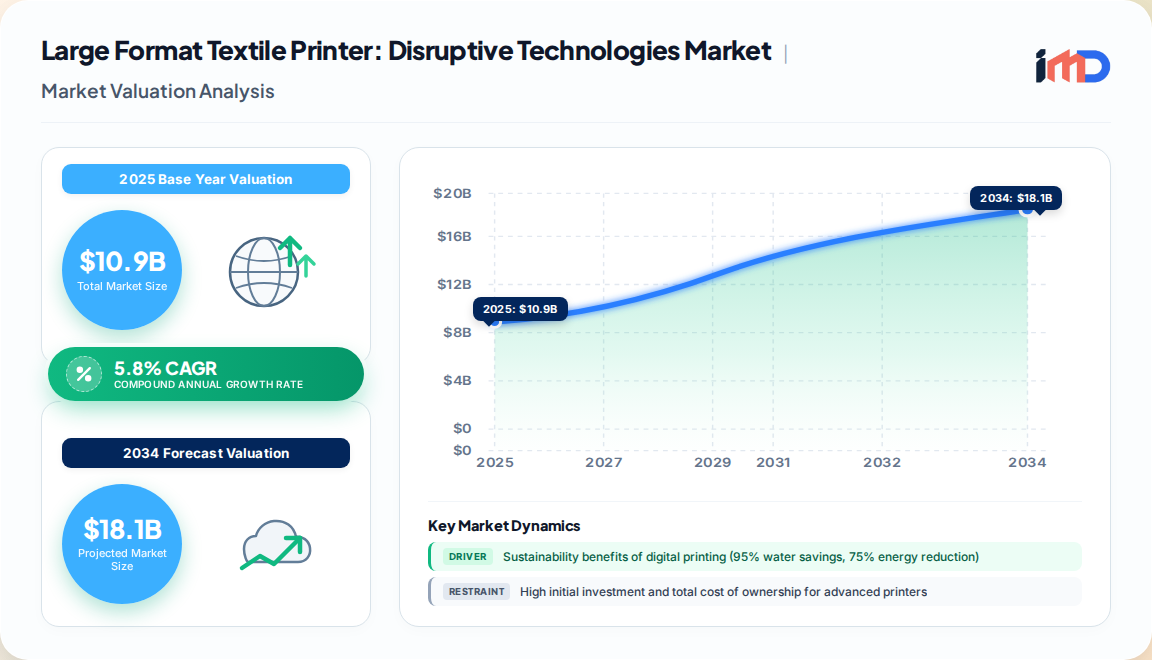
The large format textile printer market is undergoing a profound transformation, driven by disruptive technologies that are redefining production economics, sustainability benchmarks, and creative possibilities. Our proprietary first-party research estimates the global large format printer market at USD 10.9 billion in 2025, projected to reach USD 17.1 billion by 2033, expanding at a CAGR of 5.8% (2026–2033). Within this broader landscape, large format textile printers represent a high-growth disruptive segment, propelled by the migration from analog screen printing to digital inkjet, the rise of single-pass systems, and the integration of IoT and AI-driven workflow automation.
Large Format Textile Printer: Disruptive Technologies Market Market Size (In Billion)
20.0B
15.0B
10.0B
5.0B
0
10.90 B
2025
11.53 B
2026
12.20 B
2027
12.91 B
2028
13.66 B
2029
14.45 B
2030
15.29 B
2031
North America commands the largest regional revenue share at 34.0% in 2025, underpinned by mature advertising, packaging, and signage industries. Asia Pacific is the fastest-growing region, fueled by rapid urbanization, textile manufacturing concentration, and government-backed digitalization initiatives. The textile printing market itself is valued at USD 25.6 billion in 2025 and is forecast to reach USD 70.7 billion by 2035, growing at a CAGR of 10.7%, with digital printing technologies capturing an escalating share of this expansive pie.
This report dissects the disruptive technologies—single-pass digital inkjet, UV-curable and eco-solvent inks, pigment-based systems, and cloud-connected workflow platforms—that are lowering barriers to adoption, enabling mass customization, and unlocking new revenue streams across apparel, home decor, soft signage, and industrial textiles.
Key Market Drivers: Sustainability, Customization, and E-Commerce
Three macro forces are accelerating the adoption of large format textile printers:
Environmental Efficiency Gains: Digital textile printing can save up to 95% of industrial water usage and reduce energy consumption by 75% compared to analog screen printing. Digital printing emits 2.6 kg CO2e per kg of fabric versus 4.3 kg for screen printing, creating a direct operating cost advantage that manufacturers can no longer ignore.
E-Commerce Personalization Demand: The surge in online retail necessitates short-run, on-demand printing for personalized apparel and customized packaging. Large format printers enable brands to fulfill individualized orders without inventory overhead, driving sustained equipment replacement cycles.
Mass Customization and Shorter Print Runs: Fashion brands require frequent design refreshes and small batch production to respond to trend cycles. This behavior drives continuous equipment utilization and ink consumption, making apparel the most commercially active end market (56.2% share in 2025).
Additionally, advancements in printhead technology, ink formulations, and color accuracy are compelling upgrades from existing equipment. The growing popularity of dye-sublimation printing for textiles, soft signage, and promotional materials is a notable contributor, delivering vivid, long-lasting prints on diverse substrates.
Restraints and Challenges: Cost Barriers and Technological Complexity
Despite robust growth prospects, several factors constrain market penetration:
High Initial Investment: The substantial cost of purchasing large format printers, coupled with ongoing expenses for ink, media, and maintenance, hinders small and medium-sized enterprises from investing in these solutions.
Technological Complexity: Entry-level models often have limited media compatibility and require specialized operator skills. The rapid pace of technological advancements necessitates frequent upgrades, increasing total cost of ownership.
Environmental and Regulatory Pressures: While digital printing is greener, regulatory tightening around chemical use and wastewater discharge imposes compliance costs on manufacturers, particularly in regions with stringent environmental standards.
Competition from Digital Displays: The proliferation of digital signage and displays poses a threat to traditional printed graphics, particularly in advertising and retail environments.
Segmentation Insights: Technology, Ink, Material, and Connectivity
The market is segmented by technology, ink type, printing material, connectivity, print width, and application. Key insights include:
Segment
Dominant Category (2025)
Fastest-Growing Category
Share/Notes
Technology
Ink-based (inkjet)
Toner-based (laser)
Ink-based accounted for 61.0% revenue share in 2025 due to advancements in ink technology and customization demand.
Ink Type
Solvent ink
UV-cured ink
Solvent ink led revenue, but UV-cured ink is expected to grow at the fastest CAGR, enabling printing on glass, ceramics, and metal.
Printing Material
Porous materials
Non-porous materials
Porous materials (textiles, paper) held the largest share, while non-porous substrates are gaining traction in industrial applications.
Connectivity
Wired
Wireless
Wired connectivity (Gigabit Ethernet, USB 3.0) dominates enterprise settings; wireless is gaining with cloud-based printing and mobile apps.
Print Width
24"–36"
Above 60"
The 24"–36" segment held the highest revenue share in 2025, but wider formats are growing with industrial textile demand.
Application
Advertising
Textiles
Advertising is the largest application, while textile printing is the fastest-growing, driven by apparel and home decor.
Digital textile printing is disrupting traditional screen printing (which still holds 48.9% share of the textile printing market), as single-pass systems like the EFI Reggiani BOLT have crossed the threshold into mainstream industrial use, with over 50 million printed metres achieved.
Regional Outlook: North America Leads, Asia Pacific Accelerates
North America's dominance is anchored in its mature advertising, packaging, and signage sectors, early adoption of eco-friendly printing technologies, and presence of leading manufacturers. The U.S. market benefits from robust use of large format printers across advertising, packaging, construction, and apparel, with high R&D investment and demand for short-run customized printing.
Large Format Textile Printer: Disruptive Technologies Market Regional Market Share
Loading chart...
Asia Pacific is the fastest-growing region, projected to register the highest CAGR from 2026 to 2033. Rapid urbanization, expanding textile manufacturing, and government support for digital transformation are key catalysts. China, India, and Southeast Asian nations are investing heavily in digital textile printing to meet export demand and sustainability regulations. Europe follows with a strong emphasis on sustainable inks and energy-efficient printers, while South America and the Middle East & Africa present emerging opportunities in signage and apparel.
Competitive Landscape and Recent Developments
The market is characterized by intense competition among global players focusing on technological innovation, sustainability, and strategic collaborations. Key companies include HP Inc., Canon Inc., Epson Corporation, Roland DG Corporation, Mimaki Engineering Co., Ltd., Xerox Corporation, Lexmark International, Inc., Mutoh Industries Ltd., Agfa-Gevaert Group, and Kornit Digital.
Recent developments underscore the disruptive trajectory:
January 2025: Roland DG Corporation launched the TrueVIS XP-640 large-format high-speed eco-solvent printer with TH eco-solvent ink, advanced printhead technologies, and increased productivity for signage and graphics professionals.
April 2026: Kornit Digital acquired PrintFactory, a cloud-native workflow and production automation software provider, strengthening end-to-end digital production ecosystems and reducing operator skill requirements.
Ongoing: EFI Reggiani's BOLT single-pass printer reached a milestone of 50 million printed metres, signaling commercial maturity of single-pass digital textile printing. The EFI Reggiani HYPER scanning printer achieves up to 13 linear metres per minute on a 1.5-metre roll, or 20 metres per minute when printing two rolls in parallel, closing the productivity gap with analog.
Strategic White-Space Analysis: Opportunities in Disruptive Technologies
Several high-potential white spaces are emerging for investors and manufacturers:
Single-Pass Digital Inkjet for High-Volume Textiles: As throughput levels approach analog speeds, the addressable market for single-pass systems in apparel and home decor expands significantly. Vendors offering both high-speed output and wide-format capability hold a structural advantage.
UV-Cured Ink Applications on Non-Traditional Substrates: The ability to print on glass, ceramics, and metal opens doors to interior design, retail displays, and industrial applications, commanding premium margins.
IoT and AI-Enabled Workflow Automation: Cloud-connected printers with predictive maintenance, remote monitoring, and automated calibration enhance uptime and reduce operational costs, appealing to large-scale print service providers.
Sustainable Ink and Substrate Solutions: With regulatory pressures mounting, eco-solvent, latex, and water-based inks present a growing revenue stream, particularly in Europe and North America.
Soft Signage and Home Decor: These segments benefit from single-pass speed improvements and demand precise color matching, creating opportunities for integrated hardware-software offerings.
Value Chain and Supply Chain Risk Assessment
The value chain spans equipment manufacturers, consumable suppliers (inks, printheads, transfer films), software providers (RIP, workflow automation), and print service providers. A two-layer structure means revenue is recurring, as ink and consumable replenishment drives continuous spending beyond initial capital equipment purchase.
Supply chain risks include:
Printhead Supply Concentration: A limited number of global suppliers dominate printhead manufacturing, creating vulnerability to disruptions.
Ink Raw Material Volatility: Fluctuations in petrochemical and pigment prices impact margins.
Regional Regulatory Divergence: Varying environmental standards across regions complicate compliance and increase operational complexity.
Logistics and Lead Times: For large-format equipment, shipping and installation require specialized handling, affecting time-to-revenue.
Mitigation strategies include dual-sourcing, localizing consumable production, and adopting modular printer designs for easier maintenance and upgrades. The shift toward cloud-based software also reduces hardware dependency and enables remote troubleshooting.
Procurement & Sourcing Strategy Analysis
For buyers of large format textile printers, a total cost of ownership approach is critical. Key considerations include:
Equipment Reliability and Uptime: Evaluate mean time between failures and service network coverage.
Ink Cost per Square Metre: Consumable costs often outweigh initial hardware costs over the printer's life; negotiate ink pricing and bulk supply agreements.
Media Compatibility: Ensure the printer supports a wide range of substrates, including porous and non-porous materials, to maximize application versatility.
Software Integration: Prioritize printers with open APIs and compatibility with existing RIP and workflow software to avoid vendor lock-in.
Sustainability Credentials: Choose printers with low VOC emissions, energy-efficient modes, and compatibility with eco-friendly inks to meet regulatory and brand requirements.
Strategic sourcing should also consider vendor financing options, extended warranties, and training programs to reduce downtime and optimize operator productivity.
Large Format Textile Printer: Disruptive Technologies Market Regional Market Share
Higher Coverage
Lower Coverage
No Coverage
Large Format Textile Printer: Disruptive Technologies Market REPORT HIGHLIGHTS
Aspects
Details
Study Period
2020-2034
Base Year
2025
Estimated Year
2026
Forecast Period
2026-2034
Historical Period
2020-2025
Growth Rate
CAGR of 5.8% from 2020-2034
Segmentation
By Technology
Ink-based
Toner-based
Others
By Ink Type
Aqueous
Table of Contents
1. Large Format Textile Printer: Disruptive Technologies Market Introduction
1.1. Research Scope
1.2. Market Segmentation
1.3. Research Objective
1.4. Definitions and Assumptions
2. Large Format Textile Printer: Disruptive Technologies Market Executive Summary
2.1. Market Snapshot
3. Large Format Textile Printer: Disruptive Technologies Market Dynamics
3.1. Market Drivers
3.1.1. Sustainability benefits of digital printing (95% water savings, 75% energy reduction)
3.1.2. E-commerce growth demanding customized, short-run packaging and apparel
3.1.3. Mass customization and personalization trends in fashion and home decor
3.1.4. Technological advancements improving print quality, speed, and substrate versatility
3.2. Market Trends
3.2.1. Shift from analog screen printing to digital inkjet in textile production
3.2.2. Rise of single-pass digital printers achieving analog-level throughput
3.2.3. Integration of IoT and cloud-based workflow automation for remote monitoring
3.2.4. Growing adoption of UV-cured and eco-solvent inks for sustainability
3.3. Market Restraints
3.3.1. High initial investment and total cost of ownership for advanced printers
3.3.2. Technological complexity and need for skilled operators
GCC Manufacturing Analytics Market to grow at 24.5% CAGR, reaching USD 2.8 Billion by 2035 from USD 0.41 Billion in 2025.
Nov 2026|239 pages
$2900.00
CUSTOM INTELLIGENCE
Tailored for you
In-depth Analysis Tailored to Specified Regions or Segments
Company Profiles Customized to User Preferences
Customized Evaluation of Competitive Landscape to Meet Your Needs
Ask for customization
Analyst at Providence Strategic Partners at Petaling Jaya
Jared Wan
I have received the report already. Thanks you for your help.it has been a pleasure working with you. Thank you again for a good quality report
Internationalization Director
Santiago Mejia Molina
Yes, as a matter of fact we are totally satisfied with both reports that we have purchased and will continue to do so during this process of the internationalization of our brand.
Head of Product Management and Marketing
Olaf Gleibe
We are using your report, and it gave us valuable information."
Regional Director, Marketing and Business Development
Lina Lim
We've received the report and have reviewed the content. Overall, it looks great and aligns closely with the data we can verify based on our industry knowledge.
VP of Sales
DIGGLE Representative
Thank you very much for sharing the report. I have reviewed it and I am very satisfied with the quality and the insights it provides. It will certainly be valuable for our internal discussions.
The GIS Mapping Tools Market is valued at $18.42 Billion in 2025, growing at 12.4% CAGR to reach $52.8 Billion by 2034. Explore trends, segments, and regional analysis.
3.3.4. Competition from digital displays in advertising applications
3.4. Market Challenges
3.4.1. Managing supply chain risks for printheads and ink raw materials
3.4.2. Balancing global regulatory divergence across regions
3.4.3. Achieving color consistency across repeat orders and substrates
4. Large Format Textile Printer: Disruptive Technologies Market Factor Analysis
4.1. Porters Five Forces
4.1.1. Bargaining Power of Suppliers
4.1.2. Bargaining Power of Buyers
4.1.3. Threat of New Entrants
4.1.4. Threat of Substitutes
4.1.5. Competitive Rivalry
4.2. PESTEL analysis
4.3. BCG Analysis
4.3.1. Stars (High Growth, High Market Share)
4.3.2. Cash Cows (Low Growth, High Market Share)
4.3.3. Question Mark (High Growth, Low Market Share)
4.3.4. Dogs (Low Growth, Low Market Share)
4.4. Ansoff Matrix Analysis
4.5. Supply Chain Analysis
4.6. Regulatory Landscape
4.7. Current Market Potential and Opportunity Assessment (TAM–SAM–SOM Framework)
4.8. IMD Analyst Note
5. Large Format Textile Printer: Disruptive Technologies Market Analysis, Insights and Forecast, 2020-2034
5.1. Analysis, Insights and Forecast - by Technology
5.1.1. Ink-based
5.1.2. Toner-based
5.1.3. Others
5.2. Analysis, Insights and Forecast - by Ink Type
5.2.1. Aqueous
5.2.2. Solvent
5.2.3. UV-cured
5.2.4. Latex
5.2.5. Dye Sublimation
5.3. Analysis, Insights and Forecast - by Printing Material
5.3.1. Porous
5.3.2. Non-porous
5.4. Analysis, Insights and Forecast - by Connectivity
5.4.1. Wired
5.4.2. Wireless
5.5. Analysis, Insights and Forecast - by Print Width
5.5.1. Up to 24"
5.5.2. 24-36"
5.5.3. 36-44"
5.5.4. 44-60"
5.5.5. Above 60"
5.6. Analysis, Insights and Forecast - by Application
5.6.1. Apparel & Textile
5.6.2. Advertising
5.6.3. CAD & Technical Printing
5.6.4. Signage
5.6.5. Others
5.7. Analysis, Insights and Forecast - by Offering
5.7.1. Printers
5.7.2. RIP Software
5.7.3. After-sales Services
5.8. Analysis, Insights and Forecast - by Region
5.8.1. North America
5.8.2. Europe
5.8.3. Asia Pacific
5.8.4. South America
5.8.5. Middle East & Africa
6. Large Format Textile Printer: Disruptive Technologies Market North America Analysis, Insights and Forecast, 2020-2034
6.1. Analysis, Insights and Forecast - by Technology
6.1.1. Ink-based
6.1.2. Toner-based
6.1.3. Others
6.2. Analysis, Insights and Forecast - by Ink Type
6.2.1. Aqueous
6.2.2. Solvent
6.2.3. UV-cured
6.2.4. Latex
6.2.5. Dye Sublimation
6.3. Analysis, Insights and Forecast - by Printing Material
6.3.1. Porous
6.3.2. Non-porous
6.4. Analysis, Insights and Forecast - by Connectivity
6.4.1. Wired
6.4.2. Wireless
6.5. Analysis, Insights and Forecast - by Print Width
6.5.1. Up to 24"
6.5.2. 24-36"
6.5.3. 36-44"
6.5.4. 44-60"
6.5.5. Above 60"
6.6. Analysis, Insights and Forecast - by Application
6.6.1. Apparel & Textile
6.6.2. Advertising
6.6.3. CAD & Technical Printing
6.6.4. Signage
6.6.5. Others
6.7. Analysis, Insights and Forecast - by Offering
6.7.1. Printers
6.7.2. RIP Software
6.7.3. After-sales Services
7. Large Format Textile Printer: Disruptive Technologies Market Europe Analysis, Insights and Forecast, 2020-2034
7.1. Analysis, Insights and Forecast - by Technology
7.1.1. Ink-based
7.1.2. Toner-based
7.1.3. Others
7.2. Analysis, Insights and Forecast - by Ink Type
7.2.1. Aqueous
7.2.2. Solvent
7.2.3. UV-cured
7.2.4. Latex
7.2.5. Dye Sublimation
7.3. Analysis, Insights and Forecast - by Printing Material
7.3.1. Porous
7.3.2. Non-porous
7.4. Analysis, Insights and Forecast - by Connectivity
7.4.1. Wired
7.4.2. Wireless
7.5. Analysis, Insights and Forecast - by Print Width
7.5.1. Up to 24"
7.5.2. 24-36"
7.5.3. 36-44"
7.5.4. 44-60"
7.5.5. Above 60"
7.6. Analysis, Insights and Forecast - by Application
7.6.1. Apparel & Textile
7.6.2. Advertising
7.6.3. CAD & Technical Printing
7.6.4. Signage
7.6.5. Others
7.7. Analysis, Insights and Forecast - by Offering
7.7.1. Printers
7.7.2. RIP Software
7.7.3. After-sales Services
8. Large Format Textile Printer: Disruptive Technologies Market Asia Pacific Analysis, Insights and Forecast, 2020-2034
8.1. Analysis, Insights and Forecast - by Technology
8.1.1. Ink-based
8.1.2. Toner-based
8.1.3. Others
8.2. Analysis, Insights and Forecast - by Ink Type
8.2.1. Aqueous
8.2.2. Solvent
8.2.3. UV-cured
8.2.4. Latex
8.2.5. Dye Sublimation
8.3. Analysis, Insights and Forecast - by Printing Material
8.3.1. Porous
8.3.2. Non-porous
8.4. Analysis, Insights and Forecast - by Connectivity
8.4.1. Wired
8.4.2. Wireless
8.5. Analysis, Insights and Forecast - by Print Width
8.5.1. Up to 24"
8.5.2. 24-36"
8.5.3. 36-44"
8.5.4. 44-60"
8.5.5. Above 60"
8.6. Analysis, Insights and Forecast - by Application
8.6.1. Apparel & Textile
8.6.2. Advertising
8.6.3. CAD & Technical Printing
8.6.4. Signage
8.6.5. Others
8.7. Analysis, Insights and Forecast - by Offering
8.7.1. Printers
8.7.2. RIP Software
8.7.3. After-sales Services
9. Large Format Textile Printer: Disruptive Technologies Market South America Analysis, Insights and Forecast, 2020-2034
9.1. Analysis, Insights and Forecast - by Technology
9.1.1. Ink-based
9.1.2. Toner-based
9.1.3. Others
9.2. Analysis, Insights and Forecast - by Ink Type
9.2.1. Aqueous
9.2.2. Solvent
9.2.3. UV-cured
9.2.4. Latex
9.2.5. Dye Sublimation
9.3. Analysis, Insights and Forecast - by Printing Material
9.3.1. Porous
9.3.2. Non-porous
9.4. Analysis, Insights and Forecast - by Connectivity
9.4.1. Wired
9.4.2. Wireless
9.5. Analysis, Insights and Forecast - by Print Width
9.5.1. Up to 24"
9.5.2. 24-36"
9.5.3. 36-44"
9.5.4. 44-60"
9.5.5. Above 60"
9.6. Analysis, Insights and Forecast - by Application
9.6.1. Apparel & Textile
9.6.2. Advertising
9.6.3. CAD & Technical Printing
9.6.4. Signage
9.6.5. Others
9.7. Analysis, Insights and Forecast - by Offering
9.7.1. Printers
9.7.2. RIP Software
9.7.3. After-sales Services
10. Large Format Textile Printer: Disruptive Technologies Market Middle East & Africa Analysis, Insights and Forecast, 2020-2034
10.1. Analysis, Insights and Forecast - by Technology
10.1.1. Ink-based
10.1.2. Toner-based
10.1.3. Others
10.2. Analysis, Insights and Forecast - by Ink Type
10.2.1. Aqueous
10.2.2. Solvent
10.2.3. UV-cured
10.2.4. Latex
10.2.5. Dye Sublimation
10.3. Analysis, Insights and Forecast - by Printing Material
10.3.1. Porous
10.3.2. Non-porous
10.4. Analysis, Insights and Forecast - by Connectivity
10.4.1. Wired
10.4.2. Wireless
10.5. Analysis, Insights and Forecast - by Print Width
10.5.1. Up to 24"
10.5.2. 24-36"
10.5.3. 36-44"
10.5.4. 44-60"
10.5.5. Above 60"
10.6. Analysis, Insights and Forecast - by Application
10.6.1. Apparel & Textile
10.6.2. Advertising
10.6.3. CAD & Technical Printing
10.6.4. Signage
10.6.5. Others
10.7. Analysis, Insights and Forecast - by Offering
10.7.1. Printers
10.7.2. RIP Software
10.7.3. After-sales Services
11. Large Format Textile Printer: Disruptive Technologies Market Competitive Analysis
11.1. Company Profiles
11.1.1. HP Inc.
11.1.1.1. Company Overview
11.1.1.2. Products
11.1.1.3. Company Financials
11.1.1.4. SWOT Analysis
11.1.2. Canon Inc.
11.1.2.1. Company Overview
11.1.2.2. Products
11.1.2.3. Company Financials
11.1.2.4. SWOT Analysis
11.1.3. Epson Corporation
11.1.3.1. Company Overview
11.1.3.2. Products
11.1.3.3. Company Financials
11.1.3.4. SWOT Analysis
11.1.4. Roland DG Corporation
11.1.4.1. Company Overview
11.1.4.2. Products
11.1.4.3. Company Financials
11.1.4.4. SWOT Analysis
11.1.5. Mimaki Engineering Co. Ltd.
11.1.5.1. Company Overview
11.1.5.2. Products
11.1.5.3. Company Financials
11.1.5.4. SWOT Analysis
11.1.6. Xerox Corporation
11.1.6.1. Company Overview
11.1.6.2. Products
11.1.6.3. Company Financials
11.1.6.4. SWOT Analysis
11.1.7. Lexmark International Inc.
11.1.7.1. Company Overview
11.1.7.2. Products
11.1.7.3. Company Financials
11.1.7.4. SWOT Analysis
11.1.8. Mutoh Industries Ltd.
11.1.8.1. Company Overview
11.1.8.2. Products
11.1.8.3. Company Financials
11.1.8.4. SWOT Analysis
11.1.9. Agfa-Gevaert Group
11.1.9.1. Company Overview
11.1.9.2. Products
11.1.9.3. Company Financials
11.1.9.4. SWOT Analysis
11.1.10. Kornit Digital
11.1.10.1. Company Overview
11.1.10.2. Products
11.1.10.3. Company Financials
11.1.10.4. SWOT Analysis
11.2. Market Entropy
11.2.1. Company's Key Areas Served
11.2.2. Recent Developments
11.3. Company Market Share Analysis, 2026
11.3.1. Top 5 Companies Market Share Analysis
11.3.2. Top 3 Companies Market Share Analysis
11.4. List of Potential Customers
List of Figures
Figure 1: Global Large Format Textile Printer: Disruptive Technologies Market Revenue Breakdown (Billion, %) by Region 2026 & 2034
Figure 2: North America Large Format Textile Printer: Disruptive Technologies Market Revenue (Billion), by Technology 2026 & 2034
Figure 3: North America Large Format Textile Printer: Disruptive Technologies Market Revenue Share (%), by Technology 2026 & 2034
Figure 4: North America Large Format Textile Printer: Disruptive Technologies Market Revenue (Billion), by Ink Type 2026 & 2034
Figure 5: North America Large Format Textile Printer: Disruptive Technologies Market Revenue Share (%), by Ink Type 2026 & 2034
Figure 6: North America Large Format Textile Printer: Disruptive Technologies Market Revenue (Billion), by Printing Material 2026 & 2034
Figure 7: North America Large Format Textile Printer: Disruptive Technologies Market Revenue Share (%), by Printing Material 2026 & 2034
Figure 8: North America Large Format Textile Printer: Disruptive Technologies Market Revenue (Billion), by Connectivity 2026 & 2034
Figure 9: North America Large Format Textile Printer: Disruptive Technologies Market Revenue Share (%), by Connectivity 2026 & 2034
Figure 10: North America Large Format Textile Printer: Disruptive Technologies Market Revenue (Billion), by Print Width 2026 & 2034
Figure 11: North America Large Format Textile Printer: Disruptive Technologies Market Revenue Share (%), by Print Width 2026 & 2034
Figure 12: North America Large Format Textile Printer: Disruptive Technologies Market Revenue (Billion), by Application 2026 & 2034
Figure 13: North America Large Format Textile Printer: Disruptive Technologies Market Revenue Share (%), by Application 2026 & 2034
Figure 14: North America Large Format Textile Printer: Disruptive Technologies Market Revenue (Billion), by Offering 2026 & 2034
Figure 15: North America Large Format Textile Printer: Disruptive Technologies Market Revenue Share (%), by Offering 2026 & 2034
Figure 16: North America Large Format Textile Printer: Disruptive Technologies Market Revenue (Billion), by Country 2026 & 2034
Figure 17: North America Large Format Textile Printer: Disruptive Technologies Market Revenue Share (%), by Country 2026 & 2034
Figure 18: Europe Large Format Textile Printer: Disruptive Technologies Market Revenue (Billion), by Technology 2026 & 2034
Figure 19: Europe Large Format Textile Printer: Disruptive Technologies Market Revenue Share (%), by Technology 2026 & 2034
Figure 20: Europe Large Format Textile Printer: Disruptive Technologies Market Revenue (Billion), by Ink Type 2026 & 2034
Figure 21: Europe Large Format Textile Printer: Disruptive Technologies Market Revenue Share (%), by Ink Type 2026 & 2034
Figure 22: Europe Large Format Textile Printer: Disruptive Technologies Market Revenue (Billion), by Printing Material 2026 & 2034
Figure 23: Europe Large Format Textile Printer: Disruptive Technologies Market Revenue Share (%), by Printing Material 2026 & 2034
Figure 24: Europe Large Format Textile Printer: Disruptive Technologies Market Revenue (Billion), by Connectivity 2026 & 2034
Figure 25: Europe Large Format Textile Printer: Disruptive Technologies Market Revenue Share (%), by Connectivity 2026 & 2034
Figure 26: Europe Large Format Textile Printer: Disruptive Technologies Market Revenue (Billion), by Print Width 2026 & 2034
Figure 27: Europe Large Format Textile Printer: Disruptive Technologies Market Revenue Share (%), by Print Width 2026 & 2034
Figure 28: Europe Large Format Textile Printer: Disruptive Technologies Market Revenue (Billion), by Application 2026 & 2034
Figure 29: Europe Large Format Textile Printer: Disruptive Technologies Market Revenue Share (%), by Application 2026 & 2034
Figure 30: Europe Large Format Textile Printer: Disruptive Technologies Market Revenue (Billion), by Offering 2026 & 2034
Figure 31: Europe Large Format Textile Printer: Disruptive Technologies Market Revenue Share (%), by Offering 2026 & 2034
Figure 32: Europe Large Format Textile Printer: Disruptive Technologies Market Revenue (Billion), by Country 2026 & 2034
Figure 33: Europe Large Format Textile Printer: Disruptive Technologies Market Revenue Share (%), by Country 2026 & 2034
Figure 34: Asia Pacific Large Format Textile Printer: Disruptive Technologies Market Revenue (Billion), by Technology 2026 & 2034
Figure 35: Asia Pacific Large Format Textile Printer: Disruptive Technologies Market Revenue Share (%), by Technology 2026 & 2034
Figure 36: Asia Pacific Large Format Textile Printer: Disruptive Technologies Market Revenue (Billion), by Ink Type 2026 & 2034
Figure 37: Asia Pacific Large Format Textile Printer: Disruptive Technologies Market Revenue Share (%), by Ink Type 2026 & 2034
Figure 38: Asia Pacific Large Format Textile Printer: Disruptive Technologies Market Revenue (Billion), by Printing Material 2026 & 2034
Figure 39: Asia Pacific Large Format Textile Printer: Disruptive Technologies Market Revenue Share (%), by Printing Material 2026 & 2034
Figure 40: Asia Pacific Large Format Textile Printer: Disruptive Technologies Market Revenue (Billion), by Connectivity 2026 & 2034
Figure 41: Asia Pacific Large Format Textile Printer: Disruptive Technologies Market Revenue Share (%), by Connectivity 2026 & 2034
Figure 42: Asia Pacific Large Format Textile Printer: Disruptive Technologies Market Revenue (Billion), by Print Width 2026 & 2034
Figure 43: Asia Pacific Large Format Textile Printer: Disruptive Technologies Market Revenue Share (%), by Print Width 2026 & 2034
Figure 44: Asia Pacific Large Format Textile Printer: Disruptive Technologies Market Revenue (Billion), by Application 2026 & 2034
Figure 45: Asia Pacific Large Format Textile Printer: Disruptive Technologies Market Revenue Share (%), by Application 2026 & 2034
Figure 46: Asia Pacific Large Format Textile Printer: Disruptive Technologies Market Revenue (Billion), by Offering 2026 & 2034
Figure 47: Asia Pacific Large Format Textile Printer: Disruptive Technologies Market Revenue Share (%), by Offering 2026 & 2034
Figure 48: Asia Pacific Large Format Textile Printer: Disruptive Technologies Market Revenue (Billion), by Country 2026 & 2034
Figure 49: Asia Pacific Large Format Textile Printer: Disruptive Technologies Market Revenue Share (%), by Country 2026 & 2034
Figure 50: South America Large Format Textile Printer: Disruptive Technologies Market Revenue (Billion), by Technology 2026 & 2034
Figure 51: South America Large Format Textile Printer: Disruptive Technologies Market Revenue Share (%), by Technology 2026 & 2034
Figure 52: South America Large Format Textile Printer: Disruptive Technologies Market Revenue (Billion), by Ink Type 2026 & 2034
Figure 53: South America Large Format Textile Printer: Disruptive Technologies Market Revenue Share (%), by Ink Type 2026 & 2034
Figure 54: South America Large Format Textile Printer: Disruptive Technologies Market Revenue (Billion), by Printing Material 2026 & 2034
Figure 55: South America Large Format Textile Printer: Disruptive Technologies Market Revenue Share (%), by Printing Material 2026 & 2034
Figure 56: South America Large Format Textile Printer: Disruptive Technologies Market Revenue (Billion), by Connectivity 2026 & 2034
Figure 57: South America Large Format Textile Printer: Disruptive Technologies Market Revenue Share (%), by Connectivity 2026 & 2034
Figure 58: South America Large Format Textile Printer: Disruptive Technologies Market Revenue (Billion), by Print Width 2026 & 2034
Figure 59: South America Large Format Textile Printer: Disruptive Technologies Market Revenue Share (%), by Print Width 2026 & 2034
Figure 60: South America Large Format Textile Printer: Disruptive Technologies Market Revenue (Billion), by Application 2026 & 2034
Figure 61: South America Large Format Textile Printer: Disruptive Technologies Market Revenue Share (%), by Application 2026 & 2034
Figure 62: South America Large Format Textile Printer: Disruptive Technologies Market Revenue (Billion), by Offering 2026 & 2034
Figure 63: South America Large Format Textile Printer: Disruptive Technologies Market Revenue Share (%), by Offering 2026 & 2034
Figure 64: South America Large Format Textile Printer: Disruptive Technologies Market Revenue (Billion), by Country 2026 & 2034
Figure 65: South America Large Format Textile Printer: Disruptive Technologies Market Revenue Share (%), by Country 2026 & 2034
Figure 66: Middle East & Africa Large Format Textile Printer: Disruptive Technologies Market Revenue (Billion), by Technology 2026 & 2034
Figure 67: Middle East & Africa Large Format Textile Printer: Disruptive Technologies Market Revenue Share (%), by Technology 2026 & 2034
Figure 68: Middle East & Africa Large Format Textile Printer: Disruptive Technologies Market Revenue (Billion), by Ink Type 2026 & 2034
Figure 69: Middle East & Africa Large Format Textile Printer: Disruptive Technologies Market Revenue Share (%), by Ink Type 2026 & 2034
Figure 70: Middle East & Africa Large Format Textile Printer: Disruptive Technologies Market Revenue (Billion), by Printing Material 2026 & 2034
Figure 71: Middle East & Africa Large Format Textile Printer: Disruptive Technologies Market Revenue Share (%), by Printing Material 2026 & 2034
Figure 72: Middle East & Africa Large Format Textile Printer: Disruptive Technologies Market Revenue (Billion), by Connectivity 2026 & 2034
Figure 73: Middle East & Africa Large Format Textile Printer: Disruptive Technologies Market Revenue Share (%), by Connectivity 2026 & 2034
Figure 74: Middle East & Africa Large Format Textile Printer: Disruptive Technologies Market Revenue (Billion), by Print Width 2026 & 2034
Figure 75: Middle East & Africa Large Format Textile Printer: Disruptive Technologies Market Revenue Share (%), by Print Width 2026 & 2034
Figure 76: Middle East & Africa Large Format Textile Printer: Disruptive Technologies Market Revenue (Billion), by Application 2026 & 2034
Figure 77: Middle East & Africa Large Format Textile Printer: Disruptive Technologies Market Revenue Share (%), by Application 2026 & 2034
Figure 78: Middle East & Africa Large Format Textile Printer: Disruptive Technologies Market Revenue (Billion), by Offering 2026 & 2034
Figure 79: Middle East & Africa Large Format Textile Printer: Disruptive Technologies Market Revenue Share (%), by Offering 2026 & 2034
Figure 80: Middle East & Africa Large Format Textile Printer: Disruptive Technologies Market Revenue (Billion), by Country 2026 & 2034
Figure 81: Middle East & Africa Large Format Textile Printer: Disruptive Technologies Market Revenue Share (%), by Country 2026 & 2034
List of Tables
Table 1: Global Large Format Textile Printer: Disruptive Technologies Market Revenue Billion Forecast, by Technology 2020 & 2034
Table 2: Global Large Format Textile Printer: Disruptive Technologies Market Revenue Billion Forecast, by Ink Type 2020 & 2034
Table 3: Global Large Format Textile Printer: Disruptive Technologies Market Revenue Billion Forecast, by Printing Material 2020 & 2034
Table 4: Global Large Format Textile Printer: Disruptive Technologies Market Revenue Billion Forecast, by Connectivity 2020 & 2034
Table 5: Global Large Format Textile Printer: Disruptive Technologies Market Revenue Billion Forecast, by Print Width 2020 & 2034
Table 6: Global Large Format Textile Printer: Disruptive Technologies Market Revenue Billion Forecast, by Application 2020 & 2034
Table 7: Global Large Format Textile Printer: Disruptive Technologies Market Revenue Billion Forecast, by Offering 2020 & 2034
Table 8: Global Large Format Textile Printer: Disruptive Technologies Market Revenue Billion Forecast, by Region 2020 & 2034
Table 9: North America Large Format Textile Printer: Disruptive Technologies Market Revenue Billion Forecast, by Technology 2020 & 2034
Table 10: North America Large Format Textile Printer: Disruptive Technologies Market Revenue Billion Forecast, by Ink Type 2020 & 2034
Table 11: North America Large Format Textile Printer: Disruptive Technologies Market Revenue Billion Forecast, by Printing Material 2020 & 2034
Table 12: North America Large Format Textile Printer: Disruptive Technologies Market Revenue Billion Forecast, by Connectivity 2020 & 2034
Table 13: North America Large Format Textile Printer: Disruptive Technologies Market Revenue Billion Forecast, by Print Width 2020 & 2034
Table 14: North America Large Format Textile Printer: Disruptive Technologies Market Revenue Billion Forecast, by Application 2020 & 2034
Table 15: North America Large Format Textile Printer: Disruptive Technologies Market Revenue Billion Forecast, by Offering 2020 & 2034
Table 16: North America Large Format Textile Printer: Disruptive Technologies Market Revenue Billion Forecast, by Country 2020 & 2034
Table 17: USA Large Format Textile Printer: Disruptive Technologies Market Revenue (Billion) Forecast, by Application 2020 & 2034
Table 18: Canada Large Format Textile Printer: Disruptive Technologies Market Revenue (Billion) Forecast, by Application 2020 & 2034
Table 19: Mexico Large Format Textile Printer: Disruptive Technologies Market Revenue (Billion) Forecast, by Application 2020 & 2034
Table 20: Europe Large Format Textile Printer: Disruptive Technologies Market Revenue Billion Forecast, by Technology 2020 & 2034
Table 21: Europe Large Format Textile Printer: Disruptive Technologies Market Revenue Billion Forecast, by Ink Type 2020 & 2034
Table 22: Europe Large Format Textile Printer: Disruptive Technologies Market Revenue Billion Forecast, by Printing Material 2020 & 2034
Table 23: Europe Large Format Textile Printer: Disruptive Technologies Market Revenue Billion Forecast, by Connectivity 2020 & 2034
Table 24: Europe Large Format Textile Printer: Disruptive Technologies Market Revenue Billion Forecast, by Print Width 2020 & 2034
Table 25: Europe Large Format Textile Printer: Disruptive Technologies Market Revenue Billion Forecast, by Application 2020 & 2034
Table 26: Europe Large Format Textile Printer: Disruptive Technologies Market Revenue Billion Forecast, by Offering 2020 & 2034
Table 27: Europe Large Format Textile Printer: Disruptive Technologies Market Revenue Billion Forecast, by Country 2020 & 2034
Table 28: Germany Large Format Textile Printer: Disruptive Technologies Market Revenue (Billion) Forecast, by Application 2020 & 2034
Table 29: UK Large Format Textile Printer: Disruptive Technologies Market Revenue (Billion) Forecast, by Application 2020 & 2034
Table 30: France Large Format Textile Printer: Disruptive Technologies Market Revenue (Billion) Forecast, by Application 2020 & 2034
Table 31: Italy Large Format Textile Printer: Disruptive Technologies Market Revenue (Billion) Forecast, by Application 2020 & 2034
Table 32: Spain Large Format Textile Printer: Disruptive Technologies Market Revenue (Billion) Forecast, by Application 2020 & 2034
Table 33: Asia Pacific Large Format Textile Printer: Disruptive Technologies Market Revenue Billion Forecast, by Technology 2020 & 2034
Table 34: Asia Pacific Large Format Textile Printer: Disruptive Technologies Market Revenue Billion Forecast, by Ink Type 2020 & 2034
Table 35: Asia Pacific Large Format Textile Printer: Disruptive Technologies Market Revenue Billion Forecast, by Printing Material 2020 & 2034
Table 36: Asia Pacific Large Format Textile Printer: Disruptive Technologies Market Revenue Billion Forecast, by Connectivity 2020 & 2034
Table 37: Asia Pacific Large Format Textile Printer: Disruptive Technologies Market Revenue Billion Forecast, by Print Width 2020 & 2034
Table 38: Asia Pacific Large Format Textile Printer: Disruptive Technologies Market Revenue Billion Forecast, by Application 2020 & 2034
Table 39: Asia Pacific Large Format Textile Printer: Disruptive Technologies Market Revenue Billion Forecast, by Offering 2020 & 2034
Table 40: Asia Pacific Large Format Textile Printer: Disruptive Technologies Market Revenue Billion Forecast, by Country 2020 & 2034
Table 41: China Large Format Textile Printer: Disruptive Technologies Market Revenue (Billion) Forecast, by Application 2020 & 2034
Table 42: Japan Large Format Textile Printer: Disruptive Technologies Market Revenue (Billion) Forecast, by Application 2020 & 2034
Table 43: India Large Format Textile Printer: Disruptive Technologies Market Revenue (Billion) Forecast, by Application 2020 & 2034
Table 44: South Korea Large Format Textile Printer: Disruptive Technologies Market Revenue (Billion) Forecast, by Application 2020 & 2034
Table 45: Australia Large Format Textile Printer: Disruptive Technologies Market Revenue (Billion) Forecast, by Application 2020 & 2034
Table 46: South America Large Format Textile Printer: Disruptive Technologies Market Revenue Billion Forecast, by Technology 2020 & 2034
Table 47: South America Large Format Textile Printer: Disruptive Technologies Market Revenue Billion Forecast, by Ink Type 2020 & 2034
Table 48: South America Large Format Textile Printer: Disruptive Technologies Market Revenue Billion Forecast, by Printing Material 2020 & 2034
Table 49: South America Large Format Textile Printer: Disruptive Technologies Market Revenue Billion Forecast, by Connectivity 2020 & 2034
Table 50: South America Large Format Textile Printer: Disruptive Technologies Market Revenue Billion Forecast, by Print Width 2020 & 2034
Table 51: South America Large Format Textile Printer: Disruptive Technologies Market Revenue Billion Forecast, by Application 2020 & 2034
Table 52: South America Large Format Textile Printer: Disruptive Technologies Market Revenue Billion Forecast, by Offering 2020 & 2034
Table 53: South America Large Format Textile Printer: Disruptive Technologies Market Revenue Billion Forecast, by Country 2020 & 2034
Table 54: Brazil Large Format Textile Printer: Disruptive Technologies Market Revenue (Billion) Forecast, by Application 2020 & 2034
Table 55: Argentina Large Format Textile Printer: Disruptive Technologies Market Revenue (Billion) Forecast, by Application 2020 & 2034
Table 56: Middle East & Africa Large Format Textile Printer: Disruptive Technologies Market Revenue Billion Forecast, by Technology 2020 & 2034
Table 57: Middle East & Africa Large Format Textile Printer: Disruptive Technologies Market Revenue Billion Forecast, by Ink Type 2020 & 2034
Table 58: Middle East & Africa Large Format Textile Printer: Disruptive Technologies Market Revenue Billion Forecast, by Printing Material 2020 & 2034
Table 59: Middle East & Africa Large Format Textile Printer: Disruptive Technologies Market Revenue Billion Forecast, by Connectivity 2020 & 2034
Table 60: Middle East & Africa Large Format Textile Printer: Disruptive Technologies Market Revenue Billion Forecast, by Print Width 2020 & 2034
Table 61: Middle East & Africa Large Format Textile Printer: Disruptive Technologies Market Revenue Billion Forecast, by Application 2020 & 2034
Table 62: Middle East & Africa Large Format Textile Printer: Disruptive Technologies Market Revenue Billion Forecast, by Offering 2020 & 2034
Table 63: Middle East & Africa Large Format Textile Printer: Disruptive Technologies Market Revenue Billion Forecast, by Country 2020 & 2034
Table 64: UAE Large Format Textile Printer: Disruptive Technologies Market Revenue (Billion) Forecast, by Application 2020 & 2034
Table 65: Saudi Arabia Large Format Textile Printer: Disruptive Technologies Market Revenue (Billion) Forecast, by Application 2020 & 2034
Table 66: South Africa Large Format Textile Printer: Disruptive Technologies Market Revenue (Billion) Forecast, by Application 2020 & 2034
Frequently Asked Questions
1What is the market size of the large format textile printer market in 2025?
The global large format printer market, which encompasses textile printers, was valued at USD 10.9 billion in 2025 and is projected to reach USD 17.1 billion by 2033, growing at a CAGR of 5.8% from 2026 to 2033.
2Which region dominates the large format textile printer market?
North America held the largest revenue share at 34.0% in 2025, driven by mature advertising, packaging, and signage industries. Asia Pacific is the fastest-growing region, expected to register the highest CAGR through 2033.
3What are the key disruptive technologies in large format textile printing?
Single-pass digital inkjet systems, UV-cured and eco-solvent inks, pigment-based printing, and IoT-enabled workflow automation are the primary disruptive technologies. Single-pass printers like the EFI Reggiani BOLT have surpassed 50 million printed metres, signaling mainstream adoption.
4How does digital textile printing compare to screen printing in terms of sustainability?
Digital textile printing can save up to 95% of industrial water usage and reduce energy consumption by 75% compared to analog screen printing. It also emits 2.6 kg CO2e per kg of fabric versus 4.3 kg for screen printing, offering a significant environmental advantage.
5Who are the leading companies in the large format textile printer market?
Key players include HP Inc., Canon Inc., Epson Corporation, Roland DG Corporation, Mimaki Engineering Co., Ltd., Xerox Corporation, Lexmark International, Inc., Mutoh Industries Ltd., Agfa-Gevaert Group, and Kornit Digital.
Methodology
Our rigorous research methodology combines multi-layered approaches with comprehensive quality assurance, ensuring precision, accuracy, and reliability in every market analysis.
Primary Research
Our proprietary research relies on a 70–80% primary research component, conducting in-depth interviews with C-suite executives, product managers, and technical directors across the value chain.
We engage with 4–5 specific company types: large format printer OEMs (e.g., HP, Epson, Roland DG), ink and consumable suppliers, RIP software developers, print service providers (PSPs), and textile/apparel brands adopting digital printing.
Stakeholder job titles interviewed include Director of Product Management, Chief Technology Officer, Procurement Director, and Production Manager at textile printing facilities.
Primary interviews are conducted quarterly to capture real-time shifts in technology adoption and pricing dynamics.
Key Stakeholders Interviewed
Key Stakeholders Interviewed
Stakeholder Role
Interview Share (%)
Director of Product Management
30%
Chief Technology Officer
25%
Procurement Director
25%
Production Manager
20%
Industry Ecosystem Breakdown
Industry Ecosystem Breakdown
Company Type
Representation (%)
Large Format Printer OEMs
35%
Ink & Consumable Suppliers
25%
RIP & Workflow Software Developers
15%
Print Service Providers (PSPs)
15%
Textile & Apparel Brands
10%
Secondary Research & Industry Benchmarking
20–30% secondary research draws from official multilateral sources such as UN Comtrade for trade flows, World Bank for economic indicators, OECD for regulatory frameworks, and US ITC for tariffs and market access.
We also benchmark against non-profit trade association data, including FESPA's technical reports, PRINTING United Alliance's industry surveys, and Textile Exchange's sustainability benchmarks.
Financial databases including Bloomberg, Factiva, Hoovers, and PitchBook are used to triangulate company revenues, M&A activity, and investment trends.
All secondary data is cross-validated with our primary interviews to ensure consistency and accuracy.
Demand Modeling & Market Estimation
We employ both top-down and bottom-up methodologies simultaneously, validated via multi-level data triangulation.
Bottom-up market sizing is built on 3–4 specific quantitative metrics: (1) unit shipments of large format printers by width class and technology; (2) average selling price (ASP) by segment; (3) ink consumption per square metre printed; and (4) capacity utilization rates of print service providers.
Demand is modeled by application (apparel, home decor, soft signage, advertising) and by region, factoring in GDP growth, textile production volumes, and digital penetration rates.
We run scenario analyses (base, optimistic, pessimistic) to account for technology disruptions and regulatory changes, ensuring a robust forecast range.
Data Accuracy & Quality Check
We guarantee an estimated data accuracy level of 85–90%, achieved through rigorous multi-stage validation.
Every data point is subjected to a three-tier verification process: (1) primary interview confirmation, (2) cross-referencing with official trade statistics, and (3) sanity checks against historical trends and industry benchmarks.
Outliers are investigated and reconciled; discrepancies greater than 10% trigger additional interviews.
Every report is updated to the date of purchase, incorporating the latest available data and expert insights, ensuring clients receive the most current market intelligence.
Our quality assurance team conducts a final review for internal consistency and compliance with our proprietary research standards.