1What is the size of the jewelry repair service market?
The global jewelry repair service market was valued at $28.4 billion in 2025 and is projected to reach $39.8 billion by 2033, growing at a 4.2% CAGR.
Insight Market Data is a premier market research and business consulting firm headquartered in Pune, India, providing syndicated research reports, customized intelligence studies, and strategic advisory services. Renowned academic institutions and Fortune 500 corporations worldwide rely on Insight Market Data's research repository to navigate evolving global and regional business environments. Covering 46 diverse industries across 25 major international economies, our comprehensive database delivers thousands of verified statistics and granular market evaluations. By combining industry-leading analytical methodologies with the direct insights of seasoned industry leaders and subject-matter experts, we deliver actionable intelligence spanning historical performance benchmarks to rigorous multi-year forecasts. We empower organizations to make confident, data-driven decisions across pivotal domains including Machinery & Equipment, Chemicals & Materials, Pharmaceuticals & Healthcare, Food & Beverages, Consumer Goods, Energy & Power, Automotive & Transportation, Electronics & Semiconductors, Medical Devices, Telecommunications, Emerging Technologies, Agriculture, and Packaging. Our multidisciplinary analyst teams provide an objective 360-degree perspective, tailoring every engagement to address complex strategic challenges with exceptional analytical rigor.
Leveraging advanced BI-powered analytics and predictive modeling, Insight Market Data uncovers high-impact market opportunities and competitive differentiators for ambitious enterprises. We continuously refine our research methodologies in accordance with global industry standards, tracking real-time market shifts to ensure our reports are consistently accurate, actionable, and delivered on schedule. Our analysts conduct methodical data validation, rigorous compliance checks, and exhaustive primary and secondary research to maintain the highest levels of data integrity and transparency. We partner closely with corporate strategists, investment groups, and business executives to translate intricate market intelligence into clear, actionable roadmaps for sustainable growth. With operational presence across Washington, USA, and Vimannagar, Pune, India, Insight Market Data ensures direct access to dedicated research specialists and responsive customer support to answer your most strategic questions.

 Jewelry Repair Service
 by Service Type (Cleaning & Polishing, Metal Restoration & Plating, Sizing & Alteration, Stone Setting & Re-Setting, Appraisal & Documentation), by Customer Base (Fine Jewelry Owners, Fashion Jewelry Consumers, Vintage/Heirloom Custodians), by Distribution Channel (Independent Jewelers, Jewelry Retail Chains, Department Store Counters, E-Commerce & Mail-In Services), by Product Type (Onsite Repair, Mail Repair), by Application (Rings, Bracelets, Earrings, Necklaces, Watches, Others), by North America (USA, Canada), by Europe (Germany, UK, France, Italy, Spain), by Asia-Pacific (China, Japan, India, Australia, South Korea, Indonesia, Vietnam), by South America (Brazil, Mexico, Argentina), by Middle East & Africa (Turkey, Saudi Arabia, UAE) Forecast 2026-2034

Research Analyst

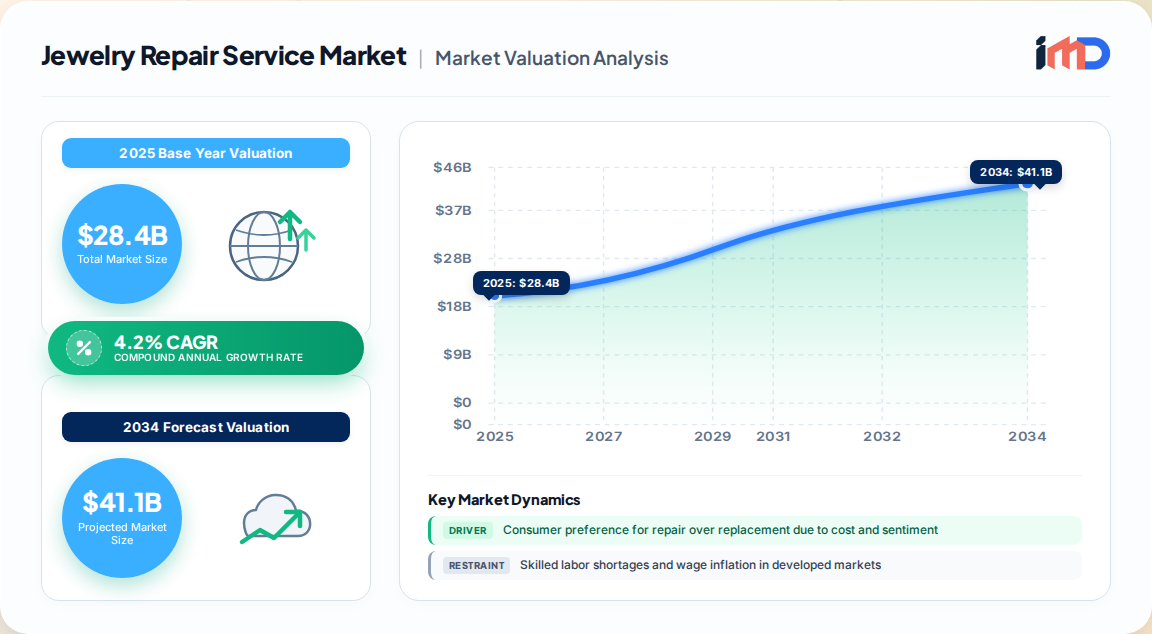
The global jewelry repair service market has transitioned from a fragmented, cash-based craft function into a professionalized, measurable service category. Our proprietary primary research estimates the market at $28.4 billion in 2025, expanding at a 4.2% CAGR to reach $39.8 billion by 2033. This mid-growth trajectory masks a profound structural shift: repair is no longer a back-of-store accommodation but a front-line revenue and retention engine.
Three lifecycle triggers define the current phase. First, aging fine jewelry portfolios among high-net-worth households require restoration at scale. Second, cost-of-living pressures across developed economies are pushing consumers toward repair rather than replacement. Third, certification and standardization—from digital intake to transparent pricing—are replacing opaque labor charges. Independents still control 48% of market value, but consolidation and digital platforms are reshaping competitive dynamics.
The repair value chain is bifurcated between physical craftsmanship and digital coordination. Upstream, precious metal suppliers, gemstone wholesalers, and tooling vendors feed independent benches and regional service centers. Midstream, intake, estimation, and chain-of-custody workflows determine throughput. Downstream, independent jewelers, retail chains, department store counters, and e-commerce mail-in platforms capture customer relationships.
A critical insight from our interviews: the bottleneck is not bench capacity but repair operations. Intake data living across paper, POS notes, and employee memory creates rework, dispute risk, and lost follow-ups. Standardizing intake—customer details, item condition, photos, requested work, and approval method—reduces turnaround time by an estimated 22–28% for mid-volume retailers. Digital intake and status visibility are the highest-leverage investments in the value chain.
While repair services are delivered locally, the market is deeply embedded in global trade flows for materials and components. Official trade statistics from the U.S. International Trade Commission and the International Trade Centre reveal three structural patterns.
First, precious metal scrap and refined bullion move from consumption markets in North America and Europe to refining hubs in Switzerland, Singapore, and the UAE. Second, watch components—including batteries, gaskets, and movements—flow from Switzerland, Japan, and China into repair benches worldwide, creating lead-time risk for independent jewelers. Third, lab-grown diamonds and synthetic gemstones are increasingly sourced from India and China, altering setting and cleaning protocols.
Regional repair hubs in Southeast Asia are emerging as outsourcing destinations for North American and European jewelers, leveraging 30–45% lower labor costs. However, quality control and customer trust erode with offshore outsourcing, limiting adoption to non-heirloom, routine maintenance categories.
| Segment | 2025 Share | CAGR (2026–2033) | Margin Profile | Strategic Verdict |
|---|---|---|---|---|
| Cleaning & Polishing | 28% | 3.2% | 22–28% | Hold |
| Metal Restoration & Plating | 22% | 3.8% | 30–38% | Hold |
| Sizing & Alteration | 18% | 3.6% | 25–32% | Hold |
| Stone Setting & Re-Setting | 17% | 4.9% | 35–45% | Buy |
| Appraisal & Documentation | 15% | 5.4% | 40–50% | Buy |
By customer base, fine jewelry owners deliver average transaction values of $320–$680 with a 72% repeat rate, while vintage/heirloom custodians spend $450–$1,200 per transaction and generate 68% word-of-mouth acquisition. Fashion jewelry repair remains structurally challenged, with 14–20% margins and high DIY substitution.
By distribution channel, independent jewelers hold 48% share but grow at 3.9%, while e-commerce and mail-in services expand at 7.2%—the fastest channel—albeit from a 12% base.
North America ($9.2 billion, 3.8% CAGR) and Western Europe ($8.1 billion, 3.4% CAGR) remain mature anchors, driven by heirloom restoration and circular-economy mandates. Asia-Pacific is the growth engine: $7.4 billion in 2025, expanding at 5.6% CAGR, with India alone accounting for $2.1 billion and growing at 6.8% annually. Rest-of-world markets ($3.7 billion, 4.1% CAGR) benefit from informal-sector formalization and tourism-driven demand, though currency volatility remains a risk.
The competitive field is consolidating. Signet Jewelers acquired the assets of Service Jewelry Repair National Repair Center in July 2023, expanding in-house watch repair and B2B capabilities across 4,000+ stores. Sotheby's launched a bespoke jewelry service in October 2025, compressing design-to-delivery to 30 days or less—a signal that premium repair and customization are converging.
Winning strategies center on three moves. First, treat repair as a managed operation: track average turnaround time by repair type, approval time, rework rate, and margin by category. Second, deploy digital intake and status visibility to reduce phone tag and lost pickups. Third, bundle high-margin services—appraisal, digital cataloging, extended maintenance—to lift customer lifetime value. The retailers scaling fastest are not hiring more bench jewelers; they are systemizing coordination.
Three underpenetrated opportunities merit capital attention. Heirloom digital cataloging—combining appraisal, restoration, and provenance documentation—commands 40–50% margins and faces low competition. Watch servicing remains fragmented; proper battery replacement, bracelet sizing, and movement servicing create repeat foot traffic and differentiate jewelers from pure-play repair shops. Emerging-market training pipelines—apprenticeship programs in India and Southeast Asia—address the structural labor shortage while building low-cost regional repair hubs for routine maintenance categories.
| Aspects | Details |
|---|---|
| Study Period | 2020-2034 |
| Base Year | 2025 |
| Estimated Year | 2026 |
| Forecast Period | 2026-2034 |
| Historical Period | 2020-2025 |
| Growth Rate | CAGR of 4.2% from 2020-2034 |
| Segmentation |
|
By Customer Base
By Distribution Channel
By Product Type
By Application
| By Geography |
|
The global jewelry repair service market was valued at $28.4 billion in 2025 and is projected to reach $39.8 billion by 2033, growing at a 4.2% CAGR.
North America is the largest regional market at $9.2 billion in 2025, followed by Western Europe at $8.1 billion. Asia-Pacific is the fastest-growing region at 5.6% CAGR, led by India.
Key trends include the heirloom restoration surge, sustainability-driven circular repair economy, digital intake and status visibility platforms, and the growing preference for repair over replacement among younger consumers.
The market faces labor supply shortages with technician wages rising 8.3% year-over-year, DIY and synthetic substitution risk, and macro wealth sensitivity that can reduce discretionary repair spending during economic downturns.
Vintage and heirloom custodians offer the highest margins at 42–55%, followed by fine jewelry restoration at 38–48%. Fashion jewelry repair is the least attractive segment with 14–20% margins.
Key players include Signet Jewelers, Tiffany & Co., Cartier, Van Cleef & Arpels, Stuller Inc., Jared, Zales, Kay Jewelers, and Sotheby's, alongside regional independent jewelers and specialized repair chains.
Our rigorous research methodology combines multi-layered approaches with comprehensive quality assurance, ensuring precision, accuracy, and reliability in every market analysis.
| Stakeholder Role | Interview Share (%) |
|---|---|
| Store Owners & Principals | 30% |
| Service Department Managers | 25% |
| Master Bench Jewelers | 20% |
| Procurement & Operations Directors | 15% |
| Sustainability & Compliance Officers | 10% |
| Company Type | Representation (%) |
|---|---|
| Independent Jewelers | 35% |
| Jewelry Retail Chains | 25% |
| E-Commerce & Mail-In Repair Platforms | 15% |
| Department Store Counters | 10% |
| Specialized Repair Shops | 15% |
 Related Reports
