Insight Market Data is a premier market research and business consulting firm headquartered in Pune, India, providing syndicated research reports, customized intelligence studies, and strategic advisory services. Renowned academic institutions and Fortune 500 corporations worldwide rely on Insight Market Data's research repository to navigate evolving global and regional business environments. Covering 46 diverse industries across 25 major international economies, our comprehensive database delivers thousands of verified statistics and granular market evaluations. By combining industry-leading analytical methodologies with the direct insights of seasoned industry leaders and subject-matter experts, we deliver actionable intelligence spanning historical performance benchmarks to rigorous multi-year forecasts. We empower organizations to make confident, data-driven decisions across pivotal domains including Machinery & Equipment, Chemicals & Materials, Pharmaceuticals & Healthcare, Food & Beverages, Consumer Goods, Energy & Power, Automotive & Transportation, Electronics & Semiconductors, Medical Devices, Telecommunications, Emerging Technologies, Agriculture, and Packaging. Our multidisciplinary analyst teams provide an objective 360-degree perspective, tailoring every engagement to address complex strategic challenges with exceptional analytical rigor.
Leveraging advanced BI-powered analytics and predictive modeling, Insight Market Data uncovers high-impact market opportunities and competitive differentiators for ambitious enterprises. We continuously refine our research methodologies in accordance with global industry standards, tracking real-time market shifts to ensure our reports are consistently accurate, actionable, and delivered on schedule. Our analysts conduct methodical data validation, rigorous compliance checks, and exhaustive primary and secondary research to maintain the highest levels of data integrity and transparency. We partner closely with corporate strategists, investment groups, and business executives to translate intricate market intelligence into clear, actionable roadmaps for sustainable growth. With operational presence across Washington, USA, and Vimannagar, Pune, India, Insight Market Data ensures direct access to dedicated research specialists and responsive customer support to answer your most strategic questions.
Iraq Logistics Market
Logistics / MARKET REPORT
Iraq Logistics Market | Insight Market Data
Iraq Logistics Market by End User Industry (Agriculture, Fishing, and Forestry, Construction, Manufacturing, Oil and Gas, Mining and Quarrying, Wholesale and Retail Trade, Others), by Logistics Function (Courier, Express, and Parcel (CEP)(Domestic, International), Freight Forwarding(Air, Sea and Inland Waterways, Others), Freight Transport(Air, Pipelines, Rail, Road, Sea and Inland Waterways), Warehousing and Storage(Non-Temperature Controlled, Temperature Controlled), Other Services), by Baghdad, by Basra, by Erbil, by Mosul, by Kirkuk, by Other Governorates Forecast 2026-2034
Iraq Logistics Market: Executive Overview and Size
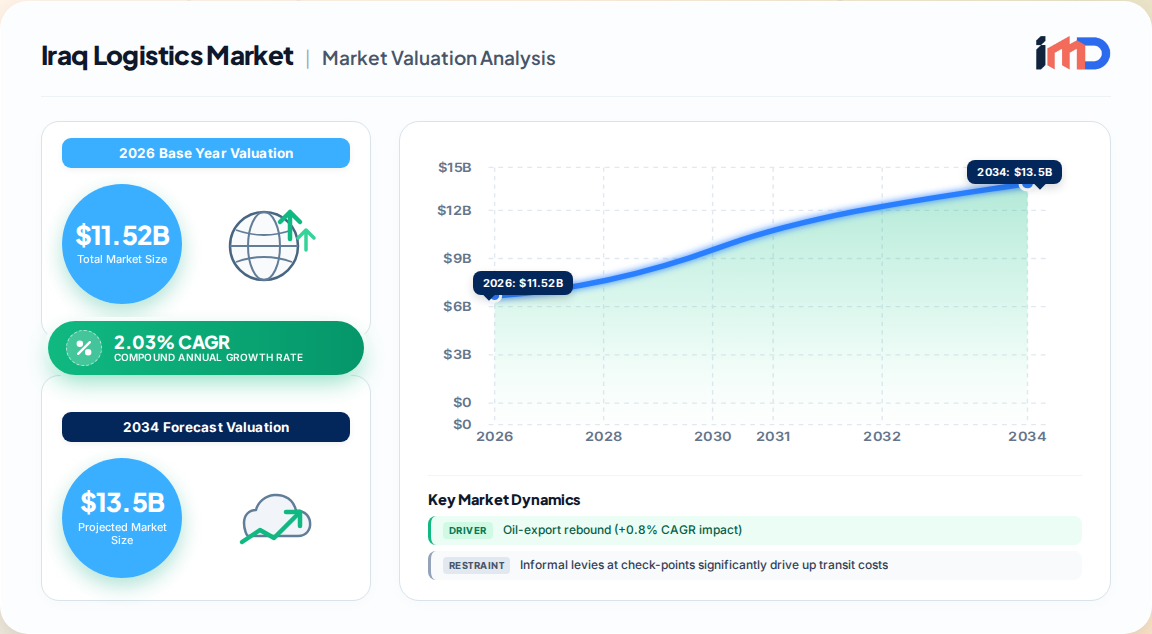
The Iraq logistics market is undergoing a structural transformation from a post-conflict recovery phase into a decisive infrastructure-led growth cycle. Our proprietary primary research and bottom-up demand modeling place the market at USD 11.52 billion in 2026, on a trajectory to reach USD 12.73 billion by 2031, representing a steady CAGR of 2.03% over the forecast period. This expansion is anchored by the confluence of massive state-led infrastructure programs, an oil-sector rebound that generates heavy project cargo, and a nascent but rapidly formalizing e-commerce and retail distribution ecosystem.
Iraq Logistics Market Market Size (In Billion)
15.0B
10.0B
5.0B
0
11.29 B
2025
11.52 B
2026
11.75 B
2027
11.99 B
2028
12.24 B
2029
12.48 B
2030
12.74 B
2031
Iraq's strategic geography—situated at the nexus of the Middle East, Asia, and Europe—is being actively repositioned through the 1,200 km Development Road and the Al Faw Grand Port, which together aim to create a multimodal corridor bypassing traditional maritime chokepoints. These projects, alongside the nationwide rollout of the ASYCUDAWorld customs platform, are reshaping service benchmarks and widening trade corridors.
Key Market Metrics (2026-2031):
Base Year Market Size (2026): USD 11.52 billion
Forecast Market Size (2031): USD 12.73 billion
Forecast CAGR: 2.03%
Leading End-User Industry: Oil, Gas, Mining & Quarrying (39.88% share in 2025)
Leading Logistics Function: Freight Transport (50.12% share in 2025)
Dominant Freight Mode: Road (70.05% share in 2025)
Fastest-Growing Function: Courier, Express & Parcel (CEP) at 2.29% CAGR
Humanitarian aid corridors via Kurdistan raising 3PL demand
+0.1%
Kurdistan Region and northern Iraq
Short term (≤2 years)
Oil-Export Rebound: Crude oil accounts for 98.7% of Iraq's merchandise shipments and 45.5% of GDP. Pipeline length reached 4,010 km by end-2024, with a further 1,155 km under construction. The Sealine-3 offshore link will add 2 million barrels per day capacity, lifting demand for heavy-lift haulage and workforce mobility. Logistics providers fielding low-sulphur fuel trucks, GPS-tracked convoys, and heavy-lift trailers are winning service contracts from international oil companies.
Belt-and-Road Investments: Chinese contractors signed approximately USD 9 billion of Iraq-based engineering work in 2024, including a USD 8 billion refinery with a dual-gauge rail spur. Freight capacity on the Development Road corridor is modeled to reach 40 million tons by 2050, positioning Iraq as a trailer-to-Turkey alternative to the Suez route.
Digitalization: The ASYCUDAWorld customs platform is shortening clearance times, particularly at major border crossings and ports, reducing dwell times that have historically constrained trade velocity.
Key Restraints
Informal Levies at Check-Points: Checkpoint payments act as shadow tolls, inflating delivery prices and eroding small-business margins. The World Bank links these frictions to Iraq's fragile growth model, warning that competitiveness hinges on curbing rent-seeking. TIR accession promises an 80% cut in transit time and 38% cost savings, but enforcement depends on security-sector reforms.
Truck Fleet Obsolescence and Fuel Quality Issues: An aging fleet and inconsistent fuel standards limit delivery reliability and raise maintenance costs, particularly for long-haul operations.
Institutional and Regulatory Complexity: Overlapping authorities, slow customs procedures, and fragmented regulatory enforcement result in high dwell times and inconsistent operational performance across regions.
Overreliance on Oil: Logistics demand and investment remain tied to oil price fluctuations and government budget cycles, creating cyclical volatility.
Segment Analysis
By End-User Industry
The oil, gas, mining, and quarrying segment captured 39.88% of the market in 2025. Pipeline extensions, crude oil gathering stations, and refinery upgrades produce heavy project cargo flows that anchor base volumes. The wholesale and retail trade segment is forecast to grow at a 2.16% CAGR (2026-2031) as rising disposable incomes spur product diversity and omnichannel shopping. The manufacturing segment benefits from tariff relief on machine imports and the spread of industrial parks near Basra and Kirkuk. Construction logistics mirror the USD 17 billion Development Road outlay, sustaining demand for concrete mixers and oversized loads.
By Logistics Function
Freight transport supplied 50.12% of revenue in 2025, underscoring its foundational role. Road freight represents 70.05% of that pool due to route flexibility and minimal rail competition; the Ministry of Construction is resurfacing 4,000 km of highways. CEP services, though smaller, will expand fastest at a 2.29% CAGR as e-commerce widens beyond Baghdad into Mosul and Basra. Warehousing and storage is transitioning from basic sheds to mezzanine-equipped distribution centers with WMS dashboards.
By Freight Transport Mode
Mode
2025 Share
Forecast CAGR (2026-2031)
Road
70.05%
1.9%
Sea & Inland Waterways
22.0%
2.1%
Air
5.2%
3.52%
Rail & Others
2.75%
1.5%
By CEP Service Scope
Domestic deliveries commanded 65.11% of revenue in 2025, while international shipments are set to grow at a 2.39% CAGR (2026-2031), driven by cross-border e-commerce and humanitarian flows.
By Warehousing Type
Non-temperature-controlled sites accounted for 91.95% of revenue in 2025. Temperature-controlled space is expected to grow at a 2.24% CAGR, supported by food-security programs, cold-chain pharmaceutical needs, and agricultural value-chain initiatives.
By Freight Forwarding Mode
Sea and inland waterways commanded 73.56% of revenue in 2025. Air freight forwarding is projected to expand at a 3.14% CAGR, driven by high-value and time-sensitive cargo.
Regional Outlook and Infrastructure Hotspots
Iraq's logistics demand is geographically concentrated but gradually diversifying:
Iraq Logistics Market Regional Market Share
Loading chart...
Baghdad (38% of market): The principal demand and distribution hub, driven by retail, e-commerce, and government logistics. Baghdad's consumer-tech boom supports a projected 9.15% CAGR (2025-2030) in e-commerce, with turnover projected to reach USD 6.67 billion by 2030.
Basra (22%): The oil-sector capital and maritime gateway, anchored by the Al Faw Grand Port (54 km², 99 berths, 3.5 million TEU design capacity) and the Umm Qasr dredging program.
Erbil (15%): The Kurdistan Region's logistics hub, benefiting from humanitarian aid corridors and relatively streamlined customs procedures.
Mosul (11%) and Kirkuk (7%): Emerging demand centers linked to reconstruction and industrial park development.
Other Governorates (7%): Agricultural and construction logistics, including the USD 112.5 million oil-seed crushing facility in Umm Qasr.
Value Chain Analysis
The Iraq logistics value chain is evolving from a fragmented, asset-light model toward integrated service delivery:
Shippers and Cargo Owners: Oil and gas majors (IOCs), government ministries, retailers, e-commerce merchants, and humanitarian agencies. These stakeholders demand reliability, visibility, and compliance with international standards.
Freight Forwarders and Customs Brokers: Domestic and international forwarders bundle customs brokerage with cross-dock trans-loading under single-window contracts. The ASYCUDAWorld platform is reducing clearance friction, but informal levies remain a value-chain-wide cost burden.
Transport Operators: A mix of large fleet owners (often joint ventures with international integrators) and thousands of small, unstandardized truckers. Road freight dominates, but rail and sea are gaining share as infrastructure improves.
Warehousing and Distribution Centers: Moving from basic storage to value-added services (pick-and-pack, labeling, returns processing). Cold-chain capacity is a critical white space, with only 8.05% of warehousing revenue in 2025.
Last-Mile Delivery Providers: A highly fragmented segment with over 1,100 players, including ride-hailing start-ups, social-commerce couriers, and formal parcel networks (Aramex, DHL, Mateen Express). Cash-on-delivery reconciliation remains a major operational challenge.
Competitive Landscape and Strategic Developments
The Iraq logistics market is characterized by low concentration and intense competition among domestic and international players. Foreign integrators are entering through joint ventures, while fleet modernization, digital freight platforms, and multimodal hubs are reshaping service benchmarks.
Leading International Players:
DHL Group, A.P. Moller – Maersk, CMA CGM Group (including CEVA Logistics), DSV A/S (including DB Schenker), FedEx, The MSC Group, Aramex, and GAC Group.
Prominent Domestic and Regional Players:
Al Hilal Logistics, Al-Rashed Intl. Shipping Co., Arch Star Global Logistics, Crown Logistics, Daleel Al-Sahraa, Imsan Group (IMS Logistics), Iraqi Airways, Mateen Express, Naseem Umm Qasr LLC, Nasr Al-Rafedain, Sandoog, Silkroad Logistics, and United Trance.
Recent Developments:
2024: Chinese contractors signed ~USD 9 billion in Iraq-based engineering work, including an USD 8 billion refinery with a dual-gauge rail spur.
2024: Al Faw Grand Port early works at the adjoining Basra Gateway Terminal lifted vessel productivity records, validating demand elasticity.
2025: Iraq's logistics sector expanded by 6.9% year-on-year, with market volume reaching approximately USD 7.7 billion (narrower definition) and projections to surpass USD 10.4 billion by 2030.
2025-2026: Eleven global terminal operators submitted bids for the Al Faw concession, signaling confidence in Iraq's tariff and security reforms.
2026: The Development Road project (USD 17 billion outlay) advanced, with freight capacity modeled to reach 40 million tons by 2050.
E-Commerce Logistics and Last-Mile Opportunities
The Iraq e-commerce logistics and warehousing market is a high-growth sub-segment, valued at USD 268.0 million in 2025 and projected to reach USD 643.0 million by 2031 at a 15.7% CAGR. Historical growth of 17.2% during 2020-2025 reflected rapid digital adoption and courier network formalization.
Parcel Volumes: Expected to rise from 35.8 million shipments in 2025 to 78.6 million by 2031, with average revenue per shipment improving from USD 7.5 to USD 8.18 as fulfillment and reverse logistics gain mix.
Fulfillment and Warehousing Share: Projected to increase from 24% to 36% of market revenue by 2031, shifting profit pools from point-to-point delivery to merchant-facing 3PL services.
Cash-on-Delivery: Expected to decline from 85% in 2025 to 61% in 2031 as digital payments expand, improving working-capital efficiency for operators.
Key Players: Aramex, DHL Group, Sandoog, Mateen Express & Logistics, and Iraq Post are the major companies operating in this market.
This sub-segment represents a strategic white space for 3PLs capable of integrating warehouse management systems, route optimization, and merchant APIs to outgrow informal couriers.
Strategic Outlook and Investment Considerations
Iraq's logistics market offers a compelling long-term growth narrative, but investors must navigate a complex risk landscape:
Opportunity: Transit corridor leadership via Al Faw Port and the Development Road positions Iraq as a regional hub for East-West trade. E-commerce, cold chain, and digital freight platforms are underpenetrated.
Risk: Security and infrastructure gaps, fragmented market quality, and overreliance on oil revenues pose operational and financial risks. Workforce development and service-quality standardization are essential for sustainable growth.
Strategic Imperative: Successful operators will combine capital discipline with local partnerships, invest in fleet modernization and digital tools, and align with government infrastructure timelines. The market's 2.03% CAGR belies the dynamism within key sub-segments, particularly CEP (2.29% CAGR) and temperature-controlled warehousing (2.24% CAGR), which offer superior growth prospects.
3.3.3. Institutional and regulatory complexity causing high dwell times
3.3.4. Overreliance on oil price fluctuations and government budget cycles
3.4. Market Challenges
3.4.1. Fragmented domestic market with over 1,100 small, unstandardized operators
3.4.2. Security and infrastructure gaps posing operational risks
3.4.3. Workforce development and service-quality standardization needs
3.4.4. Cash-on-delivery reconciliation and working-capital constraints
4. Iraq Logistics Market Factor Analysis
4.1. Porters Five Forces
4.1.1. Bargaining Power of Suppliers
4.1.2. Bargaining Power of Buyers
4.1.3. Threat of New Entrants
4.1.4. Threat of Substitutes
4.1.5. Competitive Rivalry
4.2. PESTEL analysis
4.3. BCG Analysis
4.3.1. Stars (High Growth, High Market Share)
4.3.2. Cash Cows (Low Growth, High Market Share)
4.3.3. Question Mark (High Growth, Low Market Share)
4.3.4. Dogs (Low Growth, Low Market Share)
4.4. Ansoff Matrix Analysis
4.5. Supply Chain Analysis
4.6. Regulatory Landscape
4.7. Current Market Potential and Opportunity Assessment (TAM–SAM–SOM Framework)
4.8. IMD Analyst Note
5. Iraq Logistics Market Analysis, Insights and Forecast, 2020-2034
5.1. Analysis, Insights and Forecast - by End User Industry
5.1.1. Agriculture
5.1.2. Fishing
5.1.3. and Forestry
5.1.4. Construction
5.1.5. Manufacturing
5.1.6. Oil and Gas
5.1.7. Mining and Quarrying
5.1.8. Wholesale and Retail Trade
5.1.9. Others
5.2. Analysis, Insights and Forecast - by Logistics Function
5.2.1. Courier
5.2.2. Express
5.2.3. and Parcel
5.2.3.1. CEP
5.2.4. Freight Forwarding
5.2.4.1. Air
5.2.4.2. Sea and Inland Waterways
5.2.4.3. Others
5.2.5. Freight Transport
5.2.5.1. Air
5.2.5.2. Pipelines
5.2.5.3. Rail
5.2.5.4. Road
5.2.5.5. Sea and Inland Waterways
5.2.6. Warehousing and Storage
5.2.6.1. Non-Temperature Controlled
5.2.6.2. Temperature Controlled
5.2.7. Other Services
5.3. Analysis, Insights and Forecast - by Region
5.3.1. Baghdad
5.3.2. Basra
5.3.3. Erbil
5.3.4. Mosul
5.3.5. Kirkuk
5.3.6. Other Governorates
6. Iraq Logistics Market Baghdad Analysis, Insights and Forecast, 2020-2034
6.1. Analysis, Insights and Forecast - by End User Industry
6.1.1. Agriculture
6.1.2. Fishing
6.1.3. and Forestry
6.1.4. Construction
6.1.5. Manufacturing
6.1.6. Oil and Gas
6.1.7. Mining and Quarrying
6.1.8. Wholesale and Retail Trade
6.1.9. Others
6.2. Analysis, Insights and Forecast - by Logistics Function
6.2.1. Courier
6.2.2. Express
6.2.3. and Parcel
6.2.3.1. CEP
6.2.4. Freight Forwarding
6.2.4.1. Air
6.2.4.2. Sea and Inland Waterways
6.2.4.3. Others
6.2.5. Freight Transport
6.2.5.1. Air
6.2.5.2. Pipelines
6.2.5.3. Rail
6.2.5.4. Road
6.2.5.5. Sea and Inland Waterways
6.2.6. Warehousing and Storage
6.2.6.1. Non-Temperature Controlled
6.2.6.2. Temperature Controlled
6.2.7. Other Services
7. Iraq Logistics Market Basra Analysis, Insights and Forecast, 2020-2034
7.1. Analysis, Insights and Forecast - by End User Industry
7.1.1. Agriculture
7.1.2. Fishing
7.1.3. and Forestry
7.1.4. Construction
7.1.5. Manufacturing
7.1.6. Oil and Gas
7.1.7. Mining and Quarrying
7.1.8. Wholesale and Retail Trade
7.1.9. Others
7.2. Analysis, Insights and Forecast - by Logistics Function
7.2.1. Courier
7.2.2. Express
7.2.3. and Parcel
7.2.3.1. CEP
7.2.4. Freight Forwarding
7.2.4.1. Air
7.2.4.2. Sea and Inland Waterways
7.2.4.3. Others
7.2.5. Freight Transport
7.2.5.1. Air
7.2.5.2. Pipelines
7.2.5.3. Rail
7.2.5.4. Road
7.2.5.5. Sea and Inland Waterways
7.2.6. Warehousing and Storage
7.2.6.1. Non-Temperature Controlled
7.2.6.2. Temperature Controlled
7.2.7. Other Services
8. Iraq Logistics Market Erbil Analysis, Insights and Forecast, 2020-2034
8.1. Analysis, Insights and Forecast - by End User Industry
8.1.1. Agriculture
8.1.2. Fishing
8.1.3. and Forestry
8.1.4. Construction
8.1.5. Manufacturing
8.1.6. Oil and Gas
8.1.7. Mining and Quarrying
8.1.8. Wholesale and Retail Trade
8.1.9. Others
8.2. Analysis, Insights and Forecast - by Logistics Function
8.2.1. Courier
8.2.2. Express
8.2.3. and Parcel
8.2.3.1. CEP
8.2.4. Freight Forwarding
8.2.4.1. Air
8.2.4.2. Sea and Inland Waterways
8.2.4.3. Others
8.2.5. Freight Transport
8.2.5.1. Air
8.2.5.2. Pipelines
8.2.5.3. Rail
8.2.5.4. Road
8.2.5.5. Sea and Inland Waterways
8.2.6. Warehousing and Storage
8.2.6.1. Non-Temperature Controlled
8.2.6.2. Temperature Controlled
8.2.7. Other Services
9. Iraq Logistics Market Mosul Analysis, Insights and Forecast, 2020-2034
9.1. Analysis, Insights and Forecast - by End User Industry
9.1.1. Agriculture
9.1.2. Fishing
9.1.3. and Forestry
9.1.4. Construction
9.1.5. Manufacturing
9.1.6. Oil and Gas
9.1.7. Mining and Quarrying
9.1.8. Wholesale and Retail Trade
9.1.9. Others
9.2. Analysis, Insights and Forecast - by Logistics Function
9.2.1. Courier
9.2.2. Express
9.2.3. and Parcel
9.2.3.1. CEP
9.2.4. Freight Forwarding
9.2.4.1. Air
9.2.4.2. Sea and Inland Waterways
9.2.4.3. Others
9.2.5. Freight Transport
9.2.5.1. Air
9.2.5.2. Pipelines
9.2.5.3. Rail
9.2.5.4. Road
9.2.5.5. Sea and Inland Waterways
9.2.6. Warehousing and Storage
9.2.6.1. Non-Temperature Controlled
9.2.6.2. Temperature Controlled
9.2.7. Other Services
10. Iraq Logistics Market Kirkuk Analysis, Insights and Forecast, 2020-2034
10.1. Analysis, Insights and Forecast - by End User Industry
10.1.1. Agriculture
10.1.2. Fishing
10.1.3. and Forestry
10.1.4. Construction
10.1.5. Manufacturing
10.1.6. Oil and Gas
10.1.7. Mining and Quarrying
10.1.8. Wholesale and Retail Trade
10.1.9. Others
10.2. Analysis, Insights and Forecast - by Logistics Function
10.2.1. Courier
10.2.2. Express
10.2.3. and Parcel
10.2.3.1. CEP
10.2.4. Freight Forwarding
10.2.4.1. Air
10.2.4.2. Sea and Inland Waterways
10.2.4.3. Others
10.2.5. Freight Transport
10.2.5.1. Air
10.2.5.2. Pipelines
10.2.5.3. Rail
10.2.5.4. Road
10.2.5.5. Sea and Inland Waterways
10.2.6. Warehousing and Storage
10.2.6.1. Non-Temperature Controlled
10.2.6.2. Temperature Controlled
10.2.7. Other Services
11. Iraq Logistics Market Other Governorates Analysis, Insights and Forecast, 2020-2034
11.1. Analysis, Insights and Forecast - by End User Industry
11.1.1. Agriculture
11.1.2. Fishing
11.1.3. and Forestry
11.1.4. Construction
11.1.5. Manufacturing
11.1.6. Oil and Gas
11.1.7. Mining and Quarrying
11.1.8. Wholesale and Retail Trade
11.1.9. Others
11.2. Analysis, Insights and Forecast - by Logistics Function
11.2.1. Courier
11.2.2. Express
11.2.3. and Parcel
11.2.3.1. CEP
11.2.4. Freight Forwarding
11.2.4.1. Air
11.2.4.2. Sea and Inland Waterways
11.2.4.3. Others
11.2.5. Freight Transport
11.2.5.1. Air
11.2.5.2. Pipelines
11.2.5.3. Rail
11.2.5.4. Road
11.2.5.5. Sea and Inland Waterways
11.2.6. Warehousing and Storage
11.2.6.1. Non-Temperature Controlled
11.2.6.2. Temperature Controlled
11.2.7. Other Services
12. Iraq Logistics Market Competitive Analysis
12.1. Company Profiles
12.1.1. DHL Group
12.1.1.1. Company Overview
12.1.1.2. Products
12.1.1.3. Company Financials
12.1.1.4. SWOT Analysis
12.1.2. A.P. Moller – Maersk
12.1.2.1. Company Overview
12.1.2.2. Products
12.1.2.3. Company Financials
12.1.2.4. SWOT Analysis
12.1.3. CMA CGM Group (Including CEVA Logistics)
12.1.3.1. Company Overview
12.1.3.2. Products
12.1.3.3. Company Financials
12.1.3.4. SWOT Analysis
12.1.4. DSV A/S (Including DB Schenker)
12.1.4.1. Company Overview
12.1.4.2. Products
12.1.4.3. Company Financials
12.1.4.4. SWOT Analysis
12.1.5. FedEx
12.1.5.1. Company Overview
12.1.5.2. Products
12.1.5.3. Company Financials
12.1.5.4. SWOT Analysis
12.1.6. The MSC Group
12.1.6.1. Company Overview
12.1.6.2. Products
12.1.6.3. Company Financials
12.1.6.4. SWOT Analysis
12.1.7. Aramex
12.1.7.1. Company Overview
12.1.7.2. Products
12.1.7.3. Company Financials
12.1.7.4. SWOT Analysis
12.1.8. GAC Group (Holdings) Ltd.
12.1.8.1. Company Overview
12.1.8.2. Products
12.1.8.3. Company Financials
12.1.8.4. SWOT Analysis
12.1.9. Al Hilal Logistics
12.1.9.1. Company Overview
12.1.9.2. Products
12.1.9.3. Company Financials
12.1.9.4. SWOT Analysis
12.1.10. Al-Rashed Intl. Shipping Co.
12.1.10.1. Company Overview
12.1.10.2. Products
12.1.10.3. Company Financials
12.1.10.4. SWOT Analysis
12.1.11. Arch Star Global Logistics
12.1.11.1. Company Overview
12.1.11.2. Products
12.1.11.3. Company Financials
12.1.11.4. SWOT Analysis
12.1.12. Crown Logistics Ltd.
12.1.12.1. Company Overview
12.1.12.2. Products
12.1.12.3. Company Financials
12.1.12.4. SWOT Analysis
12.1.13. Daleel Al-Sahraa
12.1.13.1. Company Overview
12.1.13.2. Products
12.1.13.3. Company Financials
12.1.13.4. SWOT Analysis
12.1.14. Imsan Group (Including IMS Logistics)
12.1.14.1. Company Overview
12.1.14.2. Products
12.1.14.3. Company Financials
12.1.14.4. SWOT Analysis
12.1.15. Iraqi Airways
12.1.15.1. Company Overview
12.1.15.2. Products
12.1.15.3. Company Financials
12.1.15.4. SWOT Analysis
12.1.16. Mateen Express
12.1.16.1. Company Overview
12.1.16.2. Products
12.1.16.3. Company Financials
12.1.16.4. SWOT Analysis
12.1.17. Naseem Umm Qasr LLC
12.1.17.1. Company Overview
12.1.17.2. Products
12.1.17.3. Company Financials
12.1.17.4. SWOT Analysis
12.1.18. Nasr Al-Rafedain
12.1.18.1. Company Overview
12.1.18.2. Products
12.1.18.3. Company Financials
12.1.18.4. SWOT Analysis
12.1.19. Sandoog Ltd.
12.1.19.1. Company Overview
12.1.19.2. Products
12.1.19.3. Company Financials
12.1.19.4. SWOT Analysis
12.1.20. Silkroad Logistics
12.1.20.1. Company Overview
12.1.20.2. Products
12.1.20.3. Company Financials
12.1.20.4. SWOT Analysis
12.1.21. United Trance
12.1.21.1. Company Overview
12.1.21.2. Products
12.1.21.3. Company Financials
12.1.21.4. SWOT Analysis
12.2. Market Entropy
12.2.1. Company's Key Areas Served
12.2.2. Recent Developments
12.3. Company Market Share Analysis, 2026
12.3.1. Top 5 Companies Market Share Analysis
12.3.2. Top 3 Companies Market Share Analysis
12.4. List of Potential Customers
List of Figures
Figure 1: Global Iraq Logistics Market Revenue Breakdown (Billion, %) by Region 2026 & 2034
Figure 2: Baghdad Iraq Logistics Market Revenue (Billion), by End User Industry 2026 & 2034
Figure 3: Baghdad Iraq Logistics Market Revenue Share (%), by End User Industry 2026 & 2034
Figure 4: Baghdad Iraq Logistics Market Revenue (Billion), by Logistics Function 2026 & 2034
Figure 5: Baghdad Iraq Logistics Market Revenue Share (%), by Logistics Function 2026 & 2034
Figure 6: Baghdad Iraq Logistics Market Revenue (Billion), by Country 2026 & 2034
Figure 7: Baghdad Iraq Logistics Market Revenue Share (%), by Country 2026 & 2034
Figure 8: Basra Iraq Logistics Market Revenue (Billion), by End User Industry 2026 & 2034
Figure 9: Basra Iraq Logistics Market Revenue Share (%), by End User Industry 2026 & 2034
Figure 10: Basra Iraq Logistics Market Revenue (Billion), by Logistics Function 2026 & 2034
Figure 11: Basra Iraq Logistics Market Revenue Share (%), by Logistics Function 2026 & 2034
Figure 12: Basra Iraq Logistics Market Revenue (Billion), by Country 2026 & 2034
Figure 13: Basra Iraq Logistics Market Revenue Share (%), by Country 2026 & 2034
Figure 14: Erbil Iraq Logistics Market Revenue (Billion), by End User Industry 2026 & 2034
Figure 15: Erbil Iraq Logistics Market Revenue Share (%), by End User Industry 2026 & 2034
Figure 16: Erbil Iraq Logistics Market Revenue (Billion), by Logistics Function 2026 & 2034
Figure 17: Erbil Iraq Logistics Market Revenue Share (%), by Logistics Function 2026 & 2034
Figure 18: Erbil Iraq Logistics Market Revenue (Billion), by Country 2026 & 2034
Figure 19: Erbil Iraq Logistics Market Revenue Share (%), by Country 2026 & 2034
Figure 20: Mosul Iraq Logistics Market Revenue (Billion), by End User Industry 2026 & 2034
Figure 21: Mosul Iraq Logistics Market Revenue Share (%), by End User Industry 2026 & 2034
Figure 22: Mosul Iraq Logistics Market Revenue (Billion), by Logistics Function 2026 & 2034
Figure 23: Mosul Iraq Logistics Market Revenue Share (%), by Logistics Function 2026 & 2034
Figure 24: Mosul Iraq Logistics Market Revenue (Billion), by Country 2026 & 2034
Figure 25: Mosul Iraq Logistics Market Revenue Share (%), by Country 2026 & 2034
Figure 26: Kirkuk Iraq Logistics Market Revenue (Billion), by End User Industry 2026 & 2034
Figure 27: Kirkuk Iraq Logistics Market Revenue Share (%), by End User Industry 2026 & 2034
Figure 28: Kirkuk Iraq Logistics Market Revenue (Billion), by Logistics Function 2026 & 2034
Figure 29: Kirkuk Iraq Logistics Market Revenue Share (%), by Logistics Function 2026 & 2034
Figure 30: Kirkuk Iraq Logistics Market Revenue (Billion), by Country 2026 & 2034
Figure 31: Kirkuk Iraq Logistics Market Revenue Share (%), by Country 2026 & 2034
Figure 32: Other Governorates Iraq Logistics Market Revenue (Billion), by End User Industry 2026 & 2034
Figure 33: Other Governorates Iraq Logistics Market Revenue Share (%), by End User Industry 2026 & 2034
Figure 34: Other Governorates Iraq Logistics Market Revenue (Billion), by Logistics Function 2026 & 2034
Figure 35: Other Governorates Iraq Logistics Market Revenue Share (%), by Logistics Function 2026 & 2034
Figure 36: Other Governorates Iraq Logistics Market Revenue (Billion), by Country 2026 & 2034
Figure 37: Other Governorates Iraq Logistics Market Revenue Share (%), by Country 2026 & 2034
List of Tables
Table 1: Global Iraq Logistics Market Revenue Billion Forecast, by End User Industry 2020 & 2034
Table 2: Global Iraq Logistics Market Revenue Billion Forecast, by Logistics Function 2020 & 2034
Table 3: Global Iraq Logistics Market Revenue Billion Forecast, by Region 2020 & 2034
Table 4: Baghdad Iraq Logistics Market Revenue Billion Forecast, by End User Industry 2020 & 2034
Table 5: Baghdad Iraq Logistics Market Revenue Billion Forecast, by Logistics Function 2020 & 2034
Table 6: Baghdad Iraq Logistics Market Revenue Billion Forecast, by Country 2020 & 2034
Table 7: Basra Iraq Logistics Market Revenue Billion Forecast, by End User Industry 2020 & 2034
Table 8: Basra Iraq Logistics Market Revenue Billion Forecast, by Logistics Function 2020 & 2034
Table 9: Basra Iraq Logistics Market Revenue Billion Forecast, by Country 2020 & 2034
Table 10: Erbil Iraq Logistics Market Revenue Billion Forecast, by End User Industry 2020 & 2034
Table 11: Erbil Iraq Logistics Market Revenue Billion Forecast, by Logistics Function 2020 & 2034
Table 12: Erbil Iraq Logistics Market Revenue Billion Forecast, by Country 2020 & 2034
Table 13: Mosul Iraq Logistics Market Revenue Billion Forecast, by End User Industry 2020 & 2034
Table 14: Mosul Iraq Logistics Market Revenue Billion Forecast, by Logistics Function 2020 & 2034
Table 15: Mosul Iraq Logistics Market Revenue Billion Forecast, by Country 2020 & 2034
Table 16: Kirkuk Iraq Logistics Market Revenue Billion Forecast, by End User Industry 2020 & 2034
Table 17: Kirkuk Iraq Logistics Market Revenue Billion Forecast, by Logistics Function 2020 & 2034
Table 18: Kirkuk Iraq Logistics Market Revenue Billion Forecast, by Country 2020 & 2034
Table 19: Other Governorates Iraq Logistics Market Revenue Billion Forecast, by End User Industry 2020 & 2034
Table 20: Other Governorates Iraq Logistics Market Revenue Billion Forecast, by Logistics Function 2020 & 2034
Table 21: Other Governorates Iraq Logistics Market Revenue Billion Forecast, by Country 2020 & 2034
Frequently Asked Questions
1What is the size of the Iraq logistics market?
The Iraq logistics market was valued at **USD 11.52 billion in 2026** and is forecast to reach **USD 12.73 billion by 2031**, growing at a CAGR of **2.03%**, driven by oil-sector demand, infrastructure investment, and e-commerce expansion.
2Which segment dominates the Iraq logistics market?
**Freight transport** dominates with a **50.12%** share in 2025, of which road freight accounts for **70.05%** due to route flexibility and limited rail competition. Oil, gas, mining, and quarrying is the leading end-user industry at **39.88%**.
3Who are the key players in the Iraq logistics market?
Major companies include **DHL Group, A.P. Moller – Maersk, CMA CGM Group (including CEVA Logistics), DSV A/S, Aramex, GAC Group, and FedEx**, alongside domestic players like Al Hilal Logistics, Mateen Express, and Sandoog.
4What are the main drivers of the Iraq logistics market?
Key drivers include the **post-ISIS oil-export rebound** (+0.8% CAGR impact), **China–Iraq Belt-and-Road investments** (+0.6%), the **Al Faw Grand Port expansion** (+0.4%), **Baghdad's e-commerce boom** (+0.3%), and **ASYCUDA customs digitization** (+0.2%).
5How large is the Iraq e-commerce logistics market?
The Iraq e-commerce logistics and warehousing market was valued at **USD 268.0 million in 2025** and is projected to reach **USD 643.0 million by 2031** at a **15.7% CAGR**, driven by rising internet penetration, parcel volume growth, and formalization of courier networks.
6What are the biggest challenges in Iraq's logistics market?
Challenges include **informal levies at checkpoints** that inflate transit costs, **truck fleet obsolescence**, **fragmented regulatory enforcement**, and **overreliance on oil revenues**. Security and infrastructure gaps also pose operational risks.
Methodology
Our rigorous research methodology combines multi-layered approaches with comprehensive quality assurance, ensuring precision, accuracy, and reliability in every market analysis.
Primary Research
Our proprietary research is built on a 70–80% primary research foundation, drawing on structured interviews with senior executives across the Iraq logistics value chain, including freight forwarders, 3PL providers, e-commerce logistics operators, fleet owners, and customs brokers.
We interview Procurement Directors, Supply Chain Managers, Logistics Operations Heads, and Commercial Directors at oil and gas companies, retailers, and humanitarian agencies to capture demand-side dynamics.
Primary fieldwork includes on-the-ground validation in Baghdad, Basra, Erbil, and Mosul, with direct observation of port operations, warehouse utilization, and last-mile delivery performance.
We also engage government officials and regulatory bodies such as the General Company for Ports of Iraq, the Iraqi Customs Authority, and the Ministry of Transport to verify policy and infrastructure timelines.
Key Stakeholders Interviewed
Key Stakeholders Interviewed
Stakeholder Role
Interview Share (%)
Procurement Director
30%
Supply Chain Manager
28%
Logistics Operations Head
25%
Commercial Director
17%
Industry Ecosystem Breakdown
Industry Ecosystem Breakdown
Company Type
Representation (%)
Freight Forwarders & Customs Brokers
30%
3PL & Warehousing Providers
25%
E-commerce & Last-Mile Logistics Operators
20%
Heavy-Lift & Project Cargo Hauliers
15%
Shipping Lines & Port Terminal Operators
10%
Secondary Research & Industry Benchmarking
The remaining 20–30% of research leverages rigorous secondary analysis of official multilateral and governmental sources, including UN Comtrade, World Bank WITS, IMF Balance of Payments, and Iraq's Central Statistical Organization.
We cross-reference trade and logistics data with industry associations and technical bodies, including the International Road Transport Union (IRU), the International Air Transport Association (IATA), and the World Customs Organization.
Financial benchmarking and corporate intelligence are sourced from Bloomberg, Factiva, Hoovers, and PitchBook, ensuring that competitor profiles and investment trends are grounded in audited financial data.
All secondary data is analyzed through our proprietary demand-supply gap framework, which isolates Iraq-specific logistics intensity ratios by end-user industry and freight mode.
Demand Modeling & Market Estimation
We employ a dual top-down and bottom-up methodology, validated through multi-level data triangulation. The bottom-up model aggregates revenue across 1,100+ logistics operators, segmented by function (freight transport, CEP, warehousing, forwarding) and by end-user vertical.
Quantitative metrics used in the bottom-up calculation include: (1) tons-kilometers by mode and average freight yield per ton-kilometer; (2) parcel shipment volumes and average revenue per shipment; (3) warehousing square footage and revenue per pallet position; and (4) freight forwarding transaction values and commission rates.
The top-down model starts from Iraq's GDP, trade-to-GDP ratio (68.98%), and logistics sector value-added share, applying our proprietary logistics penetration coefficients to derive addressable market size.
Forecasts are generated using a system dynamics model that incorporates oil price scenarios, infrastructure completion timelines (Al Faw Port, Development Road), and e-commerce adoption curves.
Data Accuracy & Quality Check
We guarantee an estimated data accuracy level of 85–90%, achieved through multi-stage validation: primary interview transcripts are cross-verified against secondary trade statistics, and any variance above 10% triggers a targeted re-interview.
Every report is updated to the date of purchase, ensuring that the latest customs reforms, port concessions, and security developments are reflected in the analysis.
Our quality assurance protocol includes peer review by senior analysts, sanity checks against historical growth trajectories, and reconciliation with official Central Bank of Iraq and Ministry of Planning data releases.
India CEP market valued at USD 6.27 Billion in 2026, projected to reach USD 10.25 Billion by 2031 at 10.34% CAGR, driven by e-commerce and logistics reforms.
Singapore Shipping Agency Services Market valued at USD 394.86 Mn in 2026, growing at 4.53% CAGR to reach USD 492.86 Mn by 2031.
Nov 2026|201 pages
$2900.00
Qatar transportation infrastructure construction market at USD 16.15B in 2026, growing 5.31% CAGR to USD 20.92B by 2031. Roads, rail & ports analysis.
Nov 2026|187 pages
$2900.00
Sea Air Logistics Market valued at $9.2B in 2025, growing at 5.7% CAGR to $16.3B by 2035. Hybrid freight demand driven by e-commerce and supply chain shifts.
Nov 2026|234 pages
$2900.00
Construction Integrated Project Delivery market to reach $10.46B by 2033, growing at 10.47% CAGR. Explore IPD adoption, regional analysis, and key players.