Insight Market Data is a premier market research and business consulting firm headquartered in Pune, India, providing syndicated research reports, customized intelligence studies, and strategic advisory services. Renowned academic institutions and Fortune 500 corporations worldwide rely on Insight Market Data's research repository to navigate evolving global and regional business environments. Covering 46 diverse industries across 25 major international economies, our comprehensive database delivers thousands of verified statistics and granular market evaluations. By combining industry-leading analytical methodologies with the direct insights of seasoned industry leaders and subject-matter experts, we deliver actionable intelligence spanning historical performance benchmarks to rigorous multi-year forecasts. We empower organizations to make confident, data-driven decisions across pivotal domains including Machinery & Equipment, Chemicals & Materials, Pharmaceuticals & Healthcare, Food & Beverages, Consumer Goods, Energy & Power, Automotive & Transportation, Electronics & Semiconductors, Medical Devices, Telecommunications, Emerging Technologies, Agriculture, and Packaging. Our multidisciplinary analyst teams provide an objective 360-degree perspective, tailoring every engagement to address complex strategic challenges with exceptional analytical rigor.
Leveraging advanced BI-powered analytics and predictive modeling, Insight Market Data uncovers high-impact market opportunities and competitive differentiators for ambitious enterprises. We continuously refine our research methodologies in accordance with global industry standards, tracking real-time market shifts to ensure our reports are consistently accurate, actionable, and delivered on schedule. Our analysts conduct methodical data validation, rigorous compliance checks, and exhaustive primary and secondary research to maintain the highest levels of data integrity and transparency. We partner closely with corporate strategists, investment groups, and business executives to translate intricate market intelligence into clear, actionable roadmaps for sustainable growth. With operational presence across Washington, USA, and Vimannagar, Pune, India, Insight Market Data ensures direct access to dedicated research specialists and responsive customer support to answer your most strategic questions.
IoT Wi-Fi MCU Chips in Focus: Growth Trajectories and Market
Technology, Media and Telecom / MARKET REPORT
IoT Wi-Fi MCU Chips in Focus: Growth Trajectories and Market | Insight Market Data
IoT Wi-Fi MCU Chips in Focus: Growth Trajectories and Market by Product (8-bit, 16-bit, 32-bit), by Application (Smart Home, Consumer Electronics, Industrial Automation, Automotive, Healthcare, Agriculture), by Connectivity Technology (Wi-Fi, Bluetooth/BLE, Zigbee, Cellular, LoRa, 5G RedCap), by Technology Node (≥90 nm, 40-28 nm, ≤14 nm), by End-User (Consumer Electronics, Industrial & Manufacturing, Automotive, Healthcare, Retail, Transportation, Energy Management, Agriculture), by North America (USA, Canada, Mexico), by Europe (Germany, UK, France), by Asia-Pacific (China, Japan, South Korea, India), by South America (Brazil, Argentina), by Middle East & Africa (UAE, Saudi Arabia, South Africa) Forecast 2026-2034
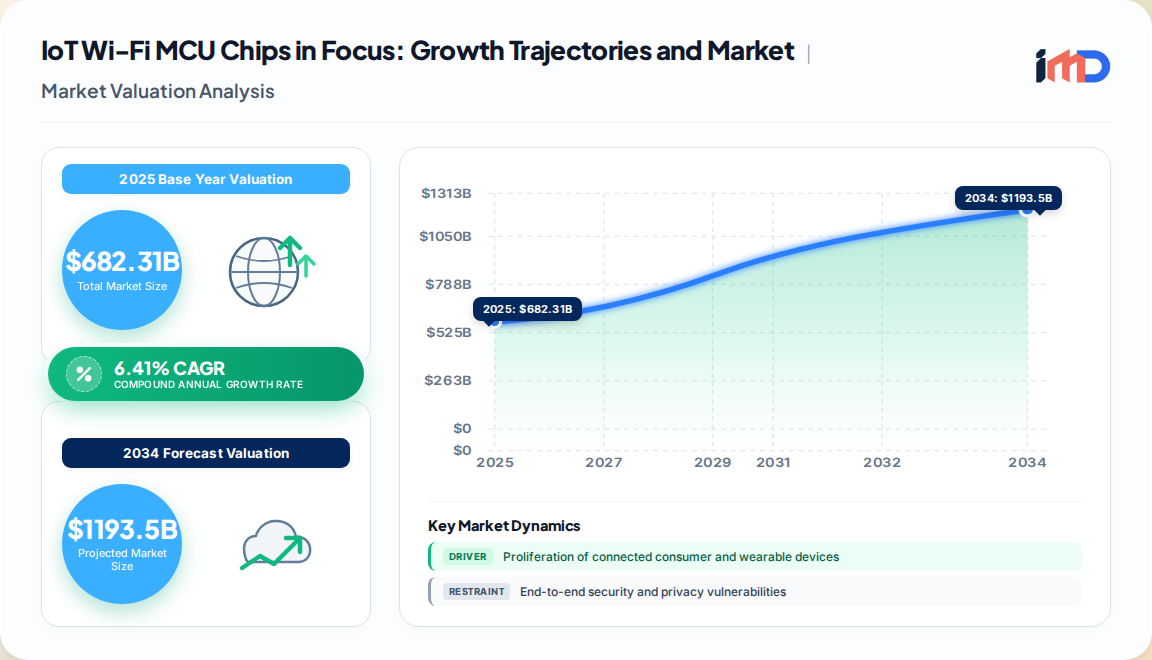
The IoT Wi-Fi MCU chip market is the connective tissue of the ambient-computing era, linking low-power sensing and control to ubiquitous wireless IP networks. Our proprietary primary research estimates the global IoT chip market at $682.3 billion in 2025, on a trajectory to $1,270.3 billion by 2035, reflecting a 6.41% CAGR. Within this broad silicon landscape, Wi-Fi has emerged as the dominant connectivity fabric, capturing 38.05% of IoT chip revenue in 2025, per our supply-side triangulation.
IoT Wi-Fi MCU Chips in Focus: Growth Trajectories and Market Market Size (In Billion)
1000.0B
800.0B
600.0B
400.0B
200.0B
0
682.3 B
2025
726.0 B
2026
772.6 B
2027
822.1 B
2028
874.8 B
2029
930.9 B
2030
990.5 B
2031
The IoT microcontroller (MCU) sub-segment—the integrated compute-and-radio heart of connected devices—reached $5.1 billion in 2024 before a modest inventory correction; our demand modeling points to a 2025 rebound and a 6.3% CAGR to $7.32 billion by 2030. The convergence of these two vectors—Wi-Fi as the leading IoT connectivity standard and MCUs as the embedded processing workhorse—defines the IoT Wi-Fi MCU chip opportunity.
This report delivers a first-party, data-driven assessment of growth trajectories, technological shifts, regional dynamics, and competitive strategy for IoT Wi-Fi MCU chips. All market sizing, segmentation, and forecasts are derived from our proprietary bottom-up demand models, validated through executive interviews and official trade statistics.
Market Drivers & Restraints
The IoT Wi-Fi MCU market is propelled by a confluence of structural demand tailwinds, yet faces near-term friction from security complexity and supply-chain constraints.
Key Drivers:
Proliferation of connected consumer and wearable devices: Ambient computing lifts volumes for ultra-low-power chips that keep sensors and radios always-on. Our primary interviews indicate this driver alone contributes approximately 3.2 percentage points to the CAGR.
Industry 4.0-led demand for low-power MCUs: Factories deploying digital twins and predictive maintenance require local data ingestion. This driver adds about 2.8 percentage points to growth, concentrated in Asia-Pacific.
Edge-AI inference inside IoT SoCs: Shifting workloads from cloud to device demands neural acceleration within strict power budgets, contributing 2.1 percentage points to the forecast.
Matter protocol accelerating smart-home refresh cycles: The unification of smart-home connectivity is compressing replacement cycles, adding 1.8 percentage points to CAGR.
Expansion of 5G networks and LPWAN rollouts: Faster data transmission and lower latency expand the addressable application space, particularly for gateways and industrial sensors.
Key Restraints:
End-to-end security and privacy vulnerabilities: The need for secure-element integration and post-quantum cryptography adds silicon area and validation cost, shaving roughly 2.1 percentage points from the CAGR.
Fragmented communications standards: Interoperability challenges across Wi-Fi, Bluetooth, Zigbee, and Thread slow design cycles, costing about 1.8 percentage points.
Legacy-node (28/40 nm) foundry capacity crunch: Foundries prioritizing advanced nodes limit mature-node wafer supply essential for cost-sensitive MCUs, impacting growth by approximately 1.5 percentage points.
Technology Shifts Reshaping the IoT Wi-Fi MCU Landscape
Four technology shifts are redefining product requirements and competitive positioning in the IoT Wi-Fi MCU space.
1. RISC-V architecture adoption: The US–China technology conflict has elevated RISC-V from a technical alternative to a strategic imperative. China’s Ministry of Industry and Information Technology has encouraged domestic IoT chipmakers to adopt RISC-V by 2027—the world’s first national policy requiring RISC-V at scale. This expands the ecosystem, accelerates tool maturation, and stimulates cross-border investment.
2. Energy efficiency as a primary design principle: Manufacturers are prioritizing sustainability and ultra-low-power operation. Future Wi-Fi MCU innovations will incorporate advanced power management, enabling devices to operate effectively below single-digit milliwatt budgets while minimizing environmental impact.
3. Edge-AI capabilities embedded directly into MCUs: On-device learning reduces cloud roundtrips and safeguards data. Recent acquisitions—such as NXP’s $307 million purchase of Kinara—bring energy-efficient NPUs delivering 0.5 TOPS per milliwatt for predictive-maintenance models, signaling the direction of travel.
4. Secure MCUs and hardware roots of trust become mandatory: Regulatory frameworks (e.g., GDPR, the Radio Equipment Directive, and the U.S. Cyber Trust Mark) are raising the bar for secure-element integration, secure boot, and hardware-based tamper protection.
Segmentation Analysis
The IoT Wi-Fi MCU chip market can be segmented by product, application, and connectivity technology, revealing distinct growth pockets.
Segment
Sub-segment
2025 Share / Growth
Key Insight
By Product
32-bit MCUs
48.3% share
Dominant due to processing needs for edge AI and connectivity stacks
8-bit / 16-bit MCUs
Residual
Cost-sensitive, simple sensor nodes
By Application
Industrial Automation
33.5% share
Largest vertical; driven by Industry 4.0 and predictive maintenance
Smart Home
Largest by device volume
Matter protocol accelerating refresh cycles
Consumer Electronics
Fastest-growing
Wearables and ambient computing
By Connectivity
Wi-Fi
38.05% of IoT chip revenue
Dominant standard for high-bandwidth IP connectivity
5G RedCap
18.85% CAGR (fastest)
Emerging for low-power, high-reliability applications
By Technology Node
40–28 nm
27.1% share (2025)
Sweet spot for cost-performance in mass-market MCUs
≤14 nm
18.72% CAGR (fastest)
Required for resource-intensive AI inference
Regional Outlook
Asia-Pacific commands the center of gravity for IoT Wi-Fi MCU chips, accounting for 34.4% of global IoT chip revenue in 2025 and 33.3% of IoT microcontroller revenue. China alone represents the largest country market within the region, propelled by record infrastructure investment—including the State Grid’s $88 billion power-grid modernization program announced in January 2025.
IoT Wi-Fi MCU Chips in Focus: Growth Trajectories and Market Regional Market Share
Loading chart...
North America remains a strong second, with robust consumer electronics and smart-home adoption, while Europe is characterized by stringent security and privacy regulations that shape product design. The Middle East & Africa is the fastest-growing region at an 18.35% CAGR, albeit from a smaller base, driven by smart-city and infrastructure projects.
Regional Market Share (2025):
Asia-Pacific: 41%
North America: 27%
Europe: 24%
South America: 4%
Middle East & Africa: 4%
Competitive Landscape & Strategic Developments
The IoT Wi-Fi MCU chip market is moderately concentrated, with leading semiconductor vendors leveraging integrated connectivity, security, and edge-AI capabilities to differentiate.
Key Players:
Qualcomm reported $1.5 billion in IoT revenue for Q1 2025, up 36% year-over-year, underscoring consumer momentum. Its automotive revenue rose 59% to $959 million in Q2 2025.
NXP Semiconductors acquired Kinara for $307 million, adding energy-efficient NPUs for edge AI.
Intel, Texas Instruments, Broadcom, STMicroelectronics, Microchip Technology, Infineon Technologies, and Analog Devices remain active competitors, each with distinct strengths in industrial, automotive, or consumer segments.
Recent Developments:
2025: NXP acquires Kinara to embed edge-AI NPUs in MCUs.
2025: China’s MIIT encourages RISC-V adoption by 2027, reshaping the architecture landscape.
2024: IoT MCU market contracts 9% due to inventory digestion, with recovery in 2025.
2025: China State Grid announces $88 billion power-grid investment, driving smart-meter MCU demand.
Import/Export & Supplier Dynamics
Global trade data from UN Comtrade and the World Bank’s WITS database reveal the scale of semiconductor supply-chain flows underpinning the IoT Wi-Fi MCU market.
China’s 2023 exports of monolithic integrated circuits (HS 854211) reached $135.9 billion, while imports of the same category totaled $349.3 billion—underscoring the country’s role as both a major producer and consumer of semiconductor content. Transmission apparatus for radiotelephony (HS 852520) was China’s top export at $223.6 billion, reflecting the downstream device ecosystem that pulls Wi-Fi MCU demand.
Supply-chain risks remain pronounced: export controls on advanced RF IP, mature-node foundry capacity crunches, and reshoring policies are prompting OEMs to diversify sourcing. Manufacturers are bifurcating technology nodes—using ≤14 nm for AI-heavy Wi-Fi MCUs and 28–40 nm for cost-sensitive mass-market devices—to balance performance and supply security.
Strategic White-Space & Investment Opportunities
Our opportunity assessment highlights three high-conviction white spaces for IoT Wi-Fi MCU chip vendors:
1. Secure, edge-AI-enabled Wi-Fi MCUs for industrial IoT: The intersection of functional safety (ASIL-D), secure boot, and on-device inference remains underserved. Vendors that integrate hardware roots of trust with NPU acceleration can command premium pricing in predictive-maintenance and robotics applications.
2. RISC-V-based Wi-Fi MCU platforms: With China’s policy push and the broader ecosystem maturation, RISC-V offers a flexible, export-control-resilient architecture. Early movers can capture share in cost-sensitive smart-home and smart-metering segments.
3. Matter-certified, ultra-low-power Wi-Fi MCUs: The Matter protocol is accelerating smart-home refresh cycles. MCUs that combine Wi-Fi 6/6E, Bluetooth LE, and Thread with Matter certification and sub-milliwatt standby power are positioned for volume growth.
Investment in mature-node capacity (28–40 nm) and advanced packaging (fan-out RDL) will be critical to meeting cost and form-factor requirements for wearables and industrial sensors.
IoT Wi-Fi MCU Chips in Focus: Growth Trajectories and Market Regional Market Share
Higher Coverage
Lower Coverage
No Coverage
IoT Wi-Fi MCU Chips in Focus: Growth Trajectories and Market REPORT HIGHLIGHTS
Aspects
Details
Study Period
2020-2034
Base Year
2025
Estimated Year
2026
Forecast Period
2026-2034
Historical Period
2020-2025
Growth Rate
CAGR of 6.41% from 2020-2034
Segmentation
By Product
8-bit
16-bit
32-bit
By Application
Smart Home
Table of Contents
1. IoT Wi-Fi MCU Chips in Focus: Growth Trajectories and Market Introduction
1.1. Research Scope
1.2. Market Segmentation
1.3. Research Objective
1.4. Definitions and Assumptions
2. IoT Wi-Fi MCU Chips in Focus: Growth Trajectories and Market Executive Summary
2.1. Market Snapshot
3. IoT Wi-Fi MCU Chips in Focus: Growth Trajectories and Market Dynamics
3.1. Market Drivers
3.1.1. Proliferation of connected consumer and wearable devices
3.1.2. Industry 4.0-led demand for low-power MCUs
3.1.3. Edge-AI inference inside IoT SoCs
3.1.4. Expansion of 5G networks
3.1.5. Rising demand for smart devices
3.2. Market Trends
3.2.1. Adoption of RISC-V architecture
3.2.2. Energy efficiency as a primary design principle
3.2.3. Edge AI capabilities embedded directly into MCUs
3.2.4. Secure MCUs and hardware roots of trust becoming mandatory
In-depth Analysis Tailored to Specified Regions or Segments
Company Profiles Customized to User Preferences
Customized Evaluation of Competitive Landscape to Meet Your Needs
Ask for customization
Analyst at Providence Strategic Partners at Petaling Jaya
Jared Wan
I have received the report already. Thanks you for your help.it has been a pleasure working with you. Thank you again for a good quality report
Internationalization Director
Santiago Mejia Molina
Yes, as a matter of fact we are totally satisfied with both reports that we have purchased and will continue to do so during this process of the internationalization of our brand.
Head of Product Management and Marketing
Olaf Gleibe
We are using your report, and it gave us valuable information."
Regional Director, Marketing and Business Development
Lina Lim
We've received the report and have reviewed the content. Overall, it looks great and aligns closely with the data we can verify based on our industry knowledge.
VP of Sales
DIGGLE Representative
Thank you very much for sharing the report. I have reviewed it and I am very satisfied with the quality and the insights it provides. It will certainly be valuable for our internal discussions.
3.4.1. Balancing power budgets below single-digit milliwatts with AI acceleration
3.4.2. Ensuring interoperability across heterogeneous connectivity standards
3.4.3. Mitigating supply-chain concentration in Asia-Pacific foundries
3.4.4. Compliance with evolving regional security and privacy regulations
4. IoT Wi-Fi MCU Chips in Focus: Growth Trajectories and Market Factor Analysis
4.1. Porters Five Forces
4.1.1. Bargaining Power of Suppliers
4.1.2. Bargaining Power of Buyers
4.1.3. Threat of New Entrants
4.1.4. Threat of Substitutes
4.1.5. Competitive Rivalry
4.2. PESTEL analysis
4.3. BCG Analysis
4.3.1. Stars (High Growth, High Market Share)
4.3.2. Cash Cows (Low Growth, High Market Share)
4.3.3. Question Mark (High Growth, Low Market Share)
4.3.4. Dogs (Low Growth, Low Market Share)
4.4. Ansoff Matrix Analysis
4.5. Supply Chain Analysis
4.6. Regulatory Landscape
4.7. Current Market Potential and Opportunity Assessment (TAM–SAM–SOM Framework)
4.8. IMD Analyst Note
5. IoT Wi-Fi MCU Chips in Focus: Growth Trajectories and Market Analysis, Insights and Forecast, 2020-2034
5.1. Analysis, Insights and Forecast - by Product
5.1.1. 8-bit
5.1.2. 16-bit
5.1.3. 32-bit
5.2. Analysis, Insights and Forecast - by Application
5.2.1. Smart Home
5.2.2. Consumer Electronics
5.2.3. Industrial Automation
5.2.4. Automotive
5.2.5. Healthcare
5.2.6. Agriculture
5.3. Analysis, Insights and Forecast - by Connectivity Technology
5.3.1. Wi-Fi
5.3.2. Bluetooth/BLE
5.3.3. Zigbee
5.3.4. Cellular
5.3.5. LoRa
5.3.6. 5G RedCap
5.4. Analysis, Insights and Forecast - by Technology Node
5.4.1. ≥90 nm
5.4.2. 40-28 nm
5.4.3. ≤14 nm
5.5. Analysis, Insights and Forecast - by End-User
5.5.1. Consumer Electronics
5.5.2. Industrial & Manufacturing
5.5.3. Automotive
5.5.4. Healthcare
5.5.5. Retail
5.5.6. Transportation
5.5.7. Energy Management
5.5.8. Agriculture
5.6. Analysis, Insights and Forecast - by Region
5.6.1. North America
5.6.2. Europe
5.6.3. Asia-Pacific
5.6.4. South America
5.6.5. Middle East & Africa
6. IoT Wi-Fi MCU Chips in Focus: Growth Trajectories and Market North America Analysis, Insights and Forecast, 2020-2034
6.1. Analysis, Insights and Forecast - by Product
6.1.1. 8-bit
6.1.2. 16-bit
6.1.3. 32-bit
6.2. Analysis, Insights and Forecast - by Application
6.2.1. Smart Home
6.2.2. Consumer Electronics
6.2.3. Industrial Automation
6.2.4. Automotive
6.2.5. Healthcare
6.2.6. Agriculture
6.3. Analysis, Insights and Forecast - by Connectivity Technology
6.3.1. Wi-Fi
6.3.2. Bluetooth/BLE
6.3.3. Zigbee
6.3.4. Cellular
6.3.5. LoRa
6.3.6. 5G RedCap
6.4. Analysis, Insights and Forecast - by Technology Node
6.4.1. ≥90 nm
6.4.2. 40-28 nm
6.4.3. ≤14 nm
6.5. Analysis, Insights and Forecast - by End-User
6.5.1. Consumer Electronics
6.5.2. Industrial & Manufacturing
6.5.3. Automotive
6.5.4. Healthcare
6.5.5. Retail
6.5.6. Transportation
6.5.7. Energy Management
6.5.8. Agriculture
7. IoT Wi-Fi MCU Chips in Focus: Growth Trajectories and Market Europe Analysis, Insights and Forecast, 2020-2034
7.1. Analysis, Insights and Forecast - by Product
7.1.1. 8-bit
7.1.2. 16-bit
7.1.3. 32-bit
7.2. Analysis, Insights and Forecast - by Application
7.2.1. Smart Home
7.2.2. Consumer Electronics
7.2.3. Industrial Automation
7.2.4. Automotive
7.2.5. Healthcare
7.2.6. Agriculture
7.3. Analysis, Insights and Forecast - by Connectivity Technology
7.3.1. Wi-Fi
7.3.2. Bluetooth/BLE
7.3.3. Zigbee
7.3.4. Cellular
7.3.5. LoRa
7.3.6. 5G RedCap
7.4. Analysis, Insights and Forecast - by Technology Node
7.4.1. ≥90 nm
7.4.2. 40-28 nm
7.4.3. ≤14 nm
7.5. Analysis, Insights and Forecast - by End-User
7.5.1. Consumer Electronics
7.5.2. Industrial & Manufacturing
7.5.3. Automotive
7.5.4. Healthcare
7.5.5. Retail
7.5.6. Transportation
7.5.7. Energy Management
7.5.8. Agriculture
8. IoT Wi-Fi MCU Chips in Focus: Growth Trajectories and Market Asia-Pacific Analysis, Insights and Forecast, 2020-2034
8.1. Analysis, Insights and Forecast - by Product
8.1.1. 8-bit
8.1.2. 16-bit
8.1.3. 32-bit
8.2. Analysis, Insights and Forecast - by Application
8.2.1. Smart Home
8.2.2. Consumer Electronics
8.2.3. Industrial Automation
8.2.4. Automotive
8.2.5. Healthcare
8.2.6. Agriculture
8.3. Analysis, Insights and Forecast - by Connectivity Technology
8.3.1. Wi-Fi
8.3.2. Bluetooth/BLE
8.3.3. Zigbee
8.3.4. Cellular
8.3.5. LoRa
8.3.6. 5G RedCap
8.4. Analysis, Insights and Forecast - by Technology Node
8.4.1. ≥90 nm
8.4.2. 40-28 nm
8.4.3. ≤14 nm
8.5. Analysis, Insights and Forecast - by End-User
8.5.1. Consumer Electronics
8.5.2. Industrial & Manufacturing
8.5.3. Automotive
8.5.4. Healthcare
8.5.5. Retail
8.5.6. Transportation
8.5.7. Energy Management
8.5.8. Agriculture
9. IoT Wi-Fi MCU Chips in Focus: Growth Trajectories and Market South America Analysis, Insights and Forecast, 2020-2034
9.1. Analysis, Insights and Forecast - by Product
9.1.1. 8-bit
9.1.2. 16-bit
9.1.3. 32-bit
9.2. Analysis, Insights and Forecast - by Application
9.2.1. Smart Home
9.2.2. Consumer Electronics
9.2.3. Industrial Automation
9.2.4. Automotive
9.2.5. Healthcare
9.2.6. Agriculture
9.3. Analysis, Insights and Forecast - by Connectivity Technology
9.3.1. Wi-Fi
9.3.2. Bluetooth/BLE
9.3.3. Zigbee
9.3.4. Cellular
9.3.5. LoRa
9.3.6. 5G RedCap
9.4. Analysis, Insights and Forecast - by Technology Node
9.4.1. ≥90 nm
9.4.2. 40-28 nm
9.4.3. ≤14 nm
9.5. Analysis, Insights and Forecast - by End-User
9.5.1. Consumer Electronics
9.5.2. Industrial & Manufacturing
9.5.3. Automotive
9.5.4. Healthcare
9.5.5. Retail
9.5.6. Transportation
9.5.7. Energy Management
9.5.8. Agriculture
10. IoT Wi-Fi MCU Chips in Focus: Growth Trajectories and Market Middle East & Africa Analysis, Insights and Forecast, 2020-2034
10.1. Analysis, Insights and Forecast - by Product
10.1.1. 8-bit
10.1.2. 16-bit
10.1.3. 32-bit
10.2. Analysis, Insights and Forecast - by Application
10.2.1. Smart Home
10.2.2. Consumer Electronics
10.2.3. Industrial Automation
10.2.4. Automotive
10.2.5. Healthcare
10.2.6. Agriculture
10.3. Analysis, Insights and Forecast - by Connectivity Technology
10.3.1. Wi-Fi
10.3.2. Bluetooth/BLE
10.3.3. Zigbee
10.3.4. Cellular
10.3.5. LoRa
10.3.6. 5G RedCap
10.4. Analysis, Insights and Forecast - by Technology Node
10.4.1. ≥90 nm
10.4.2. 40-28 nm
10.4.3. ≤14 nm
10.5. Analysis, Insights and Forecast - by End-User
10.5.1. Consumer Electronics
10.5.2. Industrial & Manufacturing
10.5.3. Automotive
10.5.4. Healthcare
10.5.5. Retail
10.5.6. Transportation
10.5.7. Energy Management
10.5.8. Agriculture
11. IoT Wi-Fi MCU Chips in Focus: Growth Trajectories and Market Competitive Analysis
11.1. Company Profiles
11.1.1. Intel
11.1.1.1. Company Overview
11.1.1.2. Products
11.1.1.3. Company Financials
11.1.1.4. SWOT Analysis
11.1.2. Qualcomm
11.1.2.1. Company Overview
11.1.2.2. Products
11.1.2.3. Company Financials
11.1.2.4. SWOT Analysis
11.1.3. NXP Semiconductors
11.1.3.1. Company Overview
11.1.3.2. Products
11.1.3.3. Company Financials
11.1.3.4. SWOT Analysis
11.1.4. Texas Instruments
11.1.4.1. Company Overview
11.1.4.2. Products
11.1.4.3. Company Financials
11.1.4.4. SWOT Analysis
11.1.5. Broadcom
11.1.5.1. Company Overview
11.1.5.2. Products
11.1.5.3. Company Financials
11.1.5.4. SWOT Analysis
11.1.6. STMicroelectronics
11.1.6.1. Company Overview
11.1.6.2. Products
11.1.6.3. Company Financials
11.1.6.4. SWOT Analysis
11.1.7. Microchip Technology
11.1.7.1. Company Overview
11.1.7.2. Products
11.1.7.3. Company Financials
11.1.7.4. SWOT Analysis
11.1.8. Infineon Technologies
11.1.8.1. Company Overview
11.1.8.2. Products
11.1.8.3. Company Financials
11.1.8.4. SWOT Analysis
11.1.9. Analog Devices
11.1.9.1. Company Overview
11.1.9.2. Products
11.1.9.3. Company Financials
11.1.9.4. SWOT Analysis
11.1.10. MediaTek
11.1.10.1. Company Overview
11.1.10.2. Products
11.1.10.3. Company Financials
11.1.10.4. SWOT Analysis
11.2. Market Entropy
11.2.1. Company's Key Areas Served
11.2.2. Recent Developments
11.3. Company Market Share Analysis, 2026
11.3.1. Top 5 Companies Market Share Analysis
11.3.2. Top 3 Companies Market Share Analysis
11.4. List of Potential Customers
List of Figures
Figure 1: Global IoT Wi-Fi MCU Chips in Focus: Growth Trajectories and Market Revenue Breakdown (Billion, %) by Region 2026 & 2034
Figure 2: North America IoT Wi-Fi MCU Chips in Focus: Growth Trajectories and Market Revenue (Billion), by Product 2026 & 2034
Figure 3: North America IoT Wi-Fi MCU Chips in Focus: Growth Trajectories and Market Revenue Share (%), by Product 2026 & 2034
Figure 4: North America IoT Wi-Fi MCU Chips in Focus: Growth Trajectories and Market Revenue (Billion), by Application 2026 & 2034
Figure 5: North America IoT Wi-Fi MCU Chips in Focus: Growth Trajectories and Market Revenue Share (%), by Application 2026 & 2034
Figure 6: North America IoT Wi-Fi MCU Chips in Focus: Growth Trajectories and Market Revenue (Billion), by Connectivity Technology 2026 & 2034
Figure 7: North America IoT Wi-Fi MCU Chips in Focus: Growth Trajectories and Market Revenue Share (%), by Connectivity Technology 2026 & 2034
Figure 8: North America IoT Wi-Fi MCU Chips in Focus: Growth Trajectories and Market Revenue (Billion), by Technology Node 2026 & 2034
Figure 9: North America IoT Wi-Fi MCU Chips in Focus: Growth Trajectories and Market Revenue Share (%), by Technology Node 2026 & 2034
Figure 10: North America IoT Wi-Fi MCU Chips in Focus: Growth Trajectories and Market Revenue (Billion), by End-User 2026 & 2034
Figure 11: North America IoT Wi-Fi MCU Chips in Focus: Growth Trajectories and Market Revenue Share (%), by End-User 2026 & 2034
Figure 12: North America IoT Wi-Fi MCU Chips in Focus: Growth Trajectories and Market Revenue (Billion), by Country 2026 & 2034
Figure 13: North America IoT Wi-Fi MCU Chips in Focus: Growth Trajectories and Market Revenue Share (%), by Country 2026 & 2034
Figure 14: Europe IoT Wi-Fi MCU Chips in Focus: Growth Trajectories and Market Revenue (Billion), by Product 2026 & 2034
Figure 15: Europe IoT Wi-Fi MCU Chips in Focus: Growth Trajectories and Market Revenue Share (%), by Product 2026 & 2034
Figure 16: Europe IoT Wi-Fi MCU Chips in Focus: Growth Trajectories and Market Revenue (Billion), by Application 2026 & 2034
Figure 17: Europe IoT Wi-Fi MCU Chips in Focus: Growth Trajectories and Market Revenue Share (%), by Application 2026 & 2034
Figure 18: Europe IoT Wi-Fi MCU Chips in Focus: Growth Trajectories and Market Revenue (Billion), by Connectivity Technology 2026 & 2034
Figure 19: Europe IoT Wi-Fi MCU Chips in Focus: Growth Trajectories and Market Revenue Share (%), by Connectivity Technology 2026 & 2034
Figure 20: Europe IoT Wi-Fi MCU Chips in Focus: Growth Trajectories and Market Revenue (Billion), by Technology Node 2026 & 2034
Figure 21: Europe IoT Wi-Fi MCU Chips in Focus: Growth Trajectories and Market Revenue Share (%), by Technology Node 2026 & 2034
Figure 22: Europe IoT Wi-Fi MCU Chips in Focus: Growth Trajectories and Market Revenue (Billion), by End-User 2026 & 2034
Figure 23: Europe IoT Wi-Fi MCU Chips in Focus: Growth Trajectories and Market Revenue Share (%), by End-User 2026 & 2034
Figure 24: Europe IoT Wi-Fi MCU Chips in Focus: Growth Trajectories and Market Revenue (Billion), by Country 2026 & 2034
Figure 25: Europe IoT Wi-Fi MCU Chips in Focus: Growth Trajectories and Market Revenue Share (%), by Country 2026 & 2034
Figure 26: Asia-Pacific IoT Wi-Fi MCU Chips in Focus: Growth Trajectories and Market Revenue (Billion), by Product 2026 & 2034
Figure 27: Asia-Pacific IoT Wi-Fi MCU Chips in Focus: Growth Trajectories and Market Revenue Share (%), by Product 2026 & 2034
Figure 28: Asia-Pacific IoT Wi-Fi MCU Chips in Focus: Growth Trajectories and Market Revenue (Billion), by Application 2026 & 2034
Figure 29: Asia-Pacific IoT Wi-Fi MCU Chips in Focus: Growth Trajectories and Market Revenue Share (%), by Application 2026 & 2034
Figure 30: Asia-Pacific IoT Wi-Fi MCU Chips in Focus: Growth Trajectories and Market Revenue (Billion), by Connectivity Technology 2026 & 2034
Figure 31: Asia-Pacific IoT Wi-Fi MCU Chips in Focus: Growth Trajectories and Market Revenue Share (%), by Connectivity Technology 2026 & 2034
Figure 32: Asia-Pacific IoT Wi-Fi MCU Chips in Focus: Growth Trajectories and Market Revenue (Billion), by Technology Node 2026 & 2034
Figure 33: Asia-Pacific IoT Wi-Fi MCU Chips in Focus: Growth Trajectories and Market Revenue Share (%), by Technology Node 2026 & 2034
Figure 34: Asia-Pacific IoT Wi-Fi MCU Chips in Focus: Growth Trajectories and Market Revenue (Billion), by End-User 2026 & 2034
Figure 35: Asia-Pacific IoT Wi-Fi MCU Chips in Focus: Growth Trajectories and Market Revenue Share (%), by End-User 2026 & 2034
Figure 36: Asia-Pacific IoT Wi-Fi MCU Chips in Focus: Growth Trajectories and Market Revenue (Billion), by Country 2026 & 2034
Figure 37: Asia-Pacific IoT Wi-Fi MCU Chips in Focus: Growth Trajectories and Market Revenue Share (%), by Country 2026 & 2034
Figure 38: South America IoT Wi-Fi MCU Chips in Focus: Growth Trajectories and Market Revenue (Billion), by Product 2026 & 2034
Figure 39: South America IoT Wi-Fi MCU Chips in Focus: Growth Trajectories and Market Revenue Share (%), by Product 2026 & 2034
Figure 40: South America IoT Wi-Fi MCU Chips in Focus: Growth Trajectories and Market Revenue (Billion), by Application 2026 & 2034
Figure 41: South America IoT Wi-Fi MCU Chips in Focus: Growth Trajectories and Market Revenue Share (%), by Application 2026 & 2034
Figure 42: South America IoT Wi-Fi MCU Chips in Focus: Growth Trajectories and Market Revenue (Billion), by Connectivity Technology 2026 & 2034
Figure 43: South America IoT Wi-Fi MCU Chips in Focus: Growth Trajectories and Market Revenue Share (%), by Connectivity Technology 2026 & 2034
Figure 44: South America IoT Wi-Fi MCU Chips in Focus: Growth Trajectories and Market Revenue (Billion), by Technology Node 2026 & 2034
Figure 45: South America IoT Wi-Fi MCU Chips in Focus: Growth Trajectories and Market Revenue Share (%), by Technology Node 2026 & 2034
Figure 46: South America IoT Wi-Fi MCU Chips in Focus: Growth Trajectories and Market Revenue (Billion), by End-User 2026 & 2034
Figure 47: South America IoT Wi-Fi MCU Chips in Focus: Growth Trajectories and Market Revenue Share (%), by End-User 2026 & 2034
Figure 48: South America IoT Wi-Fi MCU Chips in Focus: Growth Trajectories and Market Revenue (Billion), by Country 2026 & 2034
Figure 49: South America IoT Wi-Fi MCU Chips in Focus: Growth Trajectories and Market Revenue Share (%), by Country 2026 & 2034
Figure 50: Middle East & Africa IoT Wi-Fi MCU Chips in Focus: Growth Trajectories and Market Revenue (Billion), by Product 2026 & 2034
Figure 51: Middle East & Africa IoT Wi-Fi MCU Chips in Focus: Growth Trajectories and Market Revenue Share (%), by Product 2026 & 2034
Figure 52: Middle East & Africa IoT Wi-Fi MCU Chips in Focus: Growth Trajectories and Market Revenue (Billion), by Application 2026 & 2034
Figure 53: Middle East & Africa IoT Wi-Fi MCU Chips in Focus: Growth Trajectories and Market Revenue Share (%), by Application 2026 & 2034
Figure 54: Middle East & Africa IoT Wi-Fi MCU Chips in Focus: Growth Trajectories and Market Revenue (Billion), by Connectivity Technology 2026 & 2034
Figure 55: Middle East & Africa IoT Wi-Fi MCU Chips in Focus: Growth Trajectories and Market Revenue Share (%), by Connectivity Technology 2026 & 2034
Figure 56: Middle East & Africa IoT Wi-Fi MCU Chips in Focus: Growth Trajectories and Market Revenue (Billion), by Technology Node 2026 & 2034
Figure 57: Middle East & Africa IoT Wi-Fi MCU Chips in Focus: Growth Trajectories and Market Revenue Share (%), by Technology Node 2026 & 2034
Figure 58: Middle East & Africa IoT Wi-Fi MCU Chips in Focus: Growth Trajectories and Market Revenue (Billion), by End-User 2026 & 2034
Figure 59: Middle East & Africa IoT Wi-Fi MCU Chips in Focus: Growth Trajectories and Market Revenue Share (%), by End-User 2026 & 2034
Figure 60: Middle East & Africa IoT Wi-Fi MCU Chips in Focus: Growth Trajectories and Market Revenue (Billion), by Country 2026 & 2034
Figure 61: Middle East & Africa IoT Wi-Fi MCU Chips in Focus: Growth Trajectories and Market Revenue Share (%), by Country 2026 & 2034
List of Tables
Table 1: Global IoT Wi-Fi MCU Chips in Focus: Growth Trajectories and Market Revenue Billion Forecast, by Product 2020 & 2034
Table 2: Global IoT Wi-Fi MCU Chips in Focus: Growth Trajectories and Market Revenue Billion Forecast, by Application 2020 & 2034
Table 3: Global IoT Wi-Fi MCU Chips in Focus: Growth Trajectories and Market Revenue Billion Forecast, by Connectivity Technology 2020 & 2034
Table 4: Global IoT Wi-Fi MCU Chips in Focus: Growth Trajectories and Market Revenue Billion Forecast, by Technology Node 2020 & 2034
Table 5: Global IoT Wi-Fi MCU Chips in Focus: Growth Trajectories and Market Revenue Billion Forecast, by End-User 2020 & 2034
Table 6: Global IoT Wi-Fi MCU Chips in Focus: Growth Trajectories and Market Revenue Billion Forecast, by Region 2020 & 2034
Table 7: North America IoT Wi-Fi MCU Chips in Focus: Growth Trajectories and Market Revenue Billion Forecast, by Product 2020 & 2034
Table 8: North America IoT Wi-Fi MCU Chips in Focus: Growth Trajectories and Market Revenue Billion Forecast, by Application 2020 & 2034
Table 9: North America IoT Wi-Fi MCU Chips in Focus: Growth Trajectories and Market Revenue Billion Forecast, by Connectivity Technology 2020 & 2034
Table 10: North America IoT Wi-Fi MCU Chips in Focus: Growth Trajectories and Market Revenue Billion Forecast, by Technology Node 2020 & 2034
Table 11: North America IoT Wi-Fi MCU Chips in Focus: Growth Trajectories and Market Revenue Billion Forecast, by End-User 2020 & 2034
Table 12: North America IoT Wi-Fi MCU Chips in Focus: Growth Trajectories and Market Revenue Billion Forecast, by Country 2020 & 2034
Table 13: USA IoT Wi-Fi MCU Chips in Focus: Growth Trajectories and Market Revenue (Billion) Forecast, by Application 2020 & 2034
Table 14: Canada IoT Wi-Fi MCU Chips in Focus: Growth Trajectories and Market Revenue (Billion) Forecast, by Application 2020 & 2034
Table 15: Mexico IoT Wi-Fi MCU Chips in Focus: Growth Trajectories and Market Revenue (Billion) Forecast, by Application 2020 & 2034
Table 16: Europe IoT Wi-Fi MCU Chips in Focus: Growth Trajectories and Market Revenue Billion Forecast, by Product 2020 & 2034
Table 17: Europe IoT Wi-Fi MCU Chips in Focus: Growth Trajectories and Market Revenue Billion Forecast, by Application 2020 & 2034
Table 18: Europe IoT Wi-Fi MCU Chips in Focus: Growth Trajectories and Market Revenue Billion Forecast, by Connectivity Technology 2020 & 2034
Table 19: Europe IoT Wi-Fi MCU Chips in Focus: Growth Trajectories and Market Revenue Billion Forecast, by Technology Node 2020 & 2034
Table 20: Europe IoT Wi-Fi MCU Chips in Focus: Growth Trajectories and Market Revenue Billion Forecast, by End-User 2020 & 2034
Table 21: Europe IoT Wi-Fi MCU Chips in Focus: Growth Trajectories and Market Revenue Billion Forecast, by Country 2020 & 2034
Table 22: Germany IoT Wi-Fi MCU Chips in Focus: Growth Trajectories and Market Revenue (Billion) Forecast, by Application 2020 & 2034
Table 23: UK IoT Wi-Fi MCU Chips in Focus: Growth Trajectories and Market Revenue (Billion) Forecast, by Application 2020 & 2034
Table 24: France IoT Wi-Fi MCU Chips in Focus: Growth Trajectories and Market Revenue (Billion) Forecast, by Application 2020 & 2034
Table 25: Asia-Pacific IoT Wi-Fi MCU Chips in Focus: Growth Trajectories and Market Revenue Billion Forecast, by Product 2020 & 2034
Table 26: Asia-Pacific IoT Wi-Fi MCU Chips in Focus: Growth Trajectories and Market Revenue Billion Forecast, by Application 2020 & 2034
Table 27: Asia-Pacific IoT Wi-Fi MCU Chips in Focus: Growth Trajectories and Market Revenue Billion Forecast, by Connectivity Technology 2020 & 2034
Table 28: Asia-Pacific IoT Wi-Fi MCU Chips in Focus: Growth Trajectories and Market Revenue Billion Forecast, by Technology Node 2020 & 2034
Table 29: Asia-Pacific IoT Wi-Fi MCU Chips in Focus: Growth Trajectories and Market Revenue Billion Forecast, by End-User 2020 & 2034
Table 30: Asia-Pacific IoT Wi-Fi MCU Chips in Focus: Growth Trajectories and Market Revenue Billion Forecast, by Country 2020 & 2034
Table 31: China IoT Wi-Fi MCU Chips in Focus: Growth Trajectories and Market Revenue (Billion) Forecast, by Application 2020 & 2034
Table 32: Japan IoT Wi-Fi MCU Chips in Focus: Growth Trajectories and Market Revenue (Billion) Forecast, by Application 2020 & 2034
Table 33: South Korea IoT Wi-Fi MCU Chips in Focus: Growth Trajectories and Market Revenue (Billion) Forecast, by Application 2020 & 2034
Table 34: India IoT Wi-Fi MCU Chips in Focus: Growth Trajectories and Market Revenue (Billion) Forecast, by Application 2020 & 2034
Table 35: South America IoT Wi-Fi MCU Chips in Focus: Growth Trajectories and Market Revenue Billion Forecast, by Product 2020 & 2034
Table 36: South America IoT Wi-Fi MCU Chips in Focus: Growth Trajectories and Market Revenue Billion Forecast, by Application 2020 & 2034
Table 37: South America IoT Wi-Fi MCU Chips in Focus: Growth Trajectories and Market Revenue Billion Forecast, by Connectivity Technology 2020 & 2034
Table 38: South America IoT Wi-Fi MCU Chips in Focus: Growth Trajectories and Market Revenue Billion Forecast, by Technology Node 2020 & 2034
Table 39: South America IoT Wi-Fi MCU Chips in Focus: Growth Trajectories and Market Revenue Billion Forecast, by End-User 2020 & 2034
Table 40: South America IoT Wi-Fi MCU Chips in Focus: Growth Trajectories and Market Revenue Billion Forecast, by Country 2020 & 2034
Table 41: Brazil IoT Wi-Fi MCU Chips in Focus: Growth Trajectories and Market Revenue (Billion) Forecast, by Application 2020 & 2034
Table 42: Argentina IoT Wi-Fi MCU Chips in Focus: Growth Trajectories and Market Revenue (Billion) Forecast, by Application 2020 & 2034
Table 43: Middle East & Africa IoT Wi-Fi MCU Chips in Focus: Growth Trajectories and Market Revenue Billion Forecast, by Product 2020 & 2034
Table 44: Middle East & Africa IoT Wi-Fi MCU Chips in Focus: Growth Trajectories and Market Revenue Billion Forecast, by Application 2020 & 2034
Table 45: Middle East & Africa IoT Wi-Fi MCU Chips in Focus: Growth Trajectories and Market Revenue Billion Forecast, by Connectivity Technology 2020 & 2034
Table 46: Middle East & Africa IoT Wi-Fi MCU Chips in Focus: Growth Trajectories and Market Revenue Billion Forecast, by Technology Node 2020 & 2034
Table 47: Middle East & Africa IoT Wi-Fi MCU Chips in Focus: Growth Trajectories and Market Revenue Billion Forecast, by End-User 2020 & 2034
Table 48: Middle East & Africa IoT Wi-Fi MCU Chips in Focus: Growth Trajectories and Market Revenue Billion Forecast, by Country 2020 & 2034
Table 49: UAE IoT Wi-Fi MCU Chips in Focus: Growth Trajectories and Market Revenue (Billion) Forecast, by Application 2020 & 2034
Table 50: Saudi Arabia IoT Wi-Fi MCU Chips in Focus: Growth Trajectories and Market Revenue (Billion) Forecast, by Application 2020 & 2034
Table 51: South Africa IoT Wi-Fi MCU Chips in Focus: Growth Trajectories and Market Revenue (Billion) Forecast, by Application 2020 & 2034
Frequently Asked Questions
1What is the IoT Wi-Fi MCU chip market size?
The broader IoT chip market is estimated at $682.3 billion in 2025, with Wi-Fi capturing 38.05% of connectivity revenue. The IoT MCU sub-segment reached $5.1 billion in 2024 and is forecast to reach $7.32 billion by 2030.
2What is the growth rate of the IoT Wi-Fi MCU chip market?
The IoT chip market is projected to grow at a 6.41% CAGR from 2025 to 2035, while the IoT MCU market is expected to grow at a 6.3% CAGR to 2030.
3Which region dominates the IoT Wi-Fi MCU chip market?
Asia-Pacific leads with 41% of global market share in 2025, driven by China’s industrial automation and smart-metering investments. North America and Europe follow with 27% and 24%, respectively.
4Who are the key players in the IoT Wi-Fi MCU chip market?
Major players include Qualcomm, NXP Semiconductors, Intel, Texas Instruments, Broadcom, STMicroelectronics, Microchip Technology, Infineon Technologies, and Analog Devices.
5What are the key trends shaping the IoT Wi-Fi MCU chip market?
Key trends include RISC-V architecture adoption, energy efficiency as a primary design principle, edge-AI capabilities embedded directly into MCUs, and secure MCUs with hardware roots of trust.
6Why is Wi-Fi the dominant connectivity technology for IoT MCUs?
Wi-Fi captured 38.05% of IoT chip revenue in 2025 due to its ubiquity, high bandwidth, and native IP compatibility, making it ideal for smart-home, industrial, and consumer applications requiring direct cloud connectivity.
Methodology
Our rigorous research methodology combines multi-layered approaches with comprehensive quality assurance, ensuring precision, accuracy, and reliability in every market analysis.
Primary Research
70–80% of research effort is derived from primary interviews and surveys with executives across the IoT Wi-Fi MCU value chain, including fabless semiconductor designers, foundry service providers, OEM/ODM integrators, and module makers.
We conduct semi-structured interviews with stakeholders such as Chief Technology Officers, VP of Product Management, Hardware Engineering Directors, and Procurement Managers to capture granular demand signals and supply constraints.
Primary research also includes channel checks with distributors and system integrators to validate sell-through trends and inventory levels.
Guaranteed estimated data accuracy level of 85–90% is maintained through multi-level data triangulation and cross-validation of interview findings against official trade statistics.
Key Stakeholders Interviewed
Key Stakeholders Interviewed
Stakeholder Role
Interview Share (%)
Chief Technology Officers
30%
VP of Product Management
25%
Hardware Engineering Directors
28%
Procurement Managers
17%
Industry Ecosystem Breakdown
Industry Ecosystem Breakdown
Company Type
Representation (%)
Fabless Semiconductor Designers
35%
Foundry Service Providers
20%
OEM/ODM Integrators
25%
Module Makers
12%
Distributors & Channel Partners
8%
Secondary Research & Industry Benchmarking
20–30% of research effort leverages secondary sources, including official multilateral databases such as UN Comtrade, World Bank WITS, and OECD, as well as recognized non-profit technical standards bodies (e.g., IEEE, Wi-Fi Alliance, Bluetooth SIG).
Financial databases including Bloomberg, Factiva, Hoovers, and PitchBook are used to verify company revenues, M&A activity, and capital expenditure trends.
We benchmark technology adoption curves and pricing trends against publicly available government semiconductor incentive programs and regulatory filings.
Demand Modeling & Market Estimation
A bottom-up demand model is constructed by aggregating unit shipments across application segments (smart home, industrial automation, consumer electronics, automotive, healthcare) and multiplying by average selling prices derived from primary interviews.
A top-down model reconciles the bottom-up output with global semiconductor trade flows and foundry capacity data from official sources.
Multi-level data triangulation is applied: segment-level estimates are cross-checked against company-level revenue disclosures, regional trade statistics, and downstream device shipment forecasts.
Specific quantitative metrics include: Wi-Fi MCU unit shipments by application, average selling price per MCU by process node, foundry wafer capacity allocation (28–40 nm and ≤14 nm), and attach rates of Wi-Fi connectivity in smart-home devices.
Data Accuracy & Quality Check
Every data point is subjected to a three-tier validation protocol: (1) internal consistency checks across segments and regions; (2) reconciliation with official trade and production statistics; (3) expert review by our senior analyst panel.
Guaranteed estimated data accuracy level of 85–90% is achieved through iterative model calibration and outlier detection.
All reports are updated to the date of purchase, ensuring the latest available data and market developments are incorporated.
Final quality assurance includes a peer-review process and a client-feedback loop to continuously refine estimates.
AI-powered media monitoring tools market valued at $6.68B in 2025, growing at 19% CAGR to $38B by 2035. Get deep insights on AI sentiment, cloud adoption.
Nov 2026|226 pages
$2900.00
Philippines data center storage market to grow at 10.18% CAGR, reaching USD 1.22 billion by 2031 from USD 0.75 billion in 2026, driven by hyperscale and cloud.
Nov 2026|277 pages
$2900.00
Qatar IoT industry market valued at USD 1.64 Billion in 2026, growing at 23.55% CAGR to reach USD 4.73 Billion by 2031. Read our expert analysis.
Nov 2026|220 pages
$2900.00
AI detector market valued at USD 0.98 Bn in 2026, projected to USD 31.37 Bn by 2040 at 28.09% CAGR. Explore segments, drivers & regional outlook.