1What is the current size of the IoT microcontroller (MCU) market?
The global IoT MCU market was valued at $8.64 billion in 2026 and is projected to reach $22.98 billion by 2034, growing at a CAGR of 13%.
Insight Market Data is a premier market research and business consulting firm headquartered in Pune, India, providing syndicated research reports, customized intelligence studies, and strategic advisory services. Renowned academic institutions and Fortune 500 corporations worldwide rely on Insight Market Data's research repository to navigate evolving global and regional business environments. Covering 46 diverse industries across 25 major international economies, our comprehensive database delivers thousands of verified statistics and granular market evaluations. By combining industry-leading analytical methodologies with the direct insights of seasoned industry leaders and subject-matter experts, we deliver actionable intelligence spanning historical performance benchmarks to rigorous multi-year forecasts. We empower organizations to make confident, data-driven decisions across pivotal domains including Machinery & Equipment, Chemicals & Materials, Pharmaceuticals & Healthcare, Food & Beverages, Consumer Goods, Energy & Power, Automotive & Transportation, Electronics & Semiconductors, Medical Devices, Telecommunications, Emerging Technologies, Agriculture, and Packaging. Our multidisciplinary analyst teams provide an objective 360-degree perspective, tailoring every engagement to address complex strategic challenges with exceptional analytical rigor.
Leveraging advanced BI-powered analytics and predictive modeling, Insight Market Data uncovers high-impact market opportunities and competitive differentiators for ambitious enterprises. We continuously refine our research methodologies in accordance with global industry standards, tracking real-time market shifts to ensure our reports are consistently accurate, actionable, and delivered on schedule. Our analysts conduct methodical data validation, rigorous compliance checks, and exhaustive primary and secondary research to maintain the highest levels of data integrity and transparency. We partner closely with corporate strategists, investment groups, and business executives to translate intricate market intelligence into clear, actionable roadmaps for sustainable growth. With operational presence across Washington, USA, and Vimannagar, Pune, India, Insight Market Data ensures direct access to dedicated research specialists and responsive customer support to answer your most strategic questions.
 IoT Microcontroller (MCU Market
 by Product (8-bit, 16-bit, 32-bit, 64-bit), by Application (Industrial Automation, Smart Homes, Consumer Electronics, Automotive, Medical Devices, Others), by North America (USA, Canada, Mexico), by Europe (Germany, UK, France, Italy, Spain, Rest of Europe), by Asia Pacific (China, Japan, India, South Korea, Southeast Asia, Rest of APAC), by South America (Brazil, Argentina, Rest of South America), by Middle East & Africa (UAE, Saudi Arabia, South Africa, Rest of MEA) Forecast 2026-2034

Senior Research Analyst


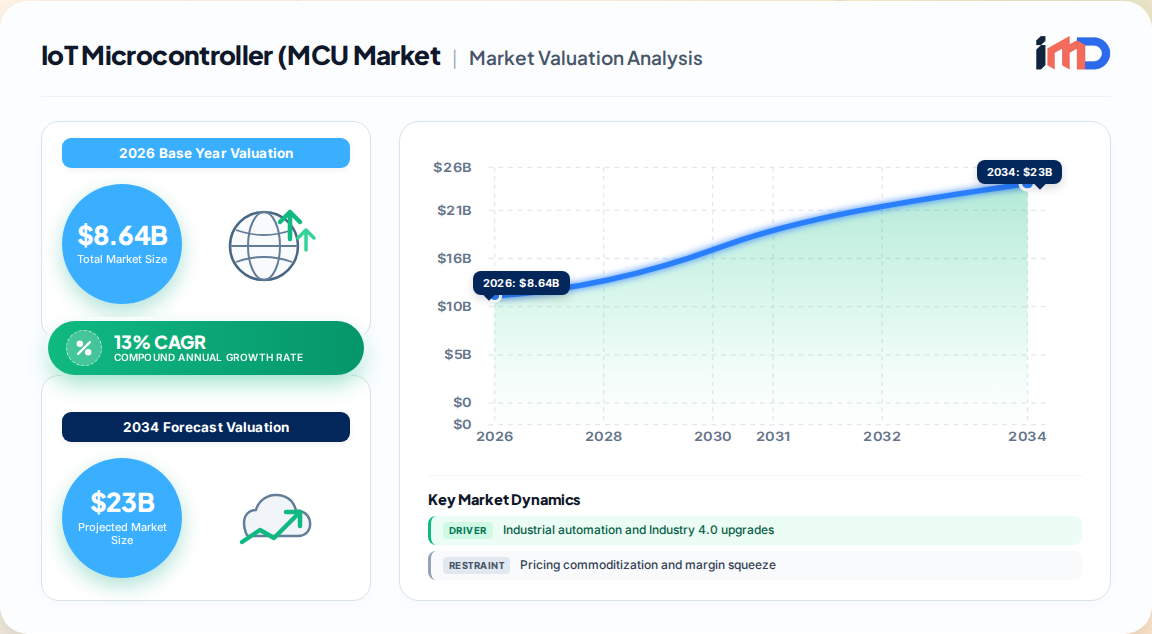
The global IoT microcontroller (MCU) market represents one of the most dynamic and strategically vital segments of the semiconductor industry. Our proprietary primary research estimates the market at $8.64 billion in 2026, projected to expand to $22.98 billion by 2034, registering a CAGR of 13% during the forecast period. This trajectory is underpinned by the proliferation of connected devices—forecasted to exceed 40 billion installed units by 2030—and the accelerating migration toward intelligent, secure, and energy-efficient edge architectures.
Unlike general-purpose MCUs, IoT MCUs are purpose-built for connected applications, integrating processing, memory, and communication interfaces on a single low-power die. The market is transitioning from simple connectivity nodes to autonomous edge computing platforms, reshaping competitive dynamics and supply chain requirements across all major regions.
Drivers:
Restraints:
The 32-bit segment is the dominant architecture, accounting for 51.4% of global microcontroller revenue in 2025, and is projected to maintain its lead, reaching $6.52 billion by 2030 at a 14% CAGR. This dominance is driven by the complexity of modern consumer electronics (smart TVs, AR/VR headsets, gaming consoles) and the real-time control requirements of industrial automation. The 8-bit segment remains resilient in cost-sensitive, ultra-low-power applications such as smart wearables and simple sensors, growing at 13% CAGR.
From an architecture perspective, ARM-based designs commanded 62.55% of the Americas market in 2025, underpinned by a mature ecosystem and broad toolchain support. However, the RISC-V instruction set is emerging as a strategic alternative, with China’s Ministry of Industry and Information Technology officially encouraging domestic IoT chipmakers to adopt RISC-V by 2027. This policy is expected to accelerate ecosystem maturation and drive cost disruption in entry-level SKUs.
| Application Segment | 2021 Value ($M) | 2030 Projection ($M) | CAGR | Key Growth Factors |
|---|---|---|---|---|
| Industrial Automation | 1,550 | 4,390 | 13% | Industry 4.0, predictive maintenance, robotics |
| Consumer Electronics | – | – | 12% | Smart wearables, health monitoring, smart home |
| Smart Homes | – | – | 13% | Matter protocol, energy management, security |
| Automotive | – | – | 5.9% (64-bit) | Electrification, ADAS, software-defined vehicles |
Note: Consumer electronics and smart home figures are aggregated within the broader application mix; exact segment values are available in our full dataset.
The consumer electronics segment, encompassing smartwatches and fitness trackers, is witnessing significant demand, accelerated by health consciousness and sensor technology advancements. The COVID-19 pandemic further boosted wearable adoption, a trend that continues to sustain double-digit growth. In the Americas, healthcare and medical devices record the highest CAGR at 5.78% through 2031, driven by FDA-cleared AI medical devices.
Asia-Pacific dominates the global IoT MCU market, accounting for 42.5% of global share in 2025, and is projected to grow at a 14% CAGR from 2021 to 2030. China, India, and Southeast Asian countries are the primary engines, fueled by 5G network investments, government smart infrastructure initiatives, and a massive base of smart wearable consumers.
Europe represents a mature but steadily growing market, valued at $1.04 billion in 2021 and projected to reach $2.83 billion by 2030 at a 13% CAGR. The region’s growth is anchored in smart meter rollouts and grid modernization investments across Western and Northern Europe.
The Americas market, while smaller in absolute terms, is undergoing a structural rebalancing. The market size is expected to grow from $739.52 million in 2026 to $815.33 million by 2031 at a 1.97% CAGR. This measured growth reflects a transition from post-pandemic recovery to steady demand. The United States accounted for 49.35% of 2025 revenue, while Brazil registers the fastest growth trajectory, supported by the $186.6 billion Nova Indústria Brazil program and PADIS incentives.
The IoT MCU market is highly concentrated, with leading players leveraging differentiated IP, wireless integration, and software ecosystems. Key vendors include Renesas Electronics, STMicroelectronics, Texas Instruments, Silicon Laboratories, Nuvoton Technology, NXP Semiconductors, Microchip Technology, Holtek Semiconductor, Espressif Systems, and Broadcom.
Recent strategic developments underscore the industry’s pivot toward edge AI, security, and wireless connectivity:
The convergence of edge AI and security presents the most significant white-space opportunity. Our primary research indicates that secure MCUs with hardware roots of trust are becoming mandatory, driven by standards such as U.S. NIST IR 8425. Vendors that can deliver PSA Certified or SESIP-compliant devices with integrated AI accelerators will command premium pricing in industrial and medical segments. Furthermore, the RISC-V ecosystem offers a greenfield for cost-sensitive IoT applications, particularly in Asia, where national policies are actively shaping adoption. Investment in near-shoring capacity—such as the $52 billion U.S. CHIPS Act and Brazil’s PADIS program—is expected to reduce supply chain risk and stimulate regional design activity.
The IoT MCU value chain spans raw wafer supply, foundry fabrication, OSAT (outsourced semiconductor assembly and test), and distribution. Key inputs include silicon wafers, photoresist, and rare-earth metals. The supply chain remains vulnerable to geopolitical tensions, particularly export controls on advanced nodes. However, the shift toward 22nm FD-SOI and embedded MRAM is enabling more resilient, lower-power designs. Our trade analysis indicates that while Asia remains the fabrication hub, design and IP activities are increasingly distributed across North America, Europe, and Israel.
OEMs are advised to adopt a multi-sourcing strategy for critical MCU families, qualifying at least two vendors per function. Given lead time volatility, buffer inventories of 12–16 weeks are recommended for high-reliability segments. Long-term supply agreements (LTAs) with foundries and a focus on pin-compatible alternatives across product families can mitigate risk. Furthermore, engaging with distributors that offer design-in support and secure provisioning services can accelerate time-to-market for connected devices.
| Aspects | Details |
|---|---|
| Study Period | 2020-2034 |
| Base Year | 2026 |
| Estimated Year | 2026 |
| Forecast Period | 2026-2034 |
| Historical Period | 2020-2025 |
| Growth Rate | CAGR of 13% from 2020-2034 |
| Segmentation |
|
| By Geography |
|
The global IoT MCU market was valued at $8.64 billion in 2026 and is projected to reach $22.98 billion by 2034, growing at a CAGR of 13%.
Asia-Pacific dominates with a 42.5% market share in 2025, driven by China, India, and Southeast Asian countries, and is expected to maintain the fastest growth at a 14% CAGR.
Key applications include industrial automation, smart homes, consumer electronics, and automotive. Industrial automation is a major segment, projected to reach $4.39 billion by 2030.
Leading players include Renesas Electronics, STMicroelectronics, Texas Instruments, NXP Semiconductors, Microchip Technology, Silicon Laboratories, and Espressif Systems.
Key trends include the adoption of RISC-V architecture, edge AI integration, energy-efficient design, and secure MCUs with hardware roots of trust.
Our rigorous research methodology combines multi-layered approaches with comprehensive quality assurance, ensuring precision, accuracy, and reliability in every market analysis.
| Stakeholder Role | Interview Share (%) |
|---|---|
| Procurement Director | 30% |
| Hardware Engineering Manager | 30% |
| Product Manager | 25% |
| Supply Chain Analyst | 15% |
| Company Type | Representation (%) |
|---|---|
| MCU Fabricators | 35% |
| Fabless Semiconductor Designers | 25% |
| IoT Device OEMs | 25% |
| Distributors & Supply Chain Partners | 15% |
 Related Reports
