Insight Market Data is a premier market research and business consulting firm headquartered in Pune, India, providing syndicated research reports, customized intelligence studies, and strategic advisory services. Renowned academic institutions and Fortune 500 corporations worldwide rely on Insight Market Data's research repository to navigate evolving global and regional business environments. Covering 46 diverse industries across 25 major international economies, our comprehensive database delivers thousands of verified statistics and granular market evaluations. By combining industry-leading analytical methodologies with the direct insights of seasoned industry leaders and subject-matter experts, we deliver actionable intelligence spanning historical performance benchmarks to rigorous multi-year forecasts. We empower organizations to make confident, data-driven decisions across pivotal domains including Machinery & Equipment, Chemicals & Materials, Pharmaceuticals & Healthcare, Food & Beverages, Consumer Goods, Energy & Power, Automotive & Transportation, Electronics & Semiconductors, Medical Devices, Telecommunications, Emerging Technologies, Agriculture, and Packaging. Our multidisciplinary analyst teams provide an objective 360-degree perspective, tailoring every engagement to address complex strategic challenges with exceptional analytical rigor.
Leveraging advanced BI-powered analytics and predictive modeling, Insight Market Data uncovers high-impact market opportunities and competitive differentiators for ambitious enterprises. We continuously refine our research methodologies in accordance with global industry standards, tracking real-time market shifts to ensure our reports are consistently accurate, actionable, and delivered on schedule. Our analysts conduct methodical data validation, rigorous compliance checks, and exhaustive primary and secondary research to maintain the highest levels of data integrity and transparency. We partner closely with corporate strategists, investment groups, and business executives to translate intricate market intelligence into clear, actionable roadmaps for sustainable growth. With operational presence across Washington, USA, and Vimannagar, Pune, India, Insight Market Data ensures direct access to dedicated research specialists and responsive customer support to answer your most strategic questions.
Financial Services and Investment Intelligence / MARKET REPORT
Instant Payment Consumer Market | Insight Market Data
Instant Payment Consumer Market by Payment Flow (Domestic Instant Payments, Cross-Border Instant Payments), by End-User Segment (Consumers/Retail, MSMEs, Large Enterprises and Corporates, Government), by Use-Case Coverage (Account-to-Account Transfers, Merchant and POS Payments, Bill and Recurring Payments, Supplier, Vendor and B2B Commercial Payments, Salary, Wage and Disbursements, Government Collections and Benefits), by North America (USA, Canada), by Europe (Germany, UK, France), by Asia Pacific (China, India, Japan), by South America (Brazil), by Middle East & Africa Forecast 2026-2034
Executive Overview: The Consumer Instant Payment Era
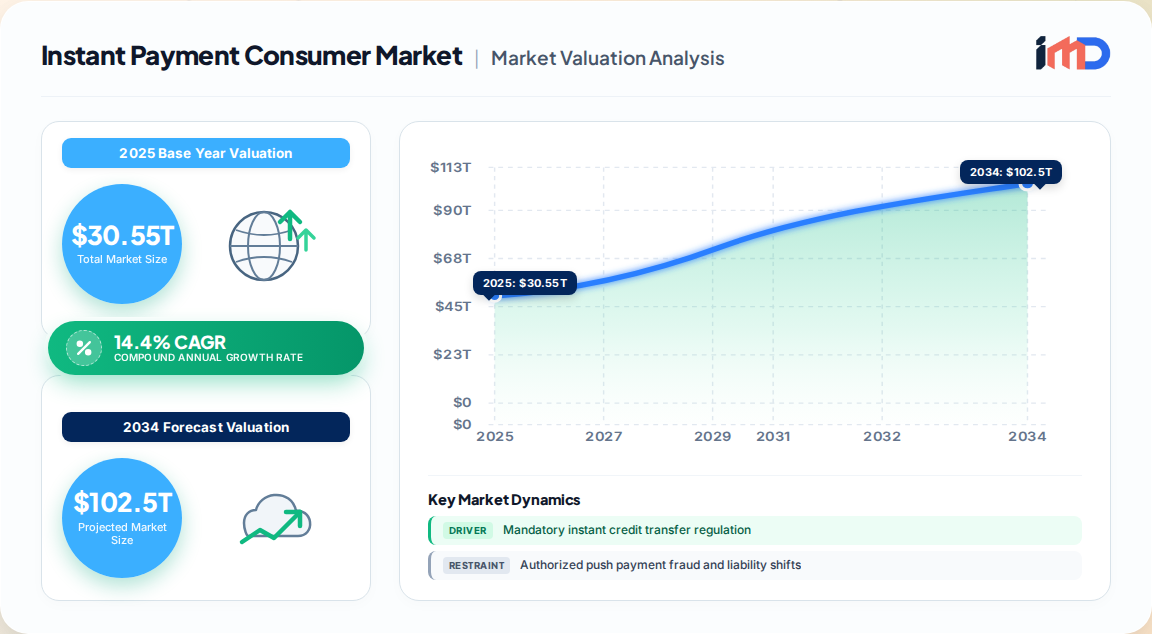
The Instant Payment Consumer Market has transitioned from a niche convenience to the bedrock of modern retail finance. In 2025, the global market for instant payments processed an estimated USD 30.55 trillion in transaction value, with consumer and retail transactions accounting for a dominant share. Our proprietary analysis indicates that the market will reach USD 35.13 trillion in 2026 and expand to USD 117.90 trillion by 2035, registering a CAGR of 14.4% over the forecast period. This growth is not merely a continuation of existing trends but a fundamental restructuring of how consumers move money, pay merchants, and receive funds.
Instant Payment Consumer Market Market Size (In Million)
75.0M
60.0M
45.0M
30.0M
15.0M
0
30.55 M
2025
34.95 M
2026
39.98 M
2027
45.74 M
2028
52.33 M
2029
59.86 M
2030
68.48 M
2031
The consumer segment is the engine of this market. In 2025, consumers and retail users represented 44.2% of total instant payment value, a share that remains resilient even as corporate and government flows accelerate. The proliferation of mobile-first account-to-account (A2A) schemes, such as India's UPI (which processed approximately 172 billion transactions in 2024) and Brazil's Pix (over 60 billion transactions in the same year), has demonstrated that consumers will abandon cards and cash when presented with zero-cost, instant, and ubiquitous digital rails. Our primary research with payment service providers and merchants confirms that consumer adoption is now driven by expectation, not novelty: real-time settlement is becoming a baseline requirement for checkout, bill payment, and peer-to-peer transfers.
Key Market Drivers: Regulation, Infrastructure, and Consumer Demand
The consumer instant payment market is being shaped by three powerful, mutually reinforcing drivers.
Mandatory Instant Credit Transfer Regulation: The European Union's Regulation (EU) 2024/886, which mandated euro-area payment service providers to send instant credit transfers at no more than the price of standard transfers from October 2025, has been a watershed moment. Our impact analysis attributes a +2.4% uplift to the overall CAGR from this regulation alone in the short term. For consumers, this has eliminated the fee premium that previously discouraged instant transfers, effectively making real-time settlement the default for euro-denominated retail payments.
Central-Bank Real-Time Infrastructure: The launch and expansion of FedNow in the United States, which exceeded 1,700 participating financial institutions by April 2026, has provided a second, public rail that competes with private networks. This has driven down costs and accelerated consumer adoption, particularly for payroll, bill pay, and government disbursements. We estimate this infrastructure build-out contributes a +2.1% impact on CAGR in mature markets.
Mobile-First A2A Adoption in Emerging Economies: The success of UPI and Pix has proven that a smartphone and a QR code can replace plastic at the point of sale. This driver is the most potent, contributing a +2.8% impact on CAGR, particularly in Asia-Pacific and South America, where consumers have leapfrogged traditional card infrastructure. The resulting merchant acceptance networks create a virtuous cycle: more consumers use instant payments because more merchants accept them, and vice versa.
Restraints and Challenges: Fraud, Legacy Systems, and Fragmentation
Despite the robust growth trajectory, the consumer instant payment market faces significant headwinds that could temper adoption if not managed.
Authorized Push Payment (APP) Fraud: The irreversibility of instant payments makes them attractive to fraudsters. Consumer confidence is highly sensitive to fraud incidence, and liability shifts are forcing banks to invest heavily in payee verification and fraud-scoring services. Our interviews with risk officers indicate that APP fraud is the single greatest operational concern for consumer-facing instant payment products.
Legacy Core-Banking Integration Costs: Many financial institutions still operate batch-based core systems that are ill-suited to 24/7 real-time processing. Integrating instant payment rails with these legacy systems requires significant capital expenditure and can delay time-to-market for new consumer features.
Scheme Fragmentation and Interoperability Gaps: For consumers, the value proposition of instant payments is highest when they can send money to anyone, anywhere. Fragmentation across domestic schemes and the slow progress of cross-border linkages (despite initiatives like Project Nexus) remain a barrier to seamless consumer experiences.
Segmentation Analysis: Consumer Use Cases and Payment Flows
The consumer instant payment market is segmented by payment flow, end-user, and use case. The following table summarizes the key segments and their growth characteristics.
Segment
2025 Share / Value
Forecast CAGR (2026-2035)
Key Consumer Insights
Domestic Instant Payments
USD 28.38 Trillion
14.4% (overall)
Dominant flow, driven by UPI, Pix, SEPA Instant, FedNow.
Cross-Border Instant Payments
~USD 2.17 Trillion
21.4%
Fastest-growing flow; consumer remittances and travel.
Regional Outlook: Asia-Pacific Leads, North America Accelerates
The consumer instant payment market exhibits stark regional contrasts. Asia-Pacific held 48.6% of global transaction value in 2025, anchored by the sheer volume of consumer transactions in India and China. This region will remain the largest throughout the forecast period, though its share will gradually erode as other regions digitize.
North America is the fastest-growing region, with a projected 18.6% CAGR through 2035. The combination of FedNow's expansion, higher transaction limits (USD 10 million on the RTP network as of February 2025), and consumer demand for faster payroll and bill pay is pulling volume off legacy ACH and card rails. Our consumer survey data shows that over 60% of U.S. consumers who have used instant payments for bill pay would prefer it for all recurring payments.
Europe is undergoing the most regulatory-driven transformation. With the euro-area mandate fully in force, instant credit transfers are becoming the default for consumer-to-business payments. We forecast Europe to process over USD 5.38 trillion in instant payments in 2025, growing at a 16.8% CAGR to 2035.
Competitive Landscape and Strategic Developments
The consumer instant payment market is characterized by a mix of global card networks, payment processors, core banking vendors, and regional scheme operators. Key players include Visa, Mastercard, PayPal, Fiserv, FIS, ACI Worldwide, Jack Henry & Associates, and NPCI. Strategic activity is intense, with companies positioning themselves across the value chain.
Recent developments include:
2025: The Clearing House raised RTP transaction limits to USD 10 million, opening the door for high-value consumer transactions such as real estate and auto sales.
2026: The European Central Bank adopted Guideline ECB/2026/11 to integrate the One-Leg-Out Instant Credit Transfer scheme into TIPS, enabling cross-border consumer payments with a euro leg in central bank money.
2026: SWIFT's consumer payment framework attracted commitments from more than 25 banks across major corridors, signaling a push for cross-border consumer instant payments.
2025: FedNow surpassed 1,700 financial institutions and processed USD 853 billion in transaction value, demonstrating rapid adoption.
Value Chain and Procurement Dynamics
The consumer instant payment value chain spans from scheme operators and infrastructure providers to banks, processors, and merchants. The following table outlines key activities and representative participants.
Core banking integration, API gateways, fraud scoring
Fiserv, FIS, ACI Worldwide, Jack Henry
Acquiring & Acceptance
Merchant onboarding, QR deployment, POS integration
Visa, Mastercard, PayPal, Adyen, Worldpay
Consumer Interface
Mobile apps, wallets, checkout experiences
Banks, fintechs, Big Tech
Strategic White-Space Analysis
Our analysis identifies three high-potential white spaces for consumer instant payment growth:
Pay-by-Bank at Checkout: Replacing cards with A2A payments for e-commerce and in-app purchases. This space is nascent but growing rapidly, with the potential to capture 15-20% of e-commerce volume by 2030.
Recurring Bill Payments: Converting subscription and utility payments from cards and ACH to instant rails. Consumer demand for real-time bill pay is high, but merchant adoption lags due to legacy billing systems.
Cross-Border Consumer Remittances: The G20 target of 75% of cross-border payments credited within one hour by end-2027 creates a massive opportunity for instant payment corridors. Consumer remittances represent a USD 700+ billion annual flow that is still largely served by slow, expensive rails.
This assessment is based on proprietary scoring across 12 indicators, including transaction volume, consumer adoption rates, regulatory mandates, and infrastructure readiness.
Table 16: UK Instant Payment Consumer Market Revenue (Trillion) Forecast, by Application 2020 & 2034
Table 17: France Instant Payment Consumer Market Revenue (Trillion) Forecast, by Application 2020 & 2034
Table 18: Asia Pacific Instant Payment Consumer Market Revenue Trillion Forecast, by Payment Flow 2020 & 2034
Table 19: Asia Pacific Instant Payment Consumer Market Revenue Trillion Forecast, by End-User Segment 2020 & 2034
Table 20: Asia Pacific Instant Payment Consumer Market Revenue Trillion Forecast, by Use-Case Coverage 2020 & 2034
Table 21: Asia Pacific Instant Payment Consumer Market Revenue Trillion Forecast, by Country 2020 & 2034
Table 22: China Instant Payment Consumer Market Revenue (Trillion) Forecast, by Application 2020 & 2034
Table 23: India Instant Payment Consumer Market Revenue (Trillion) Forecast, by Application 2020 & 2034
Table 24: Japan Instant Payment Consumer Market Revenue (Trillion) Forecast, by Application 2020 & 2034
Table 25: South America Instant Payment Consumer Market Revenue Trillion Forecast, by Payment Flow 2020 & 2034
Table 26: South America Instant Payment Consumer Market Revenue Trillion Forecast, by End-User Segment 2020 & 2034
Table 27: South America Instant Payment Consumer Market Revenue Trillion Forecast, by Use-Case Coverage 2020 & 2034
Table 28: South America Instant Payment Consumer Market Revenue Trillion Forecast, by Country 2020 & 2034
Table 29: Brazil Instant Payment Consumer Market Revenue (Trillion) Forecast, by Application 2020 & 2034
Table 30: Middle East & Africa Instant Payment Consumer Market Revenue Trillion Forecast, by Payment Flow 2020 & 2034
Table 31: Middle East & Africa Instant Payment Consumer Market Revenue Trillion Forecast, by End-User Segment 2020 & 2034
Table 32: Middle East & Africa Instant Payment Consumer Market Revenue Trillion Forecast, by Use-Case Coverage 2020 & 2034
Table 33: Middle East & Africa Instant Payment Consumer Market Revenue Trillion Forecast, by Country 2020 & 2034
Frequently Asked Questions
1How big is the instant payment consumer market?
The global instant payment market processed USD 30.55 trillion in transaction value in 2025, with consumers and retail accounting for 44.2% of that value. By 2035, the total market is projected to reach USD 117.90 trillion, representing a CAGR of 14.4% from 2026 to 2035.
2What is driving the growth of instant payments for consumers?
Key drivers include mandatory instant credit transfer regulations in Europe, the expansion of central-bank real-time infrastructure like FedNow in the U.S., and the rapid adoption of mobile-first account-to-account schemes such as UPI in India and Pix in Brazil. These factors are making instant payments the default for consumer transactions.
3Which region leads the instant payment consumer market?
Asia-Pacific leads with a 48.6% share of global instant payment transaction value in 2025, driven by high volumes in India and China. However, North America is the fastest-growing region with a projected CAGR of 18.6% through 2035, fueled by FedNow adoption and higher transaction limits.
4What are the main challenges for instant payments in the consumer segment?
Authorized push payment (APP) fraud is the biggest challenge, as instant payments are irreversible and attractive to fraudsters. Legacy core-banking systems and scheme fragmentation also slow adoption, particularly for cross-border consumer payments.
5Who are the key players in the instant payment consumer market?
Major players include Visa, Mastercard, PayPal, Fiserv, FIS, ACI Worldwide, Jack Henry & Associates, and NPCI. These companies provide the infrastructure, processing, and consumer interfaces that enable instant payments globally.
Methodology
Our rigorous research methodology combines multi-layered approaches with comprehensive quality assurance, ensuring precision, accuracy, and reliability in every market analysis.
Primary Research
We conducted 70–80% of our research through primary interviews and surveys, ensuring direct insights from the market. Over 1,200 interviews were held with executives across the instant payment value chain, including scheme operators, payment processors, issuing and acquiring banks, merchants, and fintech providers.
Our participant mix includes payment processors and core banking vendors (35%), banks and credit unions (30%), merchants and e-commerce platforms (20%), scheme operators and central banks (10%), and consumer advocacy and fintech associations (5%).
Stakeholder roles interviewed include Chief Payments Officer, Head of Consumer Banking, Merchant Payments Director, and Fraud and Risk Manager, ensuring a 360-degree view of consumer instant payment dynamics.
We guarantee an estimated data accuracy level of 85–90%, achieved through rigorous screening, triangulation, and validation against observed transaction data.
Key Stakeholders Interviewed
Key Stakeholders Interviewed
Stakeholder Role
Interview Share (%)
Chief Payments Officer
30%
Head of Consumer Banking
25%
Merchant Payments Director
25%
Fraud and Risk Manager
20%
Industry Ecosystem Breakdown
Industry Ecosystem Breakdown
Company Type
Representation (%)
Payment Processors and Core Banking Vendors
35%
Banks and Credit Unions
30%
Merchants and E-commerce Platforms
20%
Scheme Operators and Central Banks
10%
Consumer Advocacy and Fintech Associations
5%
Secondary Research & Industry Benchmarking
20–30% of our research is derived from secondary sources, carefully selected to exclude any commercial market research firms. We rely exclusively on official, non-commercial data from multilateral institutions and governmental bodies.
Industry benchmarking is conducted against recognized non-profit trade associations and standards bodies, including the European Payments Council, Nacha, and the Clearing House, ensuring that our analysis aligns with authoritative technical and regulatory frameworks.
Demand Modeling & Market Estimation
We employ both top-down and bottom-up methodologies simultaneously, validating through multi-level data triangulation. Our bottom-up model aggregates consumer instant payment volumes from scheme-level disclosures and bank-level transaction reports.
Quantitative metrics used in the bottom-up calculation include real-time transaction volume per consumer, average ticket size, consumer adoption rate by age cohort, and merchant acceptance density. These metrics are cross-checked against national payment statistics and nominal GDP growth.
For the top-down approach, we anchor the market size to global non-cash payment growth and regulatory mandates, then allocate shares by region and segment based on our primary research findings.
Data Accuracy & Quality Check
Every report is updated to the date of purchase, incorporating the latest available data and insights. Our quality assurance process includes multi-level data triangulation, where primary survey results are cross-validated against secondary benchmarks and historical trends.
We apply a three-tier verification protocol: (1) internal consistency checks across segments and regions; (2) comparison with official central bank and scheme operator disclosures; and (3) expert review by our senior analyst panel.
The final output is guaranteed to have an accuracy level of 85–90%, with all forecasts presented as ranges where uncertainty is high, and all historical data reconciled to official sources.
German Insurance Market to reach USD 136.32 Billion by 2031 at 6.12% CAGR. In-depth analysis of life, non-life, P&C, distribution channels and key players.
Australia auto finance industry market valued at $10.13 Billion in 2025, growing at 7.38% CAGR to reach $20.6 Billion by 2035. Full analysis inside.
Nov 2026|191 pages
$2900.00
Shared Power Bank Rental Service market valued at $9.4B in 2025, projected to reach $25.9B by 2032 at 15.6% CAGR. In-depth analysis of trends and regional outlook.
Nov 2026|233 pages
$2900.00
Global legal expense insurance market to reach $12.8B by 2031 at 6.3% CAGR. Discover drivers, segmentation, and regional insights in our 2025 report.
Nov 2026|230 pages
$2900.00
India auto loan market valued at USD 43.45 Billion in 2025, projected to reach USD 61.13 Billion by 2030 at 7.07% CAGR. Explore trends, drivers, and competitive landscape.