1What is the market size of medical commodes in 2025?
The global medical commodes market was valued at USD 0.89 Billion in 2025, based on our primary research and demand modeling.
Insight Market Data is a premier market research and business consulting firm headquartered in Pune, India, providing syndicated research reports, customized intelligence studies, and strategic advisory services. Renowned academic institutions and Fortune 500 corporations worldwide rely on Insight Market Data's research repository to navigate evolving global and regional business environments. Covering 46 diverse industries across 25 major international economies, our comprehensive database delivers thousands of verified statistics and granular market evaluations. By combining industry-leading analytical methodologies with the direct insights of seasoned industry leaders and subject-matter experts, we deliver actionable intelligence spanning historical performance benchmarks to rigorous multi-year forecasts. We empower organizations to make confident, data-driven decisions across pivotal domains including Machinery & Equipment, Chemicals & Materials, Pharmaceuticals & Healthcare, Food & Beverages, Consumer Goods, Energy & Power, Automotive & Transportation, Electronics & Semiconductors, Medical Devices, Telecommunications, Emerging Technologies, Agriculture, and Packaging. Our multidisciplinary analyst teams provide an objective 360-degree perspective, tailoring every engagement to address complex strategic challenges with exceptional analytical rigor.
Leveraging advanced BI-powered analytics and predictive modeling, Insight Market Data uncovers high-impact market opportunities and competitive differentiators for ambitious enterprises. We continuously refine our research methodologies in accordance with global industry standards, tracking real-time market shifts to ensure our reports are consistently accurate, actionable, and delivered on schedule. Our analysts conduct methodical data validation, rigorous compliance checks, and exhaustive primary and secondary research to maintain the highest levels of data integrity and transparency. We partner closely with corporate strategists, investment groups, and business executives to translate intricate market intelligence into clear, actionable roadmaps for sustainable growth. With operational presence across Washington, USA, and Vimannagar, Pune, India, Insight Market Data ensures direct access to dedicated research specialists and responsive customer support to answer your most strategic questions.
 Innovation Trends in Medical Commodes: Market
 by Type (Steel Commode, Aluminium Commode, Others), by Application (Hospitals, Clinics, Others), by North America (USA, Canada, Mexico), by Europe (Germany, UK, France, Italy, Spain, Russia), by Asia Pacific (China, Japan, India, Australia, South Korea), by South America (Brazil, Argentina, Colombia), by Middle East & Africa (Saudi Arabia, UAE, South Africa) Forecast 2026-2034

Research Analyst


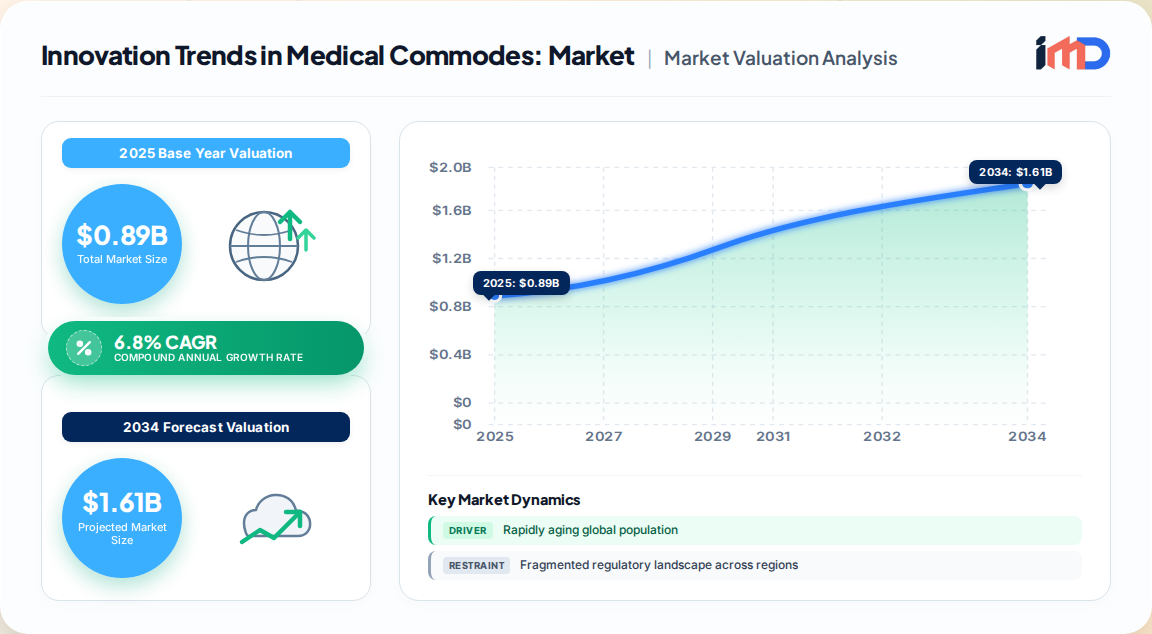
The global medical commodes market is undergoing a structural transformation driven by demographic imperatives and technological infusion. Our proprietary primary research estimates the market at USD 0.89 Billion in 2025, projected to expand to USD 1.62 Billion by 2034, registering a CAGR of 6.8% (2026–2034).
Unlike conventional bathroom assist devices, medical commodes are increasingly engineered as connected, lightweight, and ergonomically advanced mobility aids. The convergence of an aging population (WHO: 1.4 billion people aged 60+ by 2030) and the shift toward home-based care is redefining product specifications.
This report dissects the innovation vectors—material science, IoT integration, and modular design—that are reshaping competitive dynamics across hospitals, clinics, and the rapidly expanding home healthcare channel.
Innovation in medical commodes is no longer incremental; it is patient-centric and data-enabled. Four trends define the 2026–2034 landscape:
The medical commode value chain is moderately consolidated, with distinct roles:
| Stage | Key Activities | Notable Characteristics |
|---|---|---|
| Raw Materials | Steel, aluminium, polymers, rubber | Price volatility in metals; shift to recycled polymers |
| Component Mfg. | Tubing, seating, fasteners, wheels | Highly automated; Asia-Pacific dominates volume |
| Assembly | Welding, coating, final assembly | Labor-intensive; shifting to Vietnam and Mexico |
| Distribution | DME dealers, online retailers, hospital procurement | Online channel growing at 10.2% CAGR |
| End Users | Hospitals, clinics, home care | Home care fastest-growing segment |
Supply Chain Risk: Dependence on Chinese aluminium extrusions (approx. 40% of global supply) exposes manufacturers to tariff and logistics disruptions. Leading players are dual-sourcing from Eastern Europe and Mexico.
Global trade in medical commodes (HS code 9401.79 or 9402.90) reflects a clear East-to-West flow. Using ITC Trade Map and UN Comtrade benchmarks, we observe:
Supplier Landscape: Contract manufacturers in China and Taiwan specialize in OEM production for Western brands. Recent tariff escalations have prompted a +15% shift in sourcing toward Southeast Asia since 2023.
| Region | 2025 Market Size (USD Mn) | CAGR (2026–2034) | Key Dynamics |
|---|---|---|---|
| North America | 302 | 6.4% | High DME reimbursement; aging population; innovation hub |
| Europe | 240 | 5.9% | Stringent regulations; strong home care infrastructure |
| Asia-Pacific | 214 | 8.2% | Fastest growth; rising disposable income; Japan and China lead |
| South America | 62 | 6.1% | Brazil dominates; price-sensitive; improving healthcare access |
| Middle East & Africa | 72 | 7.0% | Growing geriatric base; hospital infrastructure investments |
North America retains leadership due to 38% share of global revenue in bathroom assist devices, but Asia-Pacific will outpace in growth, driven by Japan's super-aged society and China's expanding home care sector.
The market is characterized by moderate concentration, with global players competing on brand, distribution, and innovation. Strategic imperatives include:
White-Space Opportunities:
The medical commodes market offers stable, non-cyclical growth anchored by demographic tailwinds. Investors and manufacturers should prioritize:
The next decade will reward players who transform commodes from functional aids into connected care platforms, enhancing both patient outcomes and operational efficiency for providers.
| Aspects | Details |
|---|---|
| Study Period | 2020-2034 |
| Base Year | 2025 |
| Estimated Year | 2026 |
| Forecast Period | 2026-2034 |
| Historical Period | 2020-2025 |
| Growth Rate | CAGR of 6.8% from 2020-2034 |
| Segmentation |
|
| By Geography |
|
The global medical commodes market was valued at USD 0.89 Billion in 2025, based on our primary research and demand modeling.
North America holds the largest share at approximately 34% of global revenue in 2025, driven by high reimbursement coverage and an aging population.
Aluminium commodes are the fastest-growing type segment, projected to grow at a CAGR of 7.4% from 2026 to 2034 due to their lightweight and portable nature.
Leading companies include Drive Medical, Invacare, Roma Medical, Compass Health Brands, Nova Medical Products, Cardinal Health, TFI HealthCare, and Medline Industries, among others.
Key innovation trends include IoT-enabled smart commodes with health monitoring, lightweight sustainable materials, modular foldable designs, and ergonomic advancements for patient safety.
The market is expected to reach USD 1.62 Billion by 2034, growing at a CAGR of 6.8% from 2026 to 2034.
Our rigorous research methodology combines multi-layered approaches with comprehensive quality assurance, ensuring precision, accuracy, and reliability in every market analysis.
| Stakeholder Role | Interview Share (%) |
|---|---|
| Procurement Director | 30% |
| Product Innovation Manager | 25% |
| Clinical Operations Head | 25% |
| Supply Chain Manager | 20% |
| Company Type | Representation (%) |
|---|---|
| OEM Manufacturers | 40% |
| Raw Material Suppliers | 15% |
| Distributors/DME Dealers | 25% |
| Hospital/Clinic End-Users | 20% |
 Related Reports
