1What is the size of the industrial alcohol market in 2026?
Our proprietary primary research values the global industrial alcohol market at USD 141.15 billion in 2026, scaling to USD 228.61 billion by 2035 at a 5.71% CAGR.
Insight Market Data is a premier market research and business consulting firm headquartered in Pune, India, providing syndicated research reports, customized intelligence studies, and strategic advisory services. Renowned academic institutions and Fortune 500 corporations worldwide rely on Insight Market Data's research repository to navigate evolving global and regional business environments. Covering 46 diverse industries across 25 major international economies, our comprehensive database delivers thousands of verified statistics and granular market evaluations. By combining industry-leading analytical methodologies with the direct insights of seasoned industry leaders and subject-matter experts, we deliver actionable intelligence spanning historical performance benchmarks to rigorous multi-year forecasts. We empower organizations to make confident, data-driven decisions across pivotal domains including Machinery & Equipment, Chemicals & Materials, Pharmaceuticals & Healthcare, Food & Beverages, Consumer Goods, Energy & Power, Automotive & Transportation, Electronics & Semiconductors, Medical Devices, Telecommunications, Emerging Technologies, Agriculture, and Packaging. Our multidisciplinary analyst teams provide an objective 360-degree perspective, tailoring every engagement to address complex strategic challenges with exceptional analytical rigor.
Leveraging advanced BI-powered analytics and predictive modeling, Insight Market Data uncovers high-impact market opportunities and competitive differentiators for ambitious enterprises. We continuously refine our research methodologies in accordance with global industry standards, tracking real-time market shifts to ensure our reports are consistently accurate, actionable, and delivered on schedule. Our analysts conduct methodical data validation, rigorous compliance checks, and exhaustive primary and secondary research to maintain the highest levels of data integrity and transparency. We partner closely with corporate strategists, investment groups, and business executives to translate intricate market intelligence into clear, actionable roadmaps for sustainable growth. With operational presence across Washington, USA, and Vimannagar, Pune, India, Insight Market Data ensures direct access to dedicated research specialists and responsive customer support to answer your most strategic questions.
 Industrial Alcohol Market
 by Type (Isopropyl Alcohol(Technical Grade, Pharmaceutical Grade), Methyl Alcohol(Industrial Grade, Fuel Grade), Ethyl Alcohol(Denatured Ethanol, Absolute Ethanol), Isobutyl Alcohol(Technical Grade, Reagent Grade), Benzyl Alcohol(Technical Grade, Cosmetic Grade)), by Source (Molasses, Sugar, Grains, Fossil Fuels), by Processing Method (Fermentation, Synthetic), by Application (Fuel, Chemical Intermediates And Solvent, Pharmaceuticals, Personal care products, Food Ingredients), by Asia-Pacific (China, India, Japan), by Europe (Germany, France, UK), by North America (USA, Canada, Mexico), by South America (Brazil, Argentina), by Middle East & Africa (Saudi Arabia, South Africa) Forecast 2026-2034

Senior Research Analyst


 Related Reports

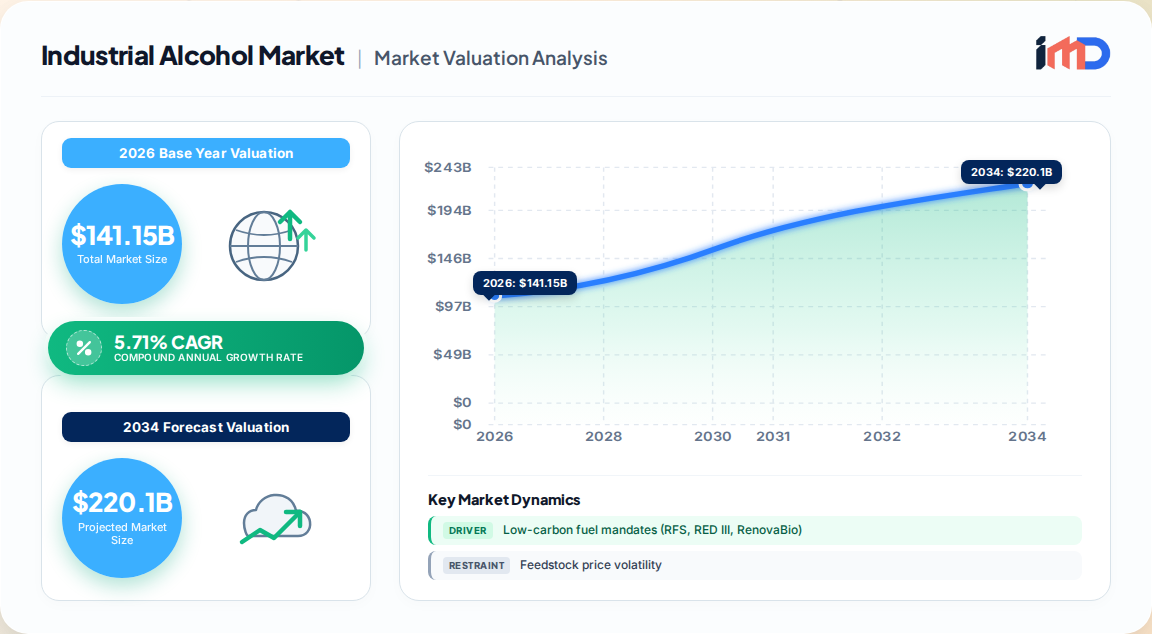
The global industrial alcohol market represents one of the most structurally resilient segments of the global chemicals and biofuels complex. Our proprietary primary research and expert interview program places the 2026 market valuation at USD 141.15 billion, on an accelerated trajectory toward USD 228.61 billion by 2035, reflecting a CAGR of 5.71% across the forecast horizon. This expansion is anchored in three converging forces: tightening low-carbon fuel mandates across the Americas and Europe, the rapid standardization of pharmaceutical-grade alcohol purity, and the diversification of bio-based feedstock platforms.
Industrial alcohol — principally ethyl alcohol (ethanol), methyl alcohol (methanol), and isopropyl alcohol — functions as a foundational input across fuel blending, chemical intermediates, solvents, pharmaceuticals, personal care, and food ingredients. Unlike discretionary consumer chemicals, demand here is structurally insulated by regulatory blending floors, GMP manufacturing requirements, and entrenched solvent substitution patterns.
Demand expansion in this market is not cyclical — it is regulation-driven and specification-driven. Our driver impact modeling isolates seven principal growth vectors, each assigned a quantified contribution to the headline CAGR.
| Driver | CAGR Impact | Primary Geography | Timeline |
|---|---|---|---|
| Low-carbon fuel mandates (RFS, RED III, RenovaBio) | 1.4% | North America, EU, Brazil | Medium-term (2–4 yr) |
| Pharmaceutical alcohol purity upgrades | 0.9% | Global | Short-term (≤2 yr) |
| Carbon-capture credit economics (45Z) | 0.8% | United States | Short-term (≤2 yr) |
| Bio-based cosmetics preservative shift | 0.7% | EU, Asia-Pacific | Medium-term (2–4 yr) |
| Second-generation cellulosic ethanol scale-up | 0.6% | US, China | Long-term (≥4 yr) |
| E20–E25 blending expansion in India | 0.5% | India | Medium-term (2–4 yr) |
| SAF alcohol-to-jet pathway integration | 0.4% | US, EU | Long-term (≥4 yr) |
The US Renewable Fuel Standard mandates 15 billion gallons of conventional biofuel blending annually, while the EU's revised Renewable Energy Directive (RED III) requires a 42.5% renewable share in transport energy by 2030. Brazil's RenovaBio decarbonization credits traded at BRL 95–110 per tonne of CO2 avoided in 2024, directly rewarding low-carbon-intensity sugarcane producers and creating a regulatory floor beneath industrial alcohol demand.
A parallel driver is the tightening of pharmaceutical purity specifications. Revised ICH Q3D elemental-impurity guidelines and updated USP monographs now mandate sub-10 ppb heavy-metal limits, compelling mid-tier distillers to invest USD 2–5 million per facility in multi-column distillation upgrades. This is concentrating supply among large-scale GMP-certified producers and widening price premiums from 12% to 18% over commodity-grade industrial solvents.
Three structural constraints temper the growth outlook and require active procurement and supply-chain mitigation.
Additionally, excise duties, licensing regimes, and dual-use controls on ethanol continue to create operational friction for smaller producers, reinforcing the market's ongoing consolidation toward scale-advantaged players.
Our segmentation framework integrates product type, feedstock source, processing method, and application, cross-validated through bottom-up production-capacity modeling.
By Type: Ethyl alcohol remains the volume anchor, registering a 5.89% CAGR through 2035. Isopropyl alcohol is projected to reach USD 28.4 billion by 2035, underpinned by high-purity solvent demand in semiconductor fabrication and pharmaceutical disinfection. Methyl alcohol, isobutyl alcohol, and benzyl alcohol complete the product matrix, each with distinct technical and reagent-grade sub-segments.
By Source: Sugar and molasses feedstocks captured 39.6% of the market in 2025, led by Brazil and India's established fermentation infrastructure. Grains are forecast to register a 6.53% CAGR through 2035, driven by US corn-based ethanol expansion.
By Application: The fuel and energy segment dominated with USD 56.7 billion in 2025, supported by national blending mandates. Cosmetics and personal care represent the fastest-growing application at a 7.24% CAGR, as bio-based preservatives displace synthetic alternatives.
| Segment | 2025/2026 Benchmark | Growth Signal |
|---|---|---|
| Fuel & Energy | USD 56.7 billion (2025) | Mandate-driven, stable |
| Ethyl Alcohol (by type) | >50% volume share | 5.89% CAGR to 2035 |
| Isopropyl Alcohol | — | USD 28.4 billion by 2035 |
| Sugar & Molasses (source) | 39.6% share (2025) | Mature, Brazil/India-led |
| Grains (source) | — | 6.53% CAGR to 2035 |
| Cosmetics & Personal Care | — | 7.24% CAGR (fastest) |
The industrial alcohol trade complex is dominated by a small number of high-volume bilateral corridors. The United States and Brazil are the world's dominant ethanol producers and exporters, with Japan and several European economies — particularly the United Kingdom — acting as principal importers. Roughly 97% of US gasoline contains at least 10% ethanol, which structurally limits US exportable surplus during high-blend periods and tightens global availability.
Supplier dynamics are shaped by three structural realities. First, feedstock cost leadership belongs to Brazil's sugarcane-based fermentation alcohol cluster, which benefits from RenovaBio credit monetization exceeding USD 4.8 billion in program investment since 2020. Second, technology leadership in carbon-capture-retrofitted dry-mill ethanol sits in the US Midwest, where over 40 ethanol plants had carbon-capture pipeline agreements in place by mid-2025, representing roughly 30% of national denatured alcohol output capacity. Third, pharmaceutical-grade supply is concentrating among GMP-certified producers capable of sub-10 ppb heavy-metal compliance.
Procurement teams should treat supplier qualification in pharma-grade alcohol as a multi-year process, and should model Brazilian sugarcane cost curves against US corn-based carbon-intensity scoring when negotiating multi-year offtake.
The competitive landscape is bifurcated between integrated agri-industrial majors and specialized fermentation and chemical players. Strategy is increasingly defined by feedstock ownership, carbon-intensity scoring, and purity-grade differentiation rather than raw capacity alone.
Key strategic developments shaping the 2026–2035 outlook include:
Leading players operating across this value chain include Cargill Incorporated, Cristalco SAS, Raizen Energia SA, MGP Ingredients Inc., Green Plains Inc., Grain Millers Inc., The Andersons Inc., BIRLA SUGAR, Valero Energy Corporation, Flint Hills Resources, Roquette Freres SA, Jiangsu Lianhai Biological Technology Co. Ltd., Archer Daniels Midland, POET LLC, and Tereos. Strategic white-space is concentrated in sustainable aviation fuel alcohol-to-jet pathways, bio-based personal care preservatives, and second-generation cellulosic ethanol scale-up — all of which command premium pricing and align with tightening decarbonization mandates.
| Aspects | Details |
|---|---|
| Study Period | 2020-2034 |
| Base Year | 2026 |
| Estimated Year | 2026 |
| Forecast Period | 2026-2034 |
| Historical Period | 2020-2025 |
| Growth Rate | CAGR of 5.71% from 2020-2034 |
| Segmentation |
|
By Source
By Processing Method
By Application
| By Geography |
|
Our proprietary primary research values the global industrial alcohol market at USD 141.15 billion in 2026, scaling to USD 228.61 billion by 2035 at a 5.71% CAGR.
Asia-Pacific commands approximately 43.2% of 2025 revenue, driven by India's molasses-based ethanol program and China's corn-to-ethanol buildout, while North America is the fastest-growing region at a 6.14% CAGR.
Low-carbon fuel mandates such as the US RFS, EU RED III, and Brazil's RenovaBio contribute 1.4% to CAGR, while pharmaceutical purity upgrades under ICH Q3D add a further 0.9% by concentrating supply among GMP-certified producers.
Ethyl alcohol is the volume anchor with more than 50% share, registering a 5.89% CAGR through 2035, while isopropyl alcohol is projected to reach USD 28.4 billion by 2035 on semiconductor and pharmaceutical solvent demand.
Feedstock price volatility in corn, sugarcane, and natural gas, methanol toxicity regulation, and water consumption sustainability pressure are the principal restraints limiting margin stability and market flexibility.
Leading players include Cargill Incorporated, Raizen Energia SA, POET LLC, Archer Daniels Midland, Green Plains Inc., Valero Energy Corporation, Tereos, and Cristalco SAS, operating across fermentation, carbon-capture retrofits, and GMP-grade purification.
Our rigorous research methodology combines multi-layered approaches with comprehensive quality assurance, ensuring precision, accuracy, and reliability in every market analysis.
| Stakeholder Role | Interview Share (%) |
|---|---|
| Procurement Director | 30% |
| Plant Operations Manager | 25% |
| Regulatory Affairs & Quality Head | 25% |
| Commercial Strategy VP | 20% |
| Company Type | Representation (%) |
|---|---|
| Fermentation & distillery operators | 32% |
| Petrochemical methanol producers | 18% |
| GMP pharmaceutical alcohol manufacturers | 22% |
| Biofuel blending & trading companies | 16% |
| Downstream solvent formulators | 12% |