1What is the current size of the India organic food market?
The India organic food market is estimated at USD 2,749.30 Million in 2026 and is projected to reach USD 11,296.09 Million by 2034.
Insight Market Data is a premier market research and business consulting firm headquartered in Pune, India, providing syndicated research reports, customized intelligence studies, and strategic advisory services. Renowned academic institutions and Fortune 500 corporations worldwide rely on Insight Market Data's research repository to navigate evolving global and regional business environments. Covering 46 diverse industries across 25 major international economies, our comprehensive database delivers thousands of verified statistics and granular market evaluations. By combining industry-leading analytical methodologies with the direct insights of seasoned industry leaders and subject-matter experts, we deliver actionable intelligence spanning historical performance benchmarks to rigorous multi-year forecasts. We empower organizations to make confident, data-driven decisions across pivotal domains including Machinery & Equipment, Chemicals & Materials, Pharmaceuticals & Healthcare, Food & Beverages, Consumer Goods, Energy & Power, Automotive & Transportation, Electronics & Semiconductors, Medical Devices, Telecommunications, Emerging Technologies, Agriculture, and Packaging. Our multidisciplinary analyst teams provide an objective 360-degree perspective, tailoring every engagement to address complex strategic challenges with exceptional analytical rigor.
Leveraging advanced BI-powered analytics and predictive modeling, Insight Market Data uncovers high-impact market opportunities and competitive differentiators for ambitious enterprises. We continuously refine our research methodologies in accordance with global industry standards, tracking real-time market shifts to ensure our reports are consistently accurate, actionable, and delivered on schedule. Our analysts conduct methodical data validation, rigorous compliance checks, and exhaustive primary and secondary research to maintain the highest levels of data integrity and transparency. We partner closely with corporate strategists, investment groups, and business executives to translate intricate market intelligence into clear, actionable roadmaps for sustainable growth. With operational presence across Washington, USA, and Vimannagar, Pune, India, Insight Market Data ensures direct access to dedicated research specialists and responsive customer support to answer your most strategic questions.

 India Organic Food Market
 by Product Type (Organic Beverages, Organic Cereal and Food Grains, Organic Meat, Poultry and Dairy, Organic Spices and Pulses, Organic Processed Food, Organic Fruits and Vegetables, Others), by Distribution Channel (Supermarkets and Hypermarkets, Specialty Stores, Convenience Stores, Online, Others), by North India, by South India, by West India, by East India Forecast 2026-2034

Research Associate

 Related Reports

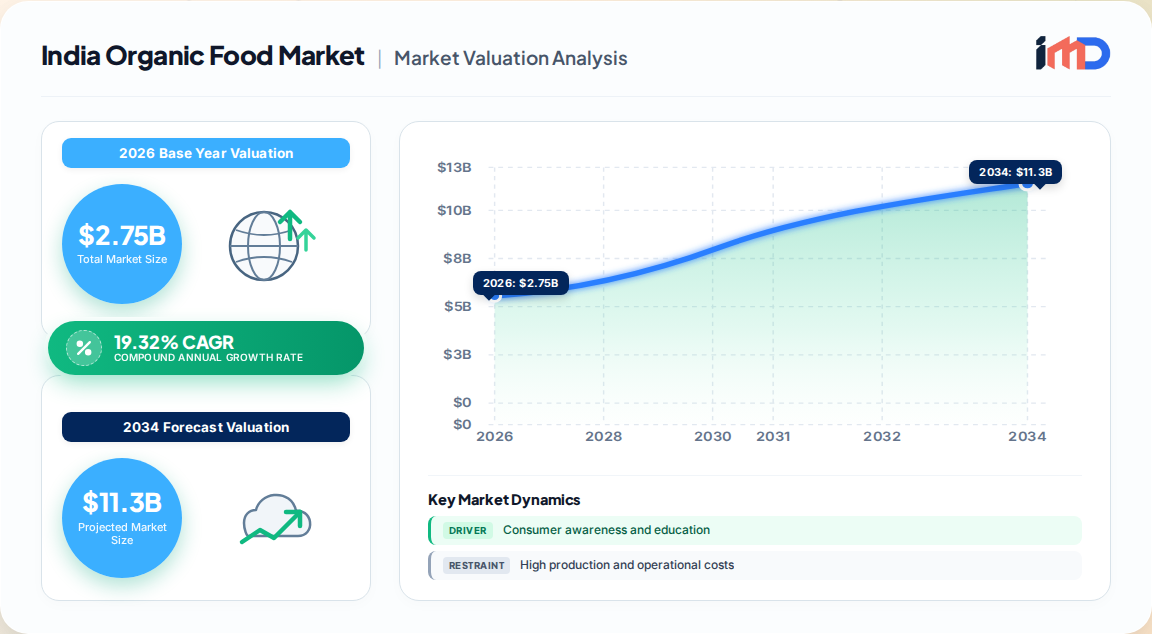
The India organic food market is undergoing a structural transformation from a niche, health-fad category into a mainstream consumer staple. Our proprietary primary research, triangulated with official trade statistics and expert interviews, estimates the market at USD 2,749.30 Million in 2026, projected to reach USD 11,296.09 Million by 2034, expanding at a robust CAGR of 19.32%.
This growth is not merely a pandemic-era anomaly; it reflects a permanent shift in Indian consumption patterns. Rising disposable incomes, urbanization, and a heightened awareness of food safety and pesticide residues are driving adoption beyond metropolitan tier-I cities into tier-II and tier-III markets. The market is also witnessing a surge in export demand for Indian organic staples, further validating the supply-side ecosystem.
Key structural shifts include the rapid formalization of retail through organized supermarkets and the explosive growth of quick-commerce and e-commerce channels. Government-backed certification frameworks, such as the National Programme for Organic Production (NPOP) and the Participatory Guarantee System (PGS), are enhancing consumer trust and reducing the prevalence of spurious products.
The India organic food market is propelled by a confluence of demand-side and supply-side factors.
Key Growth Drivers:
Key Restraints:
The organic food value chain in India is evolving from a fragmented, unorganized structure to a more integrated and traceable model.
Upstream: Farming and Aggregation
Midstream: Processing and Packaging
Downstream: Distribution and Retail
Enablers: Certification and Traceability
India is emerging as a significant player in the global organic trade, transitioning from a net importer to a net exporter of organic food products.
Export Destinations
Key Suppliers and Exporters
Import Dependence
Supply Chain Risks
The India organic food market is segmented by product type, distribution channel, and region. Our analysis reveals clear leadership positions and emerging growth hotspots.
By Product Type
By Distribution Channel
By Region
North India, particularly the National Capital Region (NCR), Punjab, and Haryana, represents the largest market for organic food in India. This is attributed to higher per capita income, greater awareness, and the presence of major organic brands and retailers.
South India, led by Karnataka, Tamil Nadu, and Kerala, is a close second. The region has a strong agricultural base for organic farming and a health-conscious populace.
West India, with Maharashtra and Gujarat, is both a major producer and consumer. Mumbai and Pune are key consumption centers.
East India is the fastest-growing region, albeit from a smaller base. Increasing government support and the entry of organized retailers are driving growth.
Tier-II and Tier-III Opportunity: Our primary research indicates that smaller cities are the next frontier. The penetration of e-commerce and quick-commerce is bridging the availability gap, and brands are customizing pack sizes and price points to suit local budgets.
The India organic food market is moderately fragmented, with a mix of established domestic players, emerging brands, and international entrants.
Key Players:
Recent Strategic Developments:
Strategic Imperatives:
Our analysis identifies several high-potential white spaces for investors and incumbents:
Key Risks:
Mitigation Strategies:
| Aspects | Details |
|---|---|
| Study Period | 2020-2034 |
| Base Year | 2026 |
| Estimated Year | 2026 |
| Forecast Period | 2026-2034 |
| Historical Period | 2020-2025 |
| Growth Rate | CAGR of 19.32% from 2020-2034 |
| Segmentation |
|
By Distribution Channel
| By Geography |
|
The India organic food market is estimated at USD 2,749.30 Million in 2026 and is projected to reach USD 11,296.09 Million by 2034.
The market is expected to grow at a compound annual growth rate (CAGR) of 19.32% from 2026 to 2034.
Organic cereals and food grains dominate the market, holding a 24% share in 2025, driven by India's staple food culture and rising health consciousness.
The online and quick-commerce channel is the fastest-growing, registering a CAGR of over 25%, fueled by convenience and expanding digital penetration.
Key drivers include rising health awareness, government initiatives like PKVY, growth in e-commerce, and increasing export demand.
Major players include ITC Limited, Dabur India Limited, Organic India, Patanjali Ayurved, Sresta Natural Bioproducts (24 Mantra Organic), and Conscious Food, among others.
Our rigorous research methodology combines multi-layered approaches with comprehensive quality assurance, ensuring precision, accuracy, and reliability in every market analysis.
| Stakeholder Role | Interview Share (%) |
|---|---|
| Procurement Director | 30% |
| Supply Chain Head | 25% |
| Category Manager | 25% |
| CEO/Founder | 20% |
| Company Type | Representation (%) |
|---|---|
| Organic Food Manufacturers | 35% |
| Aggregators/FPOs | 20% |
| Retailers | 20% |
| E-commerce Platforms | 15% |
| Certification Bodies | 10% |