1What is the size of the India online travel market in 2026?
The India online travel market is estimated at USD 60.87 Billion in 2026, up from USD 55.74 Billion in 2025, and is projected to reach USD 126.01 Billion by 2034 at a CAGR of 9.20%.
Insight Market Data is a premier market research and business consulting firm headquartered in Pune, India, providing syndicated research reports, customized intelligence studies, and strategic advisory services. Renowned academic institutions and Fortune 500 corporations worldwide rely on Insight Market Data's research repository to navigate evolving global and regional business environments. Covering 46 diverse industries across 25 major international economies, our comprehensive database delivers thousands of verified statistics and granular market evaluations. By combining industry-leading analytical methodologies with the direct insights of seasoned industry leaders and subject-matter experts, we deliver actionable intelligence spanning historical performance benchmarks to rigorous multi-year forecasts. We empower organizations to make confident, data-driven decisions across pivotal domains including Machinery & Equipment, Chemicals & Materials, Pharmaceuticals & Healthcare, Food & Beverages, Consumer Goods, Energy & Power, Automotive & Transportation, Electronics & Semiconductors, Medical Devices, Telecommunications, Emerging Technologies, Agriculture, and Packaging. Our multidisciplinary analyst teams provide an objective 360-degree perspective, tailoring every engagement to address complex strategic challenges with exceptional analytical rigor.
Leveraging advanced BI-powered analytics and predictive modeling, Insight Market Data uncovers high-impact market opportunities and competitive differentiators for ambitious enterprises. We continuously refine our research methodologies in accordance with global industry standards, tracking real-time market shifts to ensure our reports are consistently accurate, actionable, and delivered on schedule. Our analysts conduct methodical data validation, rigorous compliance checks, and exhaustive primary and secondary research to maintain the highest levels of data integrity and transparency. We partner closely with corporate strategists, investment groups, and business executives to translate intricate market intelligence into clear, actionable roadmaps for sustainable growth. With operational presence across Washington, USA, and Vimannagar, Pune, India, Insight Market Data ensures direct access to dedicated research specialists and responsive customer support to answer your most strategic questions.
 India Online Travel Market
 by Service Type (Transportation, Travel Accommodation, Vacation Packages), by Platform (Mobile, Desktop), by Mode of Booking (Online Travel Agencies, Direct Supplier Platforms), by Traveler Type (Leisure, Business, Bleisure), by Age Group (18-30, 31-45, 46-60, Above 60), by West India (Maharashtra, Gujarat), by North India (Delhi NCR, Punjab, Haryana), by South India (Karnataka, Tamil Nadu, Telangana, Kerala), by East India (West Bengal, Odisha, Bihar) Forecast 2026-2034

Research Associate


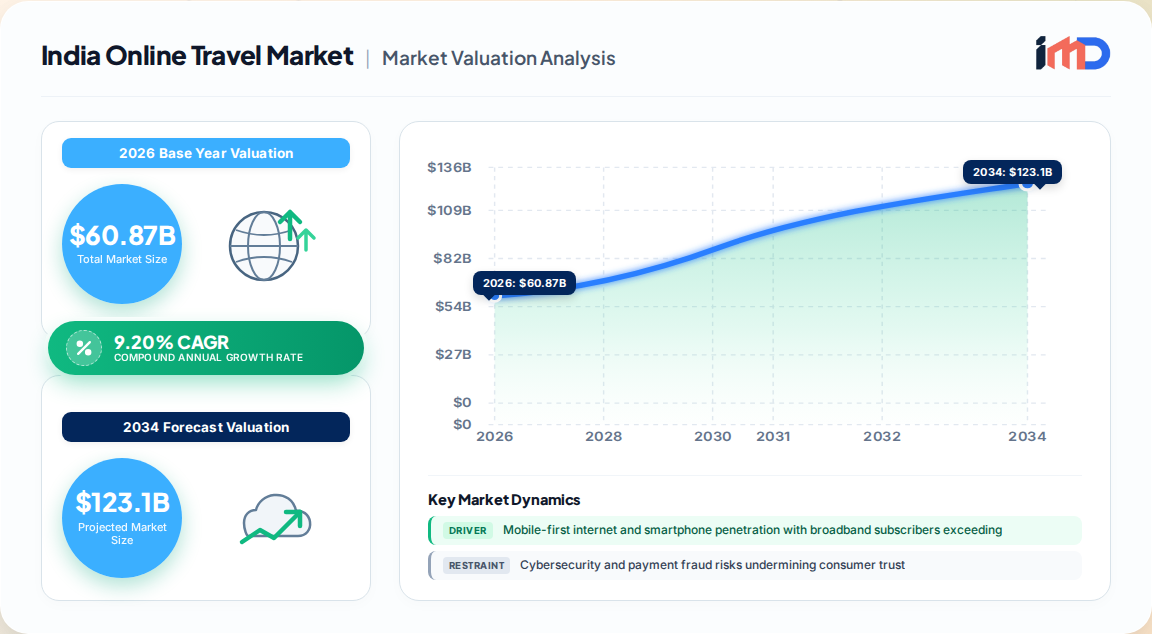
The India online travel market has solidified its position as one of the world's most dynamic digital commerce ecosystems, growing from USD 55.74 Billion in 2025 to an estimated USD 60.87 Billion in 2026. Our proprietary demand modeling projects the market to reach USD 126.01 Billion by 2034, representing a robust CAGR of 9.20% across the 2026–2034 forecast horizon. This trajectory is anchored by an unparalleled confluence of mobile-first consumer behavior, sovereign digital payment infrastructure, and a rapidly formalizing domestic travel base beyond the metro cities.
India's domestic tourism engine provides the foundational volume for this expansion. Domestic tourist visits crossed 2,948 million in 2024, a 17.5% increase over 2023, reflecting a consumer base that online travel platforms are systematically converting from offline, agent-led bookings into direct digital transactions. The market's distinctiveness lies in three structural pillars: the world's largest mobile-booking user base, an unmatched rail-ticketing franchise through IRCTC, and a fast-emerging Tier-2/Tier-3 city travel cohort that is entering the digital economy for the first time.
| Metric | Value (2025/2026) |
|---|---|
| Market Size (2025) | USD 55.74 Billion |
| Market Size (2026) | USD 60.87 Billion |
| Forecast Market Size (2034) | USD 126.01 Billion |
| CAGR (2026–2034) | 9.20% |
| Dominant Service Type | Transportation (47.3%) |
| Dominant Platform | Mobile (78.4%) |
| Leading Region | West India (35.8%) |
The India online travel market is structured around three primary service categories, each characterized by distinct booking frequency, average order value, and consumer decision cycles. Transportation leads with a 47.3% share in 2025, followed by travel accommodation at 34.1% and vacation packages at 18.6%.
Platform dynamics reveal a decisive mobile-first market structure. Mobile platforms command 78.4% of bookings, dwarfing desktop at 21.6%, and are expanding at a faster ~10.6% CAGR as app-based checkout, UPI autopay, and push-notification-led flash sales convert browsing into completed bookings. This mobile dominance is underpinned by India's broadband subscriber base exceeding 1 billion in November 2025, per TRAI data, with internet subscribers crossing 1,028.61 million by December 2025.
West India commands the largest regional share at 35.8%, driven by Mumbai and Pune's high e-commerce maturity, strong outbound and business travel demand, and a dense concentration of corporate travel spend across Maharashtra and Gujarat. North India follows at 27.9%, supported by Delhi-NCR's status as a major aviation and corporate hub. South India accounts for 24.3%, anchored by Bengaluru, Hyderabad, and Chennai's technology and industrial corridors, while East India holds 12.0%, with Kolkata and emerging Tier-2 cities driving gradual digital adoption.
The most significant structural opportunity lies in Tier-2 and Tier-3 cities, where mobile travel penetration is expanding rapidly. Over 45% of usage of MakeMyTrip's AI assistant 'Myra' originated from Tier-2 and smaller cities in FY26, signaling a decisive shift in the consumer base. This demographic is characterized by lower booking frequency but higher sensitivity to personalized, vernacular-language interfaces and flexible payment options.
The India online travel value chain integrates travel suppliers (airlines, hotels, IRCTC, bus and cab operators), OTA and meta-search platforms, payment and fintech enablers, and travel agents serving both leisure and corporate travelers.
The India online travel market is positioned for sustained double-digit growth, with the market anchored at USD 86.56 Billion in 2030 and projected to reach USD 126.01 Billion by 2034. The next growth phase will be defined by three imperatives:
The competitive landscape will remain medium-concentrated, with leading OTAs, emerging direct-supplier platforms, and fintech-enabled travel startups competing across segments. Success will hinge on balancing growth investment with margin discipline, and on building the supplier relationships and technology infrastructure required to deliver seamless, end-to-end travel experiences across India's diverse consumer base.
| Aspects | Details |
|---|---|
| Study Period | 2020-2034 |
| Base Year | 2026 |
| Estimated Year | 2026 |
| Forecast Period | 2026-2034 |
| Historical Period | 2020-2025 |
| Growth Rate | CAGR of 9.20% from 2020-2034 |
| Segmentation |
|
By Mode of Booking
By Traveler Type
By Age Group
| By Geography |
|
The India online travel market is estimated at USD 60.87 Billion in 2026, up from USD 55.74 Billion in 2025, and is projected to reach USD 126.01 Billion by 2034 at a CAGR of 9.20%.
Transportation leads the market with a 47.3% share in 2025, driven by high-frequency flight, train, and bus ticketing, including IRCTC's average of 14.53 lakh e-tickets per day in 2025–26.
Mobile accounts for 78.4% of online travel bookings, supported by India's mobile-first internet adoption, broadband subscribers crossing 1 billion, and UPI-enabled instant checkout.
West India commands the largest regional share at 35.8%, driven by Mumbai and Pune's e-commerce maturity and concentrated corporate travel spend across Maharashtra and Gujarat.
Vacation packages are the fastest-growing service type at approximately 11.4% CAGR through 2034, as consumers increasingly prefer curated, single-click holiday bundles.
UPI processed 241.6 billion transactions in FY2025–26, reducing checkout friction and cart abandonment; platforms report measurable increases in transaction completion, with Cleartrip citing a 6% rise in UPI transactions in 2025.
Key challenges include cybersecurity and payment fraud risks, fragmented unorganized accommodation supply, regulatory uncertainty on convenience fees and refunds, and escalating customer-acquisition costs amid price wars.
Our rigorous research methodology combines multi-layered approaches with comprehensive quality assurance, ensuring precision, accuracy, and reliability in every market analysis.
| Stakeholder Role | Interview Share (%) |
|---|---|
| Chief Revenue Officer / VP Sales | 30% |
| Head of Distribution & Alliances | 25% |
| Product Director (Travel & Payments) | 25% |
| Procurement & Supply Chain Manager | 20% |
| Company Type | Representation (%) |
|---|---|
| Online Travel Agencies (OTAs) | 35% |
| Hotel & Accommodation Providers | 25% |
| Airlines & Rail Operators (IRCTC) | 20% |
| Payment & Fintech Enablers | 12% |
| Travel Technology & SaaS Providers | 8% |
 Related Reports
