1What is the current size of the India home loan market?
The India home loan market is valued at USD 435.90 billion in 2026 and is projected to reach USD 809.07 billion by 2031, growing at a 13.44% CAGR.
Insight Market Data is a premier market research and business consulting firm headquartered in Pune, India, providing syndicated research reports, customized intelligence studies, and strategic advisory services. Renowned academic institutions and Fortune 500 corporations worldwide rely on Insight Market Data's research repository to navigate evolving global and regional business environments. Covering 46 diverse industries across 25 major international economies, our comprehensive database delivers thousands of verified statistics and granular market evaluations. By combining industry-leading analytical methodologies with the direct insights of seasoned industry leaders and subject-matter experts, we deliver actionable intelligence spanning historical performance benchmarks to rigorous multi-year forecasts. We empower organizations to make confident, data-driven decisions across pivotal domains including Machinery & Equipment, Chemicals & Materials, Pharmaceuticals & Healthcare, Food & Beverages, Consumer Goods, Energy & Power, Automotive & Transportation, Electronics & Semiconductors, Medical Devices, Telecommunications, Emerging Technologies, Agriculture, and Packaging. Our multidisciplinary analyst teams provide an objective 360-degree perspective, tailoring every engagement to address complex strategic challenges with exceptional analytical rigor.
Leveraging advanced BI-powered analytics and predictive modeling, Insight Market Data uncovers high-impact market opportunities and competitive differentiators for ambitious enterprises. We continuously refine our research methodologies in accordance with global industry standards, tracking real-time market shifts to ensure our reports are consistently accurate, actionable, and delivered on schedule. Our analysts conduct methodical data validation, rigorous compliance checks, and exhaustive primary and secondary research to maintain the highest levels of data integrity and transparency. We partner closely with corporate strategists, investment groups, and business executives to translate intricate market intelligence into clear, actionable roadmaps for sustainable growth. With operational presence across Washington, USA, and Vimannagar, Pune, India, Insight Market Data ensures direct access to dedicated research specialists and responsive customer support to answer your most strategic questions.
 India Home Loan Market
 by Loan Type (Fixed-Rate Home Loans, Floating-Rate Home Loans), by Provider Type (Public Sector Banks, Private Sector Banks, Others), by Customer Type (Salaried, Self-Employed), by Interest-Subsidy Scheme Participation (PMAY-CLSS Beneficiaries, Non-Subsidized Loans), by North India, by South India, by East India, by West India Forecast 2026-2034

Research Associate


 Related Reports

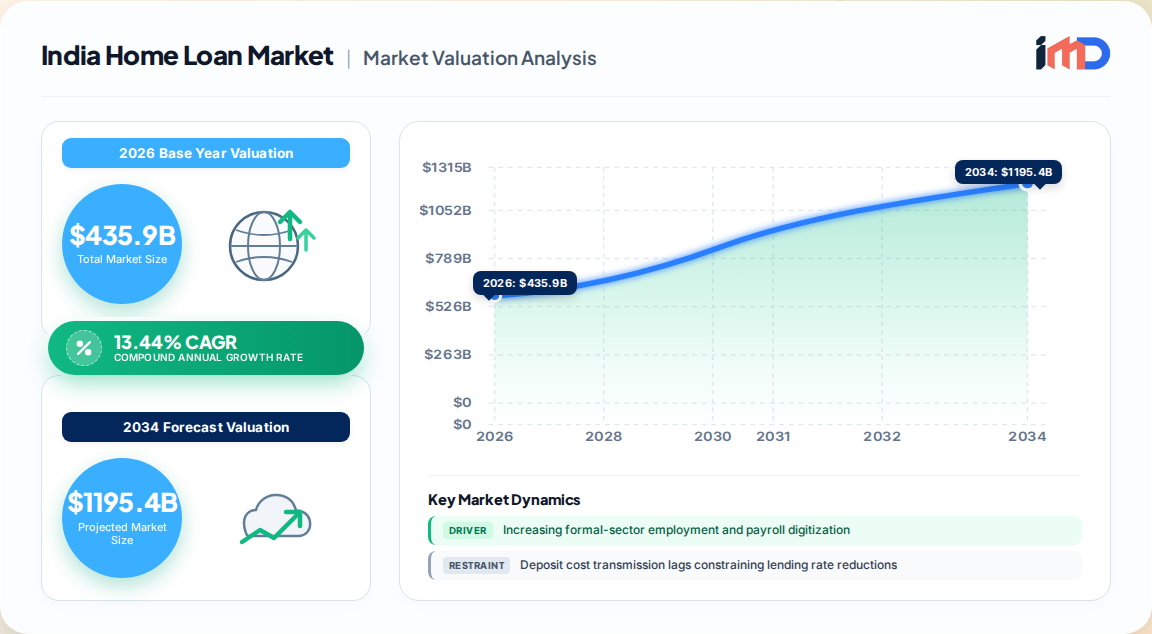
The India home loan market represents one of the most resilient and rapidly expanding segments of the nation's financial services landscape. Our proprietary primary research and expert interviews estimate the market at USD 435.90 billion in 2026, projected to reach USD 809.07 billion by 2031, expanding at a robust 13.44% CAGR during the forecast period. This growth trajectory is underpinned by irreversible urbanization, supportive policy interventions, and a fundamental shift in household aspirations toward homeownership.
The market's structural transformation is evident in the geographic diffusion of demand. While metropolitan centers continue to anchor origination volumes, our analysis reveals accelerated mortgage formation in Tier-2 and Tier-3 cities across Uttar Pradesh, Bihar, Madhya Pradesh, and Rajasthan. This decentralization is supported by improving civic infrastructure under the Smart Cities Mission and AMRUT 2.0, alongside the expansion of employment nodes beyond traditional hubs.
| Market Metric | 2026 Value | 2031 Projection | CAGR (2026-2031) |
|---|---|---|---|
| Market Size (USD Billion) | 435.90 | 809.07 | 13.44% |
| Floating-Rate Share (2025) | 73.37% | Dominant | - |
| Public Sector Bank Share (2025) | 47.33% | Stable | - |
| Salaried Borrower Share (2025) | 67.84% | Declining | - |
| Non-Subsidized Loan Share (2025) | 71.37% | Declining | - |
Monetary conditions have created a favorable credit window. The policy repo rate declined to 5.25% by December 2025, restoring affordability for prime borrowers and enabling public-sector banks to transmit rate cuts efficiently through external benchmark linkages. This environment, coupled with muted retail inflation, has intensified competitive dynamics as private banks and non-banking financial companies (NBFCs) accelerate digital onboarding and algorithmic underwriting to capture market share.
The India home loan market's expansion is propelled by a confluence of demographic, economic, and policy factors. Our impact analysis quantifies the relative contribution of each driver to the forecast CAGR.
Primary Growth Drivers:
Key Restraints:
The India home loan market exhibits distinct segment-level characteristics that inform strategic resource allocation for lenders.
By Loan Type: Floating-rate loans dominated with 73.37% share in 2025, reflecting borrower preference for rate transparency and the transmission benefits of external benchmark linkage. However, fixed-rate products are projected to grow fastest at 17.24% CAGR through 2031, as borrowers seek payment certainty amid evolving rate cycles.
By Provider Type: Public-sector banks held 47.33% share in 2025, leveraging nationwide branch networks, competitive pricing, and deep borrower trust. NBFCs recorded the highest growth trajectory at 18.38% CAGR through 2031, driven by faster turnaround times and deeper penetration into semi-urban markets. Private sector banks maintain a strong position in the salaried prime segment through digital-first propositions.
By Customer Type: Salaried borrowers accounted for 67.84% of market size in 2025, supported by stable income documentation and employer-backed credibility. Self-employed borrowers are projected to grow at 17.38% CAGR through 2031, as underwriting models incorporating cash-flow proxies and digital trails close the rate gap and unlock new originations.
By Interest-Subsidy Participation: Non-subsidized loans held 71.37% share in 2025, while PMAY-CLSS beneficiaries are set to expand at 16.44% CAGR through 2031, reflecting the policy-driven push to deepen affordable housing finance.
| Segment | Leading Category (2025) | Share | Fastest-Growing Category | CAGR to 2031 |
|---|---|---|---|---|
| Loan Type | Floating-Rate | 73.37% | Fixed-Rate | 17.24% |
| Provider Type | Public Sector Banks | 47.33% | NBFCs | 18.38% |
| Customer Type | Salaried | 67.84% | Self-Employed | 17.38% |
| Subsidy Participation | Non-Subsidized | 71.37% | PMAY-CLSS | 16.44% |
North India represents the largest regional market, with a 31.5% share in 2025, anchored by the National Capital Region's robust real estate activity, rising urban populations, and strong banking infrastructure. The region benefits from concentrated employment hubs in Delhi, Gurugram, Noida, and Faridabad, alongside substantial affordable housing supply in peripheral districts.
West India follows with approximately 26.5% share, driven by Maharashtra's industrial and services base, particularly the Mumbai Metropolitan Region and Pune. The region exhibits strong demand for mid-ticket mortgages and has witnessed significant prop-tech-led origination growth.
South India accounts for approximately 24.5% share, with Bengaluru, Hyderabad, and Chennai serving as anchors for salaried professional demand. The region's IT and professional services clusters support stable repayment behavior and lower delinquency rates.
East India holds approximately 17.5% share, with Kolkata and emerging Tier-2 cities in West Bengal, Odisha, and Bihar contributing to growth. The region presents significant white-space opportunities as mortgage penetration remains below national averages.
The India home loan market exhibits moderate concentration, with public-sector banks, private commercial banks, and housing finance companies competing across loan ticket sizes, customer segments, and geographic footprints.
Leading Institutions:
Competitive intensity has escalated as public-sector banks transmit rate cuts through external benchmark linkages while private banks and NBFCs push digital onboarding and underwriting speed. Technology gains from embedded-finance flows and algorithmic credit assessment are pulling new-to-credit and self-employed borrowers into formal mortgages.
The India home loan value chain has been reshaped by digital intermediation and regulatory standardization. Origination now flows through three primary channels: direct branch networks (dominant for public-sector banks), digital platforms (growing rapidly for private banks and NBFCs), and embedded-finance partnerships with prop-tech marketplaces.
Prop-tech integration enables automated valuation tools and bank-grade credit checks, shortening time-to-approval and routing borrowers to the most suitable lender products. Regulators have bolstered safe adoption by requiring digital lending apps to work only with regulated entities and by advancing interoperability for credit portability. These steps improve transparency, contain misconduct risk, and anchor customer trust, supporting sustained digital-led growth.
The distribution landscape is further evolving through the use of satellite-based property-valuation data, which is reducing collateral risk for NBFC pilots in urban clusters. This innovation, combined with cash-flow proxy underwriting, is expanding formal credit access to self-employed and new-to-credit borrowers.
Our analysis identifies several high-potential white spaces for lenders and investors in the India home loan market:
The market's trajectory remains firmly positive, with structural fundamentals and policy support positioning housing finance as one of India's most attractive lending segments through 2031.
| Aspects | Details |
|---|---|
| Study Period | 2020-2034 |
| Base Year | 2026 |
| Estimated Year | 2026 |
| Forecast Period | 2026-2034 |
| Historical Period | 2020-2025 |
| Growth Rate | CAGR of 13.44% from 2020-2034 |
| Segmentation |
|
By Customer Type
By Interest-Subsidy Scheme Participation
| By Geography |
|
The India home loan market is valued at USD 435.90 billion in 2026 and is projected to reach USD 809.07 billion by 2031, growing at a 13.44% CAGR.
Floating-rate home loans led the market with a 73.37% share in 2025, driven by borrower preference for rate transparency and external benchmark-linked transmission. However, fixed-rate products are growing fastest at 17.24% CAGR through 2031.
Key players include HDFC Bank, State Bank of India, ICICI Bank, Axis Bank, LIC Housing Finance, Bajaj Housing Finance, and PNB Housing Finance, competing across public-sector, private-sector, and NBFC segments.
North India represents the largest regional market with a 31.5% share in 2025, anchored by the National Capital Region's robust real estate activity and strong banking infrastructure.
Primary growth drivers include increasing formal-sector employment and payroll digitization (+3.1% CAGR impact), PMAY subsidies extended through 2027 (+3.5% CAGR impact), and accelerated urban migration into Tier-2 and Tier-3 cities (+2.7% CAGR impact).
AI-powered platforms like BASIC Home Loan's HOM-i enable instant credit checks, lender matching, and multilingual guidance, while prop-tech integration and automated valuation tools shorten approval times and improve risk assessment.
Our rigorous research methodology combines multi-layered approaches with comprehensive quality assurance, ensuring precision, accuracy, and reliability in every market analysis.
| Stakeholder Role | Interview Share (%) |
|---|---|
| Chief Retail Banking Officer | 30% |
| Head of Mortgage Underwriting | 28% |
| Product Manager – Home Loans | 24% |
| Risk and Compliance Director | 18% |
| Company Type | Representation (%) |
|---|---|
| Public-Sector Bank Home Loan Divisions | 30% |
| Private-Sector Bank Retail Lending Units | 25% |
| NBFCs and Housing Finance Companies | 20% |
| Prop-Tech and Digital Lending Platforms | 15% |
| Mortgage Guarantee and Securitization Intermediaries | 10% |