Insight Market Data is a premier market research and business consulting firm headquartered in Pune, India, providing syndicated research reports, customized intelligence studies, and strategic advisory services. Renowned academic institutions and Fortune 500 corporations worldwide rely on Insight Market Data's research repository to navigate evolving global and regional business environments. Covering 46 diverse industries across 25 major international economies, our comprehensive database delivers thousands of verified statistics and granular market evaluations. By combining industry-leading analytical methodologies with the direct insights of seasoned industry leaders and subject-matter experts, we deliver actionable intelligence spanning historical performance benchmarks to rigorous multi-year forecasts. We empower organizations to make confident, data-driven decisions across pivotal domains including Machinery & Equipment, Chemicals & Materials, Pharmaceuticals & Healthcare, Food & Beverages, Consumer Goods, Energy & Power, Automotive & Transportation, Electronics & Semiconductors, Medical Devices, Telecommunications, Emerging Technologies, Agriculture, and Packaging. Our multidisciplinary analyst teams provide an objective 360-degree perspective, tailoring every engagement to address complex strategic challenges with exceptional analytical rigor.
Leveraging advanced BI-powered analytics and predictive modeling, Insight Market Data uncovers high-impact market opportunities and competitive differentiators for ambitious enterprises. We continuously refine our research methodologies in accordance with global industry standards, tracking real-time market shifts to ensure our reports are consistently accurate, actionable, and delivered on schedule. Our analysts conduct methodical data validation, rigorous compliance checks, and exhaustive primary and secondary research to maintain the highest levels of data integrity and transparency. We partner closely with corporate strategists, investment groups, and business executives to translate intricate market intelligence into clear, actionable roadmaps for sustainable growth. With operational presence across Washington, USA, and Vimannagar, Pune, India, Insight Market Data ensures direct access to dedicated research specialists and responsive customer support to answer your most strategic questions.
India Health Insurance Market Size, CAGR & Forecast 2034 | Insight Market Data
India Health Insurance Market
Healthcare / MARKET REPORT
India Health Insurance Market | Insight Market Data
India Health Insurance Market by Policy Type (Family Floater & Group Health, Individual Health Insurance, Critical Illness Cover), by Coverage Type (Inpatient Hospitalization, Outpatient & Day-Care), by Demographic (0-18 Years, 19-45 Years, 46-60 Years, ≥61 Years), by Provider Type (Public, Private, Stand-alone Health Insurers), by Distribution Channel (Agents & Brokers, Digital & Online, Bancassurance, Direct), by North India, by West India, by South India, by East India, by Central India Forecast 2026-2034
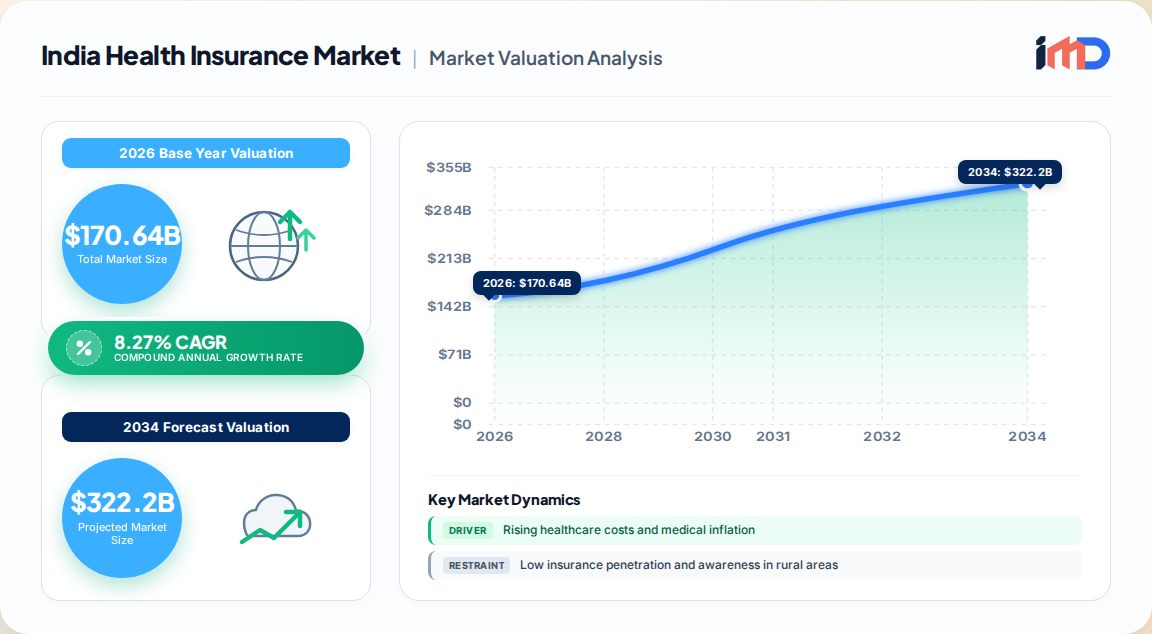
The India health insurance market is undergoing a structural transformation, propelled by post-pandemic health awareness, a rapidly expanding middle class, and aggressive government-led coverage expansion. Our proprietary primary research estimates the market at USD 170.64 Billion in 2026, up from USD 157.62 Billion in 2025, and forecasts it to reach USD 322.10 Billion by 2034, registering a CAGR of 8.27% over the forecast period.
India Health Insurance Market Market Size (In Billion)
300.0B
200.0B
100.0B
0
157.6 B
2025
170.6 B
2026
184.8 B
2027
200.0 B
2028
216.6 B
2029
234.5 B
2030
253.9 B
2031
This growth is underpinned by rising healthcare utilization, regulatory simplifications, and digitized workflows that enhance accessibility across demographics. Private-sector innovation and expanded distribution channels are intensifying competition and boosting insurance penetration in urban and semi-urban areas. Initiatives such as the National Health Claims Exchange (NHCX) and Ayushman Bharat Health Account (ABHA) are improving transparency, reducing turnaround times, and fostering interoperability between hospitals and insurers.
Market Size (2026): USD 170.64 Billion
Forecast Market Size (2034): USD 322.10 Billion
CAGR (2026-2034): 8.27%
Largest Region: North India (29.0% share, 2025)
Fastest Growing Region: South India
Leading Provider Segment: Private Providers (63%, 2025)
Market Drivers and Restraints
Key Growth Drivers
Rising Healthcare Costs and Medical Inflation: Medical inflation and rising specialization in tertiary care have increased the financial burden on households, strengthening the role of indemnity health insurance as a risk management tool. Urban and peri-urban consumers are responding by selecting higher sum-insured slabs and renewing coverage consistently. This driver contributes approximately +2.1% to the CAGR.
Government Programmes and Tax Incentives: Ayushman Bharat PM-JAY has scaled hospital coverage for eligible families, covering over 500 million beneficiaries. Regulatory reforms have eased age restrictions and streamlined pre-existing disease waiting periods. GST relief on select retail health policies has reduced the all-in cost of coverage. This driver adds about +1.8% to the CAGR.
Growing Middle-Class Income and Health-Risk Awareness: Income growth and urbanization are changing purchase behavior as households prioritize financial protection for health risks. Awareness of preventive check-ups is rising, supporting long-term market expansion ( +1.5% CAGR impact).
Digital Distribution Platforms Expanding Reach: InsurTech platforms such as Policybazaar, Acko, and Go Digit are driving online policy adoption, improving accessibility and customer experience, particularly in tier-2 and tier-3 cities ( +1.3% CAGR impact).
Uptake of OPD and Wellness Add-ons: Demand for outpatient and wellness benefits is increasing retention and expanding coverage beyond hospitalization ( +0.8% CAGR impact).
Key Restraints
Low Insurance Penetration and Awareness in Rural Areas: Health insurance penetration remains below 1% of GDP, significantly lower than global averages. Rural areas face limited awareness, affordability constraints, and access barriers, hindering broader market penetration.
High Premium Costs for Senior Citizen and Critical Illness Plans: Premiums for senior citizen health insurance have risen sharply due to higher claim ratios and medical inflation, limiting affordability for elderly populations.
Complex Claim Settlement Processes: Despite improvements, issues such as exclusions, sub-limits, and co-payments continue to affect customer experience and trust, creating friction in the claims process.
Segmentation Analysis
The India health insurance market is segmented by policy type, coverage type, demographic age group, provider type, and distribution channel.
By Policy Type
Family Floater and Group Health: Led the market with 43.63% share in 2025. This segment benefits from employer-sponsored group policies and family-centric products.
Critical Illness Cover: Projected to expand at a 17.50% CAGR through 2031, driven by rising incidence of lifestyle-related ailments.
Individual Health Insurance: Remains a significant segment, particularly among first-time buyers and young professionals.
By Coverage Type
Inpatient Hospitalization: Accounted for 58.12% of market share in 2025, reflecting the core indemnity nature of health insurance in India.
Outpatient and Day-Care Coverage: Projected to record an 18.34% CAGR through 2031, as consumers seek comprehensive coverage beyond hospitalization.
By Demographic Age Group
19-45 Years Cohort: Held 35.67% market share in 2025, driven by working-age adults prioritizing health protection.
≥61 Years Cohort: Projected to grow at a 15.70% CAGR through 2031, fueled by rising longevity and age-related health risks.
By Provider Type
Private-Sector Insurers: Dominated with 54.35% market share in 2025, supported by superior hospital tie-ups and tech-enabled platforms. Private providers overall hold 63% share.
Stand-alone Health Insurers: Projected to grow at a 17.32% CAGR through 2031, exemplified by Star Health and Allied Insurance reporting gross written premium over INR 15,000 Crore in FY2024.
By Distribution Channel
Agents and Brokers: Held 49.18% of market size in 2025, remaining the primary distribution channel.
Digital and Online Channels: Projected to post a 22.34% CAGR through 2031, driven by InsurTech platforms and direct-to-consumer models.
Regional Outlook
North India leads the India health insurance market with 29.0% revenue share in 2025, driven by strong corporate group health adoption in Delhi-NCR and large-scale state-backed insurance schemes in populous states like Uttar Pradesh. West India follows with 28.12% share, supported by high policy adoption in Maharashtra and Gujarat.
India Health Insurance Market Regional Market Share
Loading chart...
South India is the fastest-growing region, projected to grow at a 12.56% CAGR through 2031, fueled by rising healthcare costs in cities like Bengaluru and Chennai, expanding private healthcare infrastructure, and InsurTech expansion. East India and Central India are emerging markets with significant untapped potential, particularly in tier-2 and tier-3 cities.
Region
Market Share (2025)
Growth Outlook (CAGR)
North India
29.0%
Moderate (8.0-9.0%)
West India
28.12%
Moderate (8.0-9.0%)
South India
24.0%
Fast (12.56%)
East India
12.0%
Emerging (10.0-11.0%)
Central India
7.0%
Emerging (9.0-10.0%)
Competitive Landscape
The India health insurance market is moderately concentrated, with a mix of public and private insurers. Private insurers hold 63% market share, while public providers account for 37%. Key players include Star Health and Allied Insurance, HDFC ERGO, Niva Bupa, Care Health Insurance, and New India Assurance. Star Health, the largest standalone health insurer, reported gross written premium exceeding INR 15,000 Crore in FY2024.
Recent strategic developments include:
May 2025: PB Healthcare Services, a subsidiary of PB Fintech, secured USD 218 million in seed funding to establish a 1,000-bed hospital network in Delhi-NCR and integrate care delivery with insurance services.
September 2025: GST relief on select retail health policies implemented, reducing premium costs for households.
2023: IRDAI removed the age cap of 65 years for purchasing health insurance policies and mandated coverage for individuals with severe medical conditions.
Expansion of NHCX: The National Health Claims Exchange is enabling standardized claims processing and faster adjudication.
Value Chain and Distribution Dynamics
The health insurance value chain in India encompasses insurers, TPAs (Third-Party Administrators), hospital networks, brokers, agents, bancassurance partners, and InsurTech platforms. The ecosystem is regulated by the Insurance Regulatory and Development Authority of India (IRDAI).
Key trends reshaping the value chain include:
Digital Integration: API-driven issuance models are streamlining processes, reducing manual inputs, and enhancing distribution efficiency. Digital channels currently contribute a growing share of new policies and are projected to grow at a 22.34% CAGR through 2031.
Claims Automation: AI-driven underwriting and claims automation are reducing turnaround times and improving customer experience. The NHCX platform is facilitating interoperability between hospitals and insurers.
Strategic Investments: Large-scale investments, such as PB Healthcare's USD 218 million funding, are integrating care delivery with insurance, aiming to eliminate pre-authorizations and simplify claims.
Strategic White-Space and Investment Opportunities
Significant white-space opportunities exist in tier-2 and tier-3 cities, where insurance penetration remains low but digital adoption is rising. The senior citizen segment presents high-growth potential, with the ≥61 years cohort projected to grow at a 15.70% CAGR. Additionally, micro-insurance and customized products for rural populations offer untapped potential.
Investment in InsurTech and digital infrastructure is expected to accelerate, supported by regulatory reforms and a favorable FDI environment. The integration of healthcare delivery and insurance through strategic investments, such as PB Healthcare's hospital network, signals a trend toward end-to-end health ecosystems.
The market is positioned for sustained growth, driven by rising medical costs, digitized service delivery, and government initiatives aimed at expanding coverage. Stakeholders across the value chain must focus on innovation, customer-centricity, and operational efficiency to capture emerging opportunities.
India Health Insurance Market Regional Market Share
Higher Coverage
Lower Coverage
No Coverage
India Health Insurance Market REPORT HIGHLIGHTS
Aspects
Details
Study Period
2020-2034
Base Year
2026
Estimated Year
2026
Forecast Period
2026-2034
Historical Period
2020-2025
Growth Rate
CAGR of 8.27% from 2020-2034
Segmentation
By Policy Type
Family Floater & Group Health
Individual Health Insurance
Critical Illness Cover
By Coverage Type
Table of Contents
1. India Health Insurance Market Introduction
1.1. Research Scope
1.2. Market Segmentation
1.3. Research Objective
1.4. Definitions and Assumptions
2. India Health Insurance Market Executive Summary
2.1. Market Snapshot
3. India Health Insurance Market Dynamics
3.1. Market Drivers
3.1.1. Rising healthcare costs and medical inflation
3.1.2. Government programmes and tax incentives (Ayushman Bharat, GST relief)
3.1.3. Growing middle-class income and health-risk awareness
3.1.4. Digital distribution platforms expanding reach
3.2. Market Trends
3.2.1. AI-driven underwriting and claims automation
3.2.2. Integration of healthcare delivery and insurance through strategic investments
3.2.3. Expansion of OPD and wellness add-ons
3.2.4. Wearable-driven dynamic pricing by insurtechs
3.3. Market Restraints
3.3.1. Low insurance penetration and awareness in rural areas
3.3.2. High premium costs for senior citizen and critical illness plans
3.3.3. Complex claim settlement processes
3.4. Market Challenges
3.4.1. Low insurance penetration below 1% of GDP
3.4.2. Affordability constraints in rural and senior segments
Inpatient Hospitalization
Outpatient & Day-Care
By Demographic
0-18 Years
19-45 Years
46-60 Years
≥61 Years
By Provider Type
Public
Private
Stand-alone Health Insurers
By Distribution Channel
Agents & Brokers
Digital & Online
Bancassurance
Direct
By Geography
North India
West India
South India
East India
Central India
3.4.3. Fraud and claims leakage in health insurance
4. India Health Insurance Market Factor Analysis
4.1. Porters Five Forces
4.1.1. Bargaining Power of Suppliers
4.1.2. Bargaining Power of Buyers
4.1.3. Threat of New Entrants
4.1.4. Threat of Substitutes
4.1.5. Competitive Rivalry
4.2. PESTEL analysis
4.3. BCG Analysis
4.3.1. Stars (High Growth, High Market Share)
4.3.2. Cash Cows (Low Growth, High Market Share)
4.3.3. Question Mark (High Growth, Low Market Share)
4.3.4. Dogs (Low Growth, Low Market Share)
4.4. Ansoff Matrix Analysis
4.5. Supply Chain Analysis
4.6. Regulatory Landscape
4.7. Current Market Potential and Opportunity Assessment (TAM–SAM–SOM Framework)
4.8. IMD Analyst Note
5. India Health Insurance Market Analysis, Insights and Forecast, 2020-2034
5.1. Analysis, Insights and Forecast - by Policy Type
5.1.1. Family Floater & Group Health
5.1.2. Individual Health Insurance
5.1.3. Critical Illness Cover
5.2. Analysis, Insights and Forecast - by Coverage Type
5.2.1. Inpatient Hospitalization
5.2.2. Outpatient & Day-Care
5.3. Analysis, Insights and Forecast - by Demographic
5.3.1. 0-18 Years
5.3.2. 19-45 Years
5.3.3. 46-60 Years
5.3.4. ≥61 Years
5.4. Analysis, Insights and Forecast - by Provider Type
5.4.1. Public
5.4.2. Private
5.4.3. Stand-alone Health Insurers
5.5. Analysis, Insights and Forecast - by Distribution Channel
5.5.1. Agents & Brokers
5.5.2. Digital & Online
5.5.3. Bancassurance
5.5.4. Direct
5.6. Analysis, Insights and Forecast - by Region
5.6.1. North India
5.6.2. West India
5.6.3. South India
5.6.4. East India
5.6.5. Central India
6. India Health Insurance Market North India Analysis, Insights and Forecast, 2020-2034
6.1. Analysis, Insights and Forecast - by Policy Type
6.1.1. Family Floater & Group Health
6.1.2. Individual Health Insurance
6.1.3. Critical Illness Cover
6.2. Analysis, Insights and Forecast - by Coverage Type
6.2.1. Inpatient Hospitalization
6.2.2. Outpatient & Day-Care
6.3. Analysis, Insights and Forecast - by Demographic
6.3.1. 0-18 Years
6.3.2. 19-45 Years
6.3.3. 46-60 Years
6.3.4. ≥61 Years
6.4. Analysis, Insights and Forecast - by Provider Type
6.4.1. Public
6.4.2. Private
6.4.3. Stand-alone Health Insurers
6.5. Analysis, Insights and Forecast - by Distribution Channel
6.5.1. Agents & Brokers
6.5.2. Digital & Online
6.5.3. Bancassurance
6.5.4. Direct
7. India Health Insurance Market West India Analysis, Insights and Forecast, 2020-2034
7.1. Analysis, Insights and Forecast - by Policy Type
7.1.1. Family Floater & Group Health
7.1.2. Individual Health Insurance
7.1.3. Critical Illness Cover
7.2. Analysis, Insights and Forecast - by Coverage Type
7.2.1. Inpatient Hospitalization
7.2.2. Outpatient & Day-Care
7.3. Analysis, Insights and Forecast - by Demographic
7.3.1. 0-18 Years
7.3.2. 19-45 Years
7.3.3. 46-60 Years
7.3.4. ≥61 Years
7.4. Analysis, Insights and Forecast - by Provider Type
7.4.1. Public
7.4.2. Private
7.4.3. Stand-alone Health Insurers
7.5. Analysis, Insights and Forecast - by Distribution Channel
7.5.1. Agents & Brokers
7.5.2. Digital & Online
7.5.3. Bancassurance
7.5.4. Direct
8. India Health Insurance Market South India Analysis, Insights and Forecast, 2020-2034
8.1. Analysis, Insights and Forecast - by Policy Type
8.1.1. Family Floater & Group Health
8.1.2. Individual Health Insurance
8.1.3. Critical Illness Cover
8.2. Analysis, Insights and Forecast - by Coverage Type
8.2.1. Inpatient Hospitalization
8.2.2. Outpatient & Day-Care
8.3. Analysis, Insights and Forecast - by Demographic
8.3.1. 0-18 Years
8.3.2. 19-45 Years
8.3.3. 46-60 Years
8.3.4. ≥61 Years
8.4. Analysis, Insights and Forecast - by Provider Type
8.4.1. Public
8.4.2. Private
8.4.3. Stand-alone Health Insurers
8.5. Analysis, Insights and Forecast - by Distribution Channel
8.5.1. Agents & Brokers
8.5.2. Digital & Online
8.5.3. Bancassurance
8.5.4. Direct
9. India Health Insurance Market East India Analysis, Insights and Forecast, 2020-2034
9.1. Analysis, Insights and Forecast - by Policy Type
9.1.1. Family Floater & Group Health
9.1.2. Individual Health Insurance
9.1.3. Critical Illness Cover
9.2. Analysis, Insights and Forecast - by Coverage Type
9.2.1. Inpatient Hospitalization
9.2.2. Outpatient & Day-Care
9.3. Analysis, Insights and Forecast - by Demographic
9.3.1. 0-18 Years
9.3.2. 19-45 Years
9.3.3. 46-60 Years
9.3.4. ≥61 Years
9.4. Analysis, Insights and Forecast - by Provider Type
9.4.1. Public
9.4.2. Private
9.4.3. Stand-alone Health Insurers
9.5. Analysis, Insights and Forecast - by Distribution Channel
9.5.1. Agents & Brokers
9.5.2. Digital & Online
9.5.3. Bancassurance
9.5.4. Direct
10. India Health Insurance Market Central India Analysis, Insights and Forecast, 2020-2034
10.1. Analysis, Insights and Forecast - by Policy Type
10.1.1. Family Floater & Group Health
10.1.2. Individual Health Insurance
10.1.3. Critical Illness Cover
10.2. Analysis, Insights and Forecast - by Coverage Type
10.2.1. Inpatient Hospitalization
10.2.2. Outpatient & Day-Care
10.3. Analysis, Insights and Forecast - by Demographic
10.3.1. 0-18 Years
10.3.2. 19-45 Years
10.3.3. 46-60 Years
10.3.4. ≥61 Years
10.4. Analysis, Insights and Forecast - by Provider Type
10.4.1. Public
10.4.2. Private
10.4.3. Stand-alone Health Insurers
10.5. Analysis, Insights and Forecast - by Distribution Channel
10.5.1. Agents & Brokers
10.5.2. Digital & Online
10.5.3. Bancassurance
10.5.4. Direct
11. India Health Insurance Market Competitive Analysis
11.1. Company Profiles
11.1.1. Star Health and Allied Insurance
11.1.1.1. Company Overview
11.1.1.2. Products
11.1.1.3. Company Financials
11.1.1.4. SWOT Analysis
11.1.2. HDFC ERGO
11.1.2.1. Company Overview
11.1.2.2. Products
11.1.2.3. Company Financials
11.1.2.4. SWOT Analysis
11.1.3. Niva Bupa
11.1.3.1. Company Overview
11.1.3.2. Products
11.1.3.3. Company Financials
11.1.3.4. SWOT Analysis
11.1.4. Care Health Insurance
11.1.4.1. Company Overview
11.1.4.2. Products
11.1.4.3. Company Financials
11.1.4.4. SWOT Analysis
11.1.5. New India Assurance
11.1.5.1. Company Overview
11.1.5.2. Products
11.1.5.3. Company Financials
11.1.5.4. SWOT Analysis
11.1.6. ICICI Lombard General Insurance
11.1.6.1. Company Overview
11.1.6.2. Products
11.1.6.3. Company Financials
11.1.6.4. SWOT Analysis
11.1.7. Oriental Insurance
11.1.7.1. Company Overview
11.1.7.2. Products
11.1.7.3. Company Financials
11.1.7.4. SWOT Analysis
11.1.8. Acko
11.1.8.1. Company Overview
11.1.8.2. Products
11.1.8.3. Company Financials
11.1.8.4. SWOT Analysis
11.1.9. Go Digit General Insurance
11.1.9.1. Company Overview
11.1.9.2. Products
11.1.9.3. Company Financials
11.1.9.4. SWOT Analysis
11.1.10. Policybazaar
11.1.10.1. Company Overview
11.1.10.2. Products
11.1.10.3. Company Financials
11.1.10.4. SWOT Analysis
11.2. Market Entropy
11.2.1. Company's Key Areas Served
11.2.2. Recent Developments
11.3. Company Market Share Analysis, 2026
11.3.1. Top 5 Companies Market Share Analysis
11.3.2. Top 3 Companies Market Share Analysis
11.4. List of Potential Customers
List of Figures
Figure 1: Global India Health Insurance Market Revenue Breakdown (Billion, %) by Region 2026 & 2034
Figure 2: North India India Health Insurance Market Revenue (Billion), by Policy Type 2026 & 2034
Figure 3: North India India Health Insurance Market Revenue Share (%), by Policy Type 2026 & 2034
Figure 4: North India India Health Insurance Market Revenue (Billion), by Coverage Type 2026 & 2034
Figure 5: North India India Health Insurance Market Revenue Share (%), by Coverage Type 2026 & 2034
Figure 6: North India India Health Insurance Market Revenue (Billion), by Demographic 2026 & 2034
Figure 7: North India India Health Insurance Market Revenue Share (%), by Demographic 2026 & 2034
Figure 8: North India India Health Insurance Market Revenue (Billion), by Provider Type 2026 & 2034
Figure 9: North India India Health Insurance Market Revenue Share (%), by Provider Type 2026 & 2034
Figure 10: North India India Health Insurance Market Revenue (Billion), by Distribution Channel 2026 & 2034
Figure 11: North India India Health Insurance Market Revenue Share (%), by Distribution Channel 2026 & 2034
Figure 12: North India India Health Insurance Market Revenue (Billion), by Country 2026 & 2034
Figure 13: North India India Health Insurance Market Revenue Share (%), by Country 2026 & 2034
Figure 14: West India India Health Insurance Market Revenue (Billion), by Policy Type 2026 & 2034
Figure 15: West India India Health Insurance Market Revenue Share (%), by Policy Type 2026 & 2034
Figure 16: West India India Health Insurance Market Revenue (Billion), by Coverage Type 2026 & 2034
Figure 17: West India India Health Insurance Market Revenue Share (%), by Coverage Type 2026 & 2034
Figure 18: West India India Health Insurance Market Revenue (Billion), by Demographic 2026 & 2034
Figure 19: West India India Health Insurance Market Revenue Share (%), by Demographic 2026 & 2034
Figure 20: West India India Health Insurance Market Revenue (Billion), by Provider Type 2026 & 2034
Figure 21: West India India Health Insurance Market Revenue Share (%), by Provider Type 2026 & 2034
Figure 22: West India India Health Insurance Market Revenue (Billion), by Distribution Channel 2026 & 2034
Figure 23: West India India Health Insurance Market Revenue Share (%), by Distribution Channel 2026 & 2034
Figure 24: West India India Health Insurance Market Revenue (Billion), by Country 2026 & 2034
Figure 25: West India India Health Insurance Market Revenue Share (%), by Country 2026 & 2034
Figure 26: South India India Health Insurance Market Revenue (Billion), by Policy Type 2026 & 2034
Figure 27: South India India Health Insurance Market Revenue Share (%), by Policy Type 2026 & 2034
Figure 28: South India India Health Insurance Market Revenue (Billion), by Coverage Type 2026 & 2034
Figure 29: South India India Health Insurance Market Revenue Share (%), by Coverage Type 2026 & 2034
Figure 30: South India India Health Insurance Market Revenue (Billion), by Demographic 2026 & 2034
Figure 31: South India India Health Insurance Market Revenue Share (%), by Demographic 2026 & 2034
Figure 32: South India India Health Insurance Market Revenue (Billion), by Provider Type 2026 & 2034
Figure 33: South India India Health Insurance Market Revenue Share (%), by Provider Type 2026 & 2034
Figure 34: South India India Health Insurance Market Revenue (Billion), by Distribution Channel 2026 & 2034
Figure 35: South India India Health Insurance Market Revenue Share (%), by Distribution Channel 2026 & 2034
Figure 36: South India India Health Insurance Market Revenue (Billion), by Country 2026 & 2034
Figure 37: South India India Health Insurance Market Revenue Share (%), by Country 2026 & 2034
Figure 38: East India India Health Insurance Market Revenue (Billion), by Policy Type 2026 & 2034
Figure 39: East India India Health Insurance Market Revenue Share (%), by Policy Type 2026 & 2034
Figure 40: East India India Health Insurance Market Revenue (Billion), by Coverage Type 2026 & 2034
Figure 41: East India India Health Insurance Market Revenue Share (%), by Coverage Type 2026 & 2034
Figure 42: East India India Health Insurance Market Revenue (Billion), by Demographic 2026 & 2034
Figure 43: East India India Health Insurance Market Revenue Share (%), by Demographic 2026 & 2034
Figure 44: East India India Health Insurance Market Revenue (Billion), by Provider Type 2026 & 2034
Figure 45: East India India Health Insurance Market Revenue Share (%), by Provider Type 2026 & 2034
Figure 46: East India India Health Insurance Market Revenue (Billion), by Distribution Channel 2026 & 2034
Figure 47: East India India Health Insurance Market Revenue Share (%), by Distribution Channel 2026 & 2034
Figure 48: East India India Health Insurance Market Revenue (Billion), by Country 2026 & 2034
Figure 49: East India India Health Insurance Market Revenue Share (%), by Country 2026 & 2034
Figure 50: Central India India Health Insurance Market Revenue (Billion), by Policy Type 2026 & 2034
Figure 51: Central India India Health Insurance Market Revenue Share (%), by Policy Type 2026 & 2034
Figure 52: Central India India Health Insurance Market Revenue (Billion), by Coverage Type 2026 & 2034
Figure 53: Central India India Health Insurance Market Revenue Share (%), by Coverage Type 2026 & 2034
Figure 54: Central India India Health Insurance Market Revenue (Billion), by Demographic 2026 & 2034
Figure 55: Central India India Health Insurance Market Revenue Share (%), by Demographic 2026 & 2034
Figure 56: Central India India Health Insurance Market Revenue (Billion), by Provider Type 2026 & 2034
Figure 57: Central India India Health Insurance Market Revenue Share (%), by Provider Type 2026 & 2034
Figure 58: Central India India Health Insurance Market Revenue (Billion), by Distribution Channel 2026 & 2034
Figure 59: Central India India Health Insurance Market Revenue Share (%), by Distribution Channel 2026 & 2034
Figure 60: Central India India Health Insurance Market Revenue (Billion), by Country 2026 & 2034
Figure 61: Central India India Health Insurance Market Revenue Share (%), by Country 2026 & 2034
List of Tables
Table 1: Global India Health Insurance Market Revenue Billion Forecast, by Policy Type 2020 & 2034
Table 2: Global India Health Insurance Market Revenue Billion Forecast, by Coverage Type 2020 & 2034
Table 3: Global India Health Insurance Market Revenue Billion Forecast, by Demographic 2020 & 2034
Table 4: Global India Health Insurance Market Revenue Billion Forecast, by Provider Type 2020 & 2034
Table 5: Global India Health Insurance Market Revenue Billion Forecast, by Distribution Channel 2020 & 2034
Table 6: Global India Health Insurance Market Revenue Billion Forecast, by Region 2020 & 2034
Table 7: North India India Health Insurance Market Revenue Billion Forecast, by Policy Type 2020 & 2034
Table 8: North India India Health Insurance Market Revenue Billion Forecast, by Coverage Type 2020 & 2034
Table 9: North India India Health Insurance Market Revenue Billion Forecast, by Demographic 2020 & 2034
Table 10: North India India Health Insurance Market Revenue Billion Forecast, by Provider Type 2020 & 2034
Table 11: North India India Health Insurance Market Revenue Billion Forecast, by Distribution Channel 2020 & 2034
Table 12: North India India Health Insurance Market Revenue Billion Forecast, by Country 2020 & 2034
Table 13: West India India Health Insurance Market Revenue Billion Forecast, by Policy Type 2020 & 2034
Table 14: West India India Health Insurance Market Revenue Billion Forecast, by Coverage Type 2020 & 2034
Table 15: West India India Health Insurance Market Revenue Billion Forecast, by Demographic 2020 & 2034
Table 16: West India India Health Insurance Market Revenue Billion Forecast, by Provider Type 2020 & 2034
Table 17: West India India Health Insurance Market Revenue Billion Forecast, by Distribution Channel 2020 & 2034
Table 18: West India India Health Insurance Market Revenue Billion Forecast, by Country 2020 & 2034
Table 19: South India India Health Insurance Market Revenue Billion Forecast, by Policy Type 2020 & 2034
Table 20: South India India Health Insurance Market Revenue Billion Forecast, by Coverage Type 2020 & 2034
Table 21: South India India Health Insurance Market Revenue Billion Forecast, by Demographic 2020 & 2034
Table 22: South India India Health Insurance Market Revenue Billion Forecast, by Provider Type 2020 & 2034
Table 23: South India India Health Insurance Market Revenue Billion Forecast, by Distribution Channel 2020 & 2034
Table 24: South India India Health Insurance Market Revenue Billion Forecast, by Country 2020 & 2034
Table 25: East India India Health Insurance Market Revenue Billion Forecast, by Policy Type 2020 & 2034
Table 26: East India India Health Insurance Market Revenue Billion Forecast, by Coverage Type 2020 & 2034
Table 27: East India India Health Insurance Market Revenue Billion Forecast, by Demographic 2020 & 2034
Table 28: East India India Health Insurance Market Revenue Billion Forecast, by Provider Type 2020 & 2034
Table 29: East India India Health Insurance Market Revenue Billion Forecast, by Distribution Channel 2020 & 2034
Table 30: East India India Health Insurance Market Revenue Billion Forecast, by Country 2020 & 2034
Table 31: Central India India Health Insurance Market Revenue Billion Forecast, by Policy Type 2020 & 2034
Table 32: Central India India Health Insurance Market Revenue Billion Forecast, by Coverage Type 2020 & 2034
Table 33: Central India India Health Insurance Market Revenue Billion Forecast, by Demographic 2020 & 2034
Table 34: Central India India Health Insurance Market Revenue Billion Forecast, by Provider Type 2020 & 2034
Table 35: Central India India Health Insurance Market Revenue Billion Forecast, by Distribution Channel 2020 & 2034
Table 36: Central India India Health Insurance Market Revenue Billion Forecast, by Country 2020 & 2034
Frequently Asked Questions
1What is the size of the India health insurance market in 2026?
The India health insurance market is estimated at USD 170.64 Billion in 2026, growing from USD 157.62 Billion in 2025. It is projected to reach USD 322.10 Billion by 2034 at a CAGR of 8.27%.
2Which region dominates the India health insurance market?
North India holds the largest market share at 29.0% in 2025, driven by strong corporate group health adoption in Delhi-NCR and state-backed schemes in Uttar Pradesh. South India is the fastest-growing region with a projected CAGR of 12.56%.
3What are the key drivers of the India health insurance market?
Key drivers include rising healthcare costs, government initiatives like Ayushman Bharat PM-JAY covering over 500 million beneficiaries, growing middle-class income and health awareness, and digital distribution platforms expanding reach.
4Which provider segment leads the India health insurance market?
Private providers dominate with a 63% market share in 2025, supported by superior hospital tie-ups, cashless claim networks exceeding 10,000 hospitals, and tech-enabled policy management. Public providers hold 37% share.
5What is the role of IRDAI in the India health insurance market?
IRDAI regulates the insurance sector, and has implemented reforms such as removing the age cap for purchasing health insurance, mandating coverage for severe medical conditions, and setting service-level standards for cashless approvals.
Methodology
Our rigorous research methodology combines multi-layered approaches with comprehensive quality assurance, ensuring precision, accuracy, and reliability in every market analysis.
Primary Research
Our proprietary research relies on a 70-80% primary research split, conducting in-depth interviews with senior executives across the health insurance value chain, including insurers, TPAs, hospital administrators, and InsurTech founders.
We interview 4-5 specific company types: private health insurers, standalone health insurers, third-party administrators (TPAs), hospital network managers, and digital distribution platforms.
3-4 specific stakeholder job titles include Chief Underwriting Officer, Head of Claims, Director of Distribution, and Chief Technology Officer.
Primary research is supplemented by surveys of corporate benefits managers and retail policyholders to capture demand-side dynamics.
Key Stakeholders Interviewed
Key Stakeholders Interviewed
Stakeholder Role
Interview Share (%)
Chief Underwriting Officer
30%
Head of Claims
25%
Director of Distribution
25%
Chief Technology Officer
20%
Industry Ecosystem Breakdown
Industry Ecosystem Breakdown
Company Type
Representation (%)
Private Health Insurers
35%
Standalone Health Insurers
20%
Third-Party Administrators (TPAs)
15%
Hospital Network Managers
15%
Digital Distribution Platforms
15%
Secondary Research & Industry Benchmarking
20-30% secondary research draws from official regulatory filings, annual reports, and data from the Insurance Regulatory and Development Authority of India (IRDAI), National Health Authority (NHA), and Ministry of Health and Family Welfare.
We benchmark against official multilateral sources such as the World Bank, OECD, and WHO health expenditure databases, as well as recognized non-profit trade associations like the Insurance Institute of India.
Financial databases utilized include Bloomberg, Factiva, Hoovers, and PitchBook for company-level financial analysis and investment tracking.
We monitor regulatory changes via IRDAI and NHA official portals, and cross-reference with World Bank health financing data.
Demand Modeling & Market Estimation
We employ both top-down and bottom-up methodologies simultaneously, validated via multi-level data triangulation. Top-down estimation uses gross written premium (GWP) data from IRDAI and industry aggregates, while bottom-up modeling builds from policy-level premiums, sum-insured distributions, and customer segmentation.
3-4 specific quantitative metrics used in bottom-up calculation include: number of active policies by segment, average premium per policy, claims ratio by provider type, and sum-insured per household.
Demand modeling incorporates macroeconomic variables (GDP per capita, medical inflation, urbanization rates) and micro-level adoption patterns from primary surveys.
We forecast using time-series models and scenario analysis, adjusting for regulatory changes, digital penetration, and competitive dynamics.
Guaranteed estimated data accuracy level of 85-90%, achieved through rigorous validation and triangulation.
Data Accuracy & Quality Check
All data undergoes a multi-stage quality check: initial primary research validation, cross-verification with secondary sources, and final expert review by our senior analyst panel.
We ensure 85-90% data accuracy by triangulating findings from at least three independent sources for each key metric.
Every report is updated to the date of purchase, incorporating the latest regulatory changes and market developments.
Client feedback and post-publication reviews are integrated to continuously refine our estimation framework.
India EHR market at USD 726.1 Million in 2025, growing at 8.01% CAGR to reach USD 1,483.4 Million by 2034. Explore ABDM-driven adoption, cloud EHR trends & vendors.
The blood temperature indicator market is valued at USD 277.1 million in 2026 and is projected to reach USD 418.1 million by 2036, growing at a CAGR of 4.2%.
Nov 2026|187 pages
$2900.00
The global intracardiac echocardiography market is valued at USD 396.2 million in 2024, growing at a 4.9% CAGR to reach USD 639.2 million by 2034.
Nov 2026|239 pages
$2900.00
OSA treatment market to grow at 15.56% CAGR, reaching $4.74B by 2036 from $923.7M in 2025, driven by GLP-1 therapies and device innovation.
Nov 2026|263 pages
$2900.00
The Clinical Trial Management System market is valued at USD 2.52 Billion in 2025 and is projected to reach USD 8.34 Billion by 2035, growing at a 12.7% CAGR.