Insight Market Data is a premier market research and business consulting firm headquartered in Pune, India, providing syndicated research reports, customized intelligence studies, and strategic advisory services. Renowned academic institutions and Fortune 500 corporations worldwide rely on Insight Market Data's research repository to navigate evolving global and regional business environments. Covering 46 diverse industries across 25 major international economies, our comprehensive database delivers thousands of verified statistics and granular market evaluations. By combining industry-leading analytical methodologies with the direct insights of seasoned industry leaders and subject-matter experts, we deliver actionable intelligence spanning historical performance benchmarks to rigorous multi-year forecasts. We empower organizations to make confident, data-driven decisions across pivotal domains including Machinery & Equipment, Chemicals & Materials, Pharmaceuticals & Healthcare, Food & Beverages, Consumer Goods, Energy & Power, Automotive & Transportation, Electronics & Semiconductors, Medical Devices, Telecommunications, Emerging Technologies, Agriculture, and Packaging. Our multidisciplinary analyst teams provide an objective 360-degree perspective, tailoring every engagement to address complex strategic challenges with exceptional analytical rigor.
Leveraging advanced BI-powered analytics and predictive modeling, Insight Market Data uncovers high-impact market opportunities and competitive differentiators for ambitious enterprises. We continuously refine our research methodologies in accordance with global industry standards, tracking real-time market shifts to ensure our reports are consistently accurate, actionable, and delivered on schedule. Our analysts conduct methodical data validation, rigorous compliance checks, and exhaustive primary and secondary research to maintain the highest levels of data integrity and transparency. We partner closely with corporate strategists, investment groups, and business executives to translate intricate market intelligence into clear, actionable roadmaps for sustainable growth. With operational presence across Washington, USA, and Vimannagar, Pune, India, Insight Market Data ensures direct access to dedicated research specialists and responsive customer support to answer your most strategic questions.
Independent Intelligence for decisions that move markets
India Coffee Retail Chains Market Size, Growth & Forecast 2025-2034
Executive Overview: India Coffee Retail Chains Market
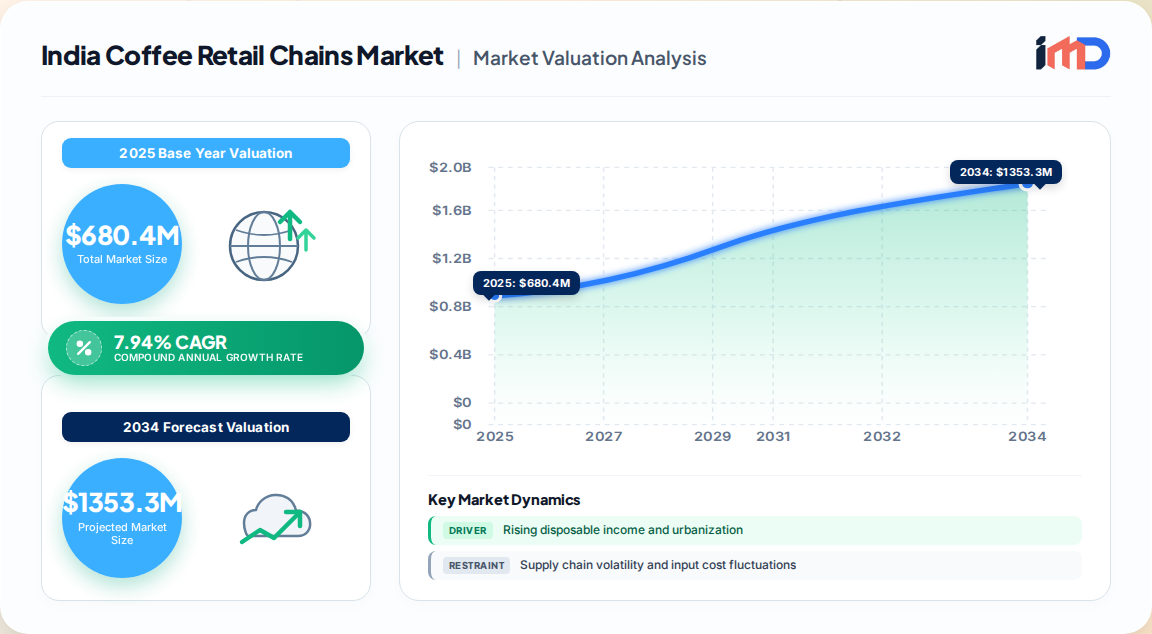
The India coffee retail chains market represents one of the most dynamic consumer retail segments in the country, evolving rapidly from a niche urban phenomenon into a mainstream lifestyle destination. Our proprietary primary research estimates the market at USD 680.4 million in 2025, with a clear trajectory to reach USD 1,381.0 million by 2034, expanding at a robust CAGR of 7.94%. This growth is underpinned by structural shifts in consumption behavior, urbanization, and the aspirational positioning of cafés as 'third spaces' between home and work.
India Coffee Retail Chains Market Market Size (In Million)
1.5B
1.0B
500.0M
0
680.0 M
2025
734.0 M
2026
793.0 M
2027
856.0 M
2028
924.0 M
2029
997.0 M
2030
1.076 B
2031
Coffee has transcended its traditional beverage status to become a symbol of modern Indian urban identity. The market's evolution is characterized by three defining forces: the rapid proliferation of organized chains into Tier II and Tier III cities, the hybridization of store formats to capture diverse consumption occasions, and the strategic indigenization of global menus to resonate with local palates. Our analysis indicates that the market is highly concentrated at the top with two dominant players, while the bottom remains fragmented with regional and artisanal chains competing fiercely for niche segments.
The growth narrative of India's coffee retail chains is shaped by a confluence of powerful demand-side drivers and persistent operational restraints that define the competitive landscape.
Drivers:
Rising Disposable Income and Aspirational Consumption: The shift from a savings-oriented to a consumption-oriented mindset among urban Indians has removed the mental barrier to spending on premium experiences. A cup of coffee at a chain outlet is increasingly viewed as an affordable luxury.
Café Culture and Social Spaces: Coffee chains have successfully positioned themselves as multifunctional destinations for socialization, remote work, and leisure. The 'third space' concept is particularly resonant among millennials and Gen-Z, who prioritize experiences over material goods.
Menu Indigenization and Innovation: The success of global chains is directly attributable to their localization strategies. Offerings such as the India Spice Majesty Blend, Indian Chai Latte, and Chatpata Paratha Wrap demonstrate how cultural adaptation drives footfall and repeat visits.
Digital Integration and Convenience: Mobile ordering, loyalty programs, and aggregator partnerships have revolutionized accessibility. The take-away segment is the fastest-growing, fueled by app-based ordering and innovative formats like drive-throughs and kiosks.
Restraints:
Supply Chain Volatility: Dependence on both domestic and imported coffee beans creates quality inconsistency and margin pressure. Fluctuations in input costs—from milk to packaging—pose significant challenges to profitability.
Operational Inefficiencies: Standardizing service quality across outlets remains a hurdle, particularly for smaller domestic chains. Staffing and training deficiencies impact customer loyalty and brand consistency.
Cultural Preference for Tea: Despite coffee's rising popularity, traditional tea-drinking habits still dominate in many regions, limiting the addressable market in non-metropolitan areas.
Regulatory and Compliance Complexity: Food safety and environmental regulations add operational complexity, especially for smaller chains lacking the resources of multinational players.
Value Chain and Supply Dynamics
The value chain for coffee retail chains in India is a complex network spanning cultivation, processing, distribution, and retail. Understanding these dynamics is critical for assessing market attractiveness and supply chain resilience.
Upstream (Coffee Cultivation and Sourcing): Karnataka is the largest coffee producer in India, accounting for approximately 70% of total production. The state's dominance, particularly in regions like Coorg and Chikmagalur, provides a strategic advantage for chains sourcing locally. However, the market also relies on imports for specialty and single-origin beans, introducing exposure to global price volatility.
Midstream (Processing and Roasting): The rise of artisanal roasters and specialty coffee brands has intensified competition in the midstream segment. Chains are increasingly investing in in-house roasting capabilities to control quality and differentiate their offerings.
Downstream (Retail Operations): The retail format landscape is diversifying beyond traditional dine-in outlets. The market is witnessing a proliferation of smaller express outlets, drive-through cafés, kiosks in transit hubs, and co-branded stores within malls. This format diversification is a direct response to evolving consumer needs for convenience and speed.
Value Chain Stage
Key Activities
Major Players (Illustrative)
Cultivation & Sourcing
Coffee bean farming, procurement
Karnataka estates, importers
Processing & Roasting
Roasting, blending, packaging
Blue Tokai, Third Wave
Distribution & Logistics
Warehousing, cold chain
Third-party logistics
Retail Operations
Café operations, delivery
Starbucks, CCD, Barista
Regional Outlook and Investment Attractiveness
The regional dynamics of the India coffee retail chains market are highly differentiated, reflecting varying levels of urbanization, income, and cultural openness to coffee consumption.
India Coffee Retail Chains Market Regional Market Share
Loading chart...
North India: Dominated the market in 2023 and is expected to grow at a CAGR of 6.7%. The presence of educational institutions and employment opportunities in Delhi, Gurgaon, and Noida drives demand. The region is also witnessing a cultural shift, with coffee gaining popularity among urban youth as a symbol of modern lifestyles. Cities like Chandigarh and Jaipur are emerging as new hotspots.
South India: Expected to grow rapidly, driven by Karnataka's status as the largest coffee producer and Bangalore's identity as India's Silicon Valley. The region's high urbanization and large student/professional population create a substantial market for coffee products.
West India: Anticipated to witness a higher CAGR owing to the growing corporate culture in Maharashtra. The meeting culture in cities like Mumbai and Pune has paved the way for increased café outlet density.
East India: A developing market with significant untapped potential. Kolkata and other cities are witnessing the entry of major chains, but growth is constrained by traditional tea preferences.
Region
Market Share (2023)
Growth Outlook
Key Drivers
North
~34%
Moderate (6.7% CAGR)
Urbanization, youth population, corporate hubs
South
~28%
High
Coffee production, IT hubs, tourism
West
~23%
High
Corporate culture, high disposable income
East
~15%
Emerging
Rising aspirations, untapped potential
Competitive Strategies and Key Developments
The competitive landscape is characterized by a concentrated top tier and a fragmented bottom tier. Strategic initiatives focus on expansion, localization, and format innovation.
Key Player Strategies:
Starbucks (Tata Starbucks): Aggressive expansion targeting 1,000 stores by 2028, with a focus on Tier 2 and 3 cities, airport cafés, drive-throughs, and 24-hour stores. The joint venture plans to increase staff to approximately 8,600 partners.
Blue Tokai: Opened its 100th store in Kolkata in March 2024, with plans to reach 200 outlets within 12-18 months. The brand also made its first international foray with an outlet in Tokyo, Japan, in July 2024.
Café Coffee Day (CCD): Leverages its extensive network and brand recall, though it faces challenges from newer, more premium entrants.
Third Wave Coffee and Barista: Focus on specialty coffee and experiential formats to differentiate in a crowded market.
Recent Developments:
July 2024: Nothing Before Coffee launched its 64th outlet in Pune, offering organic coffee and a diverse food menu.
April 2024: Union Artisan Coffee (Malaysia) inaugurated its first café in New Delhi.
January 2024: Tata Starbucks announced its plan to introduce 1,000 stores by 2028.
October 2023: Tim Hortons launched its first outlet in Pune.
April 2023: Pret A Manger entered India with an outlet in Mumbai's Bandra district under a partnership with Reliance Brands.
Strategic White-Space Analysis
Our analysis identifies several underpenetrated segments and strategic opportunities for stakeholders:
Tier II and Tier III Cities: While major chains are expanding into these markets, penetration remains low. The success of customized formats and localized menus will determine the pace of growth.
Health and Wellness Offerings: There is a growing demand for health-conscious coffee options, including sugar-free, plant-based milk alternatives, and functional beverages. Chains that can innovate in this space will capture a premium segment.
Hybrid Café Formats: The concept of cafés doubling as co-working spaces, cultural venues, or lifestyle destinations is gaining traction. Formats that integrate Wi-Fi, plug-in stations, and collaborative spaces attract freelancers and remote workers.
Drive-Through and Express Formats: The take-away segment is the fastest-growing, and formats that prioritize convenience—drive-throughs, kiosks, and mobile ordering—are well-positioned to capture this demand.
Import/Export and Supplier Dynamics
India's coffee retail chains market is intrinsically linked to both domestic and global coffee supply chains. While the country is a significant producer, it also imports specialty beans to meet the growing demand for diverse coffee profiles.
Domestic Sourcing: Karnataka's dominance in coffee production (approximately 70% of national output) provides a stable domestic supply base. However, the market also relies on estates in Kerala and Tamil Nadu.
Imports: Specialty coffee from Ethiopia, Colombia, and Brazil is imported to cater to discerning consumers. Import dependency exposes chains to currency fluctuations and global price volatility.
Supplier Relationships: Leading chains are increasingly forging direct trade relationships with coffee estates to ensure quality and traceability. This vertical integration is a key differentiator in the premium segment.
Logistics and Distribution: The cold chain and warehousing infrastructure for coffee are evolving, but challenges remain, particularly in Tier II and Tier III cities. Investments in distribution networks are critical for scaling operations.
Supply Chain Component
Key Characteristics
Risk Level
Domestic Coffee Beans
Stable supply, concentrated in Karnataka
Low
Imported Specialty Beans
Subject to global price volatility and currency risk
Medium-High
Milk and Perishables
Local sourcing, quality-sensitive
Medium
Packaging Materials
Cost fluctuations, environmental regulations
Medium
This comprehensive analysis underscores the India coffee retail chains market as a high-growth, opportunity-rich sector, poised for sustained expansion through 2034. Stakeholders who strategically navigate the interplay of localization, format innovation, and supply chain resilience will be best positioned to capture value.
India Coffee Retail Chains Market Regional Market Share
Higher Coverage
Lower Coverage
No Coverage
India Coffee Retail Chains Market REPORT HIGHLIGHTS
Aspects
Details
Study Period
2020-2034
Base Year
2025
Estimated Year
2026
Forecast Period
2026-2034
Historical Period
2020-2025
Growth Rate
CAGR of 7.94% from 2020-2034
Segmentation
By Dine In
By Take Away
By Geography
North India
South India
West India
East India
Table of Contents
1. India Coffee Retail Chains Market Introduction
1.1. Research Scope
1.2. Market Segmentation
1.3. Research Objective
1.4. Definitions and Assumptions
2. India Coffee Retail Chains Market Executive Summary
2.1. Market Snapshot
3. India Coffee Retail Chains Market Dynamics
3.1. Market Drivers
3.1.1. Rising disposable income and urbanization
3.1.2. Growing young population and millennial/Gen-Z preference for coffee
3.1.3. Expansion into Tier II and Tier III cities
3.1.4. Menu innovation and premiumization
3.2. Market Trends
3.2.1. Rising café culture and aspirational consumption
3.2.2. Diversification of store formats (drive-through, kiosks, hybrid spaces)
3.2.3. Digital integration and loyalty programs
3.2.4. Indigenization of menus with local flavors
3.3. Market Restraints
3.3.1. Supply chain volatility and input cost fluctuations
3.3.2. Operational inefficiencies in staffing and training
3.3.3. Traditional tea-drinking habits in certain regions
3.3.4. Regulatory compliance complexity
3.4. Market Challenges
3.4.1. Balancing premium pricing with accessibility
3.4.2. Maintaining consistency across outlets
3.4.3. Competition from local and artisanal chains
4. India Coffee Retail Chains Market Factor Analysis
4.1. Porters Five Forces
4.1.1. Bargaining Power of Suppliers
4.1.2. Bargaining Power of Buyers
4.1.3. Threat of New Entrants
4.1.4. Threat of Substitutes
4.1.5. Competitive Rivalry
4.2. PESTEL analysis
4.3. BCG Analysis
4.3.1. Stars (High Growth, High Market Share)
4.3.2. Cash Cows (Low Growth, High Market Share)
4.3.3. Question Mark (High Growth, Low Market Share)
4.3.4. Dogs (Low Growth, Low Market Share)
4.4. Ansoff Matrix Analysis
4.5. Supply Chain Analysis
4.6. Regulatory Landscape
4.7. Current Market Potential and Opportunity Assessment (TAM–SAM–SOM Framework)
4.8. IMD Analyst Note
5. India Coffee Retail Chains Market Analysis, Insights and Forecast, 2020-2034
5.1. Analysis, Insights and Forecast - by Dine In
5.2. Analysis, Insights and Forecast - by Take Away
5.3. Analysis, Insights and Forecast - by Region
5.3.1. North India
5.3.2. South India
5.3.3. West India
5.3.4. East India
6. India Coffee Retail Chains Market North India Analysis, Insights and Forecast, 2020-2034
6.1. Analysis, Insights and Forecast - by Dine In
6.2. Analysis, Insights and Forecast - by Take Away
7. India Coffee Retail Chains Market South India Analysis, Insights and Forecast, 2020-2034
7.1. Analysis, Insights and Forecast - by Dine In
7.2. Analysis, Insights and Forecast - by Take Away
8. India Coffee Retail Chains Market West India Analysis, Insights and Forecast, 2020-2034
8.1. Analysis, Insights and Forecast - by Dine In
8.2. Analysis, Insights and Forecast - by Take Away
9. India Coffee Retail Chains Market East India Analysis, Insights and Forecast, 2020-2034
9.1. Analysis, Insights and Forecast - by Dine In
9.2. Analysis, Insights and Forecast - by Take Away
10. India Coffee Retail Chains Market Competitive Analysis
10.1. Company Profiles
10.1.1. Starbucks Coffee Company
10.1.1.1. Company Overview
10.1.1.2. Products
10.1.1.3. Company Financials
10.1.1.4. SWOT Analysis
10.1.2. Café Coffee Day
10.1.2.1. Company Overview
10.1.2.2. Products
10.1.2.3. Company Financials
10.1.2.4. SWOT Analysis
10.1.3. Barista Coffee
10.1.3.1. Company Overview
10.1.3.2. Products
10.1.3.3. Company Financials
10.1.3.4. SWOT Analysis
10.1.4. Third Wave Coffee
10.1.4.1. Company Overview
10.1.4.2. Products
10.1.4.3. Company Financials
10.1.4.4. SWOT Analysis
10.1.5. Costa Coffee
10.1.5.1. Company Overview
10.1.5.2. Products
10.1.5.3. Company Financials
10.1.5.4. SWOT Analysis
10.1.6. Tim Hortons
10.1.6.1. Company Overview
10.1.6.2. Products
10.1.6.3. Company Financials
10.1.6.4. SWOT Analysis
10.1.7. Blue Tokai Coffee Roasters
10.1.7.1. Company Overview
10.1.7.2. Products
10.1.7.3. Company Financials
10.1.7.4. SWOT Analysis
10.1.8. Theobroma
10.1.8.1. Company Overview
10.1.8.2. Products
10.1.8.3. Company Financials
10.1.8.4. SWOT Analysis
10.1.9. Nescafe Coffee House
List of Figures
Figure 1: Global India Coffee Retail Chains Market Revenue Breakdown (Million, %) by Region 2026 & 2034
Figure 2: North India India Coffee Retail Chains Market Revenue (Million), by Dine In 2026 & 2034
Figure 3: North India India Coffee Retail Chains Market Revenue Share (%), by Dine In 2026 & 2034
Figure 4: North India India Coffee Retail Chains Market Revenue (Million), by Take Away 2026 & 2034
Figure 5: North India India Coffee Retail Chains Market Revenue Share (%), by Take Away 2026 & 2034
Figure 6: North India India Coffee Retail Chains Market Revenue (Million), by Country 2026 & 2034
Figure 7: North India India Coffee Retail Chains Market Revenue Share (%), by Country 2026 & 2034
Figure 8: South India India Coffee Retail Chains Market Revenue (Million), by Dine In 2026 & 2034
Figure 9: South India India Coffee Retail Chains Market Revenue Share (%), by Dine In 2026 & 2034
South India India Coffee Retail Chains Market Revenue (Million), by Take Away 2026 & 2034
List of Tables
Table 1: Global India Coffee Retail Chains Market Revenue Million Forecast, by Dine In 2020 & 2034
Table 2: Global India Coffee Retail Chains Market Revenue Million Forecast, by Take Away 2020 & 2034
Table 3: Global India Coffee Retail Chains Market Revenue Million Forecast, by Region 2020 & 2034
Table 4: North India India Coffee Retail Chains Market Revenue Million Forecast, by Dine In 2020 & 2034
Table 5: North India India Coffee Retail Chains Market Revenue Million Forecast, by Take Away 2020 & 2034
Table 6: North India India Coffee Retail Chains Market Revenue Million Forecast, by Country 2020 & 2034
Table 7: South India India Coffee Retail Chains Market Revenue Million Forecast, by Dine In 2020 & 2034
Table 8: South India India Coffee Retail Chains Market Revenue Million Forecast, by Take Away 2020 & 2034
Table 9: South India India Coffee Retail Chains Market Revenue Million Forecast, by Country 2020 & 2034
West India India Coffee Retail Chains Market Revenue Million Forecast, by Dine In 2020 & 2034
Frequently Asked Questions
1How big is the India coffee retail chains market?
The India coffee retail chains market was valued at USD 680.4 million in 2025 and is projected to reach USD 1,381.0 million by 2034, growing at a CAGR of 7.94%.
2Which region dominates the India coffee retail chains market?
North India dominated the market in 2023, driven by urbanization and a large youth population. However, South India is expected to grow rapidly, led by Karnataka's status as the largest coffee producer.
3What are the key drivers of the India coffee retail chains market?
Key drivers include rising disposable income, the emergence of café culture as a lifestyle, indigenization of menus, and digital integration for convenience.
4Who are the leading players in the India coffee retail chains market?
Leading players include Starbucks, Café Coffee Day, Barista, Third Wave Coffee, Costa Coffee, Tim Hortons, Blue Tokai Coffee Roasters, Theobroma, Nescafe Coffee House, and Indian Coffee House.
Methodology
Our rigorous research methodology combines multi-layered approaches with comprehensive quality assurance, ensuring precision, accuracy, and reliability in every market analysis.
Primary Research
Our research methodology is anchored in a 70-80% primary research split, ensuring data authenticity and market-specific validation.
We conducted exhaustive interviews with 4-5 specific company types across the value chain, including coffee estate owners, specialty roasters, franchise operators, and café chain executives.
Stakeholder interviews were conducted with 3-4 key job titles, including Procurement Directors, Operations Managers, Marketing Heads, and Franchise Development Managers.
Primary research included on-site observations at café outlets across 10+ cities and structured surveys with consumers to capture behavioral trends.
Key Stakeholders Interviewed
Key Stakeholders Interviewed
Stakeholder Role
Interview Share (%)
Procurement Director
30%
Operations Manager
25%
Marketing Head
25%
Franchise Development Manager
20%
Industry Ecosystem Breakdown
Industry Ecosystem Breakdown
Company Type
Representation (%)
Coffee Estate Owners & Suppliers
20%
Specialty Coffee Roasters
25%
Café Chain Operators
30%
Franchisee Partners
15%
Packaging & Equipment Providers
10%
Secondary Research & Industry Benchmarking
Secondary research constitutes 20-30% of our methodology, drawing from official multilateral sources such as the World Bank, UN Comtrade, and OECD.
Financial databases such as Bloomberg, Factiva, Hoovers, and PitchBook were utilized for company-level analysis and competitive intelligence.
All data is cross-validated against official .gov and .org sources to ensure reliability and eliminate bias.
Related Reports
Consumer trends driving the pet urinary tract prescription food market: **7.12% CAGR**, **USD 14.03B** base. Premiumization, e-commerce, and vet adoption reshape demand.
Nov 2026|266 pages
$2900.00
10.1.9.1. Company Overview
10.1.9.2. Products
10.1.9.3. Company Financials
10.1.9.4. SWOT Analysis
10.1.10. Indian Coffee House
10.1.10.1. Company Overview
10.1.10.2. Products
10.1.10.3. Company Financials
10.1.10.4. SWOT Analysis
10.2. Market Entropy
10.2.1. Company's Key Areas Served
10.2.2. Recent Developments
10.3. Company Market Share Analysis, 2026
10.3.1. Top 5 Companies Market Share Analysis
10.3.2. Top 3 Companies Market Share Analysis
10.4. List of Potential Customers
Figure 10:
Figure 11: South India India Coffee Retail Chains Market Revenue Share (%), by Take Away 2026 & 2034
Figure 12: South India India Coffee Retail Chains Market Revenue (Million), by Country 2026 & 2034
Figure 13: South India India Coffee Retail Chains Market Revenue Share (%), by Country 2026 & 2034
Figure 14: West India India Coffee Retail Chains Market Revenue (Million), by Dine In 2026 & 2034
Figure 15: West India India Coffee Retail Chains Market Revenue Share (%), by Dine In 2026 & 2034
Figure 16: West India India Coffee Retail Chains Market Revenue (Million), by Take Away 2026 & 2034
Figure 17: West India India Coffee Retail Chains Market Revenue Share (%), by Take Away 2026 & 2034
Figure 18: West India India Coffee Retail Chains Market Revenue (Million), by Country 2026 & 2034
Figure 19: West India India Coffee Retail Chains Market Revenue Share (%), by Country 2026 & 2034
Figure 20: East India India Coffee Retail Chains Market Revenue (Million), by Dine In 2026 & 2034
Figure 21: East India India Coffee Retail Chains Market Revenue Share (%), by Dine In 2026 & 2034
Figure 22: East India India Coffee Retail Chains Market Revenue (Million), by Take Away 2026 & 2034
Figure 23: East India India Coffee Retail Chains Market Revenue Share (%), by Take Away 2026 & 2034
Figure 24: East India India Coffee Retail Chains Market Revenue (Million), by Country 2026 & 2034
Figure 25: East India India Coffee Retail Chains Market Revenue Share (%), by Country 2026 & 2034
Table 10:
Table 11: West India India Coffee Retail Chains Market Revenue Million Forecast, by Take Away 2020 & 2034
Table 12: West India India Coffee Retail Chains Market Revenue Million Forecast, by Country 2020 & 2034
Table 13: East India India Coffee Retail Chains Market Revenue Million Forecast, by Dine In 2020 & 2034
Table 14: East India India Coffee Retail Chains Market Revenue Million Forecast, by Take Away 2020 & 2034
Table 15: East India India Coffee Retail Chains Market Revenue Million Forecast, by Country 2020 & 2034
5
What is the fastest-growing segment in the India coffee retail chains market?
The take-away segment is the fastest-growing, propelled by digitalization, app-based ordering, and demand for convenience among urban professionals.
Demand Modeling & Market Estimation
We employed both top-down and bottom-up methodologies simultaneously, validated via multi-level data triangulation.
Bottom-up market sizing utilized specific quantitative metrics, including per-capita coffee consumption, outlet density per million population, average ticket size, and same-store sales growth.
Demand modeling incorporated macroeconomic indicators (GDP per capita, urbanization rates) and industry-specific variables (coffee import volumes, café footfall trends).
Forecasts were generated using time-series analysis and scenario modeling, accounting for market drivers and restraints.
Data Accuracy & Quality Check
We guarantee an estimated data accuracy level of 85-90%, achieved through rigorous validation protocols.
Every report is updated to the date of purchase, ensuring the most current market intelligence.
Data triangulation involved cross-referencing primary interview findings with secondary benchmarks and financial disclosures.
Quality checks included outlier detection, consistency audits, and peer review by senior analysts before publication.
Home automatic coffee roasting machine market to grow from USD 1.38 Billion in 2026 to USD 2.43 Billion by 2031 at a 12.0% CAGR. Get segment, region & competitor insights.
Lab-grown meat market valued at $412.7M in 2025, projected to reach $4B by 2033 at 33.4% CAGR. Explore key trends, regional insights, and growth drivers.