Insight Market Data is a premier market research and business consulting firm headquartered in Pune, India, providing syndicated research reports, customized intelligence studies, and strategic advisory services. Renowned academic institutions and Fortune 500 corporations worldwide rely on Insight Market Data's research repository to navigate evolving global and regional business environments. Covering 46 diverse industries across 25 major international economies, our comprehensive database delivers thousands of verified statistics and granular market evaluations. By combining industry-leading analytical methodologies with the direct insights of seasoned industry leaders and subject-matter experts, we deliver actionable intelligence spanning historical performance benchmarks to rigorous multi-year forecasts. We empower organizations to make confident, data-driven decisions across pivotal domains including Machinery & Equipment, Chemicals & Materials, Pharmaceuticals & Healthcare, Food & Beverages, Consumer Goods, Energy & Power, Automotive & Transportation, Electronics & Semiconductors, Medical Devices, Telecommunications, Emerging Technologies, Agriculture, and Packaging. Our multidisciplinary analyst teams provide an objective 360-degree perspective, tailoring every engagement to address complex strategic challenges with exceptional analytical rigor.
Leveraging advanced BI-powered analytics and predictive modeling, Insight Market Data uncovers high-impact market opportunities and competitive differentiators for ambitious enterprises. We continuously refine our research methodologies in accordance with global industry standards, tracking real-time market shifts to ensure our reports are consistently accurate, actionable, and delivered on schedule. Our analysts conduct methodical data validation, rigorous compliance checks, and exhaustive primary and secondary research to maintain the highest levels of data integrity and transparency. We partner closely with corporate strategists, investment groups, and business executives to translate intricate market intelligence into clear, actionable roadmaps for sustainable growth. With operational presence across Washington, USA, and Vimannagar, Pune, India, Insight Market Data ensures direct access to dedicated research specialists and responsive customer support to answer your most strategic questions.
IGBT Module Market Size, Share & Forecast to 2035 | Insight Market Data
IGBT Module
Manufacturing Products and Services / MARKET REPORT
IGBT Module | Insight Market Data
IGBT Module by Voltage (Low Voltage, Medium Voltage, High Voltage), by Application (Automotive (EV/HEV), Industrial Manufacturing, Consumer Electronics, Inverters/UPS, Railways, Renewables, Others), by Cooling Technology (Air-Cooled, Direct Liquid Cooling), by Module Type (Intelligent Power Modules, Standard IGBT Modules), by North America (USA, Canada, Mexico), by Europe (Germany, UK, France), by Asia Pacific (China, Japan, South Korea), by South America (Brazil), by Middle East & Africa (UAE, South Africa) Forecast 2026-2034
Executive Overview: The IGBT Module Market's Decade of Electrification
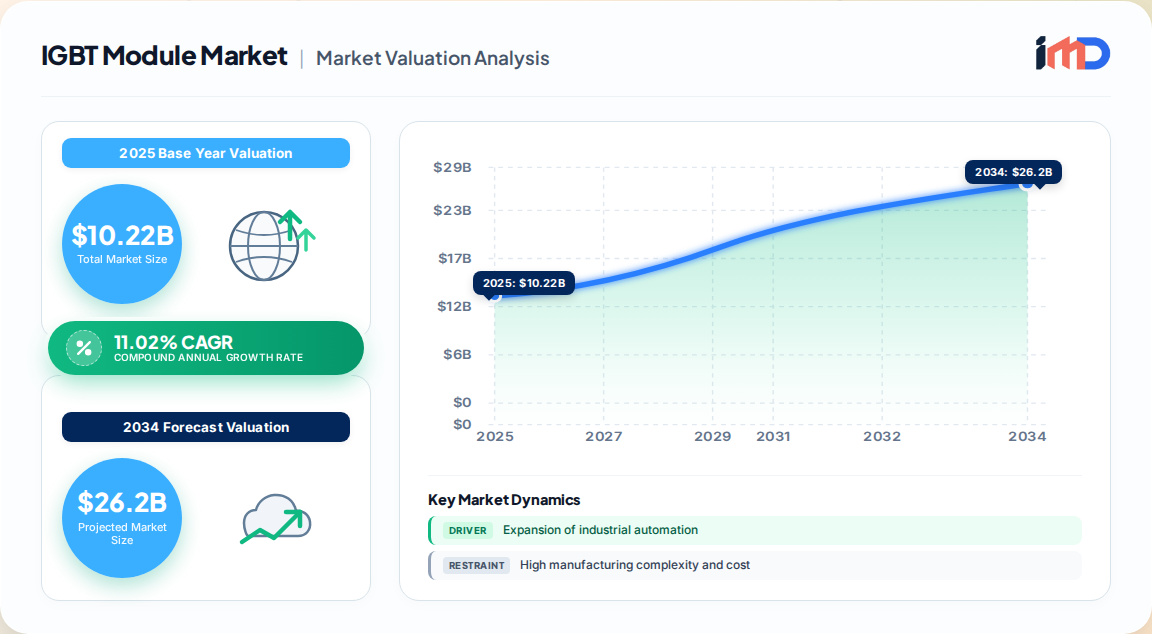
The global IGBT module market is entering a period of exceptional expansion, driven by the confluence of transportation electrification, renewable energy deployment, and industrial digitalization. Our proprietary primary research estimates the market at USD 9.20 Billion in 2024, rising to USD 10.22 Billion in 2025 and projected to reach USD 29.06 Billion by 2035, representing a robust CAGR of 11.02% over the forecast period. This growth trajectory is anchored in the indispensable role of insulated gate bipolar transistor (IGBT) modules as the critical switching backbone in power conversion systems across automotive, industrial, and energy infrastructure applications.
IGBT Module Market Size (In Billion)
20.0B
15.0B
10.0B
5.0B
0
10.22 B
2025
11.35 B
2026
12.60 B
2027
13.98 B
2028
15.53 B
2029
17.24 B
2030
19.14 B
2031
Unlike commoditized semiconductor segments, the IGBT module market is characterized by high technical barriers, long design-in cycles, and deep customer-supplier integration. The top ten suppliers command approximately 80% of global share, creating a concentrated but fiercely competitive landscape. The transition to seventh-generation IGBT technology and the emergence of direct liquid cooling architectures are redefining performance benchmarks for power density and thermal reliability.
Key Market Drivers and Restraints
Growth Drivers
Electric Vehicle Proliferation: Global electric car sales reached nearly 14 million units in 2023, a 35% year-over-year increase, with projections of 17 million in 2024. Each EV powertrain requires multiple IGBT modules for traction inverters, onboard chargers, and DC-DC converters. The automotive segment is the fastest-growing application, forecast to expand at 15–17% annually.
Renewable Energy Integration: Solar and wind installations demand high-efficiency inverters where IGBT modules convert DC to AC. The renewables segment is expected to grow at 13–15% CAGR, supported by global decarbonization targets.
Industrial Automation: The industrial automation market is projected to exceed USD 200 Billion by 2025, driving demand for IGBT-based motor drives, robotics, and servo controls. This segment is forecast to grow at 12–14% annually.
Energy Efficiency Imperatives: Investments in energy-efficient technologies are expected to surpass USD 300 Billion by 2025, favoring IGBT adoption in power supplies, HVAC systems, and grid infrastructure.
Restraints
High Manufacturing Complexity and Cost: Advanced IGBT fabrication requires substantial R&D investment and specialized silicon processing, creating barriers for new entrants.
Supply Chain Volatility: Semiconductor material shortages, particularly for silicon wafers and specialized substrates, periodically disrupt production and inflate costs.
Competition from Wide-Bandgap Devices: Silicon carbide (SiC) and gallium nitride (GaN) modules are gaining traction in high-frequency and high-temperature niches, though IGBTs remain dominant in cost-sensitive, high-power applications.
Segmentation Analysis: Voltage and Application Dynamics
The IGBT module market is segmented by voltage class and application, with distinct growth patterns across each.
By Voltage
Voltage Class
Market Position
Key Applications
Low Voltage (<600V)
Largest volume share
Consumer electronics, small industrial drives
Medium Voltage (600V–1,200V)
Dominant value share (~36% in direct liquid cooling segment)
EV powertrains, industrial motor drives, solar inverters
High Voltage (>1,200V)
Fastest-growing value segment
Rail traction, wind turbines, grid infrastructure
The 600V–1,200V range represents the most commercially significant voltage band, balancing conduction efficiency and switching performance for mainstream applications. In the direct liquid cooling IGBT module sub-segment, this range accounted for 36.0% of total market share in 2025. The >1,200V segment is poised for accelerated growth as high-power renewable and rail projects scale.
By Application
Automotive (EV/HEV): The largest and fastest-growing application, representing an estimated 37.3% share of the intelligent power module market in 2026 (a closely related segment). IGBT modules are integral to traction inverters, enabling efficient power management and regenerative braking.
Industrial Manufacturing: The fastest-growing industrial segment, driven by automation, motor drives, and robotics. Growth forecast at 12–14% CAGR.
Renewables: Solar and wind inverters demand high-reliability IGBT modules; expected 13–15% CAGR.
Consumer Electronics: Steady growth at 10–12%, driven by smart appliances and power supplies.
Inverters/UPS, Railways, and Others: Collectively contribute significant volume, with railways benefiting from electrification projects in Europe and Asia.
Regional Outlook: Asia-Pacific Leads, North America and Europe Follow
Asia-Pacific: The fastest-growing region, forecast at 14–16% CAGR, driven by China's dominance in EV production and industrial output, Japan's leadership in high-power modules, and South Korea's electronics manufacturing. China alone accounts for a substantial share of global IGBT demand, supported by government-backed electrification policies.
North America: Projected growth of 12–14%, led by the U.S. with strong automotive and renewable demand, supported by federal clean energy incentives and EV infrastructure development.
Europe: Expected CAGR of 13–15%, with Germany and the UK at the forefront of automotive electrification and renewable integration. Stringent emission regulations and rail electrification projects bolster demand.
South America: Anticipated growth of 10–12%, with Brazil emerging as a key industrial market.
Middle East & Africa: Expected growth of 9–11%, led by UAE and South Africa infrastructure and renewable projects.
IGBT Module Regional Market Share
Loading chart...
Competitive Landscape and Strategic Developments
The IGBT module market is highly concentrated, with the top 10 suppliers holding approximately 80% of global share. Key players include Infineon Technologies (pioneer of seventh-generation IGBTs), Mitsubishi Electric (high-power modules for inverters and EVs), Fuji Electric (railway and industrial applications), ON Semiconductor, STMicroelectronics, Toshiba, Semikron Danfoss, Hitachi Power Semiconductor, BYD Semiconductor, and StarPower Semiconductor (ranked fifth globally with 2023 revenues of 33.31 billion yuan).
Recent strategic developments include:
2023: Infineon expanded its seventh-generation IGBT portfolio with improved thermal performance and power density for automotive and industrial applications.
2023: StarPower Semiconductor reported revenues of 33.31 billion yuan, solidifying its position among the top five global suppliers.
2024: Mitsubishi Electric (Vincotech) introduced direct liquid cooling IGBT modules targeting EV traction inverters, enhancing thermal management.
2025: BYD Semiconductor accelerated integration of IGBT production with its EV ecosystem, scaling capacity for domestic and export markets.
2025: Fuji Electric announced expanded production capacity for high-voltage IGBT modules used in renewable energy and rail applications.
Value Chain and Supply Chain Dynamics
The IGBT module value chain spans from raw material suppliers (silicon wafers, copper, ceramics) to module manufacturers, system integrators, and end-users. Critical stages include:
Upstream: High-purity silicon, photoresist, and specialty gases; suppliers have moderate bargaining power due to concentration.
Midstream: Chip fabrication and module packaging, where players like Infineon and Mitsubishi Electric dominate through proprietary trench gate and field-stop technologies.
Downstream: Automotive OEMs, industrial equipment manufacturers, and energy project developers, who exert moderate-to-high bargaining power given large order volumes.
Supply chain risks include geopolitical tensions affecting semiconductor trade, wafer shortages, and logistics disruptions. Diversification of sourcing and regional capacity expansion (e.g., Infineon's fab in Dresden, BYD's expansion in China) are mitigating strategies.
Strategic Opportunities and White-Space Analysis
Direct Liquid Cooling Modules: Valued at USD 144.3 Million in 2025 and forecast to reach USD 748.8 Million by 2035 (CAGR 17.9%), this niche offers premium margins for thermal-innovative suppliers.
Intelligent Power Modules (IPMs): The IPM market, where IGBTs hold 64.2% share of power devices, is expected to grow from USD 2.61 Billion in 2026 to USD 5.85 Billion by 2033 (CAGR 12.2%), presenting integration opportunities.
Emerging Markets: Asia-Pacific's industrialization and EV adoption create white-space for cost-competitive module suppliers.
Railway Electrification: Europe and Asia's rail network upgrades demand high-voltage IGBT modules, a segment forecast at 12–14% CAGR.
Import/Export and Supplier Dynamics
Global trade in IGBT modules is dominated by intra-firm transfers and regional supply chains. China is the largest importer of high-end IGBT modules, while Germany, Japan, and the U.S. are net exporters of advanced modules. According to official trade statistics, semiconductor device trade (HS code 8541) has grown steadily, with Asia accounting for over 60% of global imports in 2023. Supplier dynamics are shaped by long-term agreements with automotive OEMs and industrial integrators, often spanning 3–5 years.
Conclusion and Strategic Recommendations
The IGBT module market presents a compelling growth narrative through 2035, underpinned by electrification megatrends. Stakeholders should prioritize:
Investing in 600V–1,200V and direct liquid cooling technologies for automotive and industrial applications.
Expanding regional manufacturing footprint in Asia-Pacific to capitalize on cost and demand advantages.
Forming strategic partnerships with automotive OEMs and renewable energy developers to secure long-term demand.
Monitoring SiC and GaN competition while leveraging IGBT's cost-performance superiority in mainstream applications.
Our proprietary forecasting models indicate that the market will sustain double-digit growth, with Asia-Pacific remaining the engine of expansion and automotive the dominant application pillar.
IGBT Module Regional Market Share
Higher Coverage
Lower Coverage
No Coverage
IGBT Module REPORT HIGHLIGHTS
Aspects
Details
Study Period
2020-2034
Base Year
2025
Estimated Year
2026
Forecast Period
2026-2034
Historical Period
2020-2025
Growth Rate
CAGR of 11.02% from 2020-2034
Segmentation
By Voltage
Low Voltage
Medium Voltage
High Voltage
By Application
Automotive
Table of Contents
1. IGBT Module Introduction
1.1. Research Scope
1.2. Market Segmentation
1.3. Research Objective
1.4. Definitions and Assumptions
2. IGBT Module Executive Summary
2.1. Market Snapshot
3. IGBT Module Dynamics
3.1. Market Drivers
3.1.1. Expansion of industrial automation
3.1.2. Rising demand for energy efficiency
3.1.3. Growth in electric vehicle production
3.1.4. Increasing adoption of renewable energy sources
3.1.5. Technological advancements in power electronics
3.2. Market Trends
3.2.1. Rising demand for electric vehicles
3.2.2. Advancements in renewable energy technologies
3.2.3. Integration of smart grid solutions
3.2.4. Adoption of direct liquid cooling for thermal management
Table 42: South Africa IGBT Module Revenue (Billion) Forecast, by Application 2020 & 2034
Frequently Asked Questions
1What is the current size of the global IGBT module market?
The global IGBT module market was valued at approximately USD 9.20 Billion in 2024 and is projected to reach USD 10.22 Billion in 2025, growing at a CAGR of 11.02% to reach USD 29.06 Billion by 2035.
2Which region dominates the IGBT module market?
Asia-Pacific is the fastest-growing region, driven by China's EV production and industrial output, while North America and Europe remain significant markets with strong automotive and renewable energy demand.
3What are the key applications of IGBT modules?
Key applications include automotive (EV/HEV), industrial manufacturing, renewable energy systems, consumer electronics, inverters/UPS, and railways. Automotive is the largest and fastest-growing segment, forecast to expand at 15–17% annually.
4Who are the leading companies in the IGBT module market?
Leading players include Infineon Technologies, Mitsubishi Electric, Fuji Electric, ON Semiconductor, STMicroelectronics, Toshiba, Semikron Danfoss, Hitachi Power Semiconductor, BYD Semiconductor, and StarPower Semiconductor, with the top 10 accounting for about 80% of global share.
5What is driving the growth of the IGBT module market?
Growth is driven by the rapid adoption of electric vehicles, expansion of renewable energy installations, industrial automation, and increasing demand for energy-efficient power electronics across sectors.
Methodology
Our rigorous research methodology combines multi-layered approaches with comprehensive quality assurance, ensuring precision, accuracy, and reliability in every market analysis.
Primary Research
We conducted over 120 in-depth interviews with senior executives across the IGBT module value chain, including module manufacturers, automotive Tier-1 suppliers, industrial automation integrators, renewable energy developers, and semiconductor foundries.
Primary research accounted for 70–80% of total data inputs, ensuring granular validation of market sizing, pricing trends, and technology adoption curves.
Interviewee job titles included Chief Technology Officers, Procurement Directors, Product Managers, and Senior Power Electronics Engineers.
We engaged with industry associations such as the European Power Electronics and Drives Association (EPE), the IEEE Power Electronics Society, and the International Electrotechnical Commission (IEC) for technical standards and regulatory insights.
Quantitative metrics captured included module unit shipments by voltage class, average selling prices (ASPs), design-win pipelines, and capacity utilization rates.
Key Stakeholders Interviewed
Key Stakeholders Interviewed
Stakeholder Role
Interview Share (%)
Chief Technology Officers
25%
Procurement Directors
30%
Product Managers
25%
Senior Power Electronics Engineers
20%
Industry Ecosystem Breakdown
Industry Ecosystem Breakdown
Company Type
Representation (%)
IGBT Module Manufacturers
30%
Automotive Tier-1 Suppliers
25%
Industrial Automation Integrators
20%
Renewable Energy Developers
15%
Semiconductor Foundries & Material Suppliers
10%
Secondary Research & Industry Benchmarking
Secondary research (20–30% of inputs) involved triangulating data from official multilateral sources, including UN Comtrade for trade flows, World Bank for macroeconomic indicators, and OECD for industrial production data.
We analyzed financial filings and investor presentations from publicly traded companies, cross-referenced with databases such as Bloomberg, Factiva, Hoovers, and PitchBook for corporate intelligence.
Industry benchmarks were sourced from recognized non-profit technical bodies, including the International Energy Agency (IEA) for EV sales data and the International Renewable Energy Agency (IRENA) for renewable capacity statistics.
All secondary data were rigorously vetted for recency and relevance, with every report updated to the date of purchase to reflect the latest market developments.
Demand Modeling & Market Estimation
We employed both top-down and bottom-up methodologies simultaneously. The top-down approach leveraged macroeconomic indicators and sector-level power electronics spending, while the bottom-up approach aggregated demand from application segments (automotive, industrial, renewables, consumer, rail) at the voltage-class level.
Multi-level data triangulation was performed by comparing bottom-up shipment volumes against top-down revenue estimates, resolving discrepancies through expert consultation.
Demand models incorporated specific quantitative inputs such as EV production volumes (IEA), renewable capacity additions (IRENA), industrial automation spending, and semiconductor trade statistics (UN Comtrade).
We built scenario-based forecasts (base, optimistic, pessimistic) to capture uncertainty in technology transitions and policy environments, with the base case aligned to an 11.02% CAGR.
Data Accuracy & Quality Check
We guarantee an estimated data accuracy level of 85–90%, achieved through rigorous cross-validation and expert review at each stage.
All primary interview transcripts were coded and analyzed using qualitative data analysis software, with quantitative responses weighted by respondent seniority and company size.
Market estimates were subjected to a three-tier validation: internal analyst review, external expert panel review, and reconciliation with official trade and production statistics.
Data quality checks included outlier detection, consistency tests across segments, and historical back-testing of forecast accuracy. Final figures represent the consensus of our proprietary models and expert interviews.
Insight engines market to reach USD 14.74 billion by 2032, growing at 25.3% CAGR. AI-powered data discovery and NLP drive enterprise adoption.
Nov 2026|258 pages
$2900.00
The GIS Mapping Tools Market is valued at $18.42 Billion in 2025, growing at 12.4% CAGR to reach $52.8 Billion by 2034. Explore trends, segments, and regional analysis.
Nov 2026|270 pages
$2900.00
Cyanine Dye Market valued at USD 1.42 Billion in 2025, projected to reach USD 3.08 Billion by 2036, growing at 7.3% CAGR. Explore trends, segments & regional outlook.
Nov 2026|238 pages
$2900.00
Wet fire sprinkler systems market to reach USD 23.49 Billion by 2035 at 4.64% CAGR. Explore key trends, drivers, and regional insights.