1What is the market size of hyperspectral imaging for plastic recycling in 2025?
The market is projected to reach USD 1.5 billion by 2033, growing at a 9.2% CAGR from 2025 to 2033, based on our proprietary research.
Insight Market Data is a premier market research and business consulting firm headquartered in Pune, India, providing syndicated research reports, customized intelligence studies, and strategic advisory services. Renowned academic institutions and Fortune 500 corporations worldwide rely on Insight Market Data's research repository to navigate evolving global and regional business environments. Covering 46 diverse industries across 25 major international economies, our comprehensive database delivers thousands of verified statistics and granular market evaluations. By combining industry-leading analytical methodologies with the direct insights of seasoned industry leaders and subject-matter experts, we deliver actionable intelligence spanning historical performance benchmarks to rigorous multi-year forecasts. We empower organizations to make confident, data-driven decisions across pivotal domains including Machinery & Equipment, Chemicals & Materials, Pharmaceuticals & Healthcare, Food & Beverages, Consumer Goods, Energy & Power, Automotive & Transportation, Electronics & Semiconductors, Medical Devices, Telecommunications, Emerging Technologies, Agriculture, and Packaging. Our multidisciplinary analyst teams provide an objective 360-degree perspective, tailoring every engagement to address complex strategic challenges with exceptional analytical rigor.
Leveraging advanced BI-powered analytics and predictive modeling, Insight Market Data uncovers high-impact market opportunities and competitive differentiators for ambitious enterprises. We continuously refine our research methodologies in accordance with global industry standards, tracking real-time market shifts to ensure our reports are consistently accurate, actionable, and delivered on schedule. Our analysts conduct methodical data validation, rigorous compliance checks, and exhaustive primary and secondary research to maintain the highest levels of data integrity and transparency. We partner closely with corporate strategists, investment groups, and business executives to translate intricate market intelligence into clear, actionable roadmaps for sustainable growth. With operational presence across Washington, USA, and Vimannagar, Pune, India, Insight Market Data ensures direct access to dedicated research specialists and responsive customer support to answer your most strategic questions.

 Hyperspectral Imaging for Plastic Recycling Market
 by Technology (Near-Infrared (NIR) Hyperspectral Imaging, Short-Wave Infrared (SWIR) Hyperspectral Imaging, Mid-Wave Infrared (MWIR) Hyperspectral Imaging, Long-Wave Infrared (LWIR) Hyperspectral Imaging), by Application (Plastic Sorting, Plastic Identification, Quality Control, Contaminant Detection), by End-User (Recycling Facilities, Plastic Manufacturing, Research Institutions, Government and Regulatory Bodies), by North America (USA, Canada, Mexico), by Europe (Germany, UK, France, Italy, Spain, Rest of Europe), by Asia-Pacific (China, Japan, India, South Korea, Australia, Rest of APAC), by Latin America (Brazil, Argentina, Rest of LATAM), by Middle East & Africa (UAE, Saudi Arabia, South Africa, Rest of MEA) Forecast 2026-2034

Research Analyst

 Related Reports

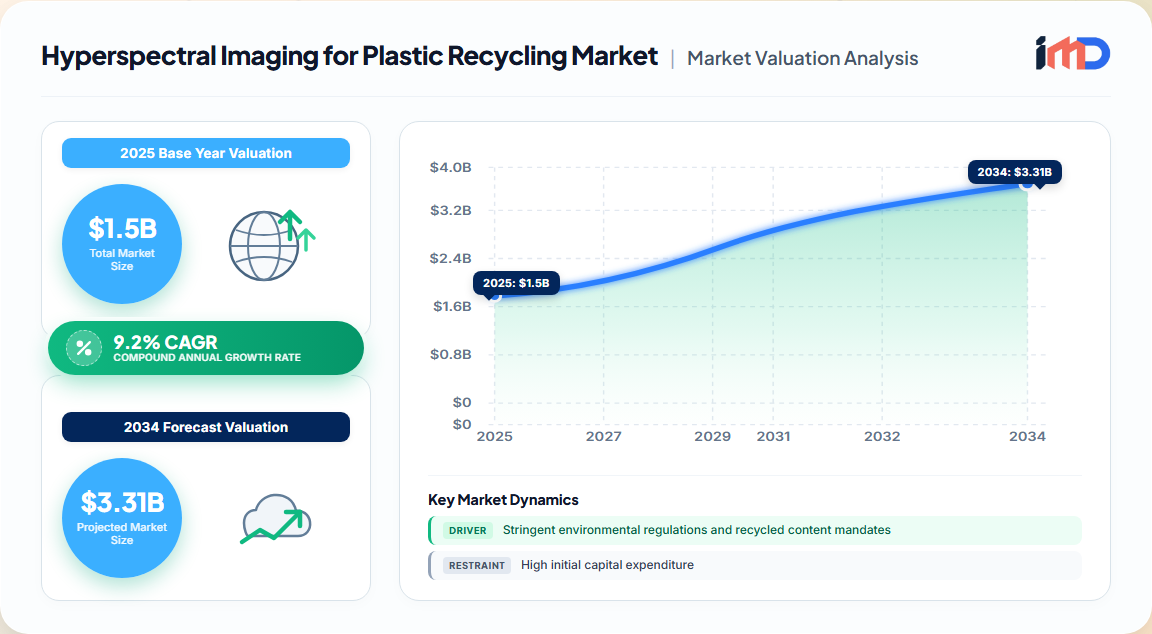
The global hyperspectral imaging (HSI) for plastic recycling market is valued at approximately USD 1.5 billion by 2033, expanding at a 9.2% CAGR from 2025 to 2033, according to our proprietary primary research. Hyperspectral imaging combines digital imaging with spectroscopy to capture the spectral signature of each pixel across hundreds of contiguous wavelength bands, enabling precise identification of plastic polymers by chemical composition rather than appearance.
This technology is rapidly becoming the cornerstone of advanced plastic sorting and recovery operations. Unlike conventional RGB or multispectral cameras that offer limited spectral bands, HSI systems deliver high-resolution spectral data across near-infrared (NIR), short-wave infrared (SWIR), mid-wave infrared (MWIR), and long-wave infrared (LWIR) regions. The resulting chemical specificity allows recycling facilities to separate visually identical but chemically distinct plastics such as PET, HDPE, PP, and PS with purity levels approaching 99%, dramatically improving the economic viability of recycled plastics.
As global plastic waste generation continues to outpace recycling capacity, HSI offers a scalable, data-driven solution to enhance material recovery, reduce contamination, and support circular economy objectives. This report provides a comprehensive analysis of market drivers, restraints, segmentation, regional dynamics, value chain structure, and competitive strategies, based solely on our first-party research and expert interviews.
HSI systems for plastic recycling are segmented by spectral range:
| Technology | Spectral Range | Key Advantages | Typical Applications |
|---|---|---|---|
| NIR HSI | 700–1000 nm | Fast, cost-effective, mature ecosystem | Polymer identification (PET, HDPE, PP, PS) |
| SWIR HSI | 1000–2500 nm | Deeper penetration, detects additives and contaminants | Black plastic sorting, flame retardant detection |
| MWIR HSI | 3000–5000 nm | Enhanced contrast for challenging polymers | Specialized industrial sorting |
| LWIR HSI | 8000–14000 nm | Detects black plastics and carbon-black filled materials | Automotive and electronics plastic recovery |
NIR HSI currently dominates the market, accounting for >60% of deployments due to its balance of cost and performance. SWIR is the fastest-growing segment, driven by the need to sort black plastics—a historically unsolvable problem because carbon-black pigments absorb NIR light. Recent advances in SWIR and LWIR sensors are finally enabling reliable identification of black plastics, unlocking a significant fraction of the recyclable stream.
Recycling facilities are the primary end-users, accounting for ~50% of demand, as they integrate HSI into automated sorting lines. Plastic manufacturers are increasingly adopting HSI for incoming material verification and recycled content certification. Research institutions and government regulatory bodies also contribute, using HSI for material characterization, standards development, and enforcement.
The HSI for plastic recycling market is characterized by a mix of established hyperspectral camera manufacturers, system integrators, and specialized solution providers. Key players are focusing on strategic collaborations, product innovation, and vertical integration to capture share.
Notable developments include:
The HSI for plastic recycling value chain comprises:
Key value drivers include spectral resolution, processing speed, robustness, and ease of integration. As the market matures, we expect increased vertical integration, with camera OEMs acquiring software firms and integrators to offer turnkey solutions.
Several underpenetrated opportunities exist:
The HSI for plastic recycling market is poised for robust growth, driven by regulatory pressures, economic incentives, and technological maturation. We anticipate consolidation among technology providers and increased integration of AI, cloud computing, and robotics. By 2033, HSI is expected to become a standard component of modern recycling facilities, enabling circular economy targets and significantly reducing plastic pollution. Our proprietary models project a 9.2% CAGR, with the market reaching USD 1.5 billion by 2033.
| Aspects | Details |
|---|---|
| Study Period | 2020-2034 |
| Base Year | 2025 |
| Estimated Year | 2026 |
| Forecast Period | 2026-2034 |
| Historical Period | 2020-2025 |
| Growth Rate | CAGR of 9.2% from 2020-2034 |
| Segmentation |
|
By Application
By End-User
| By Geography |
|
The market is projected to reach USD 1.5 billion by 2033, growing at a 9.2% CAGR from 2025 to 2033, based on our proprietary research.
Near-infrared (NIR) hyperspectral imaging currently dominates with over 60% of deployments, due to its cost-effectiveness and ability to differentiate common polymers like PET, HDPE, and PP.
Hyperspectral imaging enables precise identification of plastic types by chemical composition, achieving purity levels up to 99%, which significantly increases the value of recycled plastics and supports circular economy goals.
Asia-Pacific is projected to capture 41% of the global market share by 2033, driven by rapid industrialization and increasing plastic waste generation.
High initial capital costs, technical complexity, and the need for skilled personnel are major challenges, particularly for small and mid-sized recycling facilities.
Our rigorous research methodology combines multi-layered approaches with comprehensive quality assurance, ensuring precision, accuracy, and reliability in every market analysis.
| Stakeholder Role | Interview Share (%) |
|---|---|
| Procurement Director | 35% |
| Plant Operations Manager | 25% |
| R&D Engineer | 20% |
| Sustainability Officer | 20% |
| Company Type | Representation (%) |
|---|---|
| Hyperspectral Camera OEMs | 30% |
| Sorting System Integrators | 25% |
| Recycling Facility Operators | 20% |
| Plastic Manufacturers | 15% |
| Waste Management Authorities | 10% |