1What is the current size of the global hotel industry market?
The global hotel industry market was valued at USD 1,575.6 billion in 2025 and is projected to reach USD 2,694.9 billion by 2036, growing at a CAGR of 5.0%.
Insight Market Data is a premier market research and business consulting firm headquartered in Pune, India, providing syndicated research reports, customized intelligence studies, and strategic advisory services. Renowned academic institutions and Fortune 500 corporations worldwide rely on Insight Market Data's research repository to navigate evolving global and regional business environments. Covering 46 diverse industries across 25 major international economies, our comprehensive database delivers thousands of verified statistics and granular market evaluations. By combining industry-leading analytical methodologies with the direct insights of seasoned industry leaders and subject-matter experts, we deliver actionable intelligence spanning historical performance benchmarks to rigorous multi-year forecasts. We empower organizations to make confident, data-driven decisions across pivotal domains including Machinery & Equipment, Chemicals & Materials, Pharmaceuticals & Healthcare, Food & Beverages, Consumer Goods, Energy & Power, Automotive & Transportation, Electronics & Semiconductors, Medical Devices, Telecommunications, Emerging Technologies, Agriculture, and Packaging. Our multidisciplinary analyst teams provide an objective 360-degree perspective, tailoring every engagement to address complex strategic challenges with exceptional analytical rigor.
Leveraging advanced BI-powered analytics and predictive modeling, Insight Market Data uncovers high-impact market opportunities and competitive differentiators for ambitious enterprises. We continuously refine our research methodologies in accordance with global industry standards, tracking real-time market shifts to ensure our reports are consistently accurate, actionable, and delivered on schedule. Our analysts conduct methodical data validation, rigorous compliance checks, and exhaustive primary and secondary research to maintain the highest levels of data integrity and transparency. We partner closely with corporate strategists, investment groups, and business executives to translate intricate market intelligence into clear, actionable roadmaps for sustainable growth. With operational presence across Washington, USA, and Vimannagar, Pune, India, Insight Market Data ensures direct access to dedicated research specialists and responsive customer support to answer your most strategic questions.

 Hotel Industry
 by Hotel Type (Business/Commercial Hotels, Boutique Hotels, Resort Hotels, Casino Hotels, Transit Hotels, Bed & Breakfast Hotels, Others), by Business Model (Independent, Chain), by Price Range (Economy, Midscale, Luxury), by Ownership Model (Independent Hotels, Chain Hotels), by Booking Mode (Direct Booking, Online Travel Agent & Agencies), by North America (USA, Canada, Mexico), by Europe (Germany, UK, France, Spain, Italy), by Asia Pacific (China, Japan, India, Vietnam, Indonesia, Malaysia), by South America (Brazil, Argentina), by Middle East & Africa (Saudi Arabia, UAE, South Africa) Forecast 2026-2034

Research Associate

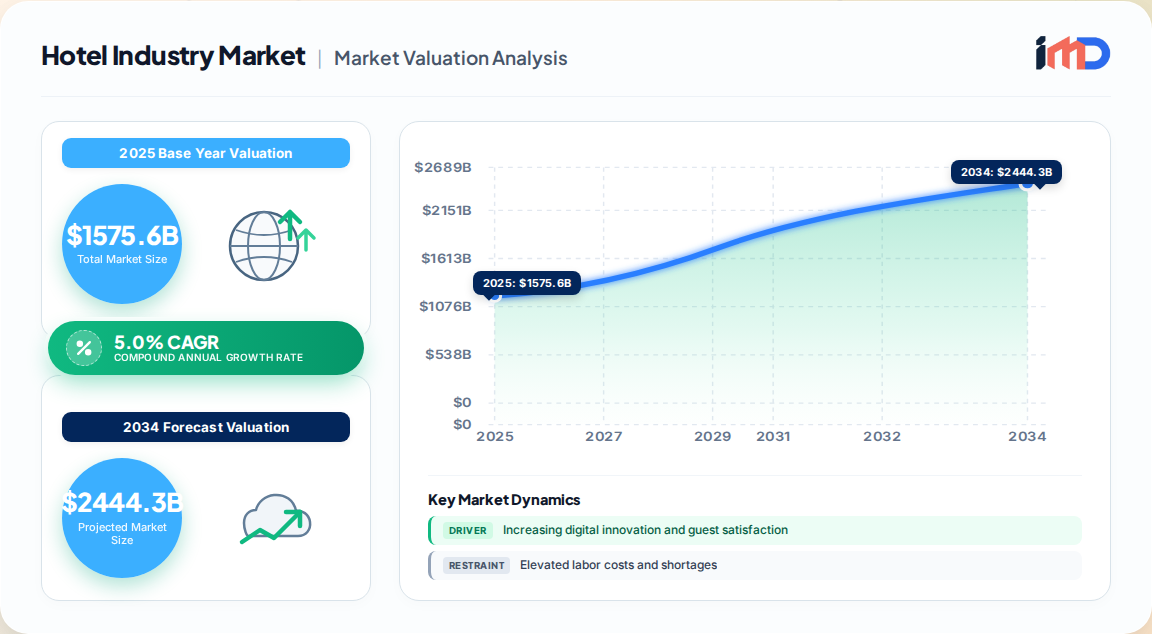
The global hotel industry market represents a resilient and adaptive segment of the travel and tourism sector, characterized by diverse accommodation types, evolving ownership models, and rapid digital transformation. Our proprietary primary research estimates the global hotel industry market at USD 1,575.6 billion in 2025, with projections indicating growth to USD 2,694.9 billion by 2036, expanding at a CAGR of 5.0%. This growth is underpinned by rising global travel demand, technological innovation, and the increasing importance of experience-driven hospitality.
The U.S. hotel industry alone was valued at USD 263.21 billion in 2024, growing at a CAGR of 7.1% through 2030, driven by record international arrivals and strong domestic travel. Globally, the hotel industry remains the most popular accommodation option, with hotels accounting for a significant share of travel and tourism revenue. Key performance indicators such as occupancy rate, average daily rate (ADR), and revenue per available room (RevPAR) are central to measuring market health and operator success.
The hotel industry market is propelled by several demand-side and supply-side factors. Our analysis identifies digital innovation and rising corporate travel as primary growth engines.
Drivers:
Restraints:
The hotel industry value chain comprises several stages, from property development to guest experience delivery.
North America dominated the global hotel industry market in 2025, holding a 36.0% revenue share, driven by robust domestic travel and international arrivals. The U.S. hospitality market alone is projected to reach USD 313.7 billion by 2032, growing at a CAGR of 3.95%. Within the U.S., the West led regional spending with a 29.44% share in 2026, while the Northeast is expected to grow fastest at 7.85% CAGR.
Europe and Asia-Pacific are also significant markets, with emerging destinations in Asia-Pacific (e.g., Vietnam, Indonesia, Malaysia) presenting high-growth opportunities due to rising middle-class income and infrastructure development. The Middle East and Africa, while smaller in share, are witnessing increased investment in luxury and business hotels, particularly in the UAE and Saudi Arabia.
Investment opportunities are abundant in the midscale and upper-midscale segment, which held a 47.64% share of U.S. hospitality in 2026, and luxury, forecast to grow at 6.2% CAGR. Emerging markets offer white-space opportunities for chain hotels seeking to expand their footprint.
The hotel industry market is segmented by hotel type, business model, price range, ownership model, booking mode, and region. Key segment insights include:
Leading players in the hotel industry market are adopting multifaceted strategies to maintain competitiveness and drive growth. Key players include Marriott International, Hilton Worldwide Holdings, InterContinental Hotels Group (IHG), Wyndham Hotels & Resorts, Choice Hotels International, Accor, Capella Hotel Group, and Royal Mansour Marrakech.
Strategic initiatives include:
Recent developments include Marriott's expansion of its loyalty program (72% of U.S. room nights booked by members in 2024) and the integration of AI-driven personalization tools. Additionally, the rise of data center construction near hotels has boosted RevPAR by approximately 5% year-over-year in 2024, illustrating the sector's adaptability to non-traditional demand sources.
Despite the industry's maturity, significant white-space opportunities exist in several areas:
By capitalizing on these opportunities, hotel operators and investors can drive growth and capture value in the evolving hotel industry landscape.
| Aspects | Details |
|---|---|
| Study Period | 2020-2034 |
| Base Year | 2025 |
| Estimated Year | 2026 |
| Forecast Period | 2026-2034 |
| Historical Period | 2020-2025 |
| Growth Rate | CAGR of 5.0% from 2020-2034 |
| Segmentation |
|
By Business Model
By Price Range
By Ownership Model
By Booking Mode
| By Geography |
|
The global hotel industry market was valued at USD 1,575.6 billion in 2025 and is projected to reach USD 2,694.9 billion by 2036, growing at a CAGR of 5.0%.
North America dominated the global hotel industry market in 2025, holding a 36.0% revenue share, driven by strong domestic travel and international arrivals.
Key growth drivers include increasing digital innovation (over 50% of bookings via mobile), rising corporate travel, strong domestic and international travel demand, and experience-driven travel trends.
OTAs led with a 37.72% share of U.S. hospitality spending in 2026, but direct digital bookings are growing fastest at a 7.9% CAGR, supported by loyalty programs and mobile technology.
Elevated labor costs and shortages (65% of U.S. owners cite labor costs as a major pressure), rising insurance premiums, high interest rates, and regulatory crackdowns on short-term rentals are key challenges.
Our rigorous research methodology combines multi-layered approaches with comprehensive quality assurance, ensuring precision, accuracy, and reliability in every market analysis.
| Stakeholder Role | Interview Share (%) |
|---|---|
| General Manager | 30% |
| Revenue Manager | 25% |
| Procurement Director | 25% |
| Director of Sales and Marketing | 20% |
| Company Type | Representation (%) |
|---|---|
| Hotel owners and operators | 35% |
| Hotel management companies | 25% |
| Online travel agencies (OTAs) | 15% |
| Technology and PMS providers | 15% |
| Industry associations and consultants | 10% |
 Related Reports
