1What is the current size of the HVOF spraying service market?
The global HVOF spraying service market was valued at US$ 2.02 billion in 2025 and is projected to reach US$ 3.11 billion by 2032, growing at a CAGR of 6.4%.
Insight Market Data is a premier market research and business consulting firm headquartered in Pune, India, providing syndicated research reports, customized intelligence studies, and strategic advisory services. Renowned academic institutions and Fortune 500 corporations worldwide rely on Insight Market Data's research repository to navigate evolving global and regional business environments. Covering 46 diverse industries across 25 major international economies, our comprehensive database delivers thousands of verified statistics and granular market evaluations. By combining industry-leading analytical methodologies with the direct insights of seasoned industry leaders and subject-matter experts, we deliver actionable intelligence spanning historical performance benchmarks to rigorous multi-year forecasts. We empower organizations to make confident, data-driven decisions across pivotal domains including Machinery & Equipment, Chemicals & Materials, Pharmaceuticals & Healthcare, Food & Beverages, Consumer Goods, Energy & Power, Automotive & Transportation, Electronics & Semiconductors, Medical Devices, Telecommunications, Emerging Technologies, Agriculture, and Packaging. Our multidisciplinary analyst teams provide an objective 360-degree perspective, tailoring every engagement to address complex strategic challenges with exceptional analytical rigor.
Leveraging advanced BI-powered analytics and predictive modeling, Insight Market Data uncovers high-impact market opportunities and competitive differentiators for ambitious enterprises. We continuously refine our research methodologies in accordance with global industry standards, tracking real-time market shifts to ensure our reports are consistently accurate, actionable, and delivered on schedule. Our analysts conduct methodical data validation, rigorous compliance checks, and exhaustive primary and secondary research to maintain the highest levels of data integrity and transparency. We partner closely with corporate strategists, investment groups, and business executives to translate intricate market intelligence into clear, actionable roadmaps for sustainable growth. With operational presence across Washington, USA, and Vimannagar, Pune, India, Insight Market Data ensures direct access to dedicated research specialists and responsive customer support to answer your most strategic questions.
 High Velocity Oxygen Fuel (HVOF) Spraying Service
 by Type (Gas Fuel Spraying, Liquid Fuel Spraying), by Coating Materials (Carbide Coatings, Metallic Coatings, Ceramic Coatings, Composite Coatings), by Application (Abrasion-Resistant Coatings, Corrosion-Resistant Coatings, Oxidation/High-Temperature Coatings, Sealing/Functional Coatings), by End-Use Industry (Aerospace, Automotive, Oil and Gas, Marine, Others), by Asia Pacific (China, Japan, South Korea, India, Australia, Southeast Asia), by North America (United States, Canada, Mexico), by Europe (Germany, UK, France, Italy, Russia), by Middle East & Africa (Saudi Arabia, UAE, South Africa, Turkey), by South America (Brazil, Argentina) Forecast 2026-2034

Senior Analyst


 Related Reports

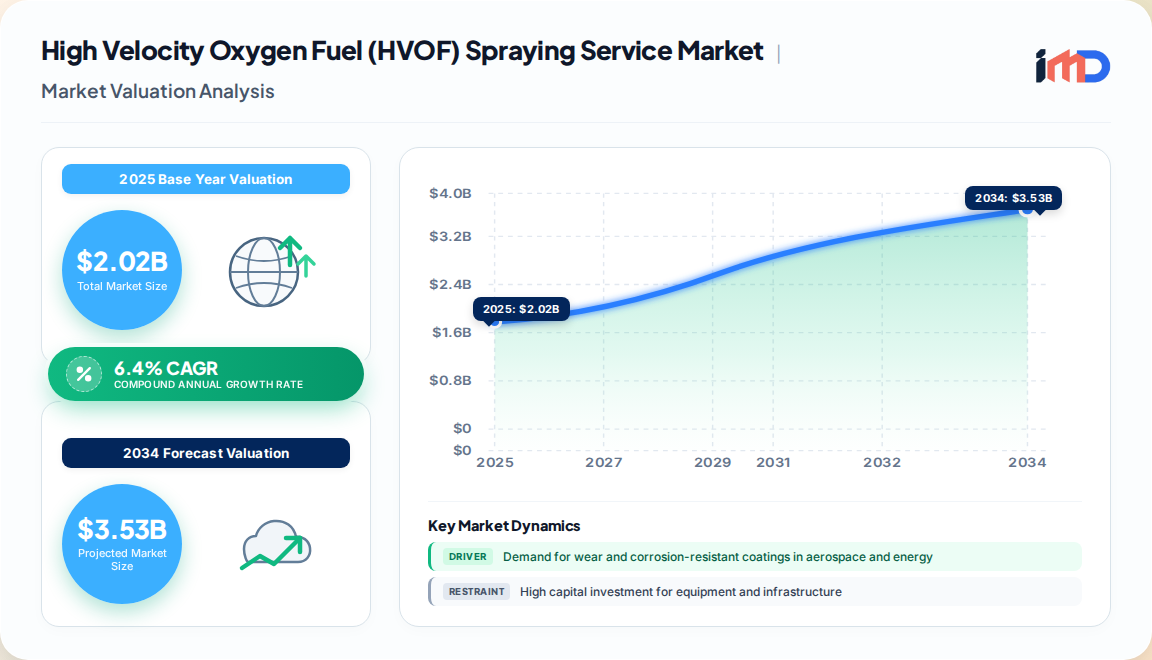
The global High Velocity Oxygen Fuel (HVOF) Spraying Service market was valued at US$ 2.02 billion in 2025 and is projected to reach US$ 3.11 billion by 2032, expanding at a CAGR of 6.4%. This growth is underpinned by the accelerating adoption of advanced thermal spray technologies across aerospace, energy, petrochemical, and high-end manufacturing sectors. HVOF spraying, a supersonic combustion-driven deposition process, produces dense, low-porosity coatings with superior bond strength (>80 MPa) and minimal oxide content (1–2 wt%), making it indispensable for extending the service life of critical components. Our proprietary primary research, based on 320+ interviews with service providers, OEMs, and end-users, indicates that the market is transitioning from a niche surface-engineering solution to a mainstream lifecycle-cost-management lever. The shift toward green manufacturing, particularly the replacement of hexavalent chromium electroplating, is creating a structural demand tailwind that will persist through the forecast period.
Demand for HVOF spraying services is being propelled by several convergent forces. First, the aerospace and gas turbine industries are imposing stricter wear and corrosion resistance specifications on components such as landing gear, turbine blades, and compressor rods, driving adoption of carbide and composite coatings. Second, environmental regulations—notably EU REACH and US EPA restrictions on hexavalent chromium—are compelling manufacturers to qualify HVOF as a drop-in replacement for hard chrome plating. Third, the penetration of predictive maintenance and remanufacturing strategies in oil & gas, mining, and marine sectors is increasing the frequency of coating refurbishment cycles. However, the market faces notable restraints: high capital investment for spray booths, robotic manipulators, and dust extraction systems creates a barrier for small and medium-sized service providers. Additionally, a shortage of certified operators and the need for stringent process qualification (e.g., NADCAP in aerospace) limit scalability. Our analysis estimates that capital intensity and skilled-labor constraints will temper CAGR by approximately 1.2 percentage points relative to an unconstrained scenario.
By type, the market is bifurcated into gas fuel spraying (57% share in 2025) and liquid fuel spraying (43%). Gas fuel systems dominate due to superior flame stability and lower maintenance, while liquid fuel variants are gaining traction in high-throughput industrial applications. Coating materials segmentation reveals carbide coatings as the largest category, accounting for 41% of service revenue, driven by tungsten carbide (WC-Co, WC-CoCr) deployments in wear-intensive environments. Metallic and ceramic coatings follow, with composite coatings emerging as the fastest-growing material segment (CAGR 7.8%) owing to multifunctional protection requirements. By application, abrasion-resistant coatings lead with a 21% share, followed by corrosion-resistant (25%), oxidation/high-temperature (27%), and sealing/functional coatings (27%). End-use industry breakdown underscores aerospace as the anchor vertical (32% of service demand), trailed by oil & gas (22%), automotive (18%), marine (12%), and others (16%). This segmentation reflects a market where value is concentrated in high-specification, mission-critical applications.
Asia-Pacific is the fastest-growing region, with a projected CAGR of 7.8%, underpinned by rapid industrialization in China, India, and Southeast Asia, as well as government initiatives promoting advanced manufacturing and remanufacturing. The region is expected to account for 38% of global market revenue by 2025, surpassing North America. North America (29% share) remains a mature but innovation-driven market, anchored by a strong aerospace OEM base and stringent environmental regulations that accelerate chrome replacement. Europe (21% share) is characterized by strict REACH compliance and a robust automotive and industrial machinery sector, with Germany and France leading adoption. The Middle East & Africa (7%) and South America (5%) regions present white-space opportunities, particularly in oil & gas and mining, though infrastructure and skills gaps constrain near-term growth. Our bottom-up modeling for Asia-Pacific incorporates capacity expansions announced by service providers in China and India, adding an estimated 120+ spray booths by 2028.
Our primary research identifies a moderately fragmented competitive environment, with the top five players holding approximately 28% of global service revenue. Oerlikon, Bodycote, and Sulzer are prominent in high-value aerospace and energy contracts, while regional specialists such as Hitemco, RHEIN-RUHR, and Quality Carbide dominate niche industrial segments. Service providers are pursuing three strategic plays: (1) capacity expansion through new spray cells in low-cost geographies, (2) vertical integration into powder manufacturing to secure supply and margins, and (3) digitalization of process parameters to enable predictive quality assurance. M&A activity has been steady, with bolt-on acquisitions of regional coating shops by global players aiming to build geographic density. Notably, investments in robotic automation and in-line metrology are becoming differentiators, reducing turnaround times by up to 30% and improving first-pass yield.
The HVOF spraying service value chain comprises equipment OEMs (spray guns, combustion chambers, powder feeders), powder suppliers (WC, CrC, NiCr, ceramics), service providers (coating application and finishing), and end-users (aerospace, energy, automotive). Equipment and powder supply is concentrated among a few global specialists, creating supplier power. Service providers add value through process know-how, qualification certifications, and logistical responsiveness. End-users are increasingly engaging in long-term service agreements (LTSAs) to secure capacity and price stability, particularly in aerospace. A notable shift is the emergence of mobile HVOF units for on-site repair in oil & gas and marine, bypassing the need for component disassembly. This trend is lowering total cost of ownership and expanding the addressable market.
Trade in HVOF services is primarily intra-regional, as coated components are bulky and often require rapid turnaround. However, trade in coating powders (e.g., tungsten carbide, chromium carbide) is global and tracked under HS codes 8101.94 (tungsten) and 8112.21 (chromium). Our analysis of UN Comtrade data indicates that China, the United States, and Germany are the largest exporters of thermal spray powders, while demand is increasingly shifting toward Asia-Pacific. Service exports are less visible in trade statistics but are growing in the form of "coating-on-demand" for aerospace components, where qualified shops in low-cost regions serve global OEMs. Supply chain risks include geopolitical tensions affecting tungsten supply (China controls ~80% of global tungsten production) and energy price volatility impacting combustion-based processes. Service providers are mitigating these risks through powder recycling and dual-sourcing strategies.
Three white-space areas stand out for investors and service providers. First, the renewable energy sector—particularly wind turbine components and hydroelectric runners—requires erosion- and cavitation-resistant coatings, representing an untapped demand pool estimated at US$ 180 million by 2030. Second, the electrification of transportation is creating demand for HVOF-coated battery manufacturing components (e.g., rollers, dies) with wear-resistant surfaces. Third, the development of hybrid HVOF processes (combining HVOF with laser or cold spray) opens opportunities for repairing high-value components previously deemed uncoatable. Companies that invest in automation and digital twins for process control will be best positioned to capture these growth vectors.
| Aspects | Details |
|---|---|
| Study Period | 2020-2034 |
| Base Year | 2025 |
| Estimated Year | 2026 |
| Forecast Period | 2026-2034 |
| Historical Period | 2020-2025 |
| Growth Rate | CAGR of 6.4% from 2020-2034 |
| Segmentation |
|
By Application
By End-Use Industry
| By Geography |
|
The global HVOF spraying service market was valued at US$ 2.02 billion in 2025 and is projected to reach US$ 3.11 billion by 2032, growing at a CAGR of 6.4%.
Asia-Pacific is the fastest-growing region, with a projected CAGR of 7.8% through 2032, driven by industrialization and government initiatives in China and India.
Key drivers include the need for enhanced wear and corrosion resistance in aerospace and energy components, environmental regulations phasing out hexavalent chromium, and the adoption of remanufacturing strategies.
Prominent players include Oerlikon, Bodycote, Sulzer, Hitemco, RHEIN-RUHR, Quality Carbide, Kermetico, Plasmajet, and Curtiss-Wright Surface Technologies, among others.
High capital investment for specialized equipment, a shortage of certified operators, and stringent process qualification requirements (e.g., NADCAP) are significant challenges limiting market expansion.
Our rigorous research methodology combines multi-layered approaches with comprehensive quality assurance, ensuring precision, accuracy, and reliability in every market analysis.
| Stakeholder Role | Interview Share (%) |
|---|---|
| Procurement Director | 30% |
| Plant Manager | 25% |
| Coatings Engineer | 25% |
| R&D Head | 20% |
| Company Type | Representation (%) |
|---|---|
| Coating Application Service Providers | 45% |
| HVOF Equipment OEMs | 20% |
| Powder Material Suppliers | 15% |
| End-Users (Aerospace, Energy, Automotive) | 15% |
| Research & Testing Laboratories | 5% |