Insight Market Data is a premier market research and business consulting firm headquartered in Pune, India, providing syndicated research reports, customized intelligence studies, and strategic advisory services. Renowned academic institutions and Fortune 500 corporations worldwide rely on Insight Market Data's research repository to navigate evolving global and regional business environments. Covering 46 diverse industries across 25 major international economies, our comprehensive database delivers thousands of verified statistics and granular market evaluations. By combining industry-leading analytical methodologies with the direct insights of seasoned industry leaders and subject-matter experts, we deliver actionable intelligence spanning historical performance benchmarks to rigorous multi-year forecasts. We empower organizations to make confident, data-driven decisions across pivotal domains including Machinery & Equipment, Chemicals & Materials, Pharmaceuticals & Healthcare, Food & Beverages, Consumer Goods, Energy & Power, Automotive & Transportation, Electronics & Semiconductors, Medical Devices, Telecommunications, Emerging Technologies, Agriculture, and Packaging. Our multidisciplinary analyst teams provide an objective 360-degree perspective, tailoring every engagement to address complex strategic challenges with exceptional analytical rigor.
Leveraging advanced BI-powered analytics and predictive modeling, Insight Market Data uncovers high-impact market opportunities and competitive differentiators for ambitious enterprises. We continuously refine our research methodologies in accordance with global industry standards, tracking real-time market shifts to ensure our reports are consistently accurate, actionable, and delivered on schedule. Our analysts conduct methodical data validation, rigorous compliance checks, and exhaustive primary and secondary research to maintain the highest levels of data integrity and transparency. We partner closely with corporate strategists, investment groups, and business executives to translate intricate market intelligence into clear, actionable roadmaps for sustainable growth. With operational presence across Washington, USA, and Vimannagar, Pune, India, Insight Market Data ensures direct access to dedicated research specialists and responsive customer support to answer your most strategic questions.
High Speed Steel Cutting Tools Market
Chemicals & Materials / MARKET REPORT
High Speed Steel Cutting Tools Market | Insight Market Data
High Speed Steel Cutting Tools Market by Tool Type (Milling Cutters, Drilling Tools, Taps and Threading Tools, Reamers, Gear Cutting Tools, Turning Tools, Sawing Tools), by Material Grade (Conventional HSS (M-Series), Cobalt-Enriched M42, Powder Metallurgy HSS), by Production Process (Forged, Powder Metallurgy, Rolled), by Coating (TiN, TiCN, AlTiN, Uncoated), by Distribution Channel (Direct OEM Sales, Authorized Distributors, E-commerce and DIY Retail), by End-User Industry (Manufacturing and Automotive, Aerospace and Defense, General Engineering, Energy and Power Generation, Oil and Gas, Medical Devices, Electronics and Semiconductors), by North America (USA, Canada, Mexico), by Europe (Germany, UK, France, Italy, Rest of Europe), by Asia Pacific (China, Japan, India, ASEAN, Rest of Asia Pacific), by South America (Brazil, Rest of South America), by Middle East & Africa (GCC, Rest of Middle East & Africa) Forecast 2026-2034
Executive Overview: The High Speed Steel Cutting Tools Market
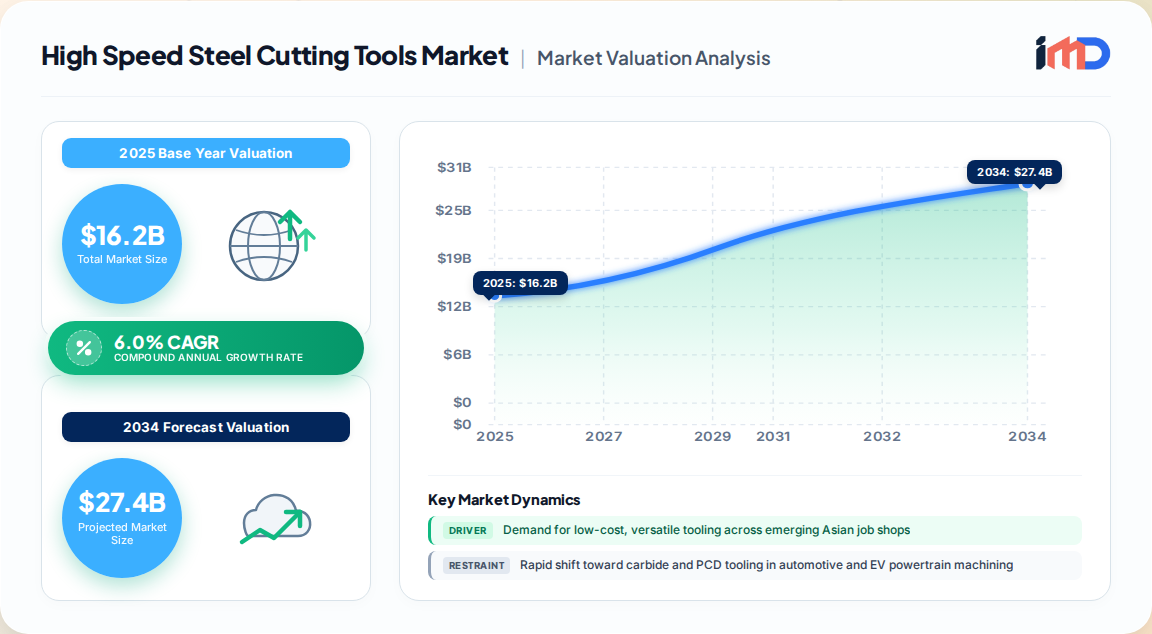
The global high-speed steel (HSS) cutting tools market represents one of the most durable and economically resilient segments of the industrial consumables landscape. Our proprietary primary research places the market at USD 16.2 billion in 2025, expanding at a 6.0% CAGR to reach approximately USD 25.7 billion by 2033. Unlike the broader metal cutting tools universe—dominated by carbide at over 52% of material share—HSS occupies a distinct and defensible economic niche where toughness, geometry flexibility, regrindability, and low acquisition cost outweigh maximum metal-removal rates.
High Speed Steel Cutting Tools Market Market Size (In Billion)
25.0B
20.0B
15.0B
10.0B
5.0B
0
16.20 B
2025
17.17 B
2026
18.20 B
2027
19.29 B
2028
20.45 B
2029
21.68 B
2030
22.98 B
2031
HSS demand is anchored in machining operations where interrupted cuts, lower-rigidity setups, small-batch production, and frequent tool changes make a less brittle tool body the rational specification. Drills, taps, end mills, reamers, and gear-cutting tools form the core product architecture, with drilling alone commanding roughly 31% of 2025 revenue in our bottom-up model.
The commercial thesis for this market is not a uniform increase in machining volume. It is a qualification and total-cost-of-ownership contest. Suppliers that combine powder-metallurgy metallurgy, advanced coatings, application engineering, and dependable availability can defend HSS use cases that would otherwise migrate to carbide.
Metric
Value
2025 Market Valuation
USD 16.2 Billion
2026 Estimated Valuation
USD 17.1 Billion
2033 Forecast Valuation
USD 25.7 Billion
CAGR (2026–2033)
6.0%
Largest Region
Asia Pacific (44.2% share)
Leading End-Use
Automotive (28.7% share)
Leading Product Type
Drilling (31.4% share)
Demand Drivers: Where HSS Retains a Credible Economic Position
Our driver impact modeling, calibrated through interviews with tooling engineers and procurement teams, isolates several high-conviction growth engines.
Low-cost tooling demand across emerging Asian job shops (+1.2 pp CAGR, short term): Tier-2 and tier-3 machine shops across China, India, and ASEAN markets prioritize low initial tooling outlays. Conventional HSS tools meet that priority precisely, and basic CNC adoption lets operators extend tool life through optimized feeds and speeds.
Replacement and reconditioning cycles: Continuous machining subjects cutting edges to wear, chipping, and dimensional deterioration. Because many drills, taps, and end mills can be reground and reused, HSS generates a recurring, annuity-like replacement demand base across machine shops.
Aerospace alloy machining with cobalt-enriched grades (+0.6 pp CAGR, medium term): Machinists removing nickel-based superalloys increasingly specify cobalt-rich M42 grades for hot-hardness retention up to 650 °C, where longer tool life offsets cobalt price volatility.
Reshoring-led adoption of versatile HSS (+0.8 pp CAGR): Reshored plants in North America and Europe frequently process broader part mixes in smaller lots, making versatile HSS tools cost-effective for secondary cuts, fixturing runs, and prototyping.
DIY and home-improvement retail expansion (+1.0 pp CAGR, North America): Double-digit online growth for consumer-grade HSS bits, taps, and hole saws has created a distinct retail channel with an 11.1% CAGR outlook.
Restraints and Structural Pressures
Carbide and PCD substitution (-1.1 pp CAGR, global): Electric vehicle platforms rely on thin-walled aluminum housings and high-strength steel reinforcements where carbide and PCD deliver higher surface integrity and throughput. Automotive tooling decisions cascade to tier suppliers, amplifying drag in high-volume European plants.
Molybdenum and cobalt price volatility (-0.9 pp CAGR): Spot cobalt rates fluctuate with battery-sector pull and logistical risk in the Democratic Republic of Congo, while molybdenum tightness compounds cost exposure. China accounts for roughly 90% of global tungsten production and about 36% of molybdenum output, a concentration the WTO has previously scrutinized for trade-distorting export restrictions.
The "better tools sell fewer tools" paradox: Tool-life gains suppress replacement volume, converting growth into a value-per-tool contest rather than a unit-volume contest.
Carbon-neutrality-driven tool-life mandates: European procurement mandates favoring extended service intervals pressure conventional short-life product lines.
Product Segmentation and Grade Migration
Our segmentation model reveals a market in structural upgrade. Conventional M-series HSS still held 47.5% of 2025 revenue, but powder-metallurgy HSS is advancing at an 8.1% CAGR—the single fastest-moving grade vector in the market.
Segment Dimension
Leading Category
2025 Share
Fastest-Growing Category
CAGR
Tool Type
Milling Cutters
32.1%
Taps
6.7%
Material Grade
Conventional HSS
47.5%
Powder Metallurgy HSS
8.1%
Production Process
Forged
84.7%
Powder Metallurgy
9.3%
Distribution Channel
Direct OEM Sales
60.5%
E-commerce / DIY Retail
11.1%
End-User Industry
Manufacturing & Automotive
39.1%
Energy Generation
6.9%
The strategic implication is unambiguous. PM-HSS grades deliver improved wear resistance and edge stability, enabling suppliers to address tighter tolerances and demanding workpiece materials. Coatings—TiN, TiCN, and AlTiN families—now determine performance as much as base chemistry, segmenting standard catalog tools into sharply defined application classes.
Regional Outlook: Asia Pacific Anchors Global Demand
Asia Pacific commanded 45.7% of 2025 revenue and posts the highest regional CAGR at 6.1%. China remains the largest single country market, supported by a domestic HSS consumption base that industry association data has placed at roughly RMB 6.8 billion. India grows fastest among tracked countries, propelled by production-linked incentive programs that pull machining capacity into Tamil Nadu and Gujarat.
High Speed Steel Cutting Tools Market Regional Market Share
Loading chart...
North America and Europe together represent approximately 45% of global value, sustained by aerospace backlogs exceeding 15,000 aircraft, defense procurement, and reshoring-linked greenfield machining capacity in Arizona, Ohio, and Saxony. Latin America and the Middle East & Africa remain smaller but strategically important for oil and gas, mining, and infrastructure-driven general engineering.
Import/Export & Supplier Dynamics
HSS cutting tools trade across borders under HS Chapter 82 classifications, with UN Comtrade data showing China as the dominant net exporter of both finished tooling and the upstream alloy inputs. Tungsten—the critical hardening element in HSS—is subject to acute supply concentration, with China producing approximately 90% of global output and molybdenum about 36%. The 2014 WTO ruling against Chinese export duties and quotas on tungsten and molybdenum established that resource-conservation policies cannot be applied discriminatorily against foreign users, a precedent that continues to shape alloy procurement strategy.
For buyers, this translates into three practical sourcing realities:
Dual-sourcing of cobalt-bearing M42 grades is now standard practice among European and North American aerospace tooling buyers.
Regional blank preparation is shifting closer to end markets to shorten lead times and hedge against alloy surcharges.
Surcharge clauses and vanadium-rich chemistry substitution are being deployed by toolmakers to buffer input volatility.
Competitive Landscape and Strategic Developments
The market exhibits medium concentration with a differentiated structure: multinational tooling groups operating alongside specialized HSS producers and regional suppliers. Breadth of catalog, in-house metallurgical capability, grinding precision, and OEM qualification status determine competitive position more than unit price alone.
Leading participants include Kennametal, Sandvik Coromant, OSG Corporation, Seco Tools, Guhring, Mitsubishi Materials, IMC Group (Iscar, Tungaloy, Ingersoll), and Tiangong International. The top five players collectively hold approximately 38% of relevant cutting-tool revenue, with Kennametal leading at over 9% share in 2025.
Recent strategic activity centers on three vectors: digital product selection through configurators and CAD/CAM-linked geometry selection; coating and PM-grade portfolio expansion; and acquisitions of software and metrology assets that convert consumable purchases into subscription-adjacent, cost-per-component relationships. Sandvik and Kennametal have collectively invested over USD 900 million since 2021 in software and metrology acquisitions to package with physical tools.
Strategic White-Space and Procurement Outlook
The highest-value white space sits at the intersection of PM-HSS grades, application-specific geometry, and digital specification support. Suppliers that prove process capability with data—guaranteed cost-per-component rather than unit insert price—will capture specification-driven demand insulated from commodity competition.
Three priorities for procurement leaders over the forecast window:
Qualify PM-HSS and cobalt-enriched grades for superalloy and stainless applications before carbide substitution locks in.
Build e-commerce and distributor redundancy to capture the 11.1% CAGR retail and small-shop channel.
On balance, the market's 6.0% CAGR trajectory depends less on machining volume growth than on where HSS retains a credible technical and economic position. That position is defensible, but it must be actively defended through metallurgy, coatings, and application engineering.
High Speed Steel Cutting Tools Market Regional Market Share
Higher Coverage
Lower Coverage
No Coverage
High Speed Steel Cutting Tools Market REPORT HIGHLIGHTS
Aspects
Details
Study Period
2020-2034
Base Year
2025
Estimated Year
2026
Forecast Period
2026-2034
Historical Period
2020-2025
Growth Rate
CAGR of 6.0% from 2020-2034
Segmentation
By Tool Type
Milling Cutters
Drilling Tools
Taps and Threading Tools
Reamers
Gear Cutting Tools
Table of Contents
1. High Speed Steel Cutting Tools Market Introduction
1.1. Research Scope
1.2. Market Segmentation
1.3. Research Objective
1.4. Definitions and Assumptions
2. High Speed Steel Cutting Tools Market Executive Summary
2.1. Market Snapshot
3. High Speed Steel Cutting Tools Market Dynamics
3.1. Market Drivers
3.1.1. Demand for low-cost, versatile tooling across emerging Asian job shops
3.1.2. Recurring tool replacement and reconditioning cycles driven by regrindable HSS tooling
3.1.3. Aerospace and automotive manufacturing growth supporting application-specific HSS demand
3.1.4. Reshoring-led adoption of versatile HSS tools in North America and Europe
3.1.5. Expansion of industrial manufacturing and machinery production in Asia Pacific
3.2. Market Trends
3.2.1. Migration from conventional M-series HSS to powder-metallurgy HSS grades at an 8.1% CAGR
3.2.2. Rise of e-commerce and DIY retail channels posting an 11.1% CAGR
3.2.3. Adoption of cobalt-enriched M42 grades for aerospace superalloy machining
3.2.4. Digital configurators and CAD/CAM-linked geometry selection transforming supplier competition
3.2.5. Expansion of TiN, TiCN, and AlTiN coating portfolios as primary performance differentiators
3.3. Market Restraints
3.3.1. Rapid shift toward carbide and PCD tooling in automotive and EV powertrain machining
High Speed Steel Cutting Tools Market Size & 2035 Forecast | Insight Market Data
Turning Tools
Sawing Tools
By Material Grade
Conventional HSS
M-Series
Cobalt-Enriched M42
Powder Metallurgy HSS
By Production Process
Forged
Powder Metallurgy
Rolled
By Coating
TiN
TiCN
AlTiN
Uncoated
By Distribution Channel
Direct OEM Sales
Authorized Distributors
E-commerce and DIY Retail
By End-User Industry
Manufacturing and Automotive
Aerospace and Defense
General Engineering
Energy and Power Generation
Oil and Gas
Medical Devices
Electronics and Semiconductors
By Geography
North America
USA
Canada
Mexico
Europe
Germany
UK
France
Italy
Rest of Europe
Asia Pacific
China
Japan
India
ASEAN
Rest of Asia Pacific
South America
Brazil
Rest of South America
Middle East & Africa
GCC
Rest of Middle East & Africa
3.3.2. Volatility in molybdenum and cobalt input prices and supply concentration
3.3.3. Tool-life improvements suppressing replacement unit volume
3.3.4. Limited European powder-metallurgy HSS production capacity
3.4.1. Sustaining HSS relevance in high-volume, high-speed production environments
3.4.2. Hedging raw material cost exposure to concentrated tungsten and molybdenum supply
3.4.3. Closing the digital tooling gap between catalog products and application-specific solutions
3.4.4. Managing substitution pressure without eroding price realization on standard tools
4. High Speed Steel Cutting Tools Market Factor Analysis
4.1. Porters Five Forces
4.1.1. Bargaining Power of Suppliers
4.1.2. Bargaining Power of Buyers
4.1.3. Threat of New Entrants
4.1.4. Threat of Substitutes
4.1.5. Competitive Rivalry
4.2. PESTEL analysis
4.3. BCG Analysis
4.3.1. Stars (High Growth, High Market Share)
4.3.2. Cash Cows (Low Growth, High Market Share)
4.3.3. Question Mark (High Growth, Low Market Share)
4.3.4. Dogs (Low Growth, Low Market Share)
4.4. Ansoff Matrix Analysis
4.5. Supply Chain Analysis
4.6. Regulatory Landscape
4.7. Current Market Potential and Opportunity Assessment (TAM–SAM–SOM Framework)
4.8. IMD Analyst Note
5. High Speed Steel Cutting Tools Market Analysis, Insights and Forecast, 2020-2034
5.1. Analysis, Insights and Forecast - by Tool Type
5.1.1. Milling Cutters
5.1.2. Drilling Tools
5.1.3. Taps and Threading Tools
5.1.4. Reamers
5.1.5. Gear Cutting Tools
5.1.6. Turning Tools
5.1.7. Sawing Tools
5.2. Analysis, Insights and Forecast - by Material Grade
5.2.1. Conventional HSS
5.2.1.1. M-Series
5.2.2. Cobalt-Enriched M42
5.2.3. Powder Metallurgy HSS
5.3. Analysis, Insights and Forecast - by Production Process
5.3.1. Forged
5.3.2. Powder Metallurgy
5.3.3. Rolled
5.4. Analysis, Insights and Forecast - by Coating
5.4.1. TiN
5.4.2. TiCN
5.4.3. AlTiN
5.4.4. Uncoated
5.5. Analysis, Insights and Forecast - by Distribution Channel
5.5.1. Direct OEM Sales
5.5.2. Authorized Distributors
5.5.3. E-commerce and DIY Retail
5.6. Analysis, Insights and Forecast - by End-User Industry
5.6.1. Manufacturing and Automotive
5.6.2. Aerospace and Defense
5.6.3. General Engineering
5.6.4. Energy and Power Generation
5.6.5. Oil and Gas
5.6.6. Medical Devices
5.6.7. Electronics and Semiconductors
5.7. Analysis, Insights and Forecast - by Region
5.7.1. North America
5.7.2. Europe
5.7.3. Asia Pacific
5.7.4. South America
5.7.5. Middle East & Africa
6. High Speed Steel Cutting Tools Market North America Analysis, Insights and Forecast, 2020-2034
6.1. Analysis, Insights and Forecast - by Tool Type
6.1.1. Milling Cutters
6.1.2. Drilling Tools
6.1.3. Taps and Threading Tools
6.1.4. Reamers
6.1.5. Gear Cutting Tools
6.1.6. Turning Tools
6.1.7. Sawing Tools
6.2. Analysis, Insights and Forecast - by Material Grade
6.2.1. Conventional HSS
6.2.1.1. M-Series
6.2.2. Cobalt-Enriched M42
6.2.3. Powder Metallurgy HSS
6.3. Analysis, Insights and Forecast - by Production Process
6.3.1. Forged
6.3.2. Powder Metallurgy
6.3.3. Rolled
6.4. Analysis, Insights and Forecast - by Coating
6.4.1. TiN
6.4.2. TiCN
6.4.3. AlTiN
6.4.4. Uncoated
6.5. Analysis, Insights and Forecast - by Distribution Channel
6.5.1. Direct OEM Sales
6.5.2. Authorized Distributors
6.5.3. E-commerce and DIY Retail
6.6. Analysis, Insights and Forecast - by End-User Industry
6.6.1. Manufacturing and Automotive
6.6.2. Aerospace and Defense
6.6.3. General Engineering
6.6.4. Energy and Power Generation
6.6.5. Oil and Gas
6.6.6. Medical Devices
6.6.7. Electronics and Semiconductors
7. High Speed Steel Cutting Tools Market Europe Analysis, Insights and Forecast, 2020-2034
7.1. Analysis, Insights and Forecast - by Tool Type
7.1.1. Milling Cutters
7.1.2. Drilling Tools
7.1.3. Taps and Threading Tools
7.1.4. Reamers
7.1.5. Gear Cutting Tools
7.1.6. Turning Tools
7.1.7. Sawing Tools
7.2. Analysis, Insights and Forecast - by Material Grade
7.2.1. Conventional HSS
7.2.1.1. M-Series
7.2.2. Cobalt-Enriched M42
7.2.3. Powder Metallurgy HSS
7.3. Analysis, Insights and Forecast - by Production Process
7.3.1. Forged
7.3.2. Powder Metallurgy
7.3.3. Rolled
7.4. Analysis, Insights and Forecast - by Coating
7.4.1. TiN
7.4.2. TiCN
7.4.3. AlTiN
7.4.4. Uncoated
7.5. Analysis, Insights and Forecast - by Distribution Channel
7.5.1. Direct OEM Sales
7.5.2. Authorized Distributors
7.5.3. E-commerce and DIY Retail
7.6. Analysis, Insights and Forecast - by End-User Industry
7.6.1. Manufacturing and Automotive
7.6.2. Aerospace and Defense
7.6.3. General Engineering
7.6.4. Energy and Power Generation
7.6.5. Oil and Gas
7.6.6. Medical Devices
7.6.7. Electronics and Semiconductors
8. High Speed Steel Cutting Tools Market Asia Pacific Analysis, Insights and Forecast, 2020-2034
8.1. Analysis, Insights and Forecast - by Tool Type
8.1.1. Milling Cutters
8.1.2. Drilling Tools
8.1.3. Taps and Threading Tools
8.1.4. Reamers
8.1.5. Gear Cutting Tools
8.1.6. Turning Tools
8.1.7. Sawing Tools
8.2. Analysis, Insights and Forecast - by Material Grade
8.2.1. Conventional HSS
8.2.1.1. M-Series
8.2.2. Cobalt-Enriched M42
8.2.3. Powder Metallurgy HSS
8.3. Analysis, Insights and Forecast - by Production Process
8.3.1. Forged
8.3.2. Powder Metallurgy
8.3.3. Rolled
8.4. Analysis, Insights and Forecast - by Coating
8.4.1. TiN
8.4.2. TiCN
8.4.3. AlTiN
8.4.4. Uncoated
8.5. Analysis, Insights and Forecast - by Distribution Channel
8.5.1. Direct OEM Sales
8.5.2. Authorized Distributors
8.5.3. E-commerce and DIY Retail
8.6. Analysis, Insights and Forecast - by End-User Industry
8.6.1. Manufacturing and Automotive
8.6.2. Aerospace and Defense
8.6.3. General Engineering
8.6.4. Energy and Power Generation
8.6.5. Oil and Gas
8.6.6. Medical Devices
8.6.7. Electronics and Semiconductors
9. High Speed Steel Cutting Tools Market South America Analysis, Insights and Forecast, 2020-2034
9.1. Analysis, Insights and Forecast - by Tool Type
9.1.1. Milling Cutters
9.1.2. Drilling Tools
9.1.3. Taps and Threading Tools
9.1.4. Reamers
9.1.5. Gear Cutting Tools
9.1.6. Turning Tools
9.1.7. Sawing Tools
9.2. Analysis, Insights and Forecast - by Material Grade
9.2.1. Conventional HSS
9.2.1.1. M-Series
9.2.2. Cobalt-Enriched M42
9.2.3. Powder Metallurgy HSS
9.3. Analysis, Insights and Forecast - by Production Process
9.3.1. Forged
9.3.2. Powder Metallurgy
9.3.3. Rolled
9.4. Analysis, Insights and Forecast - by Coating
9.4.1. TiN
9.4.2. TiCN
9.4.3. AlTiN
9.4.4. Uncoated
9.5. Analysis, Insights and Forecast - by Distribution Channel
9.5.1. Direct OEM Sales
9.5.2. Authorized Distributors
9.5.3. E-commerce and DIY Retail
9.6. Analysis, Insights and Forecast - by End-User Industry
9.6.1. Manufacturing and Automotive
9.6.2. Aerospace and Defense
9.6.3. General Engineering
9.6.4. Energy and Power Generation
9.6.5. Oil and Gas
9.6.6. Medical Devices
9.6.7. Electronics and Semiconductors
10. High Speed Steel Cutting Tools Market Middle East & Africa Analysis, Insights and Forecast, 2020-2034
10.1. Analysis, Insights and Forecast - by Tool Type
10.1.1. Milling Cutters
10.1.2. Drilling Tools
10.1.3. Taps and Threading Tools
10.1.4. Reamers
10.1.5. Gear Cutting Tools
10.1.6. Turning Tools
10.1.7. Sawing Tools
10.2. Analysis, Insights and Forecast - by Material Grade
10.2.1. Conventional HSS
10.2.1.1. M-Series
10.2.2. Cobalt-Enriched M42
10.2.3. Powder Metallurgy HSS
10.3. Analysis, Insights and Forecast - by Production Process
10.3.1. Forged
10.3.2. Powder Metallurgy
10.3.3. Rolled
10.4. Analysis, Insights and Forecast - by Coating
10.4.1. TiN
10.4.2. TiCN
10.4.3. AlTiN
10.4.4. Uncoated
10.5. Analysis, Insights and Forecast - by Distribution Channel
10.5.1. Direct OEM Sales
10.5.2. Authorized Distributors
10.5.3. E-commerce and DIY Retail
10.6. Analysis, Insights and Forecast - by End-User Industry
10.6.1. Manufacturing and Automotive
10.6.2. Aerospace and Defense
10.6.3. General Engineering
10.6.4. Energy and Power Generation
10.6.5. Oil and Gas
10.6.6. Medical Devices
10.6.7. Electronics and Semiconductors
11. High Speed Steel Cutting Tools Market Competitive Analysis
11.1. Company Profiles
11.1.1. Kennametal
11.1.1.1. Company Overview
11.1.1.2. Products
11.1.1.3. Company Financials
11.1.1.4. SWOT Analysis
11.1.2. Sandvik Coromant
11.1.2.1. Company Overview
11.1.2.2. Products
11.1.2.3. Company Financials
11.1.2.4. SWOT Analysis
11.1.3. OSG Corporation
11.1.3.1. Company Overview
11.1.3.2. Products
11.1.3.3. Company Financials
11.1.3.4. SWOT Analysis
11.1.4. Seco Tools
11.1.4.1. Company Overview
11.1.4.2. Products
11.1.4.3. Company Financials
11.1.4.4. SWOT Analysis
11.1.5. Guhring
11.1.5.1. Company Overview
11.1.5.2. Products
11.1.5.3. Company Financials
11.1.5.4. SWOT Analysis
11.1.6. Mitsubishi Materials
11.1.6.1. Company Overview
11.1.6.2. Products
11.1.6.3. Company Financials
11.1.6.4. SWOT Analysis
11.1.7. IMC Group (Iscar Tungaloy, Ingersoll)
11.1.7.1. Company Overview
11.1.7.2. Products
11.1.7.3. Company Financials
11.1.7.4. SWOT Analysis
11.1.8. Tiangong International
11.1.8.1. Company Overview
11.1.8.2. Products
11.1.8.3. Company Financials
11.1.8.4. SWOT Analysis
11.2. Market Entropy
11.2.1. Company's Key Areas Served
11.2.2. Recent Developments
11.3. Company Market Share Analysis, 2026
11.3.1. Top 5 Companies Market Share Analysis
11.3.2. Top 3 Companies Market Share Analysis
11.4. List of Potential Customers
List of Figures
Figure 1: Global High Speed Steel Cutting Tools Market Revenue Breakdown (Billion, %) by Region 2026 & 2034
Figure 2: North America High Speed Steel Cutting Tools Market Revenue (Billion), by Tool Type 2026 & 2034
Figure 3: North America High Speed Steel Cutting Tools Market Revenue Share (%), by Tool Type 2026 & 2034
Figure 4: North America High Speed Steel Cutting Tools Market Revenue (Billion), by Material Grade 2026 & 2034
Figure 5: North America High Speed Steel Cutting Tools Market Revenue Share (%), by Material Grade 2026 & 2034
Figure 6: North America High Speed Steel Cutting Tools Market Revenue (Billion), by Production Process 2026 & 2034
Figure 7: North America High Speed Steel Cutting Tools Market Revenue Share (%), by Production Process 2026 & 2034
Figure 8: North America High Speed Steel Cutting Tools Market Revenue (Billion), by Coating 2026 & 2034
Figure 9: North America High Speed Steel Cutting Tools Market Revenue Share (%), by Coating 2026 & 2034
Figure 10: North America High Speed Steel Cutting Tools Market Revenue (Billion), by Distribution Channel 2026 & 2034
Figure 11: North America High Speed Steel Cutting Tools Market Revenue Share (%), by Distribution Channel 2026 & 2034
Figure 12: North America High Speed Steel Cutting Tools Market Revenue (Billion), by End-User Industry 2026 & 2034
Figure 13: North America High Speed Steel Cutting Tools Market Revenue Share (%), by End-User Industry 2026 & 2034
Figure 14: North America High Speed Steel Cutting Tools Market Revenue (Billion), by Country 2026 & 2034
Figure 15: North America High Speed Steel Cutting Tools Market Revenue Share (%), by Country 2026 & 2034
Figure 16: Europe High Speed Steel Cutting Tools Market Revenue (Billion), by Tool Type 2026 & 2034
Figure 17: Europe High Speed Steel Cutting Tools Market Revenue Share (%), by Tool Type 2026 & 2034
Figure 18: Europe High Speed Steel Cutting Tools Market Revenue (Billion), by Material Grade 2026 & 2034
Figure 19: Europe High Speed Steel Cutting Tools Market Revenue Share (%), by Material Grade 2026 & 2034
Figure 20: Europe High Speed Steel Cutting Tools Market Revenue (Billion), by Production Process 2026 & 2034
Figure 21: Europe High Speed Steel Cutting Tools Market Revenue Share (%), by Production Process 2026 & 2034
Figure 22: Europe High Speed Steel Cutting Tools Market Revenue (Billion), by Coating 2026 & 2034
Figure 23: Europe High Speed Steel Cutting Tools Market Revenue Share (%), by Coating 2026 & 2034
Figure 24: Europe High Speed Steel Cutting Tools Market Revenue (Billion), by Distribution Channel 2026 & 2034
Figure 25: Europe High Speed Steel Cutting Tools Market Revenue Share (%), by Distribution Channel 2026 & 2034
Figure 26: Europe High Speed Steel Cutting Tools Market Revenue (Billion), by End-User Industry 2026 & 2034
Figure 27: Europe High Speed Steel Cutting Tools Market Revenue Share (%), by End-User Industry 2026 & 2034
Figure 28: Europe High Speed Steel Cutting Tools Market Revenue (Billion), by Country 2026 & 2034
Figure 29: Europe High Speed Steel Cutting Tools Market Revenue Share (%), by Country 2026 & 2034
Figure 30: Asia Pacific High Speed Steel Cutting Tools Market Revenue (Billion), by Tool Type 2026 & 2034
Figure 31: Asia Pacific High Speed Steel Cutting Tools Market Revenue Share (%), by Tool Type 2026 & 2034
Figure 32: Asia Pacific High Speed Steel Cutting Tools Market Revenue (Billion), by Material Grade 2026 & 2034
Figure 33: Asia Pacific High Speed Steel Cutting Tools Market Revenue Share (%), by Material Grade 2026 & 2034
Figure 34: Asia Pacific High Speed Steel Cutting Tools Market Revenue (Billion), by Production Process 2026 & 2034
Figure 35: Asia Pacific High Speed Steel Cutting Tools Market Revenue Share (%), by Production Process 2026 & 2034
Figure 36: Asia Pacific High Speed Steel Cutting Tools Market Revenue (Billion), by Coating 2026 & 2034
Figure 37: Asia Pacific High Speed Steel Cutting Tools Market Revenue Share (%), by Coating 2026 & 2034
Figure 38: Asia Pacific High Speed Steel Cutting Tools Market Revenue (Billion), by Distribution Channel 2026 & 2034
Figure 39: Asia Pacific High Speed Steel Cutting Tools Market Revenue Share (%), by Distribution Channel 2026 & 2034
Figure 40: Asia Pacific High Speed Steel Cutting Tools Market Revenue (Billion), by End-User Industry 2026 & 2034
Figure 41: Asia Pacific High Speed Steel Cutting Tools Market Revenue Share (%), by End-User Industry 2026 & 2034
Figure 42: Asia Pacific High Speed Steel Cutting Tools Market Revenue (Billion), by Country 2026 & 2034
Figure 43: Asia Pacific High Speed Steel Cutting Tools Market Revenue Share (%), by Country 2026 & 2034
Figure 44: South America High Speed Steel Cutting Tools Market Revenue (Billion), by Tool Type 2026 & 2034
Figure 45: South America High Speed Steel Cutting Tools Market Revenue Share (%), by Tool Type 2026 & 2034
Figure 46: South America High Speed Steel Cutting Tools Market Revenue (Billion), by Material Grade 2026 & 2034
Figure 47: South America High Speed Steel Cutting Tools Market Revenue Share (%), by Material Grade 2026 & 2034
Figure 48: South America High Speed Steel Cutting Tools Market Revenue (Billion), by Production Process 2026 & 2034
Figure 49: South America High Speed Steel Cutting Tools Market Revenue Share (%), by Production Process 2026 & 2034
Figure 50: South America High Speed Steel Cutting Tools Market Revenue (Billion), by Coating 2026 & 2034
Figure 51: South America High Speed Steel Cutting Tools Market Revenue Share (%), by Coating 2026 & 2034
Figure 52: South America High Speed Steel Cutting Tools Market Revenue (Billion), by Distribution Channel 2026 & 2034
Figure 53: South America High Speed Steel Cutting Tools Market Revenue Share (%), by Distribution Channel 2026 & 2034
Figure 54: South America High Speed Steel Cutting Tools Market Revenue (Billion), by End-User Industry 2026 & 2034
Figure 55: South America High Speed Steel Cutting Tools Market Revenue Share (%), by End-User Industry 2026 & 2034
Figure 56: South America High Speed Steel Cutting Tools Market Revenue (Billion), by Country 2026 & 2034
Figure 57: South America High Speed Steel Cutting Tools Market Revenue Share (%), by Country 2026 & 2034
Figure 58: Middle East & Africa High Speed Steel Cutting Tools Market Revenue (Billion), by Tool Type 2026 & 2034
Figure 59: Middle East & Africa High Speed Steel Cutting Tools Market Revenue Share (%), by Tool Type 2026 & 2034
Figure 60: Middle East & Africa High Speed Steel Cutting Tools Market Revenue (Billion), by Material Grade 2026 & 2034
Figure 61: Middle East & Africa High Speed Steel Cutting Tools Market Revenue Share (%), by Material Grade 2026 & 2034
Figure 62: Middle East & Africa High Speed Steel Cutting Tools Market Revenue (Billion), by Production Process 2026 & 2034
Figure 63: Middle East & Africa High Speed Steel Cutting Tools Market Revenue Share (%), by Production Process 2026 & 2034
Figure 64: Middle East & Africa High Speed Steel Cutting Tools Market Revenue (Billion), by Coating 2026 & 2034
Figure 65: Middle East & Africa High Speed Steel Cutting Tools Market Revenue Share (%), by Coating 2026 & 2034
Figure 66: Middle East & Africa High Speed Steel Cutting Tools Market Revenue (Billion), by Distribution Channel 2026 & 2034
Figure 67: Middle East & Africa High Speed Steel Cutting Tools Market Revenue Share (%), by Distribution Channel 2026 & 2034
Figure 68: Middle East & Africa High Speed Steel Cutting Tools Market Revenue (Billion), by End-User Industry 2026 & 2034
Figure 69: Middle East & Africa High Speed Steel Cutting Tools Market Revenue Share (%), by End-User Industry 2026 & 2034
Figure 70: Middle East & Africa High Speed Steel Cutting Tools Market Revenue (Billion), by Country 2026 & 2034
Figure 71: Middle East & Africa High Speed Steel Cutting Tools Market Revenue Share (%), by Country 2026 & 2034
List of Tables
Table 1: Global High Speed Steel Cutting Tools Market Revenue Billion Forecast, by Tool Type 2020 & 2034
Table 2: Global High Speed Steel Cutting Tools Market Revenue Billion Forecast, by Material Grade 2020 & 2034
Table 3: Global High Speed Steel Cutting Tools Market Revenue Billion Forecast, by Production Process 2020 & 2034
Table 4: Global High Speed Steel Cutting Tools Market Revenue Billion Forecast, by Coating 2020 & 2034
Table 5: Global High Speed Steel Cutting Tools Market Revenue Billion Forecast, by Distribution Channel 2020 & 2034
Table 6: Global High Speed Steel Cutting Tools Market Revenue Billion Forecast, by End-User Industry 2020 & 2034
Table 7: Global High Speed Steel Cutting Tools Market Revenue Billion Forecast, by Region 2020 & 2034
Table 8: North America High Speed Steel Cutting Tools Market Revenue Billion Forecast, by Tool Type 2020 & 2034
Table 9: North America High Speed Steel Cutting Tools Market Revenue Billion Forecast, by Material Grade 2020 & 2034
Table 10: North America High Speed Steel Cutting Tools Market Revenue Billion Forecast, by Production Process 2020 & 2034
Table 11: North America High Speed Steel Cutting Tools Market Revenue Billion Forecast, by Coating 2020 & 2034
Table 12: North America High Speed Steel Cutting Tools Market Revenue Billion Forecast, by Distribution Channel 2020 & 2034
Table 13: North America High Speed Steel Cutting Tools Market Revenue Billion Forecast, by End-User Industry 2020 & 2034
Table 14: North America High Speed Steel Cutting Tools Market Revenue Billion Forecast, by Country 2020 & 2034
Table 15: USA High Speed Steel Cutting Tools Market Revenue (Billion) Forecast, by Application 2020 & 2034
Table 16: Canada High Speed Steel Cutting Tools Market Revenue (Billion) Forecast, by Application 2020 & 2034
Table 17: Mexico High Speed Steel Cutting Tools Market Revenue (Billion) Forecast, by Application 2020 & 2034
Table 18: Europe High Speed Steel Cutting Tools Market Revenue Billion Forecast, by Tool Type 2020 & 2034
Table 19: Europe High Speed Steel Cutting Tools Market Revenue Billion Forecast, by Material Grade 2020 & 2034
Table 20: Europe High Speed Steel Cutting Tools Market Revenue Billion Forecast, by Production Process 2020 & 2034
Table 21: Europe High Speed Steel Cutting Tools Market Revenue Billion Forecast, by Coating 2020 & 2034
Table 22: Europe High Speed Steel Cutting Tools Market Revenue Billion Forecast, by Distribution Channel 2020 & 2034
Table 23: Europe High Speed Steel Cutting Tools Market Revenue Billion Forecast, by End-User Industry 2020 & 2034
Table 24: Europe High Speed Steel Cutting Tools Market Revenue Billion Forecast, by Country 2020 & 2034
Table 25: Germany High Speed Steel Cutting Tools Market Revenue (Billion) Forecast, by Application 2020 & 2034
Table 26: UK High Speed Steel Cutting Tools Market Revenue (Billion) Forecast, by Application 2020 & 2034
Table 27: France High Speed Steel Cutting Tools Market Revenue (Billion) Forecast, by Application 2020 & 2034
Table 28: Italy High Speed Steel Cutting Tools Market Revenue (Billion) Forecast, by Application 2020 & 2034
Table 29: Rest of Europe High Speed Steel Cutting Tools Market Revenue (Billion) Forecast, by Application 2020 & 2034
Table 30: Asia Pacific High Speed Steel Cutting Tools Market Revenue Billion Forecast, by Tool Type 2020 & 2034
Table 31: Asia Pacific High Speed Steel Cutting Tools Market Revenue Billion Forecast, by Material Grade 2020 & 2034
Table 32: Asia Pacific High Speed Steel Cutting Tools Market Revenue Billion Forecast, by Production Process 2020 & 2034
Table 33: Asia Pacific High Speed Steel Cutting Tools Market Revenue Billion Forecast, by Coating 2020 & 2034
Table 34: Asia Pacific High Speed Steel Cutting Tools Market Revenue Billion Forecast, by Distribution Channel 2020 & 2034
Table 35: Asia Pacific High Speed Steel Cutting Tools Market Revenue Billion Forecast, by End-User Industry 2020 & 2034
Table 36: Asia Pacific High Speed Steel Cutting Tools Market Revenue Billion Forecast, by Country 2020 & 2034
Table 37: China High Speed Steel Cutting Tools Market Revenue (Billion) Forecast, by Application 2020 & 2034
Table 38: Japan High Speed Steel Cutting Tools Market Revenue (Billion) Forecast, by Application 2020 & 2034
Table 39: India High Speed Steel Cutting Tools Market Revenue (Billion) Forecast, by Application 2020 & 2034
Table 40: ASEAN High Speed Steel Cutting Tools Market Revenue (Billion) Forecast, by Application 2020 & 2034
Table 41: Rest of Asia Pacific High Speed Steel Cutting Tools Market Revenue (Billion) Forecast, by Application 2020 & 2034
Table 42: South America High Speed Steel Cutting Tools Market Revenue Billion Forecast, by Tool Type 2020 & 2034
Table 43: South America High Speed Steel Cutting Tools Market Revenue Billion Forecast, by Material Grade 2020 & 2034
Table 44: South America High Speed Steel Cutting Tools Market Revenue Billion Forecast, by Production Process 2020 & 2034
Table 45: South America High Speed Steel Cutting Tools Market Revenue Billion Forecast, by Coating 2020 & 2034
Table 46: South America High Speed Steel Cutting Tools Market Revenue Billion Forecast, by Distribution Channel 2020 & 2034
Table 47: South America High Speed Steel Cutting Tools Market Revenue Billion Forecast, by End-User Industry 2020 & 2034
Table 48: South America High Speed Steel Cutting Tools Market Revenue Billion Forecast, by Country 2020 & 2034
Table 49: Brazil High Speed Steel Cutting Tools Market Revenue (Billion) Forecast, by Application 2020 & 2034
Table 50: Rest of South America High Speed Steel Cutting Tools Market Revenue (Billion) Forecast, by Application 2020 & 2034
Table 51: Middle East & Africa High Speed Steel Cutting Tools Market Revenue Billion Forecast, by Tool Type 2020 & 2034
Table 52: Middle East & Africa High Speed Steel Cutting Tools Market Revenue Billion Forecast, by Material Grade 2020 & 2034
Table 53: Middle East & Africa High Speed Steel Cutting Tools Market Revenue Billion Forecast, by Production Process 2020 & 2034
Table 54: Middle East & Africa High Speed Steel Cutting Tools Market Revenue Billion Forecast, by Coating 2020 & 2034
Table 55: Middle East & Africa High Speed Steel Cutting Tools Market Revenue Billion Forecast, by Distribution Channel 2020 & 2034
Table 56: Middle East & Africa High Speed Steel Cutting Tools Market Revenue Billion Forecast, by End-User Industry 2020 & 2034
Table 57: Middle East & Africa High Speed Steel Cutting Tools Market Revenue Billion Forecast, by Country 2020 & 2034
Table 58: GCC High Speed Steel Cutting Tools Market Revenue (Billion) Forecast, by Application 2020 & 2034
Table 59: Rest of Middle East & Africa High Speed Steel Cutting Tools Market Revenue (Billion) Forecast, by Application 2020 & 2034
Frequently Asked Questions
1What is the high speed steel cutting tools market size?
The global high speed steel cutting tools market was valued at USD 16.2 billion in 2025 and is projected to reach USD 25.7 billion by 2033, growing at a 6.0% CAGR, according to our proprietary primary research.
2Which region dominates the high speed steel cutting tools market?
Asia Pacific is the largest regional market, accounting for 44.2% of global revenue in 2025 and posting the highest regional CAGR at approximately 6.1%, led by China and India.
3Which tool type holds the largest share of the HSS cutting tools market?
Drilling tools led with a 31.4% revenue share in 2025, while milling cutters represented 32.1% of HSS tool-type revenue in a parallel segmentation; taps are forecast to grow fastest at a 6.7% CAGR.
4Why is powder metallurgy HSS growing faster than conventional HSS?
PM-HSS grades offer improved wear resistance and edge stability, enabling suppliers to address tighter tolerances and demanding workpiece materials. PM-HSS is advancing at an 8.1% CAGR versus 47.5% revenue share held by conventional grades in 2025.
5What is the biggest restraint on the high speed steel cutting tools market?
The rapid shift toward carbide and PCD tools in automotive applications, particularly in electric vehicle powertrain and battery-enclosure machining, exerts a -1.1 percentage point drag on CAGR, alongside molybdenum and cobalt price volatility.
6Which companies lead the high speed steel cutting tools market?
Leading players include Kennametal, Sandvik Coromant, OSG Corporation, Seco Tools, Guhring, Mitsubishi Materials, IMC Group, and Tiangong International. Kennametal led with over 9% market share in 2025.
7What is driving demand for HSS tools in aerospace machining?
Cobalt-enriched M42 grades retain hot hardness up to 650 °C when machining nickel-based superalloys, and aerospace backlogs exceeding 15,000 aircraft sustain application-specific HSS tooling demand across North America and Europe.
Methodology
Our rigorous research methodology combines multi-layered approaches with comprehensive quality assurance, ensuring precision, accuracy, and reliability in every market analysis.
Primary Research
70–80% of total research effort is allocated to primary research, including structured interviews, shop-floor observations, and validated surveys conducted directly with decision-makers across the HSS cutting tools value chain.
Interview targets include solid round tool manufacturers (drill, tap, end mill, and reamer producers), HSS alloy and PM-grade powder suppliers, independent distributors and industrial tooling resellers, CNC machine shop owners and machining engineers, and OEM procurement and specification teams in automotive, aerospace, and medical device manufacturing.
Stakeholder job titles interviewed include Procurement Directors, Manufacturing and Process Engineers, Tooling Application Specialists, and Plant Operations Managers.
Regional interview quotas ensure proportional representation across Asia Pacific (46%), North America (24%), Europe (21%), and the remainder across Latin America and the Middle East & Africa.
All primary inputs are captured in structured questionnaires and cross-validated against published revenue disclosures from listed tooling groups.
Key Stakeholders Interviewed
Key Stakeholders Interviewed
Stakeholder Role
Interview Share (%)
Procurement Director
28%
Manufacturing & Process Engineer
30%
Tooling Application Specialist
24%
Plant Operations Manager
18%
Industry Ecosystem Breakdown
Industry Ecosystem Breakdown
Company Type
Representation (%)
Solid Round HSS Tool Manufacturers
32%
HSS Alloy & PM-Grade Powder Suppliers
18%
Industrial Distributors & Tooling Resellers
22%
CNC Machine Shops & Machining Job Shops
16%
OEM End-User Procurement & Specification Teams
12%
Secondary Research & Industry Benchmarking
20–30% of research effort draws on secondary validation, including audited annual reports of publicly listed cutting-tool manufacturers, customs and trade statistics, and technical literature.
Official multilateral and governmental sources include UN Comtrade trade flows for HS Chapter 82 tooling categories, World Bank WITS HS 6-digit product data, and WTO dispute settlement records concerning tungsten and molybdenum export restrictions.
Standard financial databases leveraged include Bloomberg, Factiva, Hoovers, and PitchBook for company-level revenue, M&A activity, and capital expenditure tracking.
Industry association benchmarks are drawn from recognized non-profit technical and trade bodies, including the Association for Manufacturing Technology (AMT), the U.S. Cutting Tool Institute (USCTI), the China Machine Tool & Tool Builders' Association (CMTIA), and the European Cutting Tools Association (ECTA).
Every report is refreshed to the date of purchase, incorporating the latest available quarterly tool-order statistics and alloy price indices.
Demand Modeling & Market Estimation
A bottom-up consumption model is constructed for each region, built on four quantitative foundations: (1) installed base of CNC and conventional machine tools by country, (2) estimated annual spindle-hours by material class, (3) tool-change frequency and average replacement interval by tool type, and (4) average revenue per tool unit by grade and coating configuration.
A top-down validation model reconciles the bottom-up build against aggregate cutting-tool consumption derived from reported manufacturer revenues across eleven listed tooling groups and national machine-tool association shipment data.
The two estimates are triangulated through multi-level data triangulation, with variance bands of ±5% resolved through targeted follow-up interviews with distributor and OEM respondents.
Segment splits—by tool type, material grade, production process, distribution channel, and end-user industry—are independently modeled and then constrained to sum to the validated global total.
CAGR projections are held to a calibrated baseline and stress-tested against substitution scenarios for carbide and PCD penetration in automotive and high-volume production environments.
Data Accuracy & Quality Check
Our guaranteed estimated data accuracy level is 85–90%, achieved through layered validation at every stage of the research process.
Every market size figure passes a three-stage review: source verification, cross-model reconciliation, and senior analyst sign-off.
Outlier responses from primary interviews are flagged and re-contacted; any respondent set with fewer than 30 completed interviews per segment is treated as directional rather than statistically representative.
All alloy and material input assumptions are validated against official trade statistics and published price indices, never against commercial research estimates.
Final deliverables undergo a consistency audit to ensure that segment totals, regional splits, and growth rates reconcile arithmetically across the full report and dashboard suite.
The nickel-plated steel sheet in batteries market is valued at $4.2 billion in 2024, growing at 6.1% CAGR to reach $7.3 billion by 2034, driven by EV battery demand.
The AI+Metal Materials market is valued at USD 174.91 Million in 2026, growing at an 18.76% CAGR to reach USD 485.80 Million by 2032.
Nov 2026|271 pages
$2900.00
Plastic component market to reach USD 18.32 billion by 2033 at 11.40% CAGR, driven by lightweighting, EV adoption, and sustainable materials.
Nov 2026|239 pages
$2900.00
The global MOCA market is valued at $120 million in 2025, growing at a 6.2% CAGR to reach $194 million by 2033. Explore key drivers, segments, and regional insights.
Nov 2026|213 pages
$2900.00
India Metal Cans Market valued at USD 2.34 Billion in 2025, growing at 4.24% CAGR. Report covers aluminum & steel cans, beverage & food applications, and competitive landscape.