1What is the current size of the High-End Inertial Sensors Market?
The market is estimated at USD 5.16 Billion in 2025 and is projected to reach USD 8.20 Billion by 2035, growing at a CAGR of 4.75% during the forecast period.
Insight Market Data is a premier market research and business consulting firm headquartered in Pune, India, providing syndicated research reports, customized intelligence studies, and strategic advisory services. Renowned academic institutions and Fortune 500 corporations worldwide rely on Insight Market Data's research repository to navigate evolving global and regional business environments. Covering 46 diverse industries across 25 major international economies, our comprehensive database delivers thousands of verified statistics and granular market evaluations. By combining industry-leading analytical methodologies with the direct insights of seasoned industry leaders and subject-matter experts, we deliver actionable intelligence spanning historical performance benchmarks to rigorous multi-year forecasts. We empower organizations to make confident, data-driven decisions across pivotal domains including Machinery & Equipment, Chemicals & Materials, Pharmaceuticals & Healthcare, Food & Beverages, Consumer Goods, Energy & Power, Automotive & Transportation, Electronics & Semiconductors, Medical Devices, Telecommunications, Emerging Technologies, Agriculture, and Packaging. Our multidisciplinary analyst teams provide an objective 360-degree perspective, tailoring every engagement to address complex strategic challenges with exceptional analytical rigor.
Leveraging advanced BI-powered analytics and predictive modeling, Insight Market Data uncovers high-impact market opportunities and competitive differentiators for ambitious enterprises. We continuously refine our research methodologies in accordance with global industry standards, tracking real-time market shifts to ensure our reports are consistently accurate, actionable, and delivered on schedule. Our analysts conduct methodical data validation, rigorous compliance checks, and exhaustive primary and secondary research to maintain the highest levels of data integrity and transparency. We partner closely with corporate strategists, investment groups, and business executives to translate intricate market intelligence into clear, actionable roadmaps for sustainable growth. With operational presence across Washington, USA, and Vimannagar, Pune, India, Insight Market Data ensures direct access to dedicated research specialists and responsive customer support to answer your most strategic questions.
 High-End Inertial Sensors Market
 by Type (Inertial Measurement Units, Inertial Navigation Systems, Attitude and Heading Reference Systems, Micro Inertial Systems, Miniature Inertial Systems, Geophysical Inertial Systems), by Component (Sensors, Processors, Software and Algorithms), by End-User Industry (Defense and Aerospace, Industrial, Marine and Sub-Sea, Automotive, Commercial, Government, Research), by Navigation Grade (Strategic Grade, Navigation Grade, Industrial Grade), by Technology (MEMS, Fiber Optic Gyroscopes, Ring Laser Gyroscopes), by North America (USA, Canada, Mexico), by Europe (Germany, UK, France, Norway, Belgium), by Asia Pacific (China, Japan, South Korea, India), by South America (Brazil, Argentina), by Middle East and Africa (Saudi Arabia, UAE, Israel) Forecast 2026-2034

Senior Research Analyst


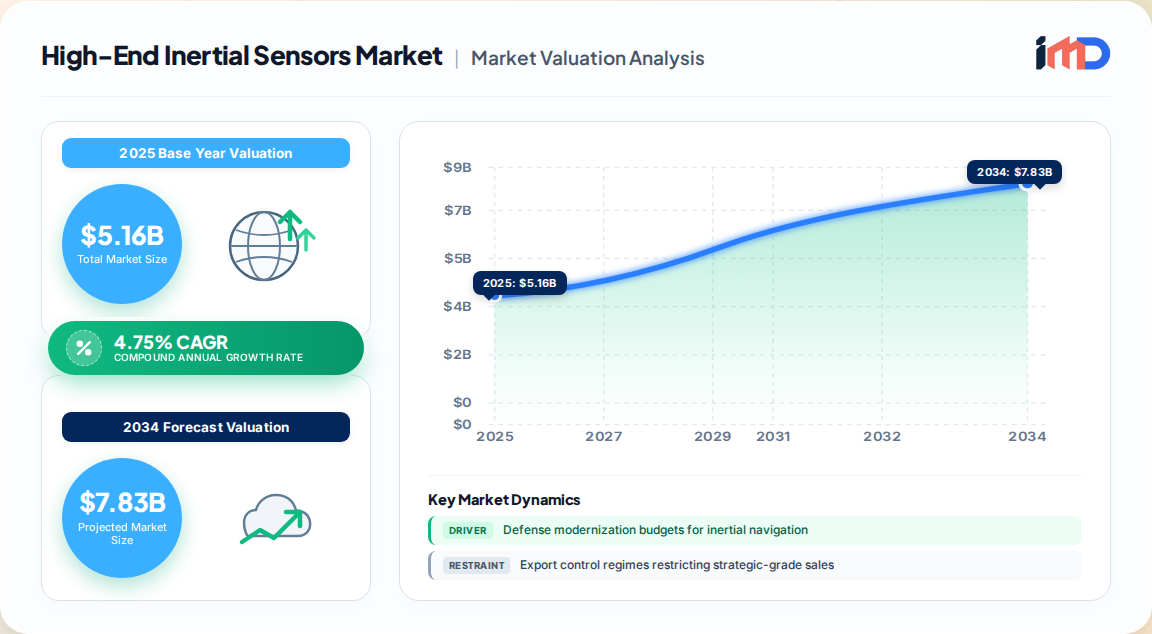
The High-End Inertial Sensors Market is experiencing robust expansion, driven by escalating demand for precision navigation in GNSS-denied environments across defense, aerospace, and industrial automation. Our proprietary primary research estimates the market at USD 5.16 Billion in 2025, projected to reach USD 8.20 Billion by 2035, reflecting a CAGR of 4.75% over the forecast period.
This growth trajectory is underpinned by three structural shifts: the proliferation of autonomous platforms requiring tactical-grade IMUs, defense modernization programs mandating resilient PNT architectures, and the miniaturization of MEMS sensors enabling broader commercial adoption. While North America retains the largest revenue share at 37.65%, the Asia-Pacific region is emerging as the fastest-growing theatre, registering an 8.21% CAGR driven by indigenous navigation programs and defense indigenization.
The demand-side fundamentals remain exceptionally strong, anchored by multi-year procurement cycles and accelerating commercial adoption.
The market structure reveals distinct performance-grade tiers with diverging growth trajectories.
| Segment | 2025 Share | Growth Outlook | Key Insight |
|---|---|---|---|
| Inertial Measurement Units (By Type) | 37.85% | Steady | Dominant form factor across platforms |
| Attitude & Heading Reference Systems | - | 8.28% CAGR | Fastest-growing type through 2031 |
| Sensors (By Component) | 42.15% | Moderate | Core revenue engine; commodity pressure |
| Software & Algorithms | - | 8.37% CAGR | Recurring licensing stream; Kalman-filter stacks |
| Defense & Aerospace (By End-User) | 32.25% | Long-term | Backbone demand, procurement-cycle dependent |
| Industrial (By End-User) | - | 8.74% CAGR | Underground GNSS-denied vehicles driving growth |
| Strategic-Grade (By Navigation Grade) | 33.55% | Stable | High-value, export-controlled |
| Industrial-Grade (By Navigation Grade) | - | 7.62% CAGR | Robotics and IoT trade accuracy for cost |
North America's leadership position is anchored by the presence of major defense primes and a dense aerospace ecosystem. The region accounted for 37.65% of 2025 revenue, supported by programs such as the U.S. Army's Mounted Assured PNT architecture blending fiber-optic gyros with encrypted GPS.
Europe represents a mature but stable market, with naval modernization and offshore wind vessel motion compensation requirements providing incremental demand. The region's regulatory emphasis on sovereign defense capabilities is fostering local supply chain development.
Asia-Pacific is the strategic growth frontier, projected to deliver an 8.21% CAGR through 2031. China's BeiDou-independent navigation initiatives, India's defense indigenization push, and automotive ADAS penetration across Japan and South Korea are the primary growth vectors.
The high-end inertial sensor value chain is characterized by specialized material inputs and vertically integrated Tier-1 integrators.
The market exhibits medium concentration, with established defense primes dominating strategic-grade segments while MEMS specialists challenge in tactical and industrial tiers.
Key competitive dynamics include:
Three high-value opportunity zones emerge from our analysis:
| Aspects | Details |
|---|---|
| Study Period | 2020-2034 |
| Base Year | 2025 |
| Estimated Year | 2026 |
| Forecast Period | 2026-2034 |
| Historical Period | 2020-2025 |
| Growth Rate | CAGR of 4.75% from 2020-2034 |
| Segmentation |
|
By Component
By End-User Industry
By Navigation Grade
By Technology
| By Geography |
|
The market is estimated at USD 5.16 Billion in 2025 and is projected to reach USD 8.20 Billion by 2035, growing at a CAGR of 4.75% during the forecast period.
North America leads the market with a 37.65% revenue share in 2025, driven by major defense primes and a dense aerospace ecosystem. Asia-Pacific is the fastest-growing region at an 8.21% CAGR.
Primary growth drivers include defense modernization budgets, UAV and autonomous vehicle proliferation, MEMS manufacturing advances reducing SWaP, and increasing demand for GNSS-denied navigation in aerospace.
The industrial segment is projected to expand at an 8.74% CAGR through 2031, driven by underground GNSS-denied vehicle deployments and robotics applications.
Key players include Honeywell, Northrop Grumman, Safran, Thales, Collins Aerospace, Rockwell Collins, Kongsberg Gruppen, STMicroelectronics, and InvenSense.
MEMS gyroscope bias instability now falls below 0.1°/h with power consumption under 1 mW, enabling tactical-grade capability in industrial robots, AGVs, and automotive applications at costs below USD 10 per axis in high-volume lines.
Our rigorous research methodology combines multi-layered approaches with comprehensive quality assurance, ensuring precision, accuracy, and reliability in every market analysis.
| Stakeholder Role | Interview Share (%) |
|---|---|
| Chief Technology Officer / VP Engineering | 32% |
| Procurement Director | 28% |
| Program Manager, Navigation Systems | 24% |
| Systems Engineer, Autonomous Platforms | 16% |
| Company Type | Representation (%) |
|---|---|
| Inertial Sensor and IMU OEMs | 32% |
| Fiber-Optic and Ring-Laser Gyroscope Manufacturers | 24% |
| MEMS Fabrication and Semiconductor Foundries | 18% |
| Defense and Aerospace Tier-1 Integrators | 16% |
| Industrial Automation and Robotics Solution Providers | 10% |
 Related Reports
