1What is the current size of the HBPA epoxy resin market?
Our proprietary research values the global HBPA epoxy resin market at USD 2.19 Billion in 2025, with a projected expansion to USD 3.03 Billion by 2032 at a CAGR of 4.8%.
Insight Market Data is a premier market research and business consulting firm headquartered in Pune, India, providing syndicated research reports, customized intelligence studies, and strategic advisory services. Renowned academic institutions and Fortune 500 corporations worldwide rely on Insight Market Data's research repository to navigate evolving global and regional business environments. Covering 46 diverse industries across 25 major international economies, our comprehensive database delivers thousands of verified statistics and granular market evaluations. By combining industry-leading analytical methodologies with the direct insights of seasoned industry leaders and subject-matter experts, we deliver actionable intelligence spanning historical performance benchmarks to rigorous multi-year forecasts. We empower organizations to make confident, data-driven decisions across pivotal domains including Machinery & Equipment, Chemicals & Materials, Pharmaceuticals & Healthcare, Food & Beverages, Consumer Goods, Energy & Power, Automotive & Transportation, Electronics & Semiconductors, Medical Devices, Telecommunications, Emerging Technologies, Agriculture, and Packaging. Our multidisciplinary analyst teams provide an objective 360-degree perspective, tailoring every engagement to address complex strategic challenges with exceptional analytical rigor.
Leveraging advanced BI-powered analytics and predictive modeling, Insight Market Data uncovers high-impact market opportunities and competitive differentiators for ambitious enterprises. We continuously refine our research methodologies in accordance with global industry standards, tracking real-time market shifts to ensure our reports are consistently accurate, actionable, and delivered on schedule. Our analysts conduct methodical data validation, rigorous compliance checks, and exhaustive primary and secondary research to maintain the highest levels of data integrity and transparency. We partner closely with corporate strategists, investment groups, and business executives to translate intricate market intelligence into clear, actionable roadmaps for sustainable growth. With operational presence across Washington, USA, and Vimannagar, Pune, India, Insight Market Data ensures direct access to dedicated research specialists and responsive customer support to answer your most strategic questions.
 HBPA Epoxy Resin Market
 by Form (Liquid, Solid), by Application (Paints and Coatings(Industrial, Special, Architectural), Electrical Insulation, Construction, Adhesives and Sealants, Floorings, Composites, Others), by End-Use Industry (Building and Construction(Residential, Commercial, Industrial, Infrastructure), Automotive(Passenger Cars, LCV, HCV), Electrical and Electronics(Transformers, Insulators, Circuits, Transistors, Solar Panels, Others), Marine, Aerospace, Others), by Reactive Diluent Type (Phenol, Cresol, Xylene, Others), by Viscosity (Low, Medium, High), by Asia-Pacific (China, India, Japan, South Korea, Australia, Indonesia, Taiwan, Malaysia, Rest of Asia-Pacific), by North America (USA, Canada, Mexico), by Europe (Germany, UK, France, Italy, Netherlands, Spain, Russia, Belgium, Rest of Europe), by South America (Brazil, Argentina, Colombia, Chile, Rest of South America), by Middle East and Africa (Saudi Arabia, UAE, South Africa, Nigeria, Rest of Middle East and Africa) Forecast 2026-2034



Senior Analyst
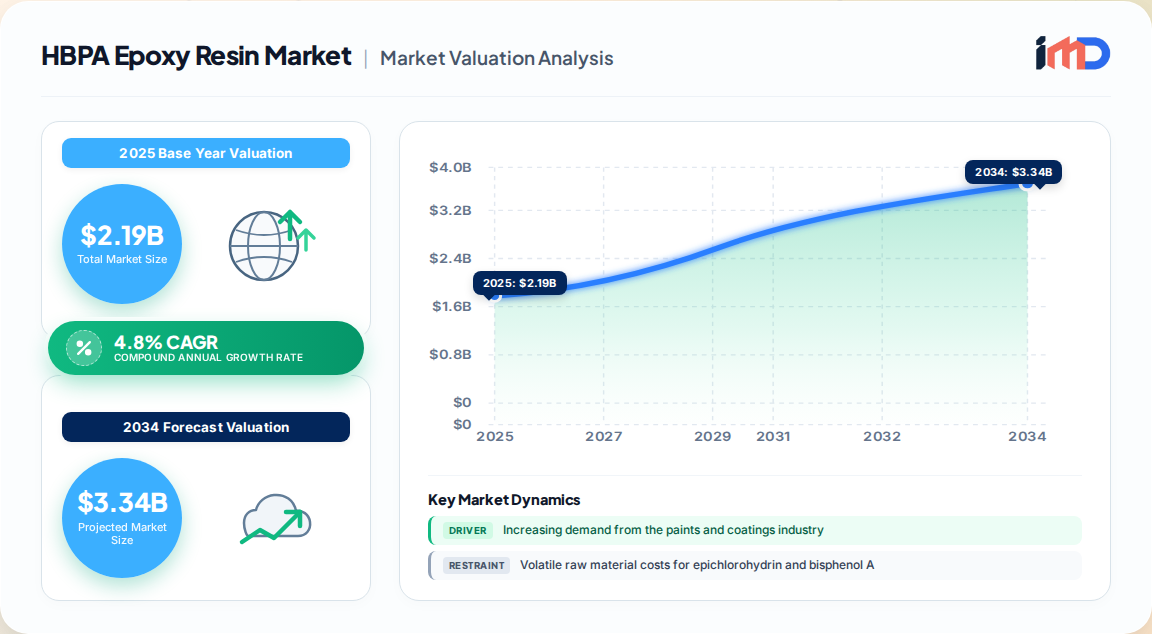
The HBPA epoxy resin market is a specialized segment of the global specialty chemicals and thermoset polymers industry, centered on epoxy systems derived from hydrogenated bisphenol A. Our proprietary bottom-up demand modeling values the global HBPA epoxy resin market at USD 2.19 Billion in 2025, with a projected expansion to USD 3.03 Billion by 2032, reflecting a CAGR of 4.8%. Volume consumption is concentrated in coating and insulation grades, where HBPA resins command a durable premium over conventional DGEBA systems because of their non-yellowing, UV-stable, and high-heat-deflection performance profile.
HBPA epoxy resins are produced through condensation polymerization of epichlorohydrin with hexahydrobisphenol A, obtained by ring hydrogenation of bisphenol A. The resulting cycloaliphatic backbone eliminates the aromatic chromophores responsible for yellowing in standard bisphenol A epoxy resins, which underpins the material's premium positioning in exterior coatings, high-voltage electrical insulation, and demanding composite applications. The market remains partially fragmented, with a low concentration ratio and a long tail of regional formulators competing alongside integrated multinational producers.
| Market Metric | 2025 Baseline | 2032 Outlook |
|---|---|---|
| Global market value | USD 2.19 Billion | USD 3.03 Billion |
| Forecast CAGR (2026-2032) | - | 4.8% |
| Fastest-growing application | - | Electrical insulation at 6.3% CAGR |
| Paints and coatings CAGR | - | 5.2% |
| Dominant region | Asia-Pacific | Asia-Pacific |
| Stage | Key Activities | Value Concentration |
|---|---|---|
| Feedstock | Bisphenol A, hydrogenation, epichlorohydrin production | High - integrated producers capture feedstock margin |
| Resin manufacture | Condensation polymerization, grading, dilution | Medium-high - technology and quality certification driven |
| Formulation | Reactive diluents, curing agents, additives, custom blends | Medium - service-intensive, fragmented |
| Distribution | Technical distributors, direct sales, toll blending | Low-medium |
| End use | Coatings, electrical insulation, construction, composites | End-user specification power |
Upstream hydrogenation of bisphenol A represents the most defensible value-chain position. Companies with captive hydrogenation and epichlorohydrin integration enjoy structural cost advantages and quality consistency that non-integrated formulators cannot easily replicate. Downstream, formulation know-how and application engineering services create stickiness with coating and electrical equipment OEMs.
Trade flows in HBPA epoxy resin follow the broader epoxy trade architecture, with Asia-Pacific functioning as the principal export surplus region and North America and Europe as net importers of formulated grades.
Supplier risk assessment indicates moderate-to-high concentration risk at the hydrogenated bisphenol A stage. Procurement teams should prioritize dual-sourcing for liquid resin grades and qualify at least one alternate supplier for solid grades used in electrical encapsulation.
By Form
By Application
By End-Use Industry
By Reactive Diluent and Viscosity Grade
Asia-Pacific dominates the HBPA epoxy resin market, accounting for an estimated 44% of global value, driven by electronics manufacturing concentration, infrastructure investment, and expanding coatings production in China, India, Japan, and South Korea.
| Region | Est. Share | Growth Profile | Key Demand Drivers |
|---|---|---|---|
| Asia-Pacific | 44% | Fastest growing | Electronics, construction, coatings, renewable energy |
| North America | 24% | Moderate | Electrical equipment, aerospace, advanced coatings |
| Europe | 21% | Moderate | High-performance coatings, electrical insulation, regulatory-driven upgrades |
| South America | 6% | Emerging | Construction, industrial coatings |
| Middle East and Africa | 5% | Emerging | Power infrastructure, construction |
North America generates substantial revenue through advanced manufacturing and early adoption of high-performance materials in automotive, aerospace, and electrical applications. Europe's trajectory is shaped by chemical regulation and premium coatings demand. Emerging regions offer volume growth but face price sensitivity and import dependence.
The market is partially fragmented with low concentration. Integrated multinationals with captive feedstock and global technical service networks compete against regional specialists with formulation agility and local customer proximity.
Key strategic imperatives include:
Profileed participants in this market include Hexion, KUKDO CHEMICAL CO., LTD., Aditya Birla Chemicals (Thailand) Limited (Epoxy Division), Atul Ltd, Mitsubishi Chemical Corporation, Anhui XinYuan Chemical Co. Ltd, Jiangsu Sanmu Group Co. Ltd, Nagase America LLC, Nagase ChemteX Corporation, New Japan Chemical Co. Ltd, Novel Chem, Sir Industriale, and Yantai Aolifu Chemical Co. Ltd.
| Aspects | Details |
|---|---|
| Study Period | 2020-2034 |
| Base Year | 2025 |
| Estimated Year | 2026 |
| Forecast Period | 2026-2034 |
| Historical Period | 2020-2025 |
| Growth Rate | CAGR of 4.8% from 2020-2034 |
| Segmentation |
|
By End-Use Industry
By Reactive Diluent Type
By Viscosity
| By Geography |
|
Our proprietary research values the global HBPA epoxy resin market at USD 2.19 Billion in 2025, with a projected expansion to USD 3.03 Billion by 2032 at a CAGR of 4.8%.
Asia-Pacific is the largest and fastest-growing region, accounting for approximately 44% of global value, driven by electronics manufacturing and construction activity in China, India, Japan, and South Korea.
Electrical insulation is the fastest-growing application at 6.3% CAGR, supported by demand for potting compounds, transformer coatings, insulators, and solar panel protection.
Leading participants include Hexion, KUKDO CHEMICAL CO., LTD., Aditya Birla Chemicals (Thailand) Limited (Epoxy Division), Atul Ltd, and Mitsubishi Chemical Corporation, alongside a long tail of regional formulators.
HBPA epoxy resins offer superior UV and moisture resistance, higher heat deflection temperature, better dimensional stability at elevated temperatures, and resistance to surface yellowing due to their cycloaliphatic backbone.
Volatile raw material costs for epichlorohydrin and bisphenol A, health and handling concerns, substitution pressure from alternative resin systems, and supply chain concentration at the hydrogenation stage are the principal restraints.
Our rigorous research methodology combines multi-layered approaches with comprehensive quality assurance, ensuring precision, accuracy, and reliability in every market analysis.
| Stakeholder Role | Interview Share (%) |
|---|---|
| Procurement Director | 30% |
| Technical and R&D Manager | 28% |
| Plant Operations Manager | 22% |
| Commercial Strategy Lead | 20% |
| Company Type | Representation (%) |
|---|---|
| Integrated Epoxy Resin Manufacturers | 32% |
| Specialty Formulators and Compounders | 28% |
| Coatings and Electrical Insulation OEMs | 22% |
| Chemical Distributors and Toll Blenders | 10% |
| Feedstock Suppliers | 8% |
 Related Reports
