1What is the GPS and GNSS receivers in aviation market size in 2025?
The market is estimated at USD 1.23 billion in 2025 and is projected to reach USD 1.70 billion by 2030, growing at a CAGR of 6.78%.
Insight Market Data is a premier market research and business consulting firm headquartered in Pune, India, providing syndicated research reports, customized intelligence studies, and strategic advisory services. Renowned academic institutions and Fortune 500 corporations worldwide rely on Insight Market Data's research repository to navigate evolving global and regional business environments. Covering 46 diverse industries across 25 major international economies, our comprehensive database delivers thousands of verified statistics and granular market evaluations. By combining industry-leading analytical methodologies with the direct insights of seasoned industry leaders and subject-matter experts, we deliver actionable intelligence spanning historical performance benchmarks to rigorous multi-year forecasts. We empower organizations to make confident, data-driven decisions across pivotal domains including Machinery & Equipment, Chemicals & Materials, Pharmaceuticals & Healthcare, Food & Beverages, Consumer Goods, Energy & Power, Automotive & Transportation, Electronics & Semiconductors, Medical Devices, Telecommunications, Emerging Technologies, Agriculture, and Packaging. Our multidisciplinary analyst teams provide an objective 360-degree perspective, tailoring every engagement to address complex strategic challenges with exceptional analytical rigor.
Leveraging advanced BI-powered analytics and predictive modeling, Insight Market Data uncovers high-impact market opportunities and competitive differentiators for ambitious enterprises. We continuously refine our research methodologies in accordance with global industry standards, tracking real-time market shifts to ensure our reports are consistently accurate, actionable, and delivered on schedule. Our analysts conduct methodical data validation, rigorous compliance checks, and exhaustive primary and secondary research to maintain the highest levels of data integrity and transparency. We partner closely with corporate strategists, investment groups, and business executives to translate intricate market intelligence into clear, actionable roadmaps for sustainable growth. With operational presence across Washington, USA, and Vimannagar, Pune, India, Insight Market Data ensures direct access to dedicated research specialists and responsive customer support to answer your most strategic questions.
 GPS And GNSS Receivers In Aviation Market
 by End-Use (Commercial Aviation, Military Aviation), by Type (Wired Receivers, Wireless Receivers), by Positioning Technology (Standard GPS, GNSS+SBAS, GNSS+GBAS/RAIM/INS), by Functional (Navigation Only, Navigation+Timing, Navigation+Integrity Monitoring), by Application (Civil, Military), by North America (USA, Canada, Mexico), by Europe (Germany, UK, France, Italy, Russia, Rest of Europe), by Asia-Pacific (China, Japan, Korea, India, Australia, Southeast Asia, Rest of Asia-Pacific), by Latin America (Brazil, Rest of Latin America), by Middle East & Africa (GCC Countries, Israel, Turkey, South Africa, Rest of Middle East & Africa) Forecast 2026-2034

Research Associate


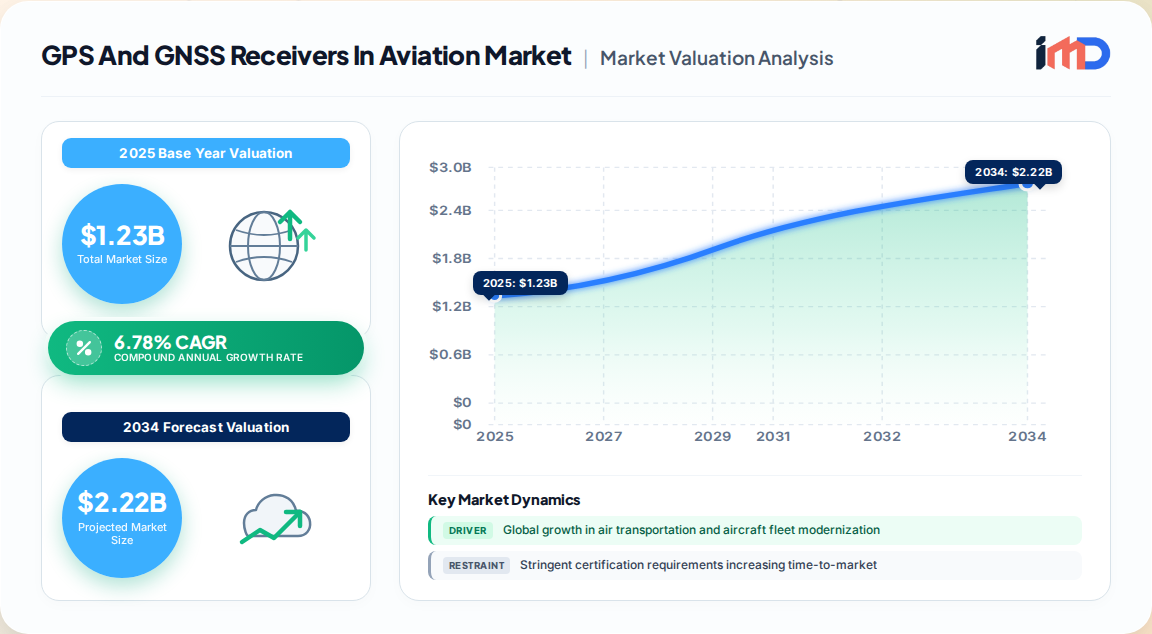
The GPS and GNSS receivers in aviation market is valued at USD 1.23 billion in 2025 and is projected to reach USD 1.70 billion by 2030, expanding at a CAGR of 6.78%. This in-house primary research assessment positions satellite-based navigation receivers as a non-discretionary avionics layer supporting performance-based navigation (PBN), ADS-B position sourcing, precision approaches, and military mission assurance.
Aviation-grade GNSS receivers are no longer standalone black boxes. They are deeply integrated with flight management systems (FMS), autopilots, and air traffic management (ATM) modernization programs. Our interviews with avionics OEMs confirm that new narrowbody and widebody platforms allocate 2–4% of avionics bill-of-material value to GNSS receiver hardware and associated augmentation software.
| Market Metric | 2025 Value | 2030 Value | Growth Trajectory |
|---|---|---|---|
| Global revenue | USD 1.23 billion | USD 1.70 billion | 6.78% CAGR |
| Fastest-growing region | Asia-Pacific | Asia-Pacific | ~6.5% regional CAGR |
| Largest application segment | Military aviation | Military aviation | Highest CAGR |
| Receiver type share | Wired receivers dominant | Wireless gaining | Gradual shift |
Demand is anchored in five structural forces identified through our interviews with tier-one avionics manufacturers and airline engineering directors.
Restraints include certification bottlenecks, GNSS signal interference and spoofing risks, and long avionics retrofit cycles that delay revenue recognition. Despite these frictions, our demand model assigns a low probability to substitution because no alternative navigation source delivers equivalent global coverage at comparable cost.
The value chain spans upstream semiconductor and antenna suppliers through avionics integrators to aircraft OEMs, MRO providers, and defense prime contractors.
Key players shaping the chain include Cobham Limited, Trimble, Inc., Qualcomm Technologies, Inc., Topcon Positioning Systems, Inc., L3Harris Technologies, Inc., Hexagon, Thales Group, CMC Electronics, FreeFlight Systems, Collins Aerospace (RTX), and Trig Avionics. Our primary research indicates a semi-consolidated competitive structure, with the top five suppliers holding an estimated 55–60% of aviation-grade receiver revenues.
The market segments by end-use, receiver type, positioning technology, and function.
| Segment Dimension | Categories | 2025 Share Estimate |
|---|---|---|
| End-use | Commercial aviation, military aviation | Military ~58%, commercial ~42% |
| Type | Wired receivers, wireless receivers | Wired ~65%, wireless ~35% |
| Positioning technology | Standard GPS, GNSS+SBAS, GNSS+GBAS/RAIM/INS | GNSS+SBAS largest |
| Functional | Navigation only, navigation+timing, navigation+integrity monitoring | Navigation+integrity growing |
| Application | Civil, military | Military fastest-growing |
Military aviation is anticipated to grow at the highest CAGR, driven by rising defense budgets and demand for anti-jam, M-Code-compatible receivers. In August 2021, BAE Systems unveiled the MicroGRAM-M, the world's smallest and most power-efficient GPS receiver compatible with next-generation M-Code military GPS. Such miniaturization expands addressable demand into UAVs and munitions.
The civil segment remains the volume anchor, supported by ADS-B equipage and precision approach requirements at secondary airports where ground-based landing aids are uneconomical.
Asia-Pacific is the fastest-growing and largest regional market. China and India drive demand through fleet expansion, new airport construction, and indigenous military aircraft programs. China's projected 1.5 billion aviation passengers by 2036 and India's position as the third-largest domestic aviation market underpin receiver demand.
North America retains technological leadership in anti-jam and military GNSS, anchored by U.S. defense budgets and GPS III constellation modernization. Europe's growth is steady, supported by EGNOS safety-of-life service, which marked 15 years of trusted accuracy in 2026, and Iris satellite-based data link commercialization across European air navigation service providers.
Latin America and the Middle East & Africa offer modest but improving opportunities as fleet renewal and ATM modernization reach secondary markets.
Competition centers on certification depth, multi-constellation performance, and anti-jam capability. Suppliers pursue mergers, partnerships, and regional expansion.
Strategic white-space exists in spoofing-resistant receivers, GNSS-INS deep fusion, and compact receivers for urban air mobility. Our primary research suggests suppliers investing in signal authentication and interference detection will capture disproportionate share of military and high-value civil retrofit programs.
The GPS and GNSS receivers in aviation market offers a predictable, regulation-backed revenue base with 6.78% CAGR through 2030. Investment priorities should target anti-jam and spoofing-resistant architectures, multi-frequency multi-constellation chipsets, and Asia-Pacific manufacturing or partnership footprints.
A key uncertainty is certification timing for advanced integrity monitoring functions. However, the long-term trajectory remains upward, supported by global ADS-B mandates, PBN adoption, and military modernization cycles. Stakeholders across OEMs, MROs, and defense primes should treat GNSS receiver capability as a strategic avionics differentiator rather than a commodity input.
| Aspects | Details |
|---|---|
| Study Period | 2020-2034 |
| Base Year | 2025 |
| Estimated Year | 2026 |
| Forecast Period | 2026-2034 |
| Historical Period | 2020-2025 |
| Growth Rate | CAGR of 6.78% from 2020-2034 |
| Segmentation |
|
By Positioning Technology
By Functional
By Application
| By Geography |
|
The market is estimated at USD 1.23 billion in 2025 and is projected to reach USD 1.70 billion by 2030, growing at a CAGR of 6.78%.
Asia-Pacific is the fastest-growing and largest regional market, driven by fleet expansion in China and India. China is projected to reach 1.5 billion aviation passengers by 2036.
The military aviation segment is anticipated to grow at the highest CAGR, supported by rising defense budgets and demand for anti-jam, M-Code-compatible GNSS receivers.
Key players include Cobham Limited, Trimble, Inc., Qualcomm Technologies, Inc., Topcon Positioning Systems, Inc., L3Harris Technologies, Inc., Hexagon, Thales Group, Collins Aerospace (RTX), CMC Electronics, FreeFlight Systems, and Trig Avionics.
Major trends include multi-constellation and multi-frequency receiver adoption, GNSS resilience and anti-spoofing technology, ADS-B equipage, performance-based navigation, and integration with inertial navigation systems.
Our rigorous research methodology combines multi-layered approaches with comprehensive quality assurance, ensuring precision, accuracy, and reliability in every market analysis.
| Stakeholder Role | Interview Share (%) |
|---|---|
| Avionics Program Director | 30% |
| Chief Navigation Engineer | 28% |
| Procurement Manager | 24% |
| Defense Acquisition Officer | 18% |
| Company Type | Representation (%) |
|---|---|
| GNSS chipset and antenna manufacturers | 22% |
| Avionics systems integrators | 28% |
| Aircraft OEMs and tier-one suppliers | 20% |
| MRO and retrofit service providers | 18% |
| Military prime contractors and procurement agencies | 12% |

Analyst at Providence Strategic Partners at Petaling Jaya
I have received the report already. Thanks you for your help.it has been a pleasure working with you. Thank you again for a good quality report

Internationalization Director
Yes, as a matter of fact we are totally satisfied with both reports that we have purchased and will continue to do so during this process of the internationalization of our brand.

Head of Product Management and Marketing
We are using your report, and it gave us valuable information."

Regional Director, Marketing and Business Development
We've received the report and have reviewed the content. Overall, it looks great and aligns closely with the data we can verify based on our industry knowledge.

VP of Sales
Thank you very much for sharing the report. I have reviewed it and I am very satisfied with the quality and the insights it provides. It will certainly be valuable for our internal discussions.
 Related Reports
