1What is the current size of the global infectious disease drugs market?
The market was valued at USD 189.80 billion in 2025 and is estimated at USD 195.83 billion in 2026. Our primary research projects it to reach USD 228.95 billion by 2031.
Insight Market Data is a premier market research and business consulting firm headquartered in Pune, India, providing syndicated research reports, customized intelligence studies, and strategic advisory services. Renowned academic institutions and Fortune 500 corporations worldwide rely on Insight Market Data's research repository to navigate evolving global and regional business environments. Covering 46 diverse industries across 25 major international economies, our comprehensive database delivers thousands of verified statistics and granular market evaluations. By combining industry-leading analytical methodologies with the direct insights of seasoned industry leaders and subject-matter experts, we deliver actionable intelligence spanning historical performance benchmarks to rigorous multi-year forecasts. We empower organizations to make confident, data-driven decisions across pivotal domains including Machinery & Equipment, Chemicals & Materials, Pharmaceuticals & Healthcare, Food & Beverages, Consumer Goods, Energy & Power, Automotive & Transportation, Electronics & Semiconductors, Medical Devices, Telecommunications, Emerging Technologies, Agriculture, and Packaging. Our multidisciplinary analyst teams provide an objective 360-degree perspective, tailoring every engagement to address complex strategic challenges with exceptional analytical rigor.
Leveraging advanced BI-powered analytics and predictive modeling, Insight Market Data uncovers high-impact market opportunities and competitive differentiators for ambitious enterprises. We continuously refine our research methodologies in accordance with global industry standards, tracking real-time market shifts to ensure our reports are consistently accurate, actionable, and delivered on schedule. Our analysts conduct methodical data validation, rigorous compliance checks, and exhaustive primary and secondary research to maintain the highest levels of data integrity and transparency. We partner closely with corporate strategists, investment groups, and business executives to translate intricate market intelligence into clear, actionable roadmaps for sustainable growth. With operational presence across Washington, USA, and Vimannagar, Pune, India, Insight Market Data ensures direct access to dedicated research specialists and responsive customer support to answer your most strategic questions.
 Global Infectious Disease Drugs Market
 by Disease (HIV, Influenza, Hepatitis, Tuberculosis, Malaria, Opportunistic & other infections), by Treatment Class (Antiviral, Antibacterial, Antiparasitic, Antifungal, Novel phage & CRISPR-based), by Drug Type (Small-molecule, Biologic / mAb, Vaccine-derived therapeutics), by Route of Administration (Oral, Injectable (IV, IM, SC), Transdermal & Inhalational), by Distribution Channel (Hospital Pharmacies, Retail & Chain Pharmacies, Online Pharmacies), by North America (USA, Canada, Mexico), by Europe (Germany, UK, France, Italy, Spain), by Asia Pacific (China, Japan, India, Australia, South Korea), by Middle East & Africa (GCC, South Africa), by Latin America (Brazil, Argentina) Forecast 2026-2034

Research Analyst

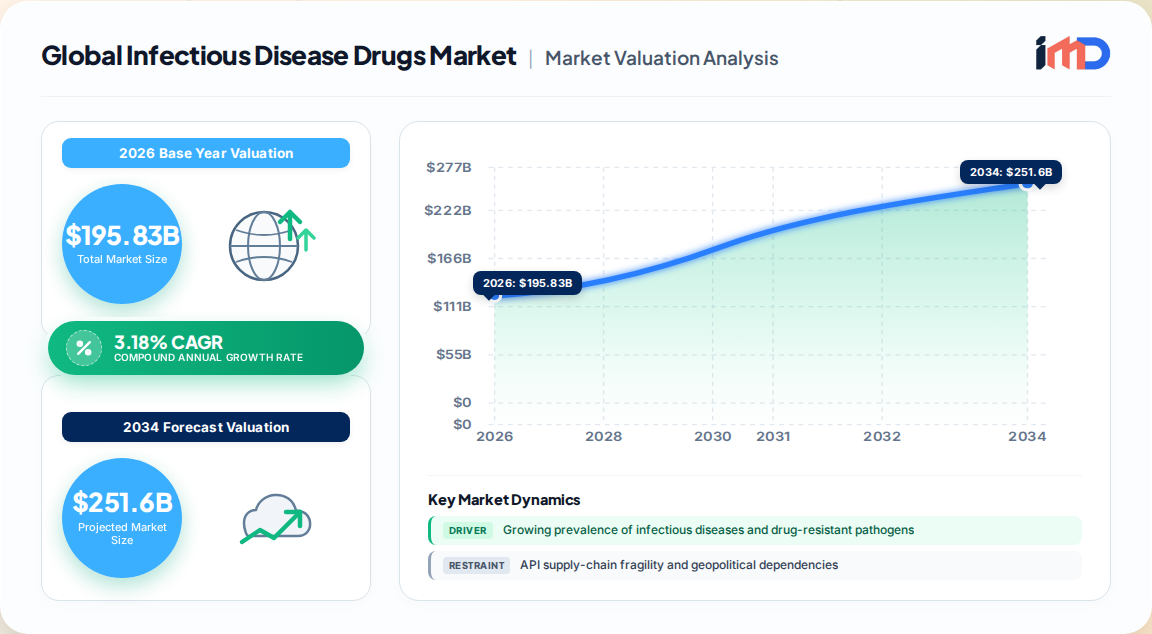
The global infectious disease drugs market represents one of the most structurally vital segments of the pharmaceutical industry, balancing chronic therapy demand with emergency-response imperatives. Our proprietary primary research estimates the market at USD 195.83 billion in 2026, expanding to USD 228.95 billion by 2031 at a CAGR of 3.18% (2026–2031). This trajectory reflects a market transitioning from volume-driven expansion toward resilience-driven innovation, shaped by tight cost-containment policies, stronger pharmacovigilance rules, and value-based purchasing models.
The 2025 base valuation stood at USD 189.80 billion, underscoring steady mid-single-digit growth that is neither explosive nor stagnant. Instead, the market is being re-engineered by three simultaneous forces: the epidemiological burden of drug-resistant pathogens, the maturation of AI-driven discovery platforms, and the geopolitical reconfiguration of active pharmaceutical ingredient (API) supply chains. Notably, 67% of antimicrobial API Drug Master Files are concentrated in India and China, a dependency that has pushed regulators into open discussions about reshoring and supply diversification.
Our driver impact analysis quantifies the forces propelling this market, with each factor assigned a percentage-point impact on the forecast CAGR.
| Driver | Impact on CAGR | Geographic Relevance | Timeline |
|---|---|---|---|
| Growing prevalence of infectious diseases | +0.9% | APAC, MEA | Long term (≥4 years) |
| Rising awareness initiatives by governments & NGOs | +0.8% | Sub-Saharan Africa, Southeast Asia | Medium term (2–4 years) |
| Expanding funding & R&D investments | +0.7% | North America, EU | Medium term (2–4 years) |
| Accelerated regulatory pathways post-COVID-19 | +0.6% | US, EU, Japan | Short term (≤2 years) |
| Long-acting injectables boosting adherence | +0.5% | High-income markets | Medium term (2–4 years) |
| AI-driven antimicrobial discovery platforms | +0.4% | North America, EU, China | Long term (≥4 years) |
Drug-resistant pathogens claim approximately 700,000 lives annually, while tuberculosis affects 10.8 million people globally, with resistant strains spreading rapidly. Artemisinin-resistant malaria has been confirmed in Rwanda and Tanzania, and surveillance in Uganda shows 11% of children harbor partial resistance to front-line malaria therapy. These epidemiological pressures sustain demand for specialized therapies despite stewardship curbs.
On the restraint side, our analysis identifies four principal drags on growth:
| Restraint | Impact on CAGR | Geographic Relevance | Timeline |
|---|---|---|---|
| API supply-chain fragility & geopolitics | -0.8% | US, EU, global | Short term (≤2 years) |
| Low diagnosis & treatment penetration in developing regions | -0.7% | Sub-Saharan Africa, Southeast Asia, rural Latin America | Long term (≥4 years) |
| Antimicrobial stewardship curbing prescriptions | -0.6% | North America, EU, rising in APAC | Short term (≤2 years) |
| Adverse side-effects & toxicity profiles | -0.5% | Global | Medium term (2–4 years) |
Antimicrobial stewardship programs now require pre-authorization for broad-spectrum antibiotics in many hospital systems, cutting usage by up to 30% in some settings. However, remote telehealth visits escape many controls, prompting the deployment of fresh audit tools and prescription surveillance platforms.
Our segment-level analysis reveals a market where legacy chronic therapies fund the innovation pipeline, while next-generation modalities post superior growth rates.
By Disease, HIV therapies led with 36.10% of market share in 2025, a position sustained by lifelong antiretroviral regimens and the advent of long-acting injectable formulations. Hepatitis drugs are forecast to grow fastest at a 3.98% CAGR to 2031, driven by expanded screening and cure-oriented regimens. Influenza, tuberculosis, malaria, and opportunistic infections complete the disease landscape.
By Treatment Class, antivirals accounted for 40.80% of market share in 2025. However, phage and CRISPR-based therapeutics are projected to expand at a 5.41% CAGR through 2031, representing the market's most disruptive innovation frontier. Antibacterials, antiparasitics, and antifungals remain foundational but face pricing pressure and stewardship headwinds.
By Drug Type, small molecules controlled 62.90% of market size in 2025, reflecting their oral bioavailability, manufacturing scalability, and cost advantages. Yet biologics and monoclonal antibodies are expected to post a 5.96% CAGR from 2026 to 2031, driven by precision targeting and improved tolerability profiles.
By Route of Administration, oral products dominated with 68.30% of share in 2025. Injectables are forecast to advance at a 6.18% CAGR, propelled by long-acting depot formulations that improve adherence in HIV and hepatitis management.
By Distribution Channel, hospital pharmacies held 52.05% of market share in 2025, particularly for injectable and infusion-based therapies. Online pharmacies are set to climb at a 7.85% CAGR over the outlook period, accelerated by telemedicine integration and direct-to-patient models.
North America captured 36.20% of global market share in 2025, supported by high treatment penetration, favorable reimbursement frameworks, and concentrated R&D activity. The region remains the primary launch market for novel antimicrobials and biologics.
Asia-Pacific is positioned to lead growth at a 7.28% CAGR to 2031. This acceleration is underpinned by rising healthcare investments, expanding disease surveillance, and large patient pools across China, India, and Southeast Asia. China's regulatory modernization—including the approval of 32 new drugs in a single month, many targeting resistant infections—has shortened approval timelines and improved market access.
Europe maintains a stable position, though EU-wide antimicrobial stewardship blueprints and value-based purchasing models temper volume growth. The Middle East and Africa represent the most underserved region, with low diagnosis and treatment penetration constituting both a persistent restraint and a long-term expansion opportunity.
The market exhibits medium concentration, with major players including AbbVie Inc., Gilead Sciences, Inc., GlaxoSmithKline plc, F. Hoffmann-La Roche Ltd., and Merck & Co., Inc. These companies leverage scale in antiviral and vaccine portfolios while increasingly pairing with technology firms to offset scientific risk.
Key strategic developments observed in our primary research include:
Governments are adding milestone payments to de-risk late-stage R&D, while the Novo Nordisk Foundation has expanded early-stage support through CARB-X. These capital injections push biotech firms to pursue high-risk targets that large pharma once avoided, gradually reshaping the innovation map toward AI-native pipeline builders.
The infectious disease drugs value chain is characterized by a pronounced upstream concentration risk and a downstream shift toward decentralized care.
Global trade in infectious disease drugs is shaped by both legitimate commercial flows and the strategic imperative of supply security. The concentration of API Drug Master Files in India and China—67%—represents the most significant structural vulnerability in the value chain.
Regulators are openly discussing reshoring strategies for essential medicines, and several governments have introduced incentive programs to localize antimicrobial production. These dynamics are expected to gradually reduce geographic concentration over the long term, though near-term dependence remains high.
Our analysis identifies three high-potential white spaces for investment and portfolio expansion:
In parallel, the market's 3.18% CAGR base case masks significant regional divergence: Asia-Pacific's 7.28% CAGR signals that emerging markets are where volume growth will concentrate, even as value growth remains anchored in North America and Europe. Companies that align portfolio, pricing, and channel strategy with this divergence will be best positioned to outperform.
| Aspects | Details |
|---|---|
| Study Period | 2020-2034 |
| Base Year | 2026 |
| Estimated Year | 2026 |
| Forecast Period | 2026-2034 |
| Historical Period | 2020-2025 |
| Growth Rate | CAGR of 3.18% from 2020-2034 |
| Segmentation |
|
By Treatment Class
By Drug Type
By Route of Administration
By Distribution Channel
| By Geography |
|
The market was valued at USD 189.80 billion in 2025 and is estimated at USD 195.83 billion in 2026. Our primary research projects it to reach USD 228.95 billion by 2031.
The global market is forecast to grow at a CAGR of 3.18% from 2026 to 2031. However, high-growth segments such as online pharmacies and biologics are expanding at 7.85% and 5.96% respectively.
North America captured 36.20% of global market share in 2025. Asia-Pacific is the fastest-growing region, projected to expand at 7.28% CAGR through 2031.
Growing prevalence of infectious diseases (+0.9% CAGR impact), rising awareness initiatives (+0.8%), expanding R&D funding (+0.7%), and accelerated regulatory pathways (+0.6%) are the primary drivers.
HIV therapies led with 36.10% of market share in 2025. Hepatitis drugs are forecast to grow fastest at a 3.98% CAGR to 2031.
Key companies include AbbVie Inc., Gilead Sciences, Inc., GlaxoSmithKline plc, F. Hoffmann-La Roche Ltd., and Merck & Co., Inc., among others operating in a medium-concentration competitive landscape.
Our rigorous research methodology combines multi-layered approaches with comprehensive quality assurance, ensuring precision, accuracy, and reliability in every market analysis.
| Stakeholder Role | Interview Share (%) |
|---|---|
| Chief Scientific Officer | 25% |
| VP of Infectious Disease R&D | 30% |
| Director of Antimicrobial Stewardship | 25% |
| Procurement Director | 20% |
| Company Type | Representation (%) |
|---|---|
| Innovative Pharmaceutical Manufacturers | 35% |
| Generic Drug Producers | 25% |
| API & Intermediate Suppliers | 15% |
| Hospital Pharmacy Chains | 15% |
| Digital Pharmacy Platforms | 10% |

 Related Reports
