Insight Market Data is a premier market research and business consulting firm headquartered in Pune, India, providing syndicated research reports, customized intelligence studies, and strategic advisory services. Renowned academic institutions and Fortune 500 corporations worldwide rely on Insight Market Data's research repository to navigate evolving global and regional business environments. Covering 46 diverse industries across 25 major international economies, our comprehensive database delivers thousands of verified statistics and granular market evaluations. By combining industry-leading analytical methodologies with the direct insights of seasoned industry leaders and subject-matter experts, we deliver actionable intelligence spanning historical performance benchmarks to rigorous multi-year forecasts. We empower organizations to make confident, data-driven decisions across pivotal domains including Machinery & Equipment, Chemicals & Materials, Pharmaceuticals & Healthcare, Food & Beverages, Consumer Goods, Energy & Power, Automotive & Transportation, Electronics & Semiconductors, Medical Devices, Telecommunications, Emerging Technologies, Agriculture, and Packaging. Our multidisciplinary analyst teams provide an objective 360-degree perspective, tailoring every engagement to address complex strategic challenges with exceptional analytical rigor.
Leveraging advanced BI-powered analytics and predictive modeling, Insight Market Data uncovers high-impact market opportunities and competitive differentiators for ambitious enterprises. We continuously refine our research methodologies in accordance with global industry standards, tracking real-time market shifts to ensure our reports are consistently accurate, actionable, and delivered on schedule. Our analysts conduct methodical data validation, rigorous compliance checks, and exhaustive primary and secondary research to maintain the highest levels of data integrity and transparency. We partner closely with corporate strategists, investment groups, and business executives to translate intricate market intelligence into clear, actionable roadmaps for sustainable growth. With operational presence across Washington, USA, and Vimannagar, Pune, India, Insight Market Data ensures direct access to dedicated research specialists and responsive customer support to answer your most strategic questions.
German Flooring Market Size, Share & Growth Forecast 2031 | Insight Market Data
German Flooring Market
Real Estate and Construction / MARKET REPORT
German Flooring Market | Insight Market Data
German Flooring Market by Product (Carpet and Area Rugs, Wood Flooring(Wood, Laminate), Ceramic Tiles Flooring, Vinyl Flooring(Vinyl, SPC, LVT), Stone Flooring, Resilient Flooring(VCT, Linoleum, Rubber, Cork), Other Products), by End User (Commercial(Healthcare, Hospitality, Retail, Corporate, Education, Industrial), Residential(New Construction, Replacement/Renovation)), by Distribution Channel (Home Centers, Specialty Stores, Online Retail, Direct Sales, Other), by Germany (South Germany, West Germany, North Germany, East Germany) Forecast 2026-2034
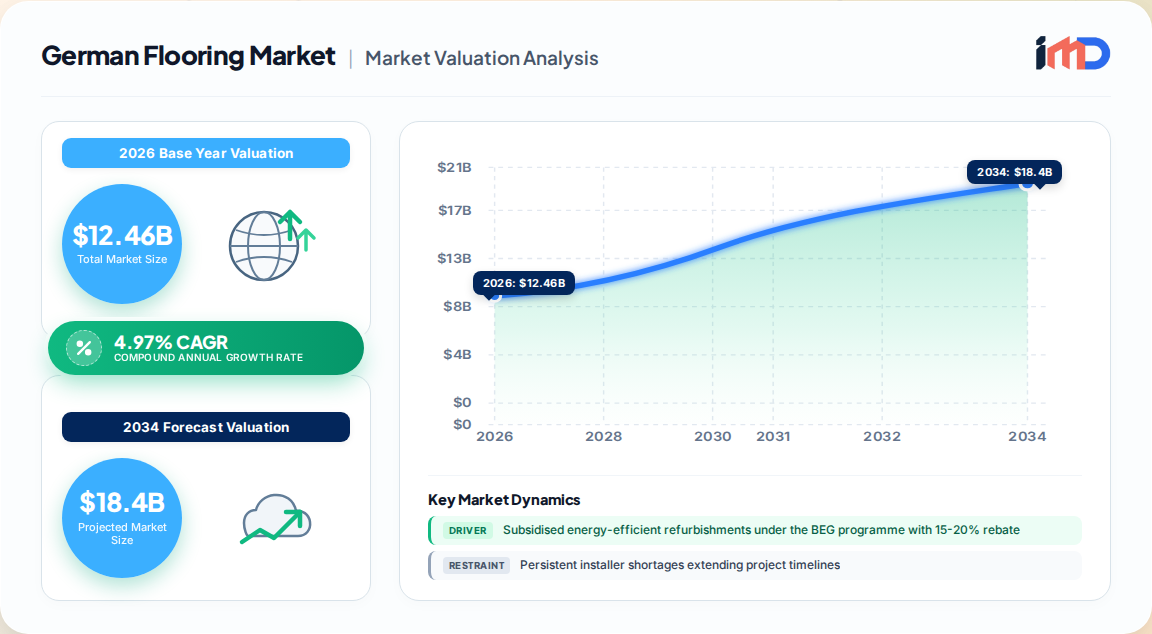
The German flooring market is one of Europe's most resilient and value-dense building-materials segments. Our proprietary primary research places the market at USD 11.87 billion in 2025, rising to USD 12.46 billion in 2026 and projected to reach USD 15.88 billion by 2031, reflecting a CAGR of 4.97% across the forecast window (2026–2031).
German Flooring Market Market Size (In Billion)
20.0B
15.0B
10.0B
5.0B
0
11.87 B
2025
12.46 B
2026
13.08 B
2027
13.73 B
2028
14.41 B
2029
15.13 B
2030
15.88 B
2031
What distinguishes Germany is not headline growth but its composition: a mature, replacement-driven market where renovation outlays are materially less cyclical than new construction starts. Demand is being lifted by government-backed energy-efficiency refurbishment subsidies, a re-urbanisation wave in Tier-2 eastern cities, and a decisive consumer shift toward indoor air quality.
Market size 2025: USD 11.87 billion
Market size 2026: USD 12.46 billion
Forecast 2031: USD 15.88 billion
CAGR 2026–2031: 4.97%
Market concentration: Medium; top five vendors hold roughly 45% of turnover
The competitive structure is notably fragmented relative to other German building-materials categories. That ~55% long tail of mid-sized sustainability specialists is where the most interesting margin capture is occurring.
Key Market Drivers
Subsidised energy-efficient refurbishments (+1.8% impact on CAGR). The national BEG subsidy framework grants 15–20% rebates on envelope upgrades, injecting fresh capital directly into flooring budgets. A complementary tax deduction allows 20% of renovation spend to be written down over three years. Specifiers chasing maximum subsidy increasingly mandate underfloor-heating-compatible floors — favouring engineered wood, ceramic tile, and thermally conductive high-density vinyl.
Re-urbanisation-led renovation wave (+1.2% impact, East & Central Germany). Younger households migrating into Leipzig, Dresden, and Erfurt are triggering elevated replacement cycles. Property investors prioritise fast-install LVT and click-lock laminate to shorten vacancy periods, and lower regional labour rates improve project ROI — nudging landlords to upgrade surfaces sooner than depreciation schedules require.
Low-VOC and recyclable flooring demand (+0.9%). Indoor air safety now ranks alongside aesthetics. The EU formaldehyde cap of 0.062 mg/m³ effective August 2026 is a hard specification gate. Suppliers with certified portfolios — including high recycled-content ranges — convert compliance into pricing power and green-building specification wins.
Underfloor heating compatibility (+0.7%). Germany's Gebäudeenergiegesetz mandates 65% renewable content for heating systems in new builds, structurally accelerating underfloor heating adoption and the conductive floor layers it demands.
Post-COVID DIY momentum (+0.6%) continues to lift home-centre traffic in suburban owner-occupied catchments.
Restraints and Structural Headwinds
Hybrid work shrinking new-office demand (−0.5% impact): Slowing commercial real estate activity in urban centres is compressing the new-build office flooring pipeline.
Installer shortages: A persistent skilled-trades gap lengthens project timelines and raises labour cost per square metre.
Hardwood input volatility: Timber price swings pressure margins in the solid and engineered wood segment.
Broader construction slowdown: New residential starts remain weak, forcing volume dependence on renovation.
Importantly, these brakes are spurring innovation rather than stalling the market: click-lock formats and engineered alternatives conserve material while easing labour bottlenecks — a classic substitution response that protects category value even as unit volumes soften.
Product Segmentation Analysis
The German mix is skewing toward resilient surfaces at the expense of soft cover.
Product Segment
2025 Position
Growth Signal (to 2031)
Wood flooring
33.92% share (leader)
Steady, premium-led
Vinyl / SPC / LVT
Established, rising
7.75% CAGR (fastest)
Ceramic tiles
Core wet-area/code-driven
Stable
Laminate
Mid-market volume
Fastest-growing within wood-laminate
Carpet & area rugs
Contract-heavy
Losing share
Stone flooring
Niche premium
Stable
Within the dedicated wood-and-laminate sub-market, our research sizes revenue at USD 3,534.1 million in 2024, reaching USD 4,535.7 million by 2030 at a 4.3% CAGR, with wood holding a 67.5% share of that sub-segment and laminate the fastest grower.
Regional Outlook: A Two-Speed Market
Germany's growth is geographically uneven, creating an arbitrage opportunity for suppliers who price and position regionally.
German Flooring Market Regional Market Share
Loading chart...
Region
2025 Share
Growth Characteristic
South Germany
30.86%
Premium renovation appetite; mature
West Germany
~27%
Dense, replacement-driven
North Germany
~22%
Coastal moisture-resilient specs
East Germany
~20%
7.64% CAGR — fastest
South Germany's premium clusters anchor specification for high-end wood and certified low-emission products. East Germany is the volume tailwind: renovation outlays there proved less cyclical than new construction even as the regional economy contracted 0.1% in 2024. Manufacturers attuned to mid-market pricing and click-lock formats gain a structural volume advantage while diversifying away from dependence on the mature South-West cluster.
End-User and Distribution Dynamics
Residential: 58.94% of 2025 market size — the dominant engine, powered by renovation.
Commercial: 5.66% CAGR to 2031 — healthcare, hospitality, retail, corporate, and education specifications.
Home centres: 36.84% of 2025 revenue — still the anchor channel.
Online stores: 10.73% CAGR — the fastest channel by a wide margin.
E-commerce is reshaping the path to purchase. Virtual visualisation tools and same-day click-and-collect models at omnichannel DIY chains and marketplaces are converting inspiration into transaction at lower friction. For brands, the implication is a dual-track channel strategy: protect home-centre shelf space and specification relationships while building digital content and fulfilment capability that can scale.
Import/Export and Supplier Dynamics
Germany is a net trading heavyweight — USD 1.55 trillion in exports and USD 1.33 trillion in imports in 2024 — and flooring sits within a highly integrated European supply chain.
Raw material exposure: Wood, cork, linoleum, and stone inputs are sourced across EU and non-EU partners; hardwood volatility is the principal sourcing risk.
Intra-EU dependency: A large share of finished flooring and semi-finished panels moves tariff-free within the EU, favouring regional manufacturing footprints near German borders.
Manufacturing base: German and neighbouring Alpine producers (panels, engineered wood, linoleum) retain strong domestic production, reducing landed-cost exposure relative to import-reliant categories.
Circularity as supply strategy: Take-back and recycling programmes (with operators recycling 750 tons annually) are increasingly treated as feedstock security, not merely ESG optics.
Sourcing caution: specifiers should monitor EU formaldehyde and thermal-conductivity certification requirements, which function as effective non-tariff barriers for uncertified imports.
Competitive Landscape and Strategic Positioning
The top five vendors control roughly 45% of turnover, leaving meaningful room for mid-sized sustainability specialists.
Where the white space sits: mid-market, certified low-VOC products engineered for underfloor heating, distributed through omnichannel retail with digital visualisation support. That intersection — sustainability certification, thermal performance, and channel agility — is under-served by the scale leaders and is precisely where mid-sized specialists can defend pricing.
Market Opportunities and Future Outlook
Certification-led premiumisation: Compliance with the 2026 formaldehyde cap and green-building rating weightings will widen the gap between certified and commodity product.
East German volume capture: The 7.64% CAGR regional differential rewards mid-market click-lock portfolios.
Online channel build-out: A 10.73% CAGR channel is currently under-optimised by most incumbents.
Labour-substituting formats: As installer shortages bind, flooring that reduces installation time earns a genuine premium.
Our outlook is constructive but disciplined: near-term growth is subsidy-assisted and renovation-led, with commercial recovery contingent on office-market stabilisation. Suppliers who align product certification, thermal compatibility, and channel agility with the two-speed regional pattern will outgrow the 4.97% market baseline.
German Flooring Market Regional Market Share
Higher Coverage
Lower Coverage
No Coverage
German Flooring Market REPORT HIGHLIGHTS
Aspects
Details
Study Period
2020-2034
Base Year
2026
Estimated Year
2026
Forecast Period
2026-2034
Historical Period
2020-2025
Growth Rate
CAGR of 4.97% from 2020-2034
Segmentation
By Product
Carpet and Area Rugs
Wood Flooring
Wood
Laminate
Ceramic Tiles Flooring
Table of Contents
1. German Flooring Market Introduction
1.1. Research Scope
1.2. Market Segmentation
1.3. Research Objective
1.4. Definitions and Assumptions
2. German Flooring Market Executive Summary
2.1. Market Snapshot
3. German Flooring Market Dynamics
3.1. Market Drivers
3.1.1. Subsidised energy-efficient refurbishments under the BEG programme with 15-20% rebates
3.1.2. Re-urbanisation-led renovation wave in East German Tier-2 cities
3.1.3. Growing low-VOC and recyclable flooring demand ahead of the 2026 formaldehyde cap
3.3.3. Broader German construction slowdown dampening new-build demand
3.3.4. Hybrid work reducing new-office flooring requirements
3.4. Market Challenges
3.4.1. Converting subsidy-driven demand into durable post-incentive volumes
3.4.2. Balancing mid-market pricing against premium certification costs
3.4.3. Managing cross-border supply chain exposure for hardwood and panel inputs
3.4.4. Recovering commercial segment growth amid softening office real estate
4. German Flooring Market Factor Analysis
4.1. Porters Five Forces
4.1.1. Bargaining Power of Suppliers
4.1.2. Bargaining Power of Buyers
4.1.3. Threat of New Entrants
4.1.4. Threat of Substitutes
4.1.5. Competitive Rivalry
4.2. PESTEL analysis
4.3. BCG Analysis
4.3.1. Stars (High Growth, High Market Share)
4.3.2. Cash Cows (Low Growth, High Market Share)
4.3.3. Question Mark (High Growth, Low Market Share)
4.3.4. Dogs (Low Growth, Low Market Share)
4.4. Ansoff Matrix Analysis
4.5. Supply Chain Analysis
4.6. Regulatory Landscape
4.7. Current Market Potential and Opportunity Assessment (TAM–SAM–SOM Framework)
4.8. IMD Analyst Note
5. German Flooring Market Analysis, Insights and Forecast, 2020-2034
5.1. Analysis, Insights and Forecast - by Product
5.1.1. Carpet and Area Rugs
5.1.2. Wood Flooring
5.1.2.1. Wood
5.1.2.2. Laminate
5.1.3. Ceramic Tiles Flooring
5.1.4. Vinyl Flooring
5.1.4.1. Vinyl
5.1.4.2. SPC
5.1.4.3. LVT
5.1.5. Stone Flooring
5.1.6. Resilient Flooring
5.1.6.1. VCT
5.1.6.2. Linoleum
5.1.6.3. Rubber
5.1.6.4. Cork
5.1.7. Other Products
5.2. Analysis, Insights and Forecast - by End User
5.2.1. Commercial
5.2.1.1. Healthcare
5.2.1.2. Hospitality
5.2.1.3. Retail
5.2.1.4. Corporate
5.2.1.5. Education
5.2.1.6. Industrial
5.2.2. Residential
5.2.2.1. New Construction
5.2.2.2. Replacement/Renovation
5.3. Analysis, Insights and Forecast - by Distribution Channel
5.3.1. Home Centers
5.3.2. Specialty Stores
5.3.3. Online Retail
5.3.4. Direct Sales
5.3.5. Other
5.4. Analysis, Insights and Forecast - by Region
5.4.1. Germany
6. German Flooring Market Competitive Analysis
6.1. Company Profiles
6.1.1. Tarkett S.A.
6.1.1.1. Company Overview
6.1.1.2. Products
6.1.1.3. Company Financials
6.1.1.4. SWOT Analysis
6.1.2. Forbo Holding AG
6.1.2.1. Company Overview
6.1.2.2. Products
6.1.2.3. Company Financials
6.1.2.4. SWOT Analysis
6.1.3. Mohawk Industries (Quick-Step)
6.1.3.1. Company Overview
6.1.3.2. Products
6.1.3.3. Company Financials
6.1.3.4. SWOT Analysis
6.1.4. Parador GmbH
6.1.4.1. Company Overview
6.1.4.2. Products
6.1.4.3. Company Financials
6.1.4.4. SWOT Analysis
6.1.5. EGGER Group
6.1.5.1. Company Overview
6.1.5.2. Products
6.1.5.3. Company Financials
6.1.5.4. SWOT Analysis
6.1.6. Beaulieu International Group
6.1.6.1. Company Overview
6.1.6.2. Products
6.1.6.3. Company Financials
6.1.6.4. SWOT Analysis
6.1.7. Shaw Industries Group
6.1.7.1. Company Overview
6.1.7.2. Products
6.1.7.3. Company Financials
6.1.7.4. SWOT Analysis
6.1.8. Boral Ltd
6.1.8.1. Company Overview
6.1.8.2. Products
6.1.8.3. Company Financials
6.1.8.4. SWOT Analysis
6.2. Market Entropy
6.2.1. Company's Key Areas Served
6.2.2. Recent Developments
6.3. Company Market Share Analysis, 2026
6.3.1. Top 5 Companies Market Share Analysis
6.3.2. Top 3 Companies Market Share Analysis
6.4. List of Potential Customers
List of Figures
Figure 1: Global German Flooring Market Revenue Breakdown (Billion, %) by Region 2026 & 2034
Figure 2: Germany German Flooring Market Revenue (Billion), by Product 2026 & 2034
Figure 3: Germany German Flooring Market Revenue Share (%), by Product 2026 & 2034
Figure 4: Germany German Flooring Market Revenue (Billion), by End User 2026 & 2034
Figure 5: Germany German Flooring Market Revenue Share (%), by End User 2026 & 2034
Figure 6: Germany German Flooring Market Revenue (Billion), by Distribution Channel 2026 & 2034
Figure 7: Germany German Flooring Market Revenue Share (%), by Distribution Channel 2026 & 2034
Figure 8: Germany German Flooring Market Revenue (Billion), by Country 2026 & 2034
Figure 9: Germany German Flooring Market Revenue Share (%), by Country 2026 & 2034
List of Tables
Table 1: Global German Flooring Market Revenue Billion Forecast, by Product 2020 & 2034
Table 2: Global German Flooring Market Revenue Billion Forecast, by End User 2020 & 2034
Table 3: Global German Flooring Market Revenue Billion Forecast, by Distribution Channel 2020 & 2034
Table 4: Global German Flooring Market Revenue Billion Forecast, by Region 2020 & 2034
Table 5: Germany German Flooring Market Revenue Billion Forecast, by Product 2020 & 2034
Table 6: Germany German Flooring Market Revenue Billion Forecast, by End User 2020 & 2034
Table 7: Germany German Flooring Market Revenue Billion Forecast, by Distribution Channel 2020 & 2034
Table 8: Germany German Flooring Market Revenue Billion Forecast, by Country 2020 & 2034
Table 9: South Germany German Flooring Market Revenue (Billion) Forecast, by Application 2020 & 2034
Table 10: West Germany German Flooring Market Revenue (Billion) Forecast, by Application 2020 & 2034
Table 11: North Germany German Flooring Market Revenue (Billion) Forecast, by Application 2020 & 2034
Table 12: East Germany German Flooring Market Revenue (Billion) Forecast, by Application 2020 & 2034
Frequently Asked Questions
1What is the size of the German flooring market?
The German flooring market was valued at USD 12.46 billion in 2026 and is projected to reach USD 15.88 billion by 2031, growing at a CAGR of 4.97%. Growth is driven primarily by subsidised renovation activity rather than new construction.
2Which flooring product segment leads the German market?
Wood flooring held the largest share at 33.92% in 2025. However, vinyl and SPC/LVT products are the fastest-growing segment, expanding at a 7.75% CAGR through 2031 on the back of click-lock installation and underfloor-heating compatibility.
3Which German region is growing fastest?
East Germany is the fastest-growing region at a 7.64% CAGR through 2031, driven by re-urbanisation in cities such as Leipzig, Dresden and Erfurt. South Germany remains the largest region, capturing 30.86% of market share in 2025.
4What is the fastest-growing distribution channel for flooring in Germany?
Online stores are growing fastest at a 10.73% CAGR through 2031, supported by virtual visualisation tools and same-day click-and-collect models. Home centres remain the largest channel with 36.84% of 2025 revenue.
5Who are the leading companies in the German flooring market?
Tarkett S.A., Forbo Holding AG, Mohawk Industries (Quick-Step), Parador GmbH and EGGER Group are the leading players. The top five vendors together control roughly 45% of turnover, indicating a moderately concentrated market.
6What regulations are shaping German flooring specifications?
The EU formaldehyde cap of 0.062 mg/m³ effective August 2026 is a key specification gate, alongside the Gebäudeenergiegesetz requirement for 65% renewable heating content in new builds, which accelerates underfloor-heating-compatible flooring demand.
Methodology
Our rigorous research methodology combines multi-layered approaches with comprehensive quality assurance, ensuring precision, accuracy, and reliability in every market analysis.
Primary Research
Our analysts conducted structured interviews and surveys contributing 70–80% of total research input, ensuring demand-side validation grounded in live procurement behaviour rather than desk assumptions.
Company types interviewed span the full German flooring value chain: flooring manufacturers and brand owners, panel and laminate substrate producers, flooring distributors and wholesalers, home-centre and omnichannel retail chains, and flooring installation contractors and specification consultants.
Stakeholder designations engaged include Procurement Directors, Commercial Category Managers, Specification and Technical Architects, and Sustainability and Compliance Officers.
Standard financial databases deployed: Bloomberg, Factiva, Hoovers, and PitchBook for company financials, transaction data, and corporate filings.
Regulatory benchmarking covers German and EU building regulations, including formaldehyde emission limits and renewable-heating requirements under national energy law.
Demand Modeling & Market Estimation
We apply top-down and bottom-up methodologies simultaneously, validating each against multi-level data triangulation across product, region, and channel.
The bottom-up model is built on specific quantitative metrics: floor area installed (million square metres) multiplied by realised price per square metre, residential renovation permit volumes by federal state, per-capita flooring replacement cycle estimates, and channel-level revenue reconciliation across home centres, specialty retail, online and direct sales.
Regional splits are modelled at federal-state level to capture the observed two-speed growth pattern between premium renovation regions and fast-uplift eastern Tier-2 cities.
All models are refreshed to the date of purchase, incorporating the latest available trade and regulatory data.
Data Accuracy & Quality Check
We guarantee an estimated data accuracy level of 85–90%, maintained through cross-validation of primary interview data against official trade and construction statistics.
Every market size figure is reconciled through multi-level triangulation before publication; outliers are re-interviewed or flagged.
Segment shares, CAGRs, and channel splits are stress-tested against historical growth patterns and supply-side capacity data.
A final senior analyst review gate ensures consistency across all tables, narrative claims, and forecast trajectories.
Elevator and Escalator Market valued at $82.79B in 2025, projected to reach $146.52B by 2035 at 6.0% CAGR. Explore trends, segments, and regional analysis.
Global elevator cables market valued at $2.53B in 2026, projected to reach $3.11B by 2030 at 5.3% CAGR. Flat cable demand driven by urbanization and smart buildings.
Nov 2026|224 pages
$2900.00
Air entraining admixtures market valued at USD 2.02 B in 2024, growing at 3.5% CAGR to reach USD 2.66 B by 2032. Freeze-thaw durability drives demand.
Nov 2026|273 pages
$2900.00
The Brushless DC Motor for HVAC System market is valued at USD 2.15 billion in 2026, growing at a 9.8% CAGR to reach USD 3.43 billion by 2031.
Nov 2026|192 pages
$2900.00
3D printing robotic arm extruders for construction market to reach $1.18B by 2035 at 12.8% CAGR, driven by automation and sustainable building.