1How big is the GCC luxury goods market?
The GCC luxury goods market is estimated at USD 20.3 Billion in 2026, up from USD 18.4 Billion in 2025, and is projected to reach USD 37.9 Billion by 2034 at a CAGR of 8.10%.
Insight Market Data is a premier market research and business consulting firm headquartered in Pune, India, providing syndicated research reports, customized intelligence studies, and strategic advisory services. Renowned academic institutions and Fortune 500 corporations worldwide rely on Insight Market Data's research repository to navigate evolving global and regional business environments. Covering 46 diverse industries across 25 major international economies, our comprehensive database delivers thousands of verified statistics and granular market evaluations. By combining industry-leading analytical methodologies with the direct insights of seasoned industry leaders and subject-matter experts, we deliver actionable intelligence spanning historical performance benchmarks to rigorous multi-year forecasts. We empower organizations to make confident, data-driven decisions across pivotal domains including Machinery & Equipment, Chemicals & Materials, Pharmaceuticals & Healthcare, Food & Beverages, Consumer Goods, Energy & Power, Automotive & Transportation, Electronics & Semiconductors, Medical Devices, Telecommunications, Emerging Technologies, Agriculture, and Packaging. Our multidisciplinary analyst teams provide an objective 360-degree perspective, tailoring every engagement to address complex strategic challenges with exceptional analytical rigor.
Leveraging advanced BI-powered analytics and predictive modeling, Insight Market Data uncovers high-impact market opportunities and competitive differentiators for ambitious enterprises. We continuously refine our research methodologies in accordance with global industry standards, tracking real-time market shifts to ensure our reports are consistently accurate, actionable, and delivered on schedule. Our analysts conduct methodical data validation, rigorous compliance checks, and exhaustive primary and secondary research to maintain the highest levels of data integrity and transparency. We partner closely with corporate strategists, investment groups, and business executives to translate intricate market intelligence into clear, actionable roadmaps for sustainable growth. With operational presence across Washington, USA, and Vimannagar, Pune, India, Insight Market Data ensures direct access to dedicated research specialists and responsive customer support to answer your most strategic questions.
 GCC Luxury Goods Market
 by Type (Travels and Hotels, Cars, Personal Luxury Goods(Apparel, Footwear, Leather Goods, Watches, Jewelry, Eyewear, Cosmetics, Fragrances, Accessories), Food and Drinks, Others), by Gender (Men, Women, Unisex), by Distribution Channel (Single-Brand Stores, Multi-Brand Stores, Online Luxury Stores, Airport Duty-Free, Other Distribution Channels), by United Arab Emirates, by Saudi Arabia, by Qatar, by Kuwait, by Oman, by Bahrain Forecast 2026-2034

Research Analyst


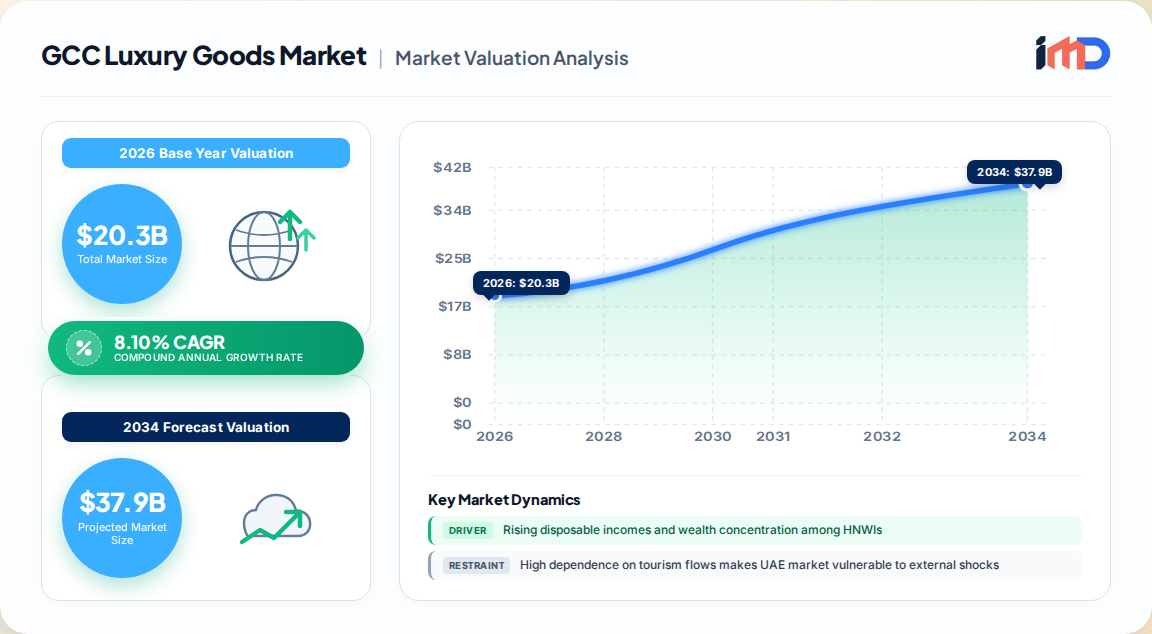
The GCC luxury goods market is a high-velocity, culturally distinctive, and structurally resilient consumer ecosystem spanning six high-income economies: Bahrain, Kuwait, Oman, Qatar, Saudi Arabia, and the United Arab Emirates. Our proprietary primary research, triangulated with official trade and investment data, estimates the market at USD 20.3 Billion in 2026, rising from USD 18.4 Billion in 2025 and projected to reach USD 37.9 Billion by 2034, reflecting a CAGR of 8.10% over 2026–2034. The UAE remains the anchor market, commanding over 48.6% of regional value in 2025, driven by high per-capita spending, a tourism-led retail model, and a tax-free consumption environment.
This expansion is not merely a function of hydrocarbon wealth. It is the result of deliberate sovereign diversification agendas, a youthful demographic bulge, and a retail infrastructure that has become a global benchmark for experiential luxury. However, growth is not uniform: the market exhibits a two-speed dynamic, with Saudi Arabia accelerating on the back of Vision 2030-driven mall pipelines and cultural festival programming, while the UAE defends its position through tourism resilience and first-mover digital commerce.
The GCC luxury market is propelled by a confluence of structural and behavioral drivers that differentiate it from mature Western markets.
Despite robust fundamentals, the market faces several binding constraints:
The GCC luxury market is not monolithic. Our segmentation analysis reveals distinct performance trajectories across product types, end users, and distribution channels.
| Segment | 2025 Share / Growth | Key Insight |
|---|---|---|
| Cars | Largest component | High disposable income and status signaling drive dominance; luxury EVs are gaining traction with new entrants such as NIO’s EL8 launch in the UAE. |
| Personal Luxury Goods | USD 10.3 Billion in 2024 | Expected to reach USD 14.7 Billion by 2033; clothing/apparel leads with 35.28% share, while watches are poised for 10.50% CAGR to 2031. |
| Travels and Hotels | High-growth | Immersive, tech-driven luxury hospitality is reshaping the category, with brands like Campbell Gray investing in culturally rooted, sustainable properties. |
| Women’s End User | 65.21% of 2025 revenue | Men’s segment is accelerating at 10.76% annually, fueled by grooming and tailoring. |
| Single-Brand Stores | 45.12% of 2025 revenue | Still dominant, but online luxury platforms are growing at 12.30% CAGR as brands invest in first-party digital experiences. |
Distribution channel deep-dive: Single-brand boutiques remain the primary touchpoint for high-consideration purchases, offering control over brand narrative and clienteling. However, the lines between physical and digital are blurring: brands are using mobile-first content, influencer endorsements, and live shopping events to drive discovery, while physical stores increasingly function as experiential showrooms and fulfillment nodes. Multi-brand department stores and airport duty-free remain critical for tourist capture, particularly in the UAE and Qatar.
The GCC luxury market is characterized by a pronounced geographic concentration, but the balance is slowly shifting.
| Country | 2025 Share | Growth Outlook | Strategic Priority |
|---|---|---|---|
| UAE | 48.6% | Moderate | Defend and digitize |
| Saudi Arabia | ~31% | High (10.05% CAGR) | Expand and localize |
| Qatar | ~8% | Moderate | Niche and events |
| Kuwait | ~5% | Stable | Clienteling-led |
| Oman | ~4% | Emerging | Tourism integration |
| Bahrain | ~3.4% | Emerging | Duty-free and retail |
The GCC luxury market is semi-consolidated, with global conglomerates and heritage maisons competing alongside regional champions and new entrants.
Recent developments:
The GCC is a net importer of luxury goods, with Europe serving as the primary source of finished products. The EU is the GCC’s second-biggest trade partner, representing 10.9% of the region’s total trade in goods in 2025, and EU exports to the Gulf region totaled €110.3 Billion in 2025, dominated by machinery, transport equipment, and chemicals—categories that include high-end automotive and luxury inputs.
The value chain for personal luxury goods typically flows from European ateliers and manufacturers to regional distributors, flagship boutiques, and multi-brand retailers. However, the channel is disintermediating: brands are increasingly bypassing wholesale to sell directly through owned boutiques and e-commerce, capturing higher margins and first-party consumer data.
Our analysis identifies several underserved or high-growth pockets within the GCC luxury market.
The GCC luxury goods market is a structurally attractive, high-growth region that rewards brands capable of balancing global prestige with local relevance. The UAE will remain the anchor, but Saudi Arabia’s rapid expansion and the region’s youthful, digitally native consumer base will reshape competitive dynamics over the forecast period. Success will hinge on cultural authenticity, omnichannel excellence, sustainability credentials, and the ability to navigate a complex, shock-prone trade environment.
| Aspects | Details |
|---|---|
| Study Period | 2020-2034 |
| Base Year | 2026 |
| Estimated Year | 2026 |
| Forecast Period | 2026-2034 |
| Historical Period | 2020-2025 |
| Growth Rate | CAGR of 8.10% from 2020-2034 |
| Segmentation |
|
By Gender
By Distribution Channel
| By Geography |
|
The GCC luxury goods market is estimated at USD 20.3 Billion in 2026, up from USD 18.4 Billion in 2025, and is projected to reach USD 37.9 Billion by 2034 at a CAGR of 8.10%.
The United Arab Emirates dominates with a 48.6% market share in 2025, driven by high consumer spending, tourism, and a tax-free retail environment. Saudi Arabia is the fastest-growing market, with a projected CAGR of 10.05% to 2031.
Key drivers include rising disposable incomes, a young and affluent population, government-backed cultural festivals, tourism, and the rapid adoption of digital commerce. The UAE recorded the highest net increase in high-net-worth individuals globally in 2024, adding 6,700 HNWIs.
Cars represent the largest component of the GCC luxury market, followed by personal luxury goods. Within personal luxury goods, clothing and apparel led with a 35.28% share in 2025, while watches are forecast to grow at a 10.50% CAGR through 2031.
Online luxury sales are growing at a 12.30% CAGR between 2026 and 2031, driven by mobile-first shopping habits—90% of surveyed consumers in Saudi Arabia shop online via smartphones. Brands are investing in first-party e-commerce and social commerce to capture this shift.
Our rigorous research methodology combines multi-layered approaches with comprehensive quality assurance, ensuring precision, accuracy, and reliability in every market analysis.
| Stakeholder Role | Interview Share (%) |
|---|---|
| Chief Marketing Officer / Brand Director | 25% |
| Retail Operations Director | 30% |
| Procurement / Supply Chain Head | 20% |
| Luxury Consumer (UHNWI/HNWI) | 25% |
| Company Type | Representation (%) |
|---|---|
| Luxury Brand Regional Offices | 30% |
| Luxury Retail Mall Operators | 20% |
| Luxury Automotive Dealerships | 15% |
| High-Net-Worth Consumers | 25% |
| Government Tourism & Retail Authorities | 10% |
 Related Reports
