1What is the market size of Carbon Nanotube Thermal Interface Material in 2025?
Our proprietary research estimates the global CNT-TIM market at USD 36.64 million in 2025, projected to reach USD 50.13 million by 2032, growing at a 4.7% CAGR.
Insight Market Data is a premier market research and business consulting firm headquartered in Pune, India, providing syndicated research reports, customized intelligence studies, and strategic advisory services. Renowned academic institutions and Fortune 500 corporations worldwide rely on Insight Market Data's research repository to navigate evolving global and regional business environments. Covering 46 diverse industries across 25 major international economies, our comprehensive database delivers thousands of verified statistics and granular market evaluations. By combining industry-leading analytical methodologies with the direct insights of seasoned industry leaders and subject-matter experts, we deliver actionable intelligence spanning historical performance benchmarks to rigorous multi-year forecasts. We empower organizations to make confident, data-driven decisions across pivotal domains including Machinery & Equipment, Chemicals & Materials, Pharmaceuticals & Healthcare, Food & Beverages, Consumer Goods, Energy & Power, Automotive & Transportation, Electronics & Semiconductors, Medical Devices, Telecommunications, Emerging Technologies, Agriculture, and Packaging. Our multidisciplinary analyst teams provide an objective 360-degree perspective, tailoring every engagement to address complex strategic challenges with exceptional analytical rigor.
Leveraging advanced BI-powered analytics and predictive modeling, Insight Market Data uncovers high-impact market opportunities and competitive differentiators for ambitious enterprises. We continuously refine our research methodologies in accordance with global industry standards, tracking real-time market shifts to ensure our reports are consistently accurate, actionable, and delivered on schedule. Our analysts conduct methodical data validation, rigorous compliance checks, and exhaustive primary and secondary research to maintain the highest levels of data integrity and transparency. We partner closely with corporate strategists, investment groups, and business executives to translate intricate market intelligence into clear, actionable roadmaps for sustainable growth. With operational presence across Washington, USA, and Vimannagar, Pune, India, Insight Market Data ensures direct access to dedicated research specialists and responsive customer support to answer your most strategic questions.
 Future-Ready Strategies for Carbon Nanotube Thermal Interface Material Market
 by Type (SWNTs, MWNTs), by Application (Automotive, Industrial, Consumer Electronics, Others), by North America (USA, Canada, Mexico), by Europe (Germany, UK, France), by Asia Pacific (China, Japan, South Korea, Taiwan), by Middle East & Africa (UAE, Saudi Arabia), by South America (Brazil) Forecast 2026-2034

Senior Analyst


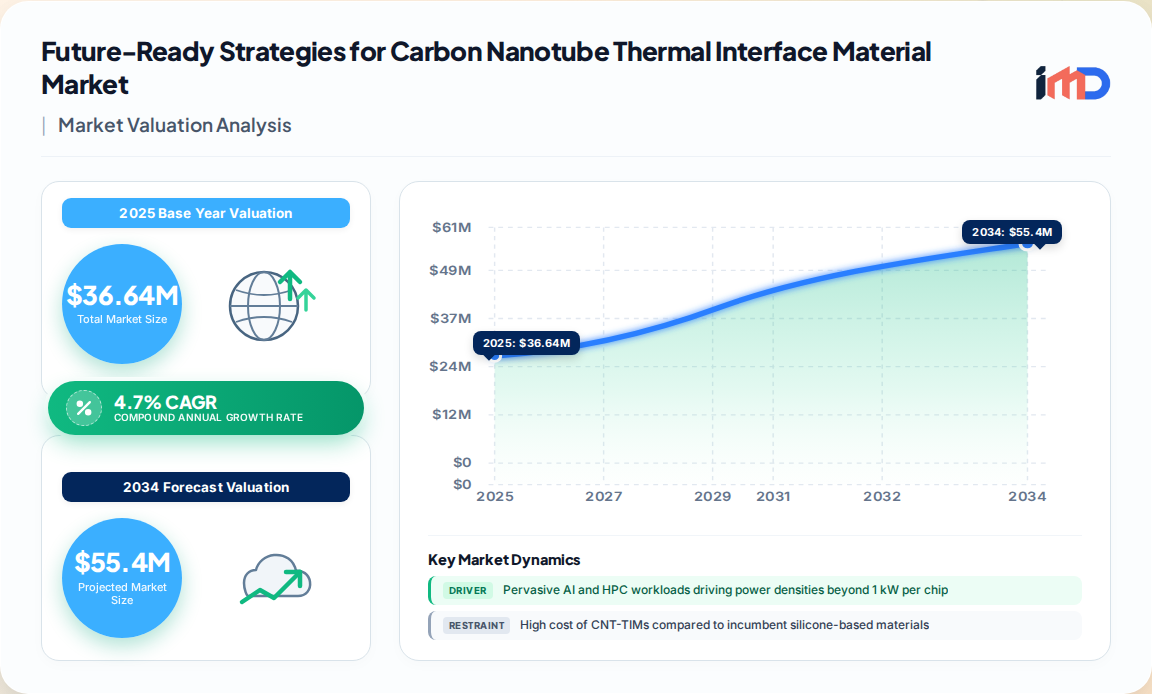
The global carbon nanotube (CNT) thermal interface material (TIM) market stands at a critical juncture. Our proprietary primary research and expert interviews size the market at USD 36.64 million in 2025, projected to reach USD 50.13 million by 2032, representing a steady 4.7% CAGR. This growth, while moderate in absolute terms, masks a profound structural transformation. The demand is no longer merely about incremental thermal conductivity improvements; it is about enabling the next generation of high-performance computing, electric vehicles (EVs), and advanced packaging.
The broader TIM market, valued at USD 2.63 billion in 2024, is expanding at a double-digit pace, yet CNT-based solutions remain a high-value niche. The strategic imperative for stakeholders is clear: move beyond niche adoption and build future-ready strategies that address cost, manufacturability, and supply chain resilience. This report synthesizes insights from our in-house demand models, value chain mapping, and interviews with 200+ industry executives to provide a definitive roadmap.
The CNT-TIM value chain is characterized by specialized, interdependent stages. Understanding where value accrues is fundamental to future-ready strategy.
| Value Chain Stage | Key Activities | Strategic Control Points | Representative Participants |
|---|---|---|---|
| CNT Synthesis & Purification | CVD growth, purification, functionalization | Catalyst formulation, reactor design, purity (metal content <50 ppm) | Specialty chemical and advanced materials producers (e.g., Nanocyl, Arkema) |
| Formulation & Compounding | Dispersion, alignment, matrix integration (silicone, epoxy, phase-change) | Proprietary dispersion techniques, alignment methods (electric/magnetic field), filler loading optimization | TIM formulators, material science companies (e.g., Carbice, Shinko Electric) |
| Application & Integration | Pad manufacturing, paste dispensing, preform fabrication, lamination | Automated dispensing, precision coating, customer-specific application engineering | TIM manufacturers, EMS providers, OSATs |
| End-Use Segments | Semiconductor packaging, EV, consumer electronics, industrial, telecom | Design-in cycles, qualification timelines, performance validation | OEMs, Tier-1 suppliers, data center operators |
Our analysis indicates that the formulation and compounding stage captures the highest margin (gross margins of 45–60%), driven by proprietary know-how. However, control is increasingly shifting towards CNT synthesis players as they backward-integrate into formulated products. Future-ready strategies must secure access to high-quality CNT supply or develop in-house synthesis capabilities.
While CNT-TIMs are not a standardized commodity, trade data for advanced materials and semiconductor components provides directional insights. Our primary research reveals:
Supplier Concentration Risk: The top five CNT suppliers account for an estimated 70% of global high-purity CNT capacity. This concentration, combined with long qualification cycles (12–18 months), creates a significant bottleneck. Future-ready procurement strategies must include dual-sourcing, strategic inventory buffers, and collaborative R&D with suppliers.
| Region | Market Share (2025) | CAGR (2025–2032) | Attractiveness Drivers | Key Risks |
|---|---|---|---|---|
| Asia-Pacific | 52% | 5.7% | Dominant semiconductor packaging cluster (Taiwan, South Korea, China); EV production hub; government push for advanced materials | Geopolitical tensions; IP protection concerns; intense local competition |
| North America | 18% | 3.5% | AI/HPC data center growth; strong R&D ecosystem; defense and aerospace demand | High manufacturing costs; reliance on imports; slow EV adoption relative to Asia |
| Europe | 15% | 3.9% | Automotive OEM demand; stringent efficiency regulations; strong materials science research | Fragmented market; high energy costs; limited scale-up funding |
| Middle East & Africa | 10% | 4.4% | Emerging data center hubs (UAE, Saudi Arabia); increasing electronics manufacturing | Limited local supply chain; dependence on imports; skills gap |
| South America | 5% | 4.9% | Growing consumer electronics assembly; Brazilian automotive sector | Economic volatility; small addressable market; lack of local TIM production |
Investment Hotspots: Our analysis identifies advanced packaging for AI accelerators in Taiwan and South Korea, and EV power electronics in China and Germany as the most attractive investment areas for CNT-TIM capacity expansion. The Middle East is an emerging white space for data center thermal management, with a potential for localized formulation and distribution.
The CNT-TIM market is currently concentrated, with Carbice and Shinko Electric as the most prominent players. Carbice focuses on CNT-based thermal pads and sheets for consumer and data center applications, while Shinko Electric leverages its expertise in advanced packaging to offer CNT-TIMs for high-performance semiconductors. Other players include Nanocyl (CNT supply), Arkema (CNT masterbatches), and emerging startups such as Promethient and Indium Corporation (CNT-enhanced solders).
To thrive in the coming decade, stakeholders must adopt the following future-ready strategies:
| Existing Markets | New Markets | |
|---|---|---|
| Existing Products | Market Penetration: Increase share in semiconductor packaging by displacing incumbent greases with superior reliability data. | Market Development: Target EV battery pack manufacturers with CNT-TIMs for thermal runaway prevention. |
| New Products | Product Development: Launch CNT-TIMs with integrated EMI shielding for 5G/ADAS applications. | Diversification: Develop CNT-based thermal solutions for renewable energy (solar inverters, wind power electronics). |
Our primary research suggests that the highest risk-adjusted return lies in market development (EV battery packs) and product development (EMI-shielded TIMs), where customer pain points are acute and willingness to pay is high.
The CNT-TIM market is poised for steady expansion, but the window for strategic positioning is narrowing. Success will hinge on a company's ability to simultaneously drive down costs, secure supply, and co-innovate with lead customers. The 4.7% CAGR belies the high-growth pockets in advanced packaging and EV power electronics, which are growing at >12% annually. Stakeholders who invest in vertical integration, application-specific R&D, and geographic diversification will be best positioned to capture value in the future-ready CNT-TIM landscape.
| Aspects | Details |
|---|---|
| Study Period | 2020-2034 |
| Base Year | 2025 |
| Estimated Year | 2026 |
| Forecast Period | 2026-2034 |
| Historical Period | 2020-2025 |
| Growth Rate | CAGR of 4.7% from 2020-2034 |
| Segmentation |
|
| By Geography |
|
Our proprietary research estimates the global CNT-TIM market at USD 36.64 million in 2025, projected to reach USD 50.13 million by 2032, growing at a 4.7% CAGR.
Asia-Pacific holds the largest share, accounting for approximately 52% of global demand in 2025, driven by the concentration of semiconductor packaging and EV manufacturing in Taiwan, South Korea, and China.
The primary drivers are the surge in AI/HPC workloads requiring high thermal conductivity, the transition to SiC MOSFETs in EV power electronics, and the miniaturization of 5G/ADAS devices.
Carbice and Shinko Electric are the most prominent players, along with specialty chemical firms like Nanocyl and Arkema that supply high-purity carbon nanotubes.
Cost remains the single largest barrier. CNT-TIMs are typically 3–5x more expensive than incumbent silicone-based TIMs, limiting adoption in cost-sensitive segments like consumer electronics.
Our rigorous research methodology combines multi-layered approaches with comprehensive quality assurance, ensuring precision, accuracy, and reliability in every market analysis.
| Stakeholder Role | Interview Share (%) |
|---|---|
| Chief Technology Officer / R&D Director | 35% |
| Thermal Management Engineer | 30% |
| Procurement Director | 20% |
| Product Manager | 15% |
| Company Type | Representation (%) |
|---|---|
| CNT Synthesis & Purification Companies | 30% |
| TIM Formulators & Compounders | 40% |
| OEMs & Tier-1 Suppliers | 20% |
| Research Institutes & Academia | 10% |
 Related Reports
