Insight Market Data is a premier market research and business consulting firm headquartered in Pune, India, providing syndicated research reports, customized intelligence studies, and strategic advisory services. Renowned academic institutions and Fortune 500 corporations worldwide rely on Insight Market Data's research repository to navigate evolving global and regional business environments. Covering 46 diverse industries across 25 major international economies, our comprehensive database delivers thousands of verified statistics and granular market evaluations. By combining industry-leading analytical methodologies with the direct insights of seasoned industry leaders and subject-matter experts, we deliver actionable intelligence spanning historical performance benchmarks to rigorous multi-year forecasts. We empower organizations to make confident, data-driven decisions across pivotal domains including Machinery & Equipment, Chemicals & Materials, Pharmaceuticals & Healthcare, Food & Beverages, Consumer Goods, Energy & Power, Automotive & Transportation, Electronics & Semiconductors, Medical Devices, Telecommunications, Emerging Technologies, Agriculture, and Packaging. Our multidisciplinary analyst teams provide an objective 360-degree perspective, tailoring every engagement to address complex strategic challenges with exceptional analytical rigor.
Leveraging advanced BI-powered analytics and predictive modeling, Insight Market Data uncovers high-impact market opportunities and competitive differentiators for ambitious enterprises. We continuously refine our research methodologies in accordance with global industry standards, tracking real-time market shifts to ensure our reports are consistently accurate, actionable, and delivered on schedule. Our analysts conduct methodical data validation, rigorous compliance checks, and exhaustive primary and secondary research to maintain the highest levels of data integrity and transparency. We partner closely with corporate strategists, investment groups, and business executives to translate intricate market intelligence into clear, actionable roadmaps for sustainable growth. With operational presence across Washington, USA, and Vimannagar, Pune, India, Insight Market Data ensures direct access to dedicated research specialists and responsive customer support to answer your most strategic questions.
France Parcel Delivery Market Size, Trends & Forecast 2031 | Insight Market Data
France Parcel Delivery Market
Logistics / MARKET REPORT
France Parcel Delivery Market | Insight Market Data
France Parcel Delivery Market by Business Model (B2B, B2C, C2C), by Speed of Delivery (Express, Non-Express), by Shipment Weight (Light Weight Shipments, Medium Weight Shipments, Heavy Weight Shipments), by Destination (Domestic, International), by Mode of Transport (Air, Road, Others), by End-User Industry (Manufacturing, E-Commerce, Services(BFSI), Wholesale and Retail Trade, Construction and Utilities, Healthcare, Food & Beverages, Others), by France (Île-de-France, Auvergne-Rhône-Alpes, Provence-Alpes-Côte d'Azur, Occitanie, Nouvelle-Aquitaine, Hauts-de-France, Grand Est, Pays de la Loire, Brittany, Normandy) Forecast 2026-2034
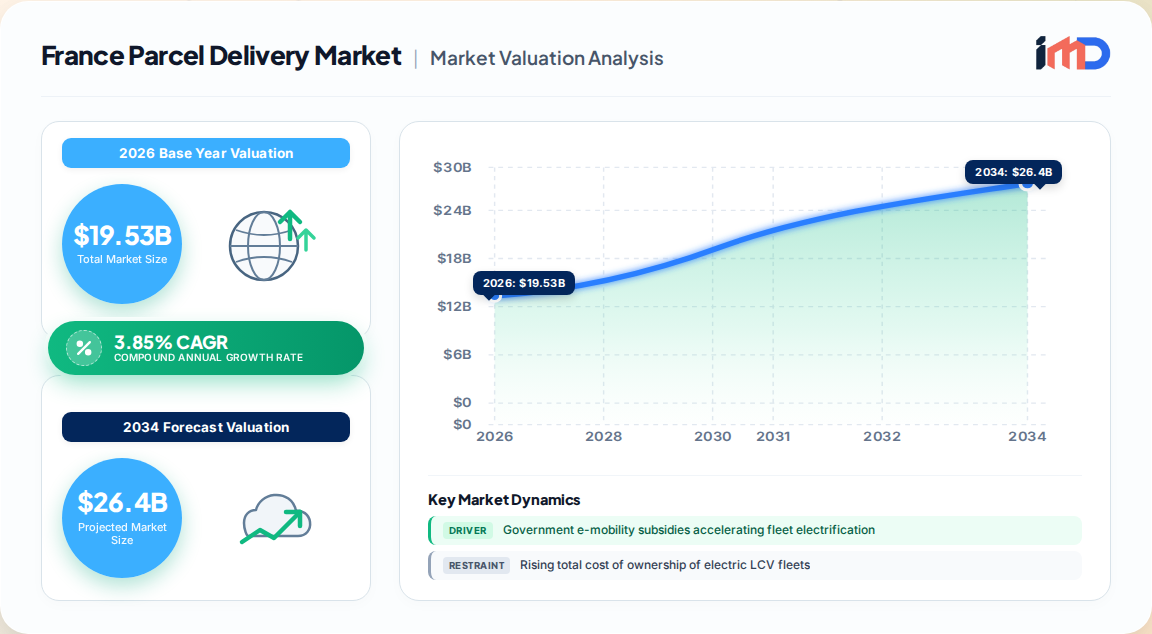
The France parcel delivery market represents one of Europe's most structurally sophisticated logistics ecosystems, defined by high population density, mature e-commerce penetration, and a dense out-of-home (OOH) collection network. Our proprietary first-party research estimates the market at USD 19.53 Billion in 2026, advancing to USD 23.59 Billion by 2031 at a CAGR of 3.85%. This trajectory follows a 2025 base of USD 18.72 Billion, confirming a steady post-2024 recovery anchored in resilient physical-goods e-commerce demand.
France Parcel Delivery Market Market Size (In Billion)
25.0B
20.0B
15.0B
10.0B
5.0B
0
18.81 B
2025
19.53 B
2026
20.28 B
2027
21.06 B
2028
21.87 B
2029
22.72 B
2030
23.59 B
2031
Unlike high-growth emerging markets, France's parcel sector is a volume-and-margin game. Operators compete less on headline growth and more on stop density, fleet productivity, and regulatory compliance. The market is transitioning from a pure transport function toward a data-orchestrated, sustainability-gated service layer where parcel flows intersect with urban access restrictions, circular-economy logistics, and cross-border marketplace dynamics.
Key headline metrics from our primary research:
Domestic flows retained 66.07% of parcel value in 2025, while international consignments grow faster at a 3.99% CAGR.
B2C accounted for 53.61% of market share in 2025 and is forecast to expand at the fastest 5.00% CAGR through 2031.
Light parcels under 5 kg represented 52.56% of volumes, growing at 4.23% CAGR.
Non-express services held 73.71% share, yet express is outpacing at a 4.37% CAGR.
Road transport conveyed 54.72% of value; air freight logs the strongest modal growth at 4.10% CAGR.
Manufacturing led end-user demand at 33.42%, with e-commerce the fastest-growing vertical at 4.19% CAGR.
Market Drivers & Restraints
Growth Drivers
Government e-mobility subsidies: France 2030 commits EUR 100 million to heavy electric trucks and depot chargers, accelerating fleet electrification and lowering total cost of ownership.
AI-enabled micro-sorting hubs: Automated vision-based sortation (e.g., 15,000 parcels/hour at regional hubs) is compressing labor hours per piece and enabling 24-hour operations.
National locker rollouts: Rail-station and supermarket alliances are widening OOH reach, with cross-border OOH deliveries surging 52% in 2024.
Digital customs (IOSS/ICS-2): Simplified VAT and advance data requirements are reducing cross-border export friction for French SMEs.
Pharma-cold-chain and fresh-food e-commerce: Temperature-controlled express is emerging as a premium, high-margin growth pocket.
Hybrid-work density clustering: Weekday residential drop-offs are concentrating delivery stops, lifting route productivity.
Restraints & Headwinds
Electric LCV total cost of ownership: Battery raw-material inflation continues to pressure fleet transition economics, particularly for SME couriers.
Low delivery density in peri-urban and rural communes: Sparse stop density erodes unit economics outside metropolitan cores.
Price wars and labor costs: Road-transport insolvencies rose 35.4% in Q4 2024 as operators struggled to pass wage and fuel hikes to shippers.
ZFE-M urban access restrictions: Across 25 low-emission zones, compliance-driven fleet upgrades add capital pressure.
Low-value parcel erosion: Chinese marketplace volumes occupy capacity but generate slender margins, with proposed per-parcel management fees adding cost from 2026.
Value Chain & Competitive Landscape
The French parcel value chain is characterized by medium market concentration, with integrated incumbents, retail-affiliated networks, and marketplace-owned logistics arms competing across distinct tiers.
Value Chain Stage
Key Activities
Representative Operator Types
First-mile & consolidation
Pickup, sorting, line-haul
Integrated carriers, postal operators
Regional sortation
Automated hub processing
Hub operators, network consolidators
Last-mile delivery
Home delivery, OOH, lockers
CEP carriers, retail networks, locker operators
Marketplace logistics
In-house fulfillment
E-commerce platforms
Reverse logistics
Returns, refurbishment
Circular-economy specialists
Major players active across the French market include DHL Group, La Poste Group, FedEx, UPS, GEODIS, Mondial Relay (InPost Group), GLS, DPD, Amazon Logistics, Paack, Star Service, and Walden Group. Notably, Amazon Logistics now ranks as France's third-largest parcel operator, reflecting vertical integration that structurally reduces volumes available to third-party carriers. La Poste's 128,000 pickup-point estate remains the country's densest OOH network, while Vinted's 7,000 pickup spots anchor the booming C2C segment.
Segmentation Analysis
By Business Model
B2C dominates at 53.61% share (2025), growing at 5.00% CAGR — the fastest among models.
B2B remains substantial, anchored by manufacturing, aerospace, and automotive flows.
C2C is the most dynamic niche, with parcel delivery growth reaching 11.2% in 2024 and expected to maintain double-digit momentum, driven by second-hand marketplaces.
Fashion & lifestyle: France's leading e-commerce vertical; Amazon (25.5%), Vinted (18.5%), SHEIN (16.8%) lead shopper share.
By Shipment Weight
Light parcels (<5 kg): 52.56% share, 4.23% CAGR.
Medium and heavy shipments remain anchored by industrial B2B flows.
Regional Outlook
Île-de-France is the dominant regional market, capturing 23.2% of national parcel value in 2025 and growing at 4.4% CAGR — the fastest among regions. Auvergne-Rhône-Alpes and Provence-Alpes-Côte d'Azur follow as secondary logistics clusters, benefiting from the Paris-Lyon-Marseille corridor that is now a pilot axis for hydrogen-powered heavy-duty fleets.
France Parcel Delivery Market Regional Market Share
Loading chart...
Île-de-France: 23.2% share; densest ZFE-M enforcement and micro-fulfillment activity.
Auvergne-Rhône-Alpes: 14.8% share; strong industrial and cross-border flows toward Switzerland and Italy.
Provence-Alpes-Côte d'Azur: 12.1% share; Mediterranean gateway and port-linked logistics.
Occitanie & Nouvelle-Aquitaine: combined ~19% share; growing e-commerce penetration with lower density challenges.
Secondary cities are expected to close the cost gap with metros as 5G rollout enables AI-driven dynamic routing beyond primary urban centers.
Import/Export & Cross-Border Dynamics
France's parcel market is increasingly shaped by inbound cross-border flows. Approximately 4.6 billion small parcels entered Europe in 2024, with 91% dispatched from China, reshaping domestic network economics at gateway hubs such as Paris-CDG and Lyon Saint-Exupéry.
Preferred export destinations for French e-merchants: Belgium, Spain, and Germany (which overtook Italy).
EU VAT exemption removal for goods under EUR 150, alongside proposed French per-parcel management fees (2026–2028), will reshape low-value import economics.
Digital customs platforms (IOSS/ICS-2) are streamlining clearance, with bonded sortation space expanding at gateway hubs.
Geopolitical uncertainty: U.S. tariff instability and EU-China trade tensions inject strategic risk into cross-border volume planning.
Strategic White-Space & Investment Opportunities
Out-of-home and locker infrastructure: Cross-border OOH volumes grew 52% in 2024; density gaps remain in peri-urban communes.
Reverse logistics networks: Return rates hit 22% in 2024, with AGEC law banning unsold-goods destruction — creating grading, refurbishment, and re-listing revenue pools.
Temperature-controlled express: Pharma and fresh-food e-commerce demand premium, high-margin capacity.
Cargo-bike micro-hubs: Academic modeling in Paris shows cargo-bike deliveries can match EV van economics at 67% coverage.
AI-driven routing and sortation: 5G-enabled dynamic routing cut delivery time 14% and fuel burn 16% in trials.
SME export enablement: Digital customs simplification opens EU-wide selling for smaller French merchants.
Competitive Strategies & Recent Developments
2025: FedEx cut up to 2,000 European jobs to protect margins amid soft pricing.
2024: Carrefour's Sprint quick-commerce service scaled beyond 1,000 stores, reaching break-even within eight months.
2024: Intermarché rolled out rapid delivery with Stuart across 1,320 outlets.
2024: GLS opened the Coudray-Montceaux AI-vision hub sorting 15,000 parcels/hour.
2024: XPO placed a 165-unit Renault E-Tech electric truck order.
2025: GEODIS announced a tenfold EV fleet expansion target by 2030.
2025: French government proposed per-parcel management fees for 2026–2028, aligning with EU VAT reform.
2024: Vinted expanded to 7,000 French pickup points; Mondial Relay continued locker expansion.
Market Outlook & Forecast Summary
The France parcel delivery market is poised for disciplined, margin-focused growth. Our proprietary model projects USD 23.59 Billion by 2031 at 3.85% CAGR, with B2C and express segments outpacing the market. Operators that combine fleet electrification, AI-enabled hub automation, and dense OOH networks will be best positioned to absorb regulatory costs and capture premium service tiers. The strategic imperative is clear: scale through density, differentiate through sustainability credentials, and monetize the reverse-logistics loop.
France Parcel Delivery Market Regional Market Share
Higher Coverage
Lower Coverage
No Coverage
France Parcel Delivery Market REPORT HIGHLIGHTS
Aspects
Details
Study Period
2020-2034
Base Year
2026
Estimated Year
2026
Forecast Period
2026-2034
Historical Period
2020-2025
Growth Rate
CAGR of 3.85% from 2020-2034
Segmentation
By Business Model
B2B
B2C
C2C
By Speed of Delivery
Express
Table of Contents
1. France Parcel Delivery Market Introduction
1.1. Research Scope
1.2. Market Segmentation
1.3. Research Objective
1.4. Definitions and Assumptions
2. France Parcel Delivery Market Executive Summary
2.1. Market Snapshot
3. France Parcel Delivery Market Dynamics
3.1. Market Drivers
3.1.1. Government e-mobility subsidies accelerating fleet electrification
4.3.3. Question Mark (High Growth, Low Market Share)
4.3.4. Dogs (Low Growth, Low Market Share)
4.4. Ansoff Matrix Analysis
4.5. Supply Chain Analysis
4.6. Regulatory Landscape
4.7. Current Market Potential and Opportunity Assessment (TAM–SAM–SOM Framework)
4.8. IMD Analyst Note
5. France Parcel Delivery Market Analysis, Insights and Forecast, 2020-2034
5.1. Analysis, Insights and Forecast - by Business Model
5.1.1. B2B
5.1.2. B2C
5.1.3. C2C
5.2. Analysis, Insights and Forecast - by Speed of Delivery
5.2.1. Express
5.2.2. Non-Express
5.3. Analysis, Insights and Forecast - by Shipment Weight
5.3.1. Light Weight Shipments
5.3.2. Medium Weight Shipments
5.3.3. Heavy Weight Shipments
5.4. Analysis, Insights and Forecast - by Destination
5.4.1. Domestic
5.4.2. International
5.5. Analysis, Insights and Forecast - by Mode of Transport
5.5.1. Air
5.5.2. Road
5.5.3. Others
5.6. Analysis, Insights and Forecast - by End-User Industry
5.6.1. Manufacturing
5.6.2. E-Commerce
5.6.3. Services
5.6.3.1. BFSI
5.6.4. Wholesale and Retail Trade
5.6.5. Construction and Utilities
5.6.6. Healthcare
5.6.7. Food & Beverages
5.6.8. Others
5.7. Analysis, Insights and Forecast - by Region
5.7.1. France
6. France Parcel Delivery Market Competitive Analysis
6.1. Company Profiles
6.1.1. DHL Group
6.1.1.1. Company Overview
6.1.1.2. Products
6.1.1.3. Company Financials
6.1.1.4. SWOT Analysis
6.1.2. La Poste Group
6.1.2.1. Company Overview
6.1.2.2. Products
6.1.2.3. Company Financials
6.1.2.4. SWOT Analysis
6.1.3. FedEx
6.1.3.1. Company Overview
6.1.3.2. Products
6.1.3.3. Company Financials
6.1.3.4. SWOT Analysis
6.1.4. UPS
6.1.4.1. Company Overview
6.1.4.2. Products
6.1.4.3. Company Financials
6.1.4.4. SWOT Analysis
6.1.5. GEODIS
6.1.5.1. Company Overview
6.1.5.2. Products
6.1.5.3. Company Financials
6.1.5.4. SWOT Analysis
6.1.6. Mondial Relay (InPost Group)
6.1.6.1. Company Overview
6.1.6.2. Products
6.1.6.3. Company Financials
6.1.6.4. SWOT Analysis
6.1.7. GLS (International Distributions Services)
6.1.7.1. Company Overview
6.1.7.2. Products
6.1.7.3. Company Financials
6.1.7.4. SWOT Analysis
6.1.8. DPD
6.1.8.1. Company Overview
6.1.8.2. Products
6.1.8.3. Company Financials
6.1.8.4. SWOT Analysis
6.1.9. Amazon Logistics
6.1.9.1. Company Overview
6.1.9.2. Products
6.1.9.3. Company Financials
6.1.9.4. SWOT Analysis
6.1.10. Paack
6.1.10.1. Company Overview
6.1.10.2. Products
6.1.10.3. Company Financials
6.1.10.4. SWOT Analysis
6.1.11. Star Service
6.1.11.1. Company Overview
6.1.11.2. Products
6.1.11.3. Company Financials
6.1.11.4. SWOT Analysis
6.1.12. Walden Group
6.1.12.1. Company Overview
6.1.12.2. Products
6.1.12.3. Company Financials
6.1.12.4. SWOT Analysis
6.1.13. STERNE Group
6.1.13.1. Company Overview
6.1.13.2. Products
6.1.13.3. Company Financials
6.1.13.4. SWOT Analysis
6.1.14. Integer.pl Capital Group
6.1.14.1. Company Overview
6.1.14.2. Products
6.1.14.3. Company Financials
6.1.14.4. SWOT Analysis
6.1.15. Logista
6.1.15.1. Company Overview
6.1.15.2. Products
6.1.15.3. Company Financials
6.1.15.4. SWOT Analysis
6.2. Market Entropy
6.2.1. Company's Key Areas Served
6.2.2. Recent Developments
6.3. Company Market Share Analysis, 2026
6.3.1. Top 5 Companies Market Share Analysis
6.3.2. Top 3 Companies Market Share Analysis
6.4. List of Potential Customers
List of Figures
Figure 1: Global France Parcel Delivery Market Revenue Breakdown (Billion, %) by Region 2026 & 2034
Figure 2: France France Parcel Delivery Market Revenue (Billion), by Business Model 2026 & 2034
Figure 3: France France Parcel Delivery Market Revenue Share (%), by Business Model 2026 & 2034
Figure 4: France France Parcel Delivery Market Revenue (Billion), by Speed of Delivery 2026 & 2034
Figure 5: France France Parcel Delivery Market Revenue Share (%), by Speed of Delivery 2026 & 2034
Figure 6: France France Parcel Delivery Market Revenue (Billion), by Shipment Weight 2026 & 2034
Figure 7: France France Parcel Delivery Market Revenue Share (%), by Shipment Weight 2026 & 2034
Figure 8: France France Parcel Delivery Market Revenue (Billion), by Destination 2026 & 2034
Figure 9: France France Parcel Delivery Market Revenue Share (%), by Destination 2026 & 2034
Figure 10: France France Parcel Delivery Market Revenue (Billion), by Mode of Transport 2026 & 2034
Figure 11: France France Parcel Delivery Market Revenue Share (%), by Mode of Transport 2026 & 2034
Figure 12: France France Parcel Delivery Market Revenue (Billion), by End-User Industry 2026 & 2034
Figure 13: France France Parcel Delivery Market Revenue Share (%), by End-User Industry 2026 & 2034
Figure 14: France France Parcel Delivery Market Revenue (Billion), by Country 2026 & 2034
Figure 15: France France Parcel Delivery Market Revenue Share (%), by Country 2026 & 2034
List of Tables
Table 1: Global France Parcel Delivery Market Revenue Billion Forecast, by Business Model 2020 & 2034
Table 2: Global France Parcel Delivery Market Revenue Billion Forecast, by Speed of Delivery 2020 & 2034
Table 3: Global France Parcel Delivery Market Revenue Billion Forecast, by Shipment Weight 2020 & 2034
Table 4: Global France Parcel Delivery Market Revenue Billion Forecast, by Destination 2020 & 2034
Table 5: Global France Parcel Delivery Market Revenue Billion Forecast, by Mode of Transport 2020 & 2034
Table 6: Global France Parcel Delivery Market Revenue Billion Forecast, by End-User Industry 2020 & 2034
Table 7: Global France Parcel Delivery Market Revenue Billion Forecast, by Region 2020 & 2034
Table 8: France France Parcel Delivery Market Revenue Billion Forecast, by Business Model 2020 & 2034
Table 9: France France Parcel Delivery Market Revenue Billion Forecast, by Speed of Delivery 2020 & 2034
Table 10: France France Parcel Delivery Market Revenue Billion Forecast, by Shipment Weight 2020 & 2034
Table 11: France France Parcel Delivery Market Revenue Billion Forecast, by Destination 2020 & 2034
Table 12: France France Parcel Delivery Market Revenue Billion Forecast, by Mode of Transport 2020 & 2034
Table 13: France France Parcel Delivery Market Revenue Billion Forecast, by End-User Industry 2020 & 2034
Table 14: France France Parcel Delivery Market Revenue Billion Forecast, by Country 2020 & 2034
Table 15: Île-de-France France Parcel Delivery Market Revenue (Billion) Forecast, by Application 2020 & 2034
Table 16: Auvergne-Rhône-Alpes France Parcel Delivery Market Revenue (Billion) Forecast, by Application 2020 & 2034
Table 17: Provence-Alpes-Côte d'Azur France Parcel Delivery Market Revenue (Billion) Forecast, by Application 2020 & 2034
Table 18: Occitanie France Parcel Delivery Market Revenue (Billion) Forecast, by Application 2020 & 2034
Table 19: Nouvelle-Aquitaine France Parcel Delivery Market Revenue (Billion) Forecast, by Application 2020 & 2034
Table 20: Hauts-de-France France Parcel Delivery Market Revenue (Billion) Forecast, by Application 2020 & 2034
Table 21: Grand Est France Parcel Delivery Market Revenue (Billion) Forecast, by Application 2020 & 2034
Table 22: Pays de la Loire France Parcel Delivery Market Revenue (Billion) Forecast, by Application 2020 & 2034
Table 23: Brittany France Parcel Delivery Market Revenue (Billion) Forecast, by Application 2020 & 2034
Table 24: Normandy France Parcel Delivery Market Revenue (Billion) Forecast, by Application 2020 & 2034
Frequently Asked Questions
1What is the size of the France parcel delivery market in 2026?
The France parcel delivery market is estimated at USD 19.53 Billion in 2026, growing from a 2025 base of USD 18.72 Billion and projected to reach USD 23.59 Billion by 2031 at a 3.85% CAGR.
2Which segment dominates the France parcel delivery market?
B2C is the largest business model segment, capturing 53.61% of market share in 2025 and forecast to grow at the fastest 5.00% CAGR through 2031, driven by e-commerce penetration.
3Who are the major companies in the France parcel delivery market?
Key operators include DHL Group, La Poste Group, FedEx, UPS, GEODIS, Mondial Relay (InPost Group), GLS, DPD, and Amazon Logistics, which now ranks as France's third-largest parcel operator.
4Why is the France parcel delivery market growing?
Growth is driven by e-commerce expansion (physical goods revenues up 6% in 2024), government e-mobility subsidies, AI-enabled sorting hubs, nationwide locker rollouts, and digital customs simplification for cross-border trade.
5Which French region leads the parcel delivery market?
Île-de-France dominates with 23.2% of national market value in 2025 and is growing at a 4.4% CAGR, supported by dense ZFE-M enforcement and micro-fulfillment activity.
6What challenges face the France parcel delivery market?
Key restraints include rising electric fleet costs, CSRD ESG compliance burdens on SME couriers, low rural delivery density, price wars, and proposed per-parcel fees on low-value Chinese imports from 2026.
Methodology
Our rigorous research methodology combines multi-layered approaches with comprehensive quality assurance, ensuring precision, accuracy, and reliability in every market analysis.
Primary Research
70–80% of research effort allocated to primary intelligence gathering via structured interviews with C-level and operational executives across the French parcel value chain.
Target respondent roles include Logistics & Supply Chain Directors, Head of Last-Mile Operations, Procurement Managers, and Chief Sustainability Officers at carriers, retailers, and marketplace platforms.
Interviews conducted with integrated CEP carriers, regional courier networks, locker infrastructure operators, e-commerce fulfillment teams, and retail omnichannel divisions.
Direct validation of parcel volumes, stop density, OOH penetration, and fleet electrification timelines through operator-level disclosures.
Cross-checks with recognized industry bodies including Fevad (Fédération e-commerce et vente à distance), ARCEP, and the French Ministry of Ecological Transition (ZFE-M framework).
Key Stakeholders Interviewed
Key Stakeholders Interviewed
Stakeholder Role
Interview Share (%)
Logistics & Supply Chain Director
32%
Head of Last-Mile Operations
28%
Procurement Manager
22%
Chief Sustainability Officer
18%
Industry Ecosystem Breakdown
Industry Ecosystem Breakdown
Company Type
Representation (%)
Integrated CEP Carriers
32%
Retail & Omnichannel Operators
22%
Locker & OOH Network Operators
18%
E-commerce Marketplace Logistics Arms
16%
Regional Courier & Subcontractor Fleets
12%
Secondary Research & Industry Benchmarking
20–30% of research effort dedicated to secondary validation using official multilateral and governmental datasets.
Sources include Eurostat, UN Comtrade, OECD, and the World Bank logistics performance indicators, alongside French national statistics (INSEE).
Financial databases consulted: Bloomberg, Factiva, Hoovers, and PitchBook, for corporate filings, carrier revenue disclosures, and investment tracking.
Benchmarking of parcel volume growth against e-commerce revenue and physical-goods retail indices.
Demand Modeling & Market Estimation
Top-down and bottom-up methodologies applied simultaneously, validated through multi-level data triangulation.
Bottom-up build-up uses parcel volume (units), average revenue per parcel (ARPP), stop density per route, OOH retrieval share, and first-attempt delivery success rates.
Demand models segment by business model (B2B/B2C/C2C), speed of delivery (express/non-express), shipment weight, and end-user industry.
Regional granularity at the 13 metropolitan French regions, weighted by e-commerce penetration and ZFE-M coverage.
Cross-border flows modeled using inbound low-value consignment data and EU VAT reform scenarios.
Data Accuracy & Quality Check
Guaranteed estimated data accuracy level of 85–90%, achieved via triangulation across primary interviews, official statistics, and corporate disclosures.
Multi-level validation: operator volumes cross-checked against ARCEP postal activity data and Fevad e-commerce indices.
All reports are updated to the date of purchase, incorporating the latest regulatory and market developments.
Scenario modeling (base, optimistic, conservative) applied to fleet electrification, cross-border fee impact, and e-commerce volume growth.
Peer review by senior analysts with domain expertise in European CEP and last-mile logistics.
Independent Intelligence for decisions that move markets
India CEP market valued at USD 6.27 Billion in 2026, projected to reach USD 10.25 Billion by 2031 at 10.34% CAGR, driven by e-commerce and logistics reforms.
Singapore Shipping Agency Services Market valued at USD 394.86 Mn in 2026, growing at 4.53% CAGR to reach USD 492.86 Mn by 2031.
Nov 2026|201 pages
$2900.00
Qatar transportation infrastructure construction market at USD 16.15B in 2026, growing 5.31% CAGR to USD 20.92B by 2031. Roads, rail & ports analysis.
Nov 2026|187 pages
$2900.00
Sea Air Logistics Market valued at $9.2B in 2025, growing at 5.7% CAGR to $16.3B by 2035. Hybrid freight demand driven by e-commerce and supply chain shifts.
Nov 2026|234 pages
$2900.00
Construction Integrated Project Delivery market to reach $10.46B by 2033, growing at 10.47% CAGR. Explore IPD adoption, regional analysis, and key players.