1What is the market size of the Food & Beverage Nitrogen Generators industry?
Our primary research estimates the global market at USD 1.21 Billion in 2025, projected to reach USD 1.70 Billion by 2030, growing at a CAGR of 5.7%.
Insight Market Data is a premier market research and business consulting firm headquartered in Pune, India, providing syndicated research reports, customized intelligence studies, and strategic advisory services. Renowned academic institutions and Fortune 500 corporations worldwide rely on Insight Market Data's research repository to navigate evolving global and regional business environments. Covering 46 diverse industries across 25 major international economies, our comprehensive database delivers thousands of verified statistics and granular market evaluations. By combining industry-leading analytical methodologies with the direct insights of seasoned industry leaders and subject-matter experts, we deliver actionable intelligence spanning historical performance benchmarks to rigorous multi-year forecasts. We empower organizations to make confident, data-driven decisions across pivotal domains including Machinery & Equipment, Chemicals & Materials, Pharmaceuticals & Healthcare, Food & Beverages, Consumer Goods, Energy & Power, Automotive & Transportation, Electronics & Semiconductors, Medical Devices, Telecommunications, Emerging Technologies, Agriculture, and Packaging. Our multidisciplinary analyst teams provide an objective 360-degree perspective, tailoring every engagement to address complex strategic challenges with exceptional analytical rigor.
Leveraging advanced BI-powered analytics and predictive modeling, Insight Market Data uncovers high-impact market opportunities and competitive differentiators for ambitious enterprises. We continuously refine our research methodologies in accordance with global industry standards, tracking real-time market shifts to ensure our reports are consistently accurate, actionable, and delivered on schedule. Our analysts conduct methodical data validation, rigorous compliance checks, and exhaustive primary and secondary research to maintain the highest levels of data integrity and transparency. We partner closely with corporate strategists, investment groups, and business executives to translate intricate market intelligence into clear, actionable roadmaps for sustainable growth. With operational presence across Washington, USA, and Vimannagar, Pune, India, Insight Market Data ensures direct access to dedicated research specialists and responsive customer support to answer your most strategic questions.
 Food & Beverage Nitrogen Generators Market
 by Capacity (Up to 1, 000 SCFH, 1, 000-5, 000 SCFH, 5, 000-10, 000 SCFH, Above 10, 000 SCFH), by Technology (PSA Nitrogen Generators, Membrane Nitrogen Generators), by Application (Food Packaging, Beverage Packaging, Food Processing, Beverage Processing), by North America (USA, Canada, Mexico), by Europe (Germany, UK, France, Italy, Spain, Russia), by Asia Pacific (China, Japan, India, South Korea, Australia), by Middle East & Africa (Saudi Arabia, UAE, South Africa), by South America (Brazil, Argentina) Forecast 2026-2034

Research Associate


 Related Reports

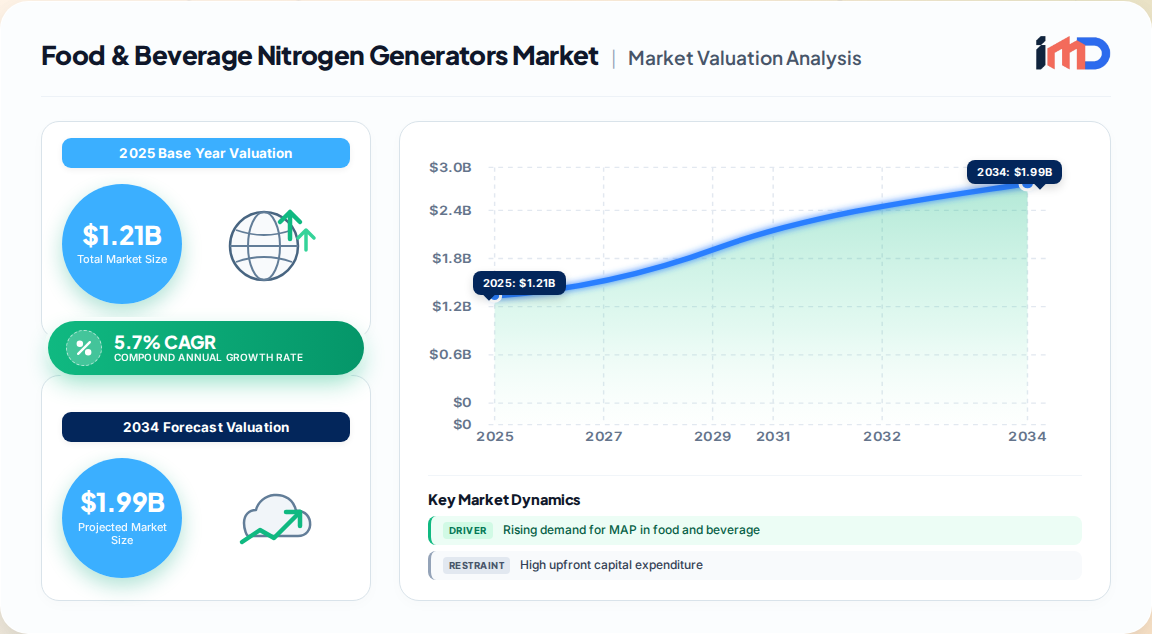
The Food & Beverage Nitrogen Generators Market represents a specialized, high-value segment within the broader industrial gas equipment landscape. Our proprietary primary research estimates the global market for food- and beverage-grade nitrogen generators at USD 1.21 Billion in 2025, projected to expand to USD 1.70 Billion by 2030, advancing at a CAGR of 5.7%. This growth is underpinned by the secular shift from delivered liquid nitrogen to on-site generation, driven by food safety mandates, cost volatility in cryogenic supply chains, and the rapid adoption of Modified Atmosphere Packaging (MAP) across perishable categories.
Unlike the general industrial nitrogen generator market, which is dominated by oil and gas and chemical inerting applications, the food and beverage vertical demands ultra-high purity (99.999%+), stringent hygiene design (EIGA food-grade compliance), and compact, modular footprints suitable for space-constrained processing facilities. These requirements create a distinct competitive arena where technology reliability, service depth, and regulatory validation are as important as capital cost.
The value chain for food and beverage nitrogen generators is characterized by a fragmented equipment tier and a concentrated industrial gas tier. Upstream, suppliers of carbon molecular sieves (CMS), polymeric membranes, compressors, and control instrumentation provide critical components. Midstream, generator OEMs integrate these components into skid-mounted or containerized systems, often partnering with engineering, procurement, and construction (EPC) firms for installation. Downstream, food and beverage processors operate the units, supported by service-level agreements for maintenance, calibration, and purity verification.
A notable trend is the emergence of "nitrogen-as-a-service" models, where OEMs or gas majors retain ownership of the generator and charge a per-cubic-meter fee. This model lowers the entry barrier for smaller processors and is gaining traction in the bakery, snack, and beverage segments.
Trade in nitrogen generators is dominated by intra-regional flows from manufacturing hubs in Europe, North America, and East Asia. According to UN Comtrade data, global exports of air separation and gas generation equipment (HS 8419.89) grew at a CAGR of 6.1% between 2019 and 2024, with China, Germany, and the United States as the largest exporters. However, food-grade certification requirements (e.g., EIGA, FDA, 3-A Sanitary Standards) create non-tariff barriers that favor established European and North American OEMs in regulated markets.
Supplier dynamics reveal a dual structure: large industrial gas companies (Air Products, Linde, Air Liquide) offer generators as part of integrated gas supply contracts, while specialized OEMs (Atlas Copco, Parker Hannifin, NOVAIR, South-Tek Systems) compete on modularity, energy efficiency, and service responsiveness. Component suppliers of CMS (e.g., Arkema, Kuraray) and membranes (e.g., Air Products, UBE) hold significant bargaining power, though qualification cycles are long.
The competitive arena is shaped by technological differentiation and service network depth. Key players include Atlas Copco, Parker Hannifin, Hitachi, Air Products, NOVAIR, Peak Industrial, CLAIND, South-Tek Systems, Oxymat, Isolcell, Inmatec, Generon, Omega Air, Donaldson, Rich, and Zhongrui. Recent strategic developments include:
Two underpenetrated opportunities stand out:
For food and beverage processors, the decision to insource nitrogen generation requires a total cost of ownership (TCO) evaluation spanning 5-7 years. Key procurement considerations include:
The market faces moderate risk from technological substitution (e.g., advances in membrane efficiency reducing PSA share) and macroeconomic headwinds affecting capital expenditure. However, the fundamental drivers—food safety, waste reduction, and supply-chain resilience—are robust. We forecast the market to sustain a 5.7% CAGR through 2030, with upside potential from regulatory mandates on food waste and the continued premiumization of packaged foods. The competitive landscape will consolidate as larger players acquire niche OEMs to broaden technology portfolios and geographic reach.
| Aspects | Details |
|---|---|
| Study Period | 2020-2034 |
| Base Year | 2025 |
| Estimated Year | 2026 |
| Forecast Period | 2026-2034 |
| Historical Period | 2020-2025 |
| Growth Rate | CAGR of 5.7% from 2020-2034 |
| Segmentation |
|
By Technology
By Application
| By Geography |
|
Our primary research estimates the global market at USD 1.21 Billion in 2025, projected to reach USD 1.70 Billion by 2030, growing at a CAGR of 5.7%.
Asia-Pacific is the largest and fastest-growing region, accounting for approximately 34% of global demand in 2025, driven by expanding food processing sectors in China and India.
Cost savings of 30-50% over five years, supply-chain security, and sustainability benefits are the primary drivers, alongside the need for consistent high-purity nitrogen for Modified Atmosphere Packaging (MAP).
Key players include Atlas Copco, Parker Hannifin, Hitachi, Air Products, NOVAIR, Peak Industrial, CLAIND, South-Tek Systems, and others, competing on technology, service, and food-grade certifications.
Most MAP applications require 99.9-99.999% purity, while dairy and infant nutrition may demand 99.999%+ to prevent oxidation and ensure food safety.
Our rigorous research methodology combines multi-layered approaches with comprehensive quality assurance, ensuring precision, accuracy, and reliability in every market analysis.
| Stakeholder Role | Interview Share (%) |
|---|---|
| Procurement Director | 30% |
| Plant Operations Manager | 25% |
| Food Safety & QA Manager | 25% |
| Sustainability Officer | 20% |
| Company Type | Representation (%) |
|---|---|
| Nitrogen Generator OEMs | 35% |
| Industrial Gas Companies | 25% |
| Food & Beverage Processors | 20% |
| Engineering & EPC Firms | 12% |
| Component Suppliers | 8% |