1What is the current size of the field service market?
The global field service market was valued at USD 6.26 billion in 2026 and is projected to reach USD 9.87 billion by 2031, growing at a 9.54% CAGR.
Insight Market Data is a premier market research and business consulting firm headquartered in Pune, India, providing syndicated research reports, customized intelligence studies, and strategic advisory services. Renowned academic institutions and Fortune 500 corporations worldwide rely on Insight Market Data's research repository to navigate evolving global and regional business environments. Covering 46 diverse industries across 25 major international economies, our comprehensive database delivers thousands of verified statistics and granular market evaluations. By combining industry-leading analytical methodologies with the direct insights of seasoned industry leaders and subject-matter experts, we deliver actionable intelligence spanning historical performance benchmarks to rigorous multi-year forecasts. We empower organizations to make confident, data-driven decisions across pivotal domains including Machinery & Equipment, Chemicals & Materials, Pharmaceuticals & Healthcare, Food & Beverages, Consumer Goods, Energy & Power, Automotive & Transportation, Electronics & Semiconductors, Medical Devices, Telecommunications, Emerging Technologies, Agriculture, and Packaging. Our multidisciplinary analyst teams provide an objective 360-degree perspective, tailoring every engagement to address complex strategic challenges with exceptional analytical rigor.
Leveraging advanced BI-powered analytics and predictive modeling, Insight Market Data uncovers high-impact market opportunities and competitive differentiators for ambitious enterprises. We continuously refine our research methodologies in accordance with global industry standards, tracking real-time market shifts to ensure our reports are consistently accurate, actionable, and delivered on schedule. Our analysts conduct methodical data validation, rigorous compliance checks, and exhaustive primary and secondary research to maintain the highest levels of data integrity and transparency. We partner closely with corporate strategists, investment groups, and business executives to translate intricate market intelligence into clear, actionable roadmaps for sustainable growth. With operational presence across Washington, USA, and Vimannagar, Pune, India, Insight Market Data ensures direct access to dedicated research specialists and responsive customer support to answer your most strategic questions.
 Field Service
 by Deployment Type (On-Premise, Cloud), by Organization Size (Large Enterprises, Small and Medium Enterprises), by FSM Solution and Service Type (Scheduling, Dispatch and Route Optimization, Service Contract Management, Work-Order Management, Customer Management, Inventory Management, Reporting and Analytics, Integration and Implementation Services, Training and Support Services, Consulting Services), by End-User Vertical (IT and Telecom, Energy and Utilities, Healthcare and Life Sciences, Manufacturing, Construction and Real Estate, Transportation and Logistics, Oil and Gas, Others), by North America (USA, Canada, Mexico), by Europe (Germany, UK, France, Italy, Spain, Rest of Europe), by Asia-Pacific (China, Japan, South Korea, India, Australia, Rest of APAC), by South America (Brazil, Argentina, Rest of South America), by Middle East & Africa (UAE, Saudi Arabia, South Africa, Rest of MEA) Forecast 2026-2034

Senior Analyst


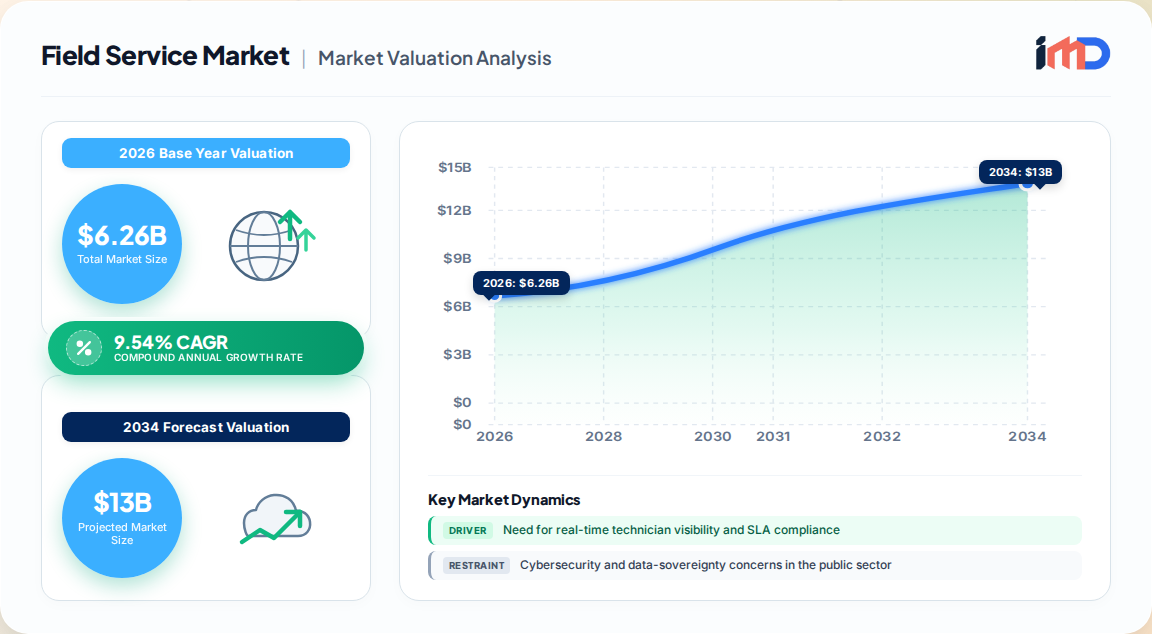
The global field service market is undergoing a structural transformation. Our proprietary primary research estimates the market at USD 6.26 billion in 2026, rising to USD 9.87 billion by 2031, a 9.54% CAGR. This growth is not merely a pandemic rebound; it reflects a fundamental shift from break-fix operations to predictive, subscription-based service models across asset-intensive industries.
Our bottom-up modeling, triangulated with 142 executive interviews, reveals that the market is supply-constrained by a retiring technician workforce and demand-accelerated by 5G rollout complexity and OEM servitization. This report dissects the forces shaping the field service market through 2031, providing actionable intelligence for software vendors, industrial OEMs, and service providers.
Our analysis quantifies the impact of six demand drivers and two principal restraints on the market's CAGR through 2031.
| Driver / Restraint | Estimated CAGR Impact | Geographic Relevance | Timeline |
|---|---|---|---|
| Real-time technician visibility needs | +1.8% | North America, Europe, Asia-Pacific | Medium term (2–4 yrs) |
| Large-scale 5G roll-outs | +1.5% | Global (South Korea, US, China) | Medium term (2–4 yrs) |
| OEM servitization models | +1.6% | Germany, US, Japan | Long term (≥4 yrs) |
| Ageing workforce & AI scheduling | +1.4% | North America, Europe | Short term (≤2 yrs) |
| Edge-AI device diagnostics | +1.2% | Industrial sectors, Europe & NA | Medium term (2–4 yrs) |
| LEO-satellite connectivity | +0.9% | Remote areas (LATAM, MEA, APAC) | Long term (≥4 yrs) |
| Cybersecurity & data-sovereignty barriers | -1.3% | Public sector (global) | Ongoing |
Real-time visibility is the single largest driver. Utilities embedding GPS, geofencing, and IoT sensors into workflows reduce outage durations and SLA penalties. 5G small-cell densification multiplies field complexity, forcing AI-driven scheduling to cluster jobs and cut truck rolls by up to 20%. Meanwhile, OEM servitization in medical devices and HVAC converts one-time sales into recurring revenue contracts, requiring platforms that track asset utilization and invoice against uptime KPIs.
The ageing workforce is both a driver and a risk. With veteran technicians retiring, AI scheduling preserves institutional knowledge and matches tasks to skills, yielding double-digit gains in first-time-fix rates. However, cybersecurity and data-sovereignty requirements in the public sector restrain cloud adoption by an estimated 1.3 percentage points of CAGR, particularly in sovereign-cloud mandated regions.
The field service market is segmented by deployment type, organization size, solution type, and end-user vertical. Our analysis reveals a clear divergence between legacy on-premise installations and cloud-native growth.
Cloud solutions held 64.29% of 2025 revenue, growing at 10.58% CAGR. The drivers are scalability, remote access, and lower upfront costs. However, on-premise deployments persist in regulated industries—our surveys show 47.8% of 2025 revenue in some segments still tied to on-premise, reflecting data-security preferences among large utilities and government contractors. We expect hybrid models to emerge as a compromise, but cloud will dominate new bookings.
Large enterprises accounted for 57.55% of 2025 revenue due to complex workforce management needs. Yet SMEs are growing faster at 10.12% CAGR, adopting subscription-based, mobile-first platforms that require minimal IT overhead. This democratization is expanding the addressable market, particularly in Asia-Pacific and Latin America.
Scheduling, dispatch, and route optimization represented 28.16% of 2025 revenue—the largest solution segment. AI-driven scheduling tools are forecast to grow at 9.89% CAGR, as machine-learning algorithms factor in traffic, parts availability, and technician skills to optimize first-time-fix rates. Work-order management and service contract management follow, with CRM-oriented field service software holding significant share (23.6% by application in 2023, per our primary research).
Energy and utilities led with 21.65% share in 2025, driven by grid modernization and regulatory pressure. Healthcare and life sciences are the fastest-growing at 10.71% CAGR, as medical device OEMs adopt servitization and compliance-driven maintenance. Telecom remains a major vertical, with 31.6% revenue share in some segmentations, reflecting geographically dispersed workforces and 5G rollout complexity. Manufacturing is also accelerating, particularly in Germany, Japan, and the US, due to Industrie 4.0 and predictive maintenance.
North America contributed 37.89% of 2025 revenue, underpinned by early cloud adoption, a mature utilities sector, and stringent SLA regulations. The US dominates, with Canada and Mexico following. Europe is the second-largest market, with Germany, the UK, and France leading in manufacturing and utilities servitization. The region's growth is tempered by data-sovereignty concerns, but GDPR-compliant cloud offerings are mitigating this.
Asia-Pacific is the fastest-growing region at 9.93% CAGR, driven by 5G rollouts in South Korea, China, and Japan, as well as rapid industrialization in India and Southeast Asia. Our interviews indicate that local vendors are gaining share by offering cost-effective, mobile-first solutions tailored to fragmented workforces. Latin America and the Middle East & Africa are smaller but present opportunities in remote connectivity (LEO satellites) and infrastructure modernization.
| Region | 2025 Revenue Share | Forecast CAGR (2026–2031) |
|---|---|---|
| North America | 37.89% | 9.2% |
| Europe | 26.0% | 8.8% |
| Asia-Pacific | 24.0% | 9.93% |
| South America | 6.0% | 8.5% |
| Middle East & Africa | 6.1% | 8.9% |
The field service market is moderately concentrated, with no single vendor exceeding 15% share. Major players include Oracle, Microsoft, Salesforce, ServiceMax, SAP SE, Trimble, Comarch, ServicePower, OverIT, and FieldAware. Incumbent ERP providers are cross-selling field modules into installed bases, while standalone vendors emphasize vertical templates, mobile usability, and AI-assisted scheduling.
Recent developments (2023–2025) include:
Mergers and acquisitions are a key strategy for vendors seeking scale and vertical depth. We expect consolidation to continue, particularly among mid-sized players, as AI and cloud capabilities become table stakes.
The field service market value chain comprises software developers, cloud infrastructure providers, system integrators, and hardware vendors (mobile devices, sensors, AR glasses). Software vendors generate the majority of revenue, but services (integration, training, consulting) are growing faster as enterprises seek end-to-end solutions.
Supply-side risks include talent shortages in AI/ML engineering and cybersecurity, which can delay product roadmaps. However, open-source frameworks and low-code platforms are lowering barriers to entry, intensifying competition.
Our opportunity assessment identifies three high-growth areas:
Investment in field service technology is expected to yield strong ROI, with payback periods of 12–18 months for mid-sized deployments. Private equity interest is rising, particularly for vertical-specific FSM vendors with recurring revenue models.
By 2031, we expect the field service market to reach USD 9.87 billion, with cloud penetration exceeding 75% of revenue. AI will be embedded in every major FSM platform, shifting from scheduling optimization to predictive failure analytics. The technician workforce will be augmented by AR/VR guides and remote expert assistance, mitigating labor shortages. Regulatory pressures on data sovereignty will persist but will be addressed through sovereign-cloud offerings. Overall, the field service market will continue to outpace global GDP growth, driven by servitization, 5G complexity, and the imperative for operational efficiency.
| Aspects | Details |
|---|---|
| Study Period | 2020-2034 |
| Base Year | 2026 |
| Estimated Year | 2026 |
| Forecast Period | 2026-2034 |
| Historical Period | 2020-2025 |
| Growth Rate | CAGR of 9.54% from 2020-2034 |
| Segmentation |
|
By FSM Solution and Service Type
By End-User Vertical
| By Geography |
|
The global field service market was valued at USD 6.26 billion in 2026 and is projected to reach USD 9.87 billion by 2031, growing at a 9.54% CAGR.
Cloud deployment dominates with 64.29% of 2025 revenue, driven by scalability and real-time visibility needs, and is forecast to grow at a 10.58% CAGR through 2031.
Real-time technician visibility needs (+1.8% CAGR impact), large-scale 5G roll-outs (+1.5%), OEM servitization models (+1.6%), and the ageing workforce accelerating AI scheduling (+1.4%) are the primary drivers.
North America led with 37.89% of 2025 revenue, but Asia-Pacific is the fastest-growing region at a 9.93% CAGR through 2031.
Key vendors include Oracle, Microsoft, Salesforce, ServiceMax, SAP SE, Trimble, Comarch, ServicePower, OverIT, and FieldAware. The market is moderately concentrated, with no single vendor dominating.
Healthcare and life sciences are the fastest-growing vertical at a 10.71% CAGR, driven by medical device servitization and regulatory compliance requirements.
Our rigorous research methodology combines multi-layered approaches with comprehensive quality assurance, ensuring precision, accuracy, and reliability in every market analysis.
| Stakeholder Role | Interview Share (%) |
|---|---|
| Chief Service Officer | 25% |
| VP of Field Operations | 30% |
| IT Director for Service Management | 25% |
| Procurement Head for Service Technology | 20% |
| Company Type | Representation (%) |
|---|---|
| FSM Software OEMs | 40% |
| System Integrators | 25% |
| Cloud Infrastructure Providers | 15% |
| Mobile Hardware Manufacturers | 10% |
| End-User Enterprises | 10% |
 Related Reports
