1What is the current size of the female-oriented game market?
The global female-oriented game market was valued at USD 11.03 Billion in 2024 and is projected to reach USD 28 Billion by 2035, growing at a CAGR of 8.9% from 2026 to 2035.
Insight Market Data is a premier market research and business consulting firm headquartered in Pune, India, providing syndicated research reports, customized intelligence studies, and strategic advisory services. Renowned academic institutions and Fortune 500 corporations worldwide rely on Insight Market Data's research repository to navigate evolving global and regional business environments. Covering 46 diverse industries across 25 major international economies, our comprehensive database delivers thousands of verified statistics and granular market evaluations. By combining industry-leading analytical methodologies with the direct insights of seasoned industry leaders and subject-matter experts, we deliver actionable intelligence spanning historical performance benchmarks to rigorous multi-year forecasts. We empower organizations to make confident, data-driven decisions across pivotal domains including Machinery & Equipment, Chemicals & Materials, Pharmaceuticals & Healthcare, Food & Beverages, Consumer Goods, Energy & Power, Automotive & Transportation, Electronics & Semiconductors, Medical Devices, Telecommunications, Emerging Technologies, Agriculture, and Packaging. Our multidisciplinary analyst teams provide an objective 360-degree perspective, tailoring every engagement to address complex strategic challenges with exceptional analytical rigor.
Leveraging advanced BI-powered analytics and predictive modeling, Insight Market Data uncovers high-impact market opportunities and competitive differentiators for ambitious enterprises. We continuously refine our research methodologies in accordance with global industry standards, tracking real-time market shifts to ensure our reports are consistently accurate, actionable, and delivered on schedule. Our analysts conduct methodical data validation, rigorous compliance checks, and exhaustive primary and secondary research to maintain the highest levels of data integrity and transparency. We partner closely with corporate strategists, investment groups, and business executives to translate intricate market intelligence into clear, actionable roadmaps for sustainable growth. With operational presence across Washington, USA, and Vimannagar, Pune, India, Insight Market Data ensures direct access to dedicated research specialists and responsive customer support to answer your most strategic questions.
 Female-oriented Game Market
 by Game Genre (Puzzle, Adventure, Simulation, Role-Playing, Casual, Otome, BL, Reverse Harem, Others), by Monetization Model (Free-to-Play, Paid, In-App Purchases, Subscription), by User Characteristics (Age Group(Minor Female, Adult Female), Gaming Experience, Interests), by Platform (iOS, Android, Web-Based), by North America (USA, Canada, Mexico), by Europe (Germany, UK, France, Italy, Russia), by Asia Pacific (China, Japan, South Korea, Southeast Asia, India, Australia), by South America (Brazil, Rest of South America), by Middle East & Africa (Egypt, South Africa, Israel, Turkey, GCC Countries) Forecast 2026-2034

Research Analyst


 Related Reports

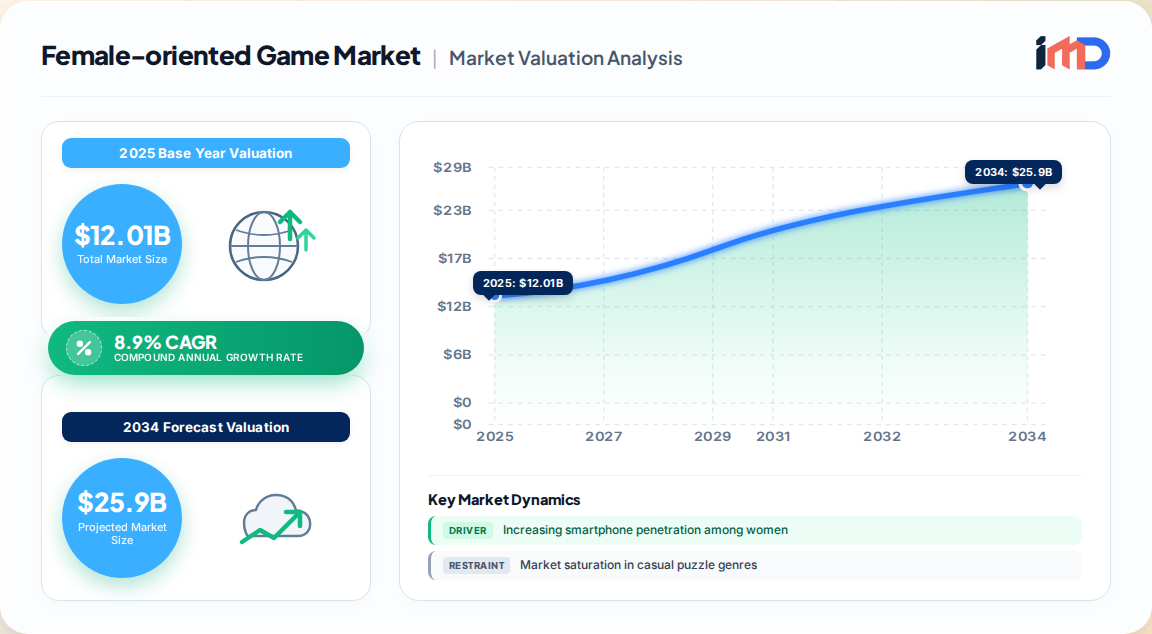
The global female-oriented game market represents one of the most dynamic and underserved segments of the interactive entertainment industry. Our proprietary primary research estimates the market at USD 11.03 Billion in 2024, rising to USD 12.01 Billion in 2025 and projected to reach USD 28 Billion by 2035, expanding at a CAGR of 8.9% across the 2026–2035 forecast period.
This growth trajectory is underpinned by shifting demographics, increased smartphone penetration among women, and a structural shift toward narrative-driven, socially connected gameplay. Contrary to legacy assumptions that frame female gamers as a niche, our bottom-up demand modeling indicates that women now represent a substantial and growing share of mobile gaming revenue in multiple geographies, particularly in Asia-Pacific and North America.
Critically, the market is no longer defined solely by "pink-washed" casual titles. It now spans a diverse spectrum: otome and romance simulations, life-simulation and decoration games, narrative adventure, social-casual puzzles, and increasingly, hardcore role-playing games featuring female protagonists. This diversification is expanding the addressable market and redefining monetization strategies.
The female-oriented game market is segmented by game genre, monetization model, user characteristics, platform, and application. Our analysis synthesizes these dimensions to reveal high-growth intersections.
| Segment Dimension | Key Sub-Segments | Growth Outlook (2026–2035) |
|---|---|---|
| Game Genre | Puzzle, Adventure, Simulation, Role-Playing, Casual, Otome, BL, Reverse Harem | Otome and simulation to outpace average; puzzle remains volume leader |
| Monetization Model | Free-to-Play, Paid, In-App Purchases, Subscription | Free-to-Play dominant; subscription and hybrid models gaining share |
| User Characteristics | Age Group (Minor Female, Adult Female), Gaming Experience, Interests | Adult female segment drives highest ARPU; minor female strong in Asia |
| Platform | iOS, Android, Web-Based | Android leads volume; iOS leads monetization in North America and Europe |
Otome and romance simulation games, while a smaller share by revenue, exhibit higher engagement and willingness to pay among core audiences. Life-simulation and decoration games maintain broad appeal, particularly in Western markets. Role-playing games with female-centric narratives are emerging as a white space, with several major publishers announcing new titles for 2026–2027.
Free-to-Play remains the dominant model, accounting for the majority of revenue. However, subscription models—offering ad-free play, exclusive stories, and monthly cosmetics—are growing rapidly, particularly among adult female players seeking predictable spending. In-App Purchases remain critical, with cosmetic and narrative progression items outperforming competitive advantage items.
Asia-Pacific represents the largest and fastest-growing region, driven by China, Japan, and South Korea, where cultural acceptance of female gaming is high and local developers produce targeted content. Japan's otome market is mature, while China's female-oriented game sector has seen explosive growth in titles blending romance with fantasy and historical themes.
North America holds a significant share, characterised by high engagement rates and strong monetization per user. The region is a bellwether for narrative-driven and socially conscious games. Europe follows closely, with robust interest in simulation and puzzle genres, though fragmentation across languages and cultures requires localised strategies.
Latin America and the Middle East & Africa are emerging contributors, with growth fueled by smartphone adoption and young demographics. However, infrastructure and payment ecosystem limitations constrain near-term monetization.
| Region | Market Share (2025) | Key Growth Drivers |
|---|---|---|
| Asia-Pacific | 41% | Smartphone penetration, local content, cultural acceptance |
| North America | 27% | High ARPU, narrative innovation, strong influencer ecosystem |
| Europe | 24% | Diverse player base, simulation/puzzle affinity |
| South America | 4% | Youth demographics, mobile-first adoption |
| Middle East & Africa | 4% | Rising connectivity, localized content demand |
The market features a mix of established global publishers, regional specialists, and emerging independent studios. Key players include Tencent, NetEase, miHoYo, Supercell, King, Zynga, Playtika, Electronic Arts, Gameloft, Nintendo, Idea Factory, Broccoli, Prototype, Konami, Papergames, 66RPG, Gree, Rovio, and Glu Mobile.
Competitive differentiation is increasingly centered on narrative quality, community engagement, and cross-platform experiences. Strategic partnerships and acquisitions are accelerating as publishers seek to build portfolios that resonate with female audiences. For instance, Tencent's collaboration with Gameloft aims to co-develop life-simulation titles, while Zynga and Playtika have joined forces on social-casual games tailored for women.
The value chain for female-oriented games encompasses content creation, development, publishing, distribution, and live operations. Key stages include:
Our analysis identifies several underserved opportunities:
Asia-Pacific offers the highest growth potential, but also intense competition and regulatory complexity. North America and Europe provide stable, high-value markets with strong monetization and lower regulatory risk. Emerging markets present long-term upside but require patient capital and local partnerships. Investors should prioritize companies with strong IP portfolios, live-ops expertise, and a track record of community engagement.
| Region | Attractiveness Score (1-10) | Key Investment Considerations |
|---|---|---|
| Asia-Pacific | 9 | Large user base, local competition, regulatory scrutiny |
| North America | 8 | High ARPU, mature market, need for differentiation |
| Europe | 7 | Fragmented, localisation requirements, strong simulation affinity |
| South America | 6 | Growth potential, payment infrastructure challenges |
| Middle East & Africa | 5 | Early-stage, cultural localisation critical, long-term upside |
As a digital-first market, traditional trade flows are not directly applicable. However, the market is shaped by cross-border digital service trade, platform fees, and intellectual property licensing. Key supplier dynamics include:
Supply chain risk is concentrated in platform policy changes (e.g., privacy restrictions, fee structures) and talent scarcity in narrative design and live-ops engineering.
| Aspects | Details |
|---|---|
| Study Period | 2020-2034 |
| Base Year | 2025 |
| Estimated Year | 2026 |
| Forecast Period | 2026-2034 |
| Historical Period | 2020-2025 |
| Growth Rate | CAGR of 8.9% from 2020-2034 |
| Segmentation |
|
By Monetization Model
By User Characteristics
By Platform
| By Geography |
|
The global female-oriented game market was valued at USD 11.03 Billion in 2024 and is projected to reach USD 28 Billion by 2035, growing at a CAGR of 8.9% from 2026 to 2035.
Asia-Pacific holds the largest share at approximately 41%, driven by high smartphone penetration and cultural acceptance in countries like China, Japan, and South Korea.
Key genres include puzzle, adventure, simulation, role-playing, casual, otome, BL, and reverse harem games, with otome and simulation showing strong growth.
Leading players include Tencent, NetEase, miHoYo, Supercell, King, Zynga, Playtika, Electronic Arts, Gameloft, Nintendo, Idea Factory, and Papergames, among others.
Major trends include the rise of narrative-driven games with strong female protagonists, social and community features, hybrid monetization models, and increased investment in localised content for emerging markets.
Our rigorous research methodology combines multi-layered approaches with comprehensive quality assurance, ensuring precision, accuracy, and reliability in every market analysis.
| Stakeholder Role | Interview Share (%) |
|---|---|
| Chief Product Officer | 30% |
| Head of Live Operations | 30% |
| Game Design Director | 25% |
| User Acquisition Manager | 15% |
| Company Type | Representation (%) |
|---|---|
| Game Developers & Publishers | 45% |
| Platform Operators (App Stores) | 20% |
| Live-Ops & Monetization Specialists | 20% |
| Marketing & Community Managers | 15% |