1What is the size of the Europe wearable medical device market?
The Europe wearable medical device market was valued at USD 11.86 billion in 2025 and is projected to reach USD 24.19 billion by 2030, growing at a CAGR of 15.32%.
Insight Market Data is a premier market research and business consulting firm headquartered in Pune, India, providing syndicated research reports, customized intelligence studies, and strategic advisory services. Renowned academic institutions and Fortune 500 corporations worldwide rely on Insight Market Data's research repository to navigate evolving global and regional business environments. Covering 46 diverse industries across 25 major international economies, our comprehensive database delivers thousands of verified statistics and granular market evaluations. By combining industry-leading analytical methodologies with the direct insights of seasoned industry leaders and subject-matter experts, we deliver actionable intelligence spanning historical performance benchmarks to rigorous multi-year forecasts. We empower organizations to make confident, data-driven decisions across pivotal domains including Machinery & Equipment, Chemicals & Materials, Pharmaceuticals & Healthcare, Food & Beverages, Consumer Goods, Energy & Power, Automotive & Transportation, Electronics & Semiconductors, Medical Devices, Telecommunications, Emerging Technologies, Agriculture, and Packaging. Our multidisciplinary analyst teams provide an objective 360-degree perspective, tailoring every engagement to address complex strategic challenges with exceptional analytical rigor.
Leveraging advanced BI-powered analytics and predictive modeling, Insight Market Data uncovers high-impact market opportunities and competitive differentiators for ambitious enterprises. We continuously refine our research methodologies in accordance with global industry standards, tracking real-time market shifts to ensure our reports are consistently accurate, actionable, and delivered on schedule. Our analysts conduct methodical data validation, rigorous compliance checks, and exhaustive primary and secondary research to maintain the highest levels of data integrity and transparency. We partner closely with corporate strategists, investment groups, and business executives to translate intricate market intelligence into clear, actionable roadmaps for sustainable growth. With operational presence across Washington, USA, and Vimannagar, Pune, India, Insight Market Data ensures direct access to dedicated research specialists and responsive customer support to answer your most strategic questions.
 Europe Wearable Medical Device
 by Diagnostic & Monitoring Devices (Vital Sign Monitoring, Sleep Monitoring, Electrocardiographs Fetal & Obstetric, Neuromonitoring), by Therapeutic Devices (Pain Management, Insulin/Glucose Monitoring, Rehabilitation, Respiratory), by Age Group (Under 18, 18-60, Above 60), by Distribution Channel (Online, Offline), by Application (Remote Patient Monitoring, Sports & Fitness, Home Healthcare), by End-User (Consumers, Hospitals & Clinics, Others), by Germany, by United Kingdom, by France, by Italy, by Spain, by Netherlands, by Nordics, by Rest of Europe Forecast 2026-2034

Research Analyst


 Related Reports

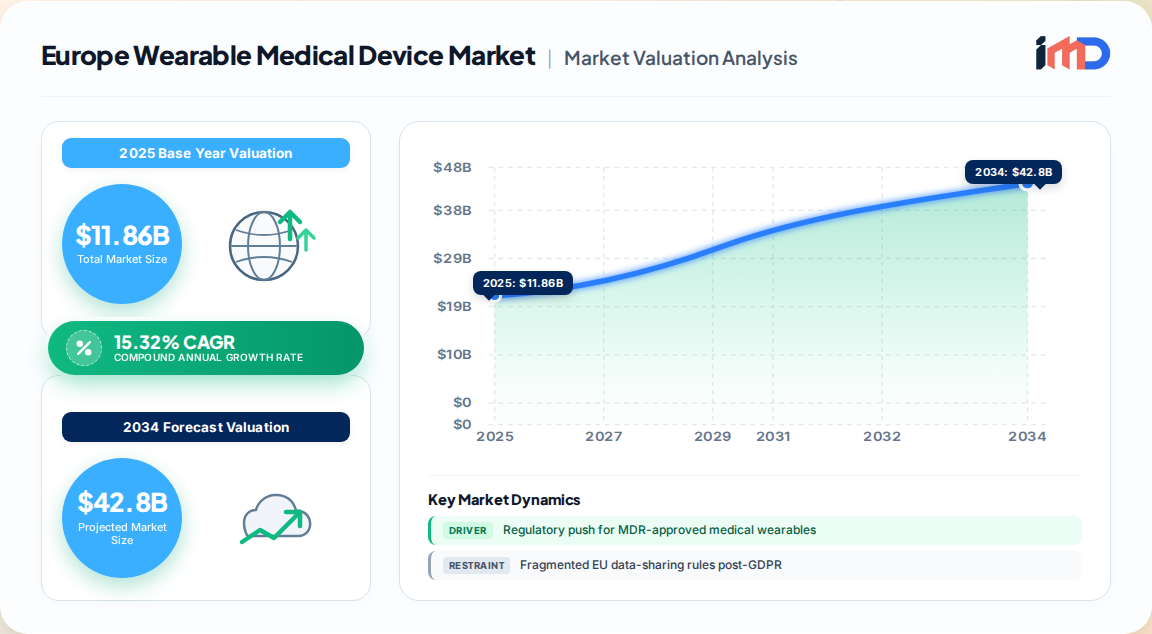
The European wearable medical device market is estimated at USD 11.86 billion in 2025 and is projected to expand to USD 24.19 billion by 2030, reflecting a CAGR of 15.32% over the forecast period. This growth is underpinned by an aging population, rising chronic disease prevalence, and the formalization of clinically validated wearables as prescribable therapies through national reimbursement frameworks.
These metrics are derived from our proprietary bottom-up demand model, validated through interviews with device OEMs, regulatory consultants, and hospital procurement directors across the region.
The European wearable medical device market is shaped by a confluence of regulatory, technological, and demographic forces. Our impact analysis quantifies the primary drivers and restraints as follows.
| Driver | Impact on CAGR | Geographic Relevance | Timeline |
|---|---|---|---|
| Regulatory push for MDR-approved medical wearables | +2.80% | EU-wide (strongest in Germany, France) | Medium term (2-4 years) |
| Rapid sensor miniaturization & multimodal chips | +2.10% | Global, EU manufacturing hubs | Long term (≥ 4 years) |
| Employer-funded corporate wellness programs | +1.90% | Germany, UK, Netherlands | Short term (≤ 2 years) |
| Healthcare payer shift to outcomes-based models | +1.60% | Nordic countries, Germany, UK | Medium term (2-4 years) |
| Micro-energy harvesting to remove charging friction | +1.20% | Global, EU R&D leadership | Long term (≥ 4 years) |
| EU digital therapeutics reimbursement pilots | +0.90% | Germany, France, Netherlands | Medium term (2-4 years) |
| Restraint | Impact on CAGR | Geographic Relevance | Timeline |
|---|---|---|---|
| Fragmented EU data-sharing rules post-GDPR | -1.80% | EU-wide (most complex in Germany) | Short term (≤ 2 years) |
| Supply-chain risk from China-centric battery vendors | -1.30% | Global, EU vulnerability | Medium term (2-4 years) |
| Plateauing early-adopter replacement cycles | -0.90% | Germany, UK, Netherlands | Short term (≤ 2 years) |
| Clinical-grade accuracy skepticism among physicians | -0.70% | Conservative EU health systems | Medium term (2-4 years) |
The Medical Device Regulation (MDR) has been a transformative driver, forcing wearable devices to prove clinical performance and transforming them from lifestyle gadgets into regulated medical tools. At the same time, fragmented GDPR interpretations across member states require manufacturers to redesign consent flows for each market, delaying pan-EU launches and curbing scalability.
The European wearable medical device market is segmented by device type, age group, distribution channel, application, and end-user. Our primary research reveals distinct growth patterns within each category.
Germany leads the European wearable medical device market with 28.37% revenue share in 2024, supported by the Digital Care Act (DVG) which mandates insurance coverage for digital therapeutics and connected medical apps. The DiGA pathway reimburses apps and devices only after proven patient benefit, fostering stronger algorithm development and long-term patient engagement.
The United Kingdom is expected to post the highest CAGR at 15.94% through 2030, driven by NHS initiatives for remote monitoring and a robust medtech innovation ecosystem. France, Italy, and Spain follow, with centralized funding and telehealth infrastructure accelerating adoption.
| Country | 2024 Share | 2030 Outlook |
|---|---|---|
| Germany | 28.37% | Continued dominance via DiGA reimbursement |
| UK | ~15.94% CAGR | Fastest-growing market; NHS-driven RPM |
| France | ~13% | Strong telehealth infrastructure |
| Italy | ~10% | Growing home-care adoption |
| Spain | ~9% | Expanding chronic disease management |
| Netherlands | ~7% | Early adopter of outcomes-based models |
| Nordics | ~7% | Payer shift to value-based care |
The European wearable medical device value chain is characterized by a complex ecosystem of specialized suppliers and regulatory intermediaries.
The European wearable medical device market is moderately concentrated, with the top five global players—Abbott Laboratories, Dexcom, Medtronic, Koninklijke Philips N.V., and Masimo—collectively holding approximately 60% of the global clinical-grade wearables market in 2025. In Europe, these players compete on clinical validation, reimbursement coverage, and integration with electronic health records.
Recent industry developments include:
Our analysis identifies several underpenetrated opportunities in the European wearable medical device market:
Europe's wearable medical device market relies on a global supply chain for critical components, particularly batteries, sensors, and semiconductors. While comprehensive trade data for finished wearable devices is not separately codified in Eurostat's COMEXT database, component-level trade flows reveal key dependencies.
Our primary interviews indicate that supply-chain resilience is a top-three procurement priority for European device OEMs, with many evaluating dual-sourcing strategies for critical components.
| Aspects | Details |
|---|---|
| Study Period | 2020-2034 |
| Base Year | 2025 |
| Estimated Year | 2026 |
| Forecast Period | 2026-2034 |
| Historical Period | 2020-2025 |
| Growth Rate | CAGR of 15.32% from 2020-2034 |
| Segmentation |
|
By Age Group
By Distribution Channel
By Application
By End-User
| By Geography |
|
The Europe wearable medical device market was valued at USD 11.86 billion in 2025 and is projected to reach USD 24.19 billion by 2030, growing at a CAGR of 15.32%.
Germany led the European market with a 28.37% revenue share in 2024, supported by its Digital Care Act (DVG) and DiGA reimbursement pathway for digital therapeutics.
Key drivers include the regulatory push for MDR-approved medical wearables (+2.80% CAGR impact), rapid sensor miniaturization (+2.10%), employer-funded wellness programs (+1.90%), and the healthcare payer shift to outcomes-based models (+1.60%).
The under-18 age group is the fastest-growing cohort at a 16.29% CAGR from 2025 to 2030, while therapeutic wearables are forecast to expand at a 15.73% CAGR.
Major players include Abbott Laboratories, Dexcom, Medtronic plc, Koninklijke Philips N.V., and Masimo, which collectively held approximately 60% of the global clinical-grade wearables market in 2025.
Fragmented EU data-sharing rules post-GDPR (-1.80% CAGR impact) and supply-chain risk from China-centric battery vendors (-1.30%) are the primary restraints, alongside plateauing replacement cycles (-0.90%) and clinical accuracy skepticism (-0.70%).
Our rigorous research methodology combines multi-layered approaches with comprehensive quality assurance, ensuring precision, accuracy, and reliability in every market analysis.
| Stakeholder Role | Interview Share (%) |
|---|---|
| Chief Medical Officer | 25% |
| Regulatory Affairs Director | 30% |
| Hospital Procurement Manager | 25% |
| Digital Health Lead | 20% |
| Company Type | Representation (%) |
|---|---|
| Device OEMs | 30% |
| Component Suppliers | 25% |
| Regulatory Consultants | 15% |
| Hospital Procurement | 15% |
| Payers/Insurers | 10% |
| Distributors | 5% |