1What is the size of the Europe real estate brokerage market?
The market was valued at USD 180.83 billion in 2025, is estimated at USD 191.21 billion in 2026, and is forecast to reach USD 252.67 billion by 2031 at a 5.74% CAGR over 2026–2031.
Insight Market Data is a premier market research and business consulting firm headquartered in Pune, India, providing syndicated research reports, customized intelligence studies, and strategic advisory services. Renowned academic institutions and Fortune 500 corporations worldwide rely on Insight Market Data's research repository to navigate evolving global and regional business environments. Covering 46 diverse industries across 25 major international economies, our comprehensive database delivers thousands of verified statistics and granular market evaluations. By combining industry-leading analytical methodologies with the direct insights of seasoned industry leaders and subject-matter experts, we deliver actionable intelligence spanning historical performance benchmarks to rigorous multi-year forecasts. We empower organizations to make confident, data-driven decisions across pivotal domains including Machinery & Equipment, Chemicals & Materials, Pharmaceuticals & Healthcare, Food & Beverages, Consumer Goods, Energy & Power, Automotive & Transportation, Electronics & Semiconductors, Medical Devices, Telecommunications, Emerging Technologies, Agriculture, and Packaging. Our multidisciplinary analyst teams provide an objective 360-degree perspective, tailoring every engagement to address complex strategic challenges with exceptional analytical rigor.
Leveraging advanced BI-powered analytics and predictive modeling, Insight Market Data uncovers high-impact market opportunities and competitive differentiators for ambitious enterprises. We continuously refine our research methodologies in accordance with global industry standards, tracking real-time market shifts to ensure our reports are consistently accurate, actionable, and delivered on schedule. Our analysts conduct methodical data validation, rigorous compliance checks, and exhaustive primary and secondary research to maintain the highest levels of data integrity and transparency. We partner closely with corporate strategists, investment groups, and business executives to translate intricate market intelligence into clear, actionable roadmaps for sustainable growth. With operational presence across Washington, USA, and Vimannagar, Pune, India, Insight Market Data ensures direct access to dedicated research specialists and responsive customer support to answer your most strategic questions.
 Europe Real Estate Brokerage Market
 by Property Type (Residential(Apartments & Condominiums, Detached Houses, Others), Commercial(Office, Retail, Logistics & Industrial, Data Centres & Specialised, Others)), by Service (Sales, Rental/Leasing), by Client Type (Individuals/Households, Corporates & SMEs, Institutional Investors), by Europe (Germany, United Kingdom, France, Spain, Italy, Netherlands, Sweden, Rest of Europe) Forecast 2026-2034

Research Analyst


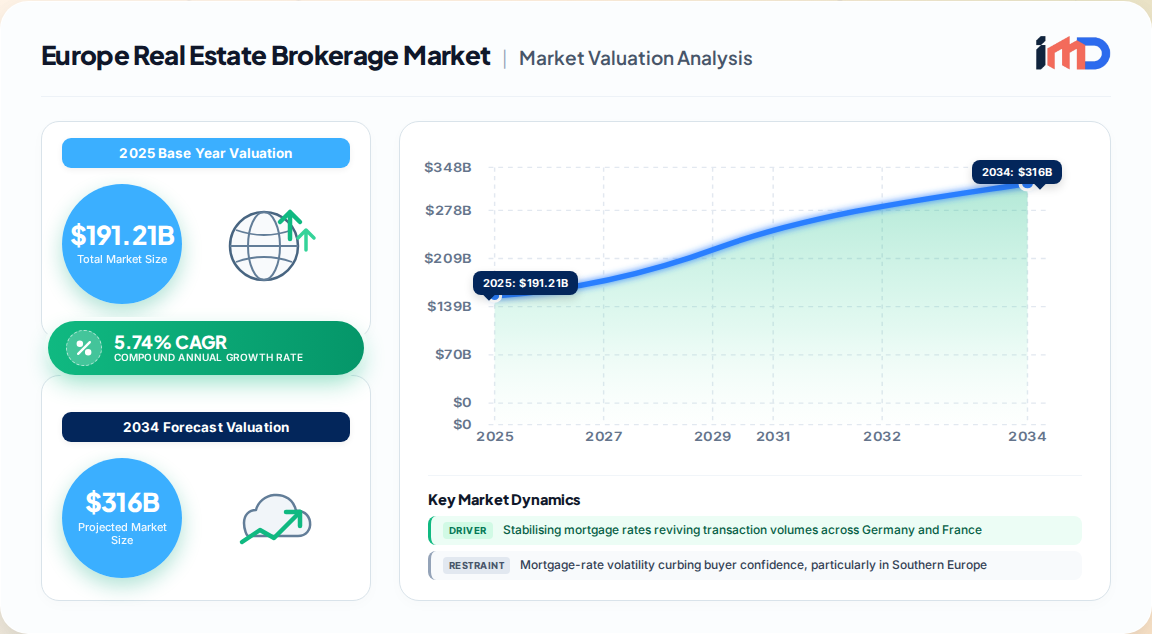
The Europe real estate brokerage market represents the commission-based and fee-based intermediation layer of Europe's property economy, spanning residential resale, new-build distribution, commercial leasing and capital-markets advisory. Our proprietary primary research and structured expert interviews place the market at USD 180.83 billion in 2025, expanding to USD 191.21 billion in 2026 and forecast to reach USD 252.67 billion by 2031, equivalent to a 5.74% CAGR over 2026–2031. Market concentration is assessed as medium, with a long tail of regional and boutique agencies coexisting alongside pan-European advisory networks.
The 2024–2025 inflection point was monetary rather than cyclical. The European Central Bank's composite cost-of-borrowing indicator for new housing loans held at 3.32% in March 2025, while floating-rate pricing slipped 8 basis points to 3.92%. That stabilisation released a backlog of deferred purchase decisions, and brokerage pipelines that had been frozen for roughly eighteen months began to clear. Our channel checks with senior transaction advisors indicate that deal cycles compressed by an average of three to five weeks across German and French residential mandates during the second half of 2025.
| Metric | Value |
|---|---|
| Base year market size (2025) | USD 180.83 Billion |
| Market size (2026) | USD 191.21 Billion |
| Forecast market size (2031) | USD 252.67 Billion |
| CAGR (2026–2031) | 5.74% |
| Largest country market | Germany (22.70% share, 2025) |
| Fastest-growing country market | Spain (6.12% CAGR, 2026–2031) |
| Leading property type | Residential (69.20%, 2025) |
| Leading service line | Sales transactions (62.30%, 2025) |
| Leading client type | Individuals and households (57.40%, 2025) |
| Fastest-growing client type | Institutional investors (6.38% CAGR) |
Our driver impact modelling isolates six forces that materially shift the brokerage revenue trajectory. Each is weighted by its incremental contribution to the 2026–2031 compound growth rate.
| Driver | CAGR Impact | Geographic Relevance | Timeline |
|---|---|---|---|
| Stabilising mortgage rates reviving transaction volumes | +1.2 pp | Germany, France | Medium term (2–4 years) |
| EU Green Deal renovation mandates driving listings | +1.1 pp | EU-wide | Medium term (2–4 years) |
| Institutional build-to-rent and SFR fund expansion | +0.9 pp | UK, Germany, Sweden | Long term (≥4 years) |
| Digital lead-generation and AI valuation tools | +0.8 pp | UK, Netherlands | Short term (≤2 years) |
| Cross-border HNWI relocation inflows | +0.7 pp | Core and Mediterranean Europe | Long term (≥4 years) |
| Blockchain-enabled property tokenisation pilots | +0.4 pp | Switzerland, Luxembourg | Long term (≥4 years) |
The Energy Performance of Buildings Directive is the single most structurally important driver for listing volume. Owners must upgrade commercial assets to energy class E by 2027 and class D by 2030, or face sale and lease restrictions. Faced with retrofit capital requirements, a measurable cohort of landlords has chosen early disposition over capital expenditure, converting a compliance burden into brokerage inventory. Agents that bundle contractor introductions, retrofit financing and certification advisory into the transaction are capturing premium fee arrangements.
On the technology side, generative-AI prospecting and automated underwriting are compressing asset-pricing workflows from hours to minutes. Our interviews with heads of capital markets suggest AI-enabled lead funnels widen buyer pools by up to 20%, allowing brokerages to grow transaction throughput without proportional headcount expansion. PropTech venture funding reached USD 3.2 billion in 2024, of which European start-ups secured approximately USD 700 million, confirming sustained investor conviction in data-centric brokerage models.
The brokerage value chain in Europe has bifurcated into a high-volume, portal-driven residential tier and a relationship-led, advisory-intensive commercial tier.
| Value Chain Stage | Core Activities | Margin Profile |
|---|---|---|
| Lead origination | Portal subscriptions, referral networks, digital marketing, AI prospecting | Low to negative on standalone basis |
| Mandate acquisition | Listing presentations, valuation, pitch, seller/buyer representation agreements | Medium; decisive for downstream economics |
| Transaction execution | Viewings, negotiation, due diligence coordination, notary engagement | High; primary commission capture point |
| Advisory wrappers | Retrofit advisory, financing brokerage, certification, relocation | High and growing |
| Post-transaction | Property management, lettings, asset management, reporting | Recurring and defensive |
The strategic centre of gravity has shifted toward advisory wrappers. Pure commission intermediation is exposed to portal disintermediation and fee regulation, whereas retrofit advisory, mortgage brokerage and relocation services are sticky, defensible and increasingly demanded by institutional clients. Brokerages that have built these adjacent capabilities report meaningfully higher revenue per mandate than those reliant on transaction fees alone.
By property type, residential assets commanded 69.20% of market revenue in 2025, reflecting Europe's homeownership culture and the depth of resale activity in Germany, France and Spain. Logistics and industrial brokerage is forecast to grow fastest at a 6.05% CAGR, driven by e-commerce penetration above 18% and last-mile warehousing demand. Commercial offices and retail remain large but face divergent trajectories as Grade-B stock reprices.
By service, sales transactions generated 62.30% of revenue in 2025, while rental and leasing brokerage is advancing at 6.32% CAGR through 2031. The rental acceleration is structurally underpinned by build-to-rent institutionalisation and affordability-driven tenure shifts across Germany, the UK and the Netherlands.
By client type, individuals and households formed 57.40% of the customer base in 2025, but institutional investors represent the fastest-growing cohort at 6.38% CAGR. Over EUR 22 billion has been deployed into BTR and private rented sector platforms, and institutional mandates typically carry higher advisory fees and longer relationship durations than retail transactions.
| Segment Dimension | Leading Sub-segment (2025) | Fastest-Growing Sub-segment |
|---|---|---|
| Property type | Residential (69.20%) | Logistics and industrial (6.05% CAGR) |
| Service | Sales (62.30%) | Rental/leasing (6.32% CAGR) |
| Client type | Individuals and households (57.40%) | Institutional investors (6.38% CAGR) |
Germany anchors the market with a 22.70% share in 2025, combining Europe's largest housing stock, a deep institutional capital pool and a safe-haven status for cross-border capital. The UK follows at 18.40% and France at 16.70%, both characterised by mature institutional frameworks and premium commercial concentration in London and Paris respectively.
Spain is the fastest-growing major market at a 6.12% CAGR, propelled by lifestyle migration, tourism-linked residential demand, Madrid office repricing and Iberian logistics exposure. Italy presents a longer-duration opportunity where fragmentation among local agencies creates consolidation headroom.
| Country | 2025 Share | 2026–2031 CAGR Outlook |
|---|---|---|
| Germany | 22.70% | Steady, institutionally anchored |
| United Kingdom | 18.40% | Moderate, portal-disrupted |
| France | 16.70% | Steady, credit-constrained recovery |
| Spain | ~9.80% | 6.12% (fastest major market) |
| Italy | ~8.60% | Moderate, consolidation-led |
| Netherlands | ~6.20% | Moderate, fee-regulated |
| Nordics | ~7.40% | Moderate, high digital penetration |
The competitive field is medium-concentrated, with a handful of pan-European advisory networks holding disproportionate share of large institutional mandates while thousands of local agencies dominate residential volume.
Recent strategic developments shaping positioning include generative-AI assistant launches aimed at agent productivity, consolidation of digital listing platforms with mortgage origination, and tokenisation pilots in Switzerland and Luxembourg where DLT-share frameworks now permit fractional ownership transfer on licensed exchanges, lowering minimum investor tickets toward USD 500.
Three under-served opportunity zones merit prioritisation.
Brokerage is a services market and does not trade in physical goods; however, cross-border capital flow functions as its effective trade layer. Institutional capital originating in the Middle East, North America and Asia-Pacific is intermediated into European assets through London, Frankfurt, Luxembourg and Amsterdam advisory hubs. Licensing and passporting frameworks determine which brokerages can intermediate these flows, making regulatory access a genuine supply-side constraint. Luxembourg's Markets in Crypto-Assets alignment and Switzerland's DLT-share recognition are early examples of jurisdictions converting regulatory clarity into brokerage service export advantage.
| Aspects | Details |
|---|---|
| Study Period | 2020-2034 |
| Base Year | 2025 |
| Estimated Year | 2026 |
| Forecast Period | 2026-2034 |
| Historical Period | 2020-2025 |
| Growth Rate | CAGR of 5.74% from 2020-2034 |
| Segmentation |
|
By Service
By Client Type
| By Geography |
|
The market was valued at USD 180.83 billion in 2025, is estimated at USD 191.21 billion in 2026, and is forecast to reach USD 252.67 billion by 2031 at a 5.74% CAGR over 2026–2031.
Germany led with a 22.70% share in 2025, supported by Europe's largest housing stock and the deepest institutional real estate capital pool, with over EUR 600 billion in managed assets.
Institutional investor brokerage is the fastest-growing client segment at a 6.38% CAGR, while logistics and industrial brokerage leads property-type growth at 6.05% CAGR through 2031.
Stabilising mortgage rates contribute a 1.2 percentage point uplift to CAGR, followed by EU Green Deal renovation mandates at 1.1 points and institutional build-to-rent expansion at 0.9 points.
Spain is projected to expand at a 6.12% CAGR between 2026 and 2031, driven by lifestyle migration, tourism-linked residential demand and Madrid office repricing.
Our rigorous research methodology combines multi-layered approaches with comprehensive quality assurance, ensuring precision, accuracy, and reliability in every market analysis.
| Stakeholder Role | Interview Share (%) |
|---|---|
| Head of Capital Markets | 30% |
| Managing Director, Residential Agency | 28% |
| Chief Operating Officer, Brokerage Operations | 24% |
| Head of Investment Strategy | 18% |
| Company Type | Representation (%) |
|---|---|
| Pan-European Commercial Advisory Networks | 30% |
| Independent Residential Estate Agency Chains | 27% |
| Digital Listing and Transaction Platforms | 18% |
| Institutional Investment and Fund Management Houses | 15% |
| PropTech and Valuation-Data Vendors | 10% |
 Related Reports


Analyst at Providence Strategic Partners at Petaling Jaya
I have received the report already. Thanks you for your help.it has been a pleasure working with you. Thank you again for a good quality report

Internationalization Director
Yes, as a matter of fact we are totally satisfied with both reports that we have purchased and will continue to do so during this process of the internationalization of our brand.

Head of Product Management and Marketing
We are using your report, and it gave us valuable information."

Regional Director, Marketing and Business Development
We've received the report and have reviewed the content. Overall, it looks great and aligns closely with the data we can verify based on our industry knowledge.

VP of Sales
Thank you very much for sharing the report. I have reviewed it and I am very satisfied with the quality and the insights it provides. It will certainly be valuable for our internal discussions.