1What is the size of the EO and IR gimbal for military market?
Our first-party research values the global military EO and IR gimbal market at USD 929 Million in 2025, forecast to reach approximately USD 1.21 Billion by 2032 at a CAGR of 3.8%.
Insight Market Data is a premier market research and business consulting firm headquartered in Pune, India, providing syndicated research reports, customized intelligence studies, and strategic advisory services. Renowned academic institutions and Fortune 500 corporations worldwide rely on Insight Market Data's research repository to navigate evolving global and regional business environments. Covering 46 diverse industries across 25 major international economies, our comprehensive database delivers thousands of verified statistics and granular market evaluations. By combining industry-leading analytical methodologies with the direct insights of seasoned industry leaders and subject-matter experts, we deliver actionable intelligence spanning historical performance benchmarks to rigorous multi-year forecasts. We empower organizations to make confident, data-driven decisions across pivotal domains including Machinery & Equipment, Chemicals & Materials, Pharmaceuticals & Healthcare, Food & Beverages, Consumer Goods, Energy & Power, Automotive & Transportation, Electronics & Semiconductors, Medical Devices, Telecommunications, Emerging Technologies, Agriculture, and Packaging. Our multidisciplinary analyst teams provide an objective 360-degree perspective, tailoring every engagement to address complex strategic challenges with exceptional analytical rigor.
Leveraging advanced BI-powered analytics and predictive modeling, Insight Market Data uncovers high-impact market opportunities and competitive differentiators for ambitious enterprises. We continuously refine our research methodologies in accordance with global industry standards, tracking real-time market shifts to ensure our reports are consistently accurate, actionable, and delivered on schedule. Our analysts conduct methodical data validation, rigorous compliance checks, and exhaustive primary and secondary research to maintain the highest levels of data integrity and transparency. We partner closely with corporate strategists, investment groups, and business executives to translate intricate market intelligence into clear, actionable roadmaps for sustainable growth. With operational presence across Washington, USA, and Vimannagar, Pune, India, Insight Market Data ensures direct access to dedicated research specialists and responsive customer support to answer your most strategic questions.
 EO and IR Gimbal for Military Market
 by Product Type (2-axis EO/IR Gimbal, 3-axis EO/IR Gimbal, Others), by Application (Military Aircraft, Military Boat, Military Vehicles), by North America (United States, Canada, Mexico), by Europe (Germany, France, UK, Italy, Russia), by Asia Pacific (China, Japan, South Korea, India, Australia), by Middle East & Africa (Israel, Turkey, GCC Countries, South Africa), by South America (Brazil, Argentina) Forecast 2026-2034

Research Associate


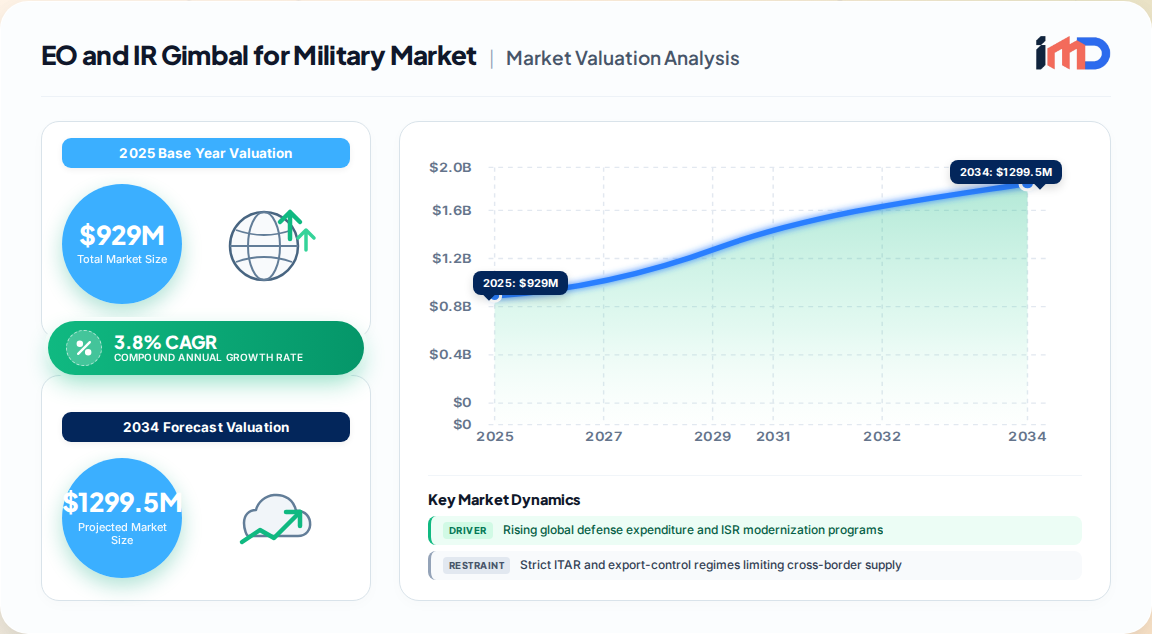
The global market for EO and IR gimbals engineered for military use represents a strategically vital segment of the defense electronics value chain. Our proprietary first-party analysis values the market at USD 929 Million in 2025, projected to expand to USD 1.21 Billion by 2032, reflecting a CAGR of 3.8% across the 2026–2032 forecast window.
Electro-optical (EO) and infrared (IR) gimbals are precision-stabilized, multi-sensor platforms that house day and thermal imaging payloads alongside laser designators and rangefinders. They deliver continuous, vibration-isolated line-of-sight stabilization, enabling surveillance, reconnaissance, target acquisition, and laser designation from airborne, naval, and ground platforms.
Structurally, the market is entering a mature-growth phase in established Western defense budgets while accelerating in Asia-Pacific and Middle Eastern procurement cycles. Three forces anchor the outlook:
Our demand modeling suggests military vehicles represent the single largest application block, followed by naval platforms and military aircraft. Among sensor architectures, 2-axis gimbals retain the widest installed base for cost-sensitive and lightweight missions, while 3-axis systems command premium pricing for high-end ISR roles requiring roll compensation.
Demand for military EO/IR gimbals is being reshaped by a combination of budget expansion, mission evolution, and platform proliferation.
Geopolitical volatility, including renewed emphasis on force readiness in Europe and elevated maritime tensions, functions as an accelerant. Notably, land-based EO/IR gimbal demand has been tracking meaningfully above the broader market trendline, reflecting front-line surveillance priorities.
| Segment | Share (2025 est.) | Growth Profile |
|---|---|---|
| 2-axis EO/IR Gimbal | 44% | Steady; dominant in lightweight UAV and vehicle roles |
| 3-axis EO/IR Gimbal | 31% | Fastest-growing by value; premium ISR and naval roles |
| Others (multi-sensor, multi-axis) | 25% | Emerging; integrated fire-control and C-UAS |
3-axis architectures are gaining share where roll stabilization and 360-degree continuous rotation are mission-critical. Multi-sensor variants combining EO, MWIR, SWIR, and laser channels are a key white-space opportunity for premium pricing.
| Application | Share (2025 est.) |
|---|---|
| Military Vehicles | 42% |
| Military Boat | 35% |
| Military Aircraft | 23% |
The vehicle segment dominates on unit volume, driven by convoy protection, border surveillance, and mobile command platforms. Maritime applications are growing fastest in value terms as navies retrofit patrol craft with stabilized, salt-fog-rated turrets.
| Region | Share (2025 est.) | Demand Character |
|---|---|---|
| North America | 34% | Largest; mature modernization, high-end ISR |
| Asia-Pacific | 31% | Fastest-growing; naval expansion and border surveillance |
| Europe | 22% | Re-arming cycle, NATO interoperability |
| Middle East & Africa | 8% | Import-driven, platform procurement bundles |
| South America | 5% | Nascent, cost-sensitive |
Asia-Pacific is the growth engine, with regional procurement strength supported by indigenous defense manufacturing programs. North America retains technological leadership and the deepest installed base, while Europe's re-armament trajectory is upgrading legacy turret fleets. Country-level demand concentrates in the United States, China, India, Israel, and key NATO states.
The supplier base is concentrated among a set of transatlantic and Asian defense primes and specialized optics houses. Our competitive mapping identifies the incumbents as Northrop Grumman, L3Harris Wescam, Teledyne FLIR, China North Industries Group, Elbit Systems, Safran, Controp Precision Technologies, Edge Autonomy, Collins Aerospace, Ascent Vision Technologies, and Leonardo DRS, alongside entrants such as AeroVironment and Ukrspecsystems.
Strategic differentiators center on:
We assess the competitive field as moderately consolidated, with the top three vendors accounting for a substantial minority of total revenue. New entrants are pressing into compact UAV payloads, where agility and cost competitiveness matter more than legacy defense relationships.
Procurement is increasingly performance-based, emphasizing mean time between failure, field-of-view versatility, and interoperability with existing command-and-control networks. Value-chain resilience is a recurring theme: we observe OEMs dual-sourcing detector supply and investing in domestic opto-electronics capacity to mitigate geopolitical export risk.
| Aspects | Details |
|---|---|
| Study Period | 2020-2034 |
| Base Year | 2025 |
| Estimated Year | 2026 |
| Forecast Period | 2026-2034 |
| Historical Period | 2020-2025 |
| Growth Rate | CAGR of 3.8% from 2020-2034 |
| Segmentation |
|
| By Geography |
|
Our first-party research values the global military EO and IR gimbal market at USD 929 Million in 2025, forecast to reach approximately USD 1.21 Billion by 2032 at a CAGR of 3.8%.
2-axis EO/IR gimbals hold the largest share at roughly 44% in 2025, though 3-axis systems represent the fastest-growing segment by value due to roll-stabilized ISR requirements.
Military vehicles account for about 42% of demand, followed by military boats at 35% and military aircraft at 23%, reflecting convoy protection and border surveillance priorities.
Asia-Pacific is the fastest-growing region, capturing roughly 31% of global share, driven by naval expansion, border surveillance budgets, and indigenous defense manufacturing programs.
Leading suppliers include Northrop Grumman, L3Harris Wescam, Teledyne FLIR, Elbit Systems, Safran, China North Industries Group, Controp Precision Technologies, and Leonardo DRS.
Our rigorous research methodology combines multi-layered approaches with comprehensive quality assurance, ensuring precision, accuracy, and reliability in every market analysis.
| Stakeholder Role | Interview Share (%) |
|---|---|
| Procurement Director | 32% |
| Program Manager | 28% |
| Gimbal Systems Engineer | 22% |
| End-User Operations Officer | 18% |
| Company Type | Representation (%) |
|---|---|
| Gimbal & Turret OEMs | 40% |
| IR Detector & Optics Suppliers | 22% |
| Platform Integrators (Air/Naval/Ground) | 20% |
| Defense Primes / Tier-1 Contractors | 18% |
 Related Reports
