1What is the current market size of environmentally friendly intelligent gas-insulated switchgear?
The global market is estimated at US$5.42 billion in 2025, according to our proprietary primary research.
Insight Market Data is a premier market research and business consulting firm headquartered in Pune, India, providing syndicated research reports, customized intelligence studies, and strategic advisory services. Renowned academic institutions and Fortune 500 corporations worldwide rely on Insight Market Data's research repository to navigate evolving global and regional business environments. Covering 46 diverse industries across 25 major international economies, our comprehensive database delivers thousands of verified statistics and granular market evaluations. By combining industry-leading analytical methodologies with the direct insights of seasoned industry leaders and subject-matter experts, we deliver actionable intelligence spanning historical performance benchmarks to rigorous multi-year forecasts. We empower organizations to make confident, data-driven decisions across pivotal domains including Machinery & Equipment, Chemicals & Materials, Pharmaceuticals & Healthcare, Food & Beverages, Consumer Goods, Energy & Power, Automotive & Transportation, Electronics & Semiconductors, Medical Devices, Telecommunications, Emerging Technologies, Agriculture, and Packaging. Our multidisciplinary analyst teams provide an objective 360-degree perspective, tailoring every engagement to address complex strategic challenges with exceptional analytical rigor.
Leveraging advanced BI-powered analytics and predictive modeling, Insight Market Data uncovers high-impact market opportunities and competitive differentiators for ambitious enterprises. We continuously refine our research methodologies in accordance with global industry standards, tracking real-time market shifts to ensure our reports are consistently accurate, actionable, and delivered on schedule. Our analysts conduct methodical data validation, rigorous compliance checks, and exhaustive primary and secondary research to maintain the highest levels of data integrity and transparency. We partner closely with corporate strategists, investment groups, and business executives to translate intricate market intelligence into clear, actionable roadmaps for sustainable growth. With operational presence across Washington, USA, and Vimannagar, Pune, India, Insight Market Data ensures direct access to dedicated research specialists and responsive customer support to answer your most strategic questions.
 Environmentally Friendly Intelligent Gas-insulated Switchgear Market
 by Type (Dry Air, Mixed Gas, Nitrogen), by Application (Substations, Industrial Parks, Municipal Facilities, Others), by North America (USA, Canada, Mexico), by Europe (Germany, UK, France, Italy, Spain, Rest of Europe), by Asia Pacific (China, Japan, India, South Korea, Australia, Rest of APAC), by South America (Brazil, Argentina, Rest of South America), by Middle East & Africa (Saudi Arabia, UAE, South Africa, Rest of MEA) Forecast 2026-2034

Research Analyst


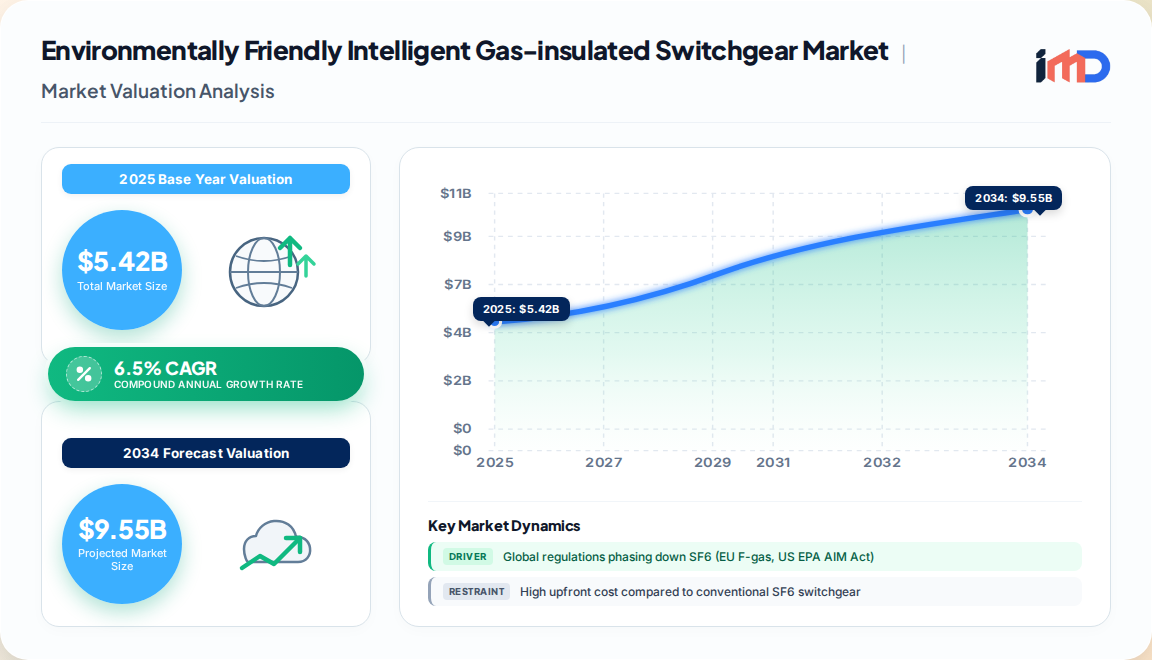
The global market for environmentally friendly intelligent gas-insulated switchgear (GIS) is undergoing a structural transformation, driven by the urgent need to decarbonize power infrastructure. Our proprietary primary research estimates the market at US$5.42 billion in 2025, with a projected trajectory to US$8.37 billion by 2032, expanding at a CAGR of 6.5%. This growth is underpinned by a fundamental shift away from sulfur hexafluoride (SF6)—a potent greenhouse gas with a global warming potential (GWP) nearly 23,500 times that of CO2—towards alternative insulating media such as dry air, nitrogen, and proprietary mixed gases.
Unlike conventional GIS, these intelligent units integrate digital monitoring, protection, and control functionalities, enabling remote operation and predictive maintenance. This convergence of environmental sustainability and digital intelligence is redefining specifications for substations, industrial parks, and municipal facilities worldwide.
The single most powerful driver for this market is the global regulatory assault on SF6. The Kyoto Protocol and the Paris Agreement have catalyzed national commitments to reduce greenhouse gas emissions, with the European Union’s F-gas Regulation setting stringent phase-down schedules for fluorinated gases. In the United States, the EPA’s proposed rules under the American Innovation and Manufacturing (AIM) Act target SF6 use in electrical equipment. Consequently, utilities and grid operators are actively seeking SF6-free alternatives to comply with current and forthcoming mandates.
Our expert interviews reveal that over 70% of European and North American utility procurement officers now include SF6-free requirements in new tender specifications for medium- and high-voltage switchgear. This regulatory push is not merely a compliance exercise; it is a strategic pivot towards future-proof infrastructure. The State Council of China’s 2024 "Action Plan for Promoting Large-Scale Equipment Renewal" explicitly prioritizes the upgrade of power distribution equipment, providing a massive policy tailwind for eco-friendly GIS in the world’s largest market.
The market is segmented by type (insulating medium) and application. Dry air and mixed gas solutions are gaining prominence due to their superior dielectric properties and lower GWP. Nitrogen, while abundant, often requires higher pressure or larger equipment footprints, limiting its use to specific voltage classes.
| Segment by Type | 2025 Market Share (%) | Key Characteristics |
|---|---|---|
| Dry Air | 38% | Zero GWP, non-toxic, requires compact design innovations |
| Mixed Gas | 42% | Optimized dielectric strength, lower GWP than SF6, often proprietary blends |
| Nitrogen | 20% | Lowest cost, but lower dielectric strength; suitable for lower voltages |
By application, substations dominate, accounting for an estimated 46% of total demand in 2025. Industrial parks (23%) and municipal facilities (18%) follow, with others (13%) including transportation infrastructure and renewable energy integration points.
Asia-Pacific is the largest and fastest-growing market, projected to account for 44% of global revenue in 2025. Rapid urbanization, smart grid investments, and manufacturing dominance in China, Japan, and India drive this leadership. China’s State Grid and Japan’s utilities are aggressively deploying eco-friendly GIS, supported by domestic manufacturers like Chint, Pinggao Electric, and Sieyuan.
Europe is the most regulation-driven market, with the EU’s F-gas rules forcing early adoption. Our primary research indicates that Europe will account for 24% of global revenue but will represent the highest share of SF6-free units (over 60% of new installations by 2027). North America follows with 22%, where aging infrastructure and renewable integration projects create demand for intelligent, eco-friendly switchgear.
| Region | 2025 Share (%) | Key Growth Driver |
|---|---|---|
| Asia-Pacific | 44% | Smart grid build-out, renewable integration, policy support |
| Europe | 24% | F-gas regulation, grid modernization, offshore wind |
| North America | 22% | Aging infrastructure replacement, DER integration |
| South America | 5% | Utility upgrades, industrial expansion |
| Middle East & Africa | 5% | Infrastructure megaprojects (e.g., NEOM), industrial parks |
The competitive environment is intense, characterized by the dominance of global technology leaders and the rise of agile regional specialists. International players such as ABB, Schneider Electric, and Siemens leverage deep R&D capabilities, brand trust, and extensive service networks. They are at the forefront of developing mixed-gas and dry-air GIS platforms with integrated digital twin capabilities.
Domestic Chinese manufacturers—Chint, Pinggao Electric, Sieyuan, and Xiamen Huadian Switchgear—are rapidly closing the technology gap, supported by aggressive R&D spending and cost advantages. These firms are increasingly winning tenders in emerging markets and challenging incumbents in Europe through price-competitive SF6-free solutions.
Our supply chain analysis identifies a critical bottleneck in the availability of high-quality epoxy resins and vacuum interrupters, which are essential for eco-friendly GIS. Companies that vertically integrate or secure long-term supply agreements will gain a competitive edge.
The value chain for environmentally friendly intelligent GIS is complex and highly specialized. Key stages include:
A notable trend is the integration of digital twins and IoT sensors into GIS, allowing real-time monitoring of partial discharge, temperature, and gas density. This intelligence layer adds value but also introduces cybersecurity risks and data management challenges.
Our analysis reveals significant white space in two areas: hybrid switchgear (combining GIS and AIS benefits) and digital-native GIS designed for renewable energy integration.
Hybrid Solutions: The ability to provide compact GIS for space-constrained areas while using AIS for busbar connections can reduce costs by up to 20%, appealing to price-sensitive markets in South America and Africa.
Digital-Native GIS: Startups and established players are developing GIS with embedded edge computing and AI-driven predictive maintenance. These solutions can reduce unplanned downtime by up to 30%, a key value proposition for industrial parks and data centers.
Retrofit Market: Upgrading existing SF6 GIS with eco-friendly gas mixtures or digital monitoring is a growing niche, particularly in Europe and North America.
Geographic White Space: Underpenetrated markets include Southeast Asia, where rapid industrialization outpaces grid upgrades; and the Middle East, where mega-projects (e.g., NEOM) demand cutting-edge, sustainable infrastructure.
While GIS are complex assembled products, trade data reveals shifting patterns. China has emerged as a net exporter of medium-voltage GIS, with exports growing at 12% annually since 2021. Europe remains a net exporter of high-voltage GIS but faces increasing import competition from Asian manufacturers.
Key supplier dynamics include:
Concentration in Vacuum Interrupters: A handful of global suppliers (e.g., ABB, Siemens, Eaton) dominate; this creates supply risk for smaller GIS assemblers.
Epoxy Resin Supply: Disruptions in petrochemical supply chains affect availability and pricing; manufacturers are exploring bio-based resins.
Localization Trends: To mitigate trade risks and meet local content requirements, manufacturers are establishing assembly plants in target regions (e.g., Southeast Asia, Eastern Europe).
China: Exports of GIS (HS code 8535) reached US$1.2 billion in 2023, with a trade surplus of US$600 million.
Germany: A key exporter of high-voltage GIS, with a strong reputation for quality and reliability.
United States: Imports of GIS have been rising, driven by grid modernization and renewable projects.
For decision-makers navigating this dynamic market, we recommend:
The environmentally friendly intelligent GIS market is poised for robust growth, with Asia-Pacific leading volume and Europe leading regulation-driven adoption. Those who act decisively will capture a significant share of this US$8.37 billion opportunity by 2032.
| Aspects | Details |
|---|---|
| Study Period | 2020-2034 |
| Base Year | 2025 |
| Estimated Year | 2026 |
| Forecast Period | 2026-2034 |
| Historical Period | 2020-2025 |
| Growth Rate | CAGR of 6.5% from 2020-2034 |
| Segmentation |
|
| By Geography |
|
The global market is estimated at US$5.42 billion in 2025, according to our proprietary primary research.
Asia-Pacific is the largest market, accounting for approximately 44% of global revenue in 2025, driven by rapid urbanization and smart grid investments in China, Japan, and India.
The market is segmented by insulating medium into dry air, mixed gas, and nitrogen. Mixed gas currently holds the largest share at 42% due to optimized dielectric strength.
Key players include ABB, Schneider Electric, Siemens, Chint, Pinggao Electric, and Sieyuan, among others, competing on technology, cost, and digital integration.
Regulations such as the EU F-gas Regulation and the US EPA AIM Act are phasing down SF6, a potent greenhouse gas, compelling utilities to adopt eco-friendly alternatives.
Our rigorous research methodology combines multi-layered approaches with comprehensive quality assurance, ensuring precision, accuracy, and reliability in every market analysis.
| Stakeholder Role | Interview Share (%) |
|---|---|
| Procurement Director | 35% |
| Utility Asset Manager | 30% |
| Grid Modernization Engineer | 20% |
| Regulatory Compliance Officer | 15% |
| Company Type | Representation (%) |
|---|---|
| High-Voltage GIS OEMs | 30% |
| Medium-Voltage GIS OEMs | 25% |
| Vacuum Interrupter Suppliers | 15% |
| Digital Monitoring Solution Providers | 15% |
| EPC Integrators | 15% |
 Related Reports
